New Poems by Maya Williams, the Poet Laureate of Portland, Maine

Put Them in the Back
The board shifts to my brother’s side on the poinsettia designed table cloth covering Reece’s kitchen table. It’s his third turn in Scrabble. For thirteen points, he puts down the wooden letters for D E A T H.
Earlier in the day, St. Peter’s First Parish Church was our destination in my grandmother’s white Impala. A beige brick Episcopalian church made in the 1690s. It’s where Martha Washington married George.
Upon arrival, we’re greeted by a cemetery.
Ugh, this is so depressing, they ought to put them in the back, remarked my brother.
I asked him why it’s so depressing.
My sister came to his defense, It’s just what he thinks. Leave him alone!
When I asked him if visiting PaRich’s grave was depressing, my sister interjected again about the difference between an aesthetic and a feeling.
PaRich has been buried at Second Liberty Baptist Church, a church with a Blacker history than the First First Lady’s, since 2008. Something about one gravesite to visit behind a house of worship amongst others makes it all feel different.
Her Facebook profile photo is a selfie with her and PaRich’s tombstone. I don’t believe my sister is depressed by death.
But I do believe she’s anxious.
Our grandmother becomes smaller and more fragile each time we hug her. PaRich will share his tombstone with her. Although no sunset date is inscribed yet, my sister feels Death inching closer and closer.
My brother says it’s her turn to put a word down and she’s still squirming.
When I Die
after Danez Smith
My family wants me in a casket.
Hair as flat as the eternal wooden bed
for my body.
Lips and cheeks painted.
Hopefully well.
But who doesn’t love a good break from tears
through laughter at the clown you once knew
at a funeral?
**
On Family Feud, Steve Harvey asks
the contestants to name the type of news
that may be happy and sad at the same time.
One of them grinned, smashed the buzzer, and shouted, Death!
**
Long sleeve fitted dress
Embalmed.
Empty.
I want to be bald
before I’m cremated.
I was bald when I was a baby,
the last time I was
my true self.
**
On a writing retreat, a woman and I
find lichen covered stones largely encircling one small bush
in the middle. The woman immediately thinks of a stage.
I immediately think of a memorial.
**
Do I want to die before my family?
Or am I waiting for them to die
so I can finally be my full true self?
As much as my mother warns me to sit
and stand
up straight
it is difficult to disclose to her
how my family
is the cause
of how often my shoulders
sadly slouch.
My therapist once said,
“The mind may tell lies,
But the body always tells the truth.”
I don’t want to wait until I die
for my shoulders to let loose and let go.
My mind says, You should love your family better
My body says, Loving your family hurts.
I Don’t Know If This is Accurate, I Only Know We Won’t be in a Single File Diagonal Line
after Anis Mojgani and Heather Christle
Ain’t no need for social distancing on the way to heaven yet folks are spread out waiting their turn to get inside. When you arrive, you feverishly blink at least ten times as you swivel your head around, bewildered.
The waiting room looks like a blue sky that contains everyone as a prodigious ceiling, floor, and set of walls like an omnipotent cube. Cirrus and cumulus forms pass through in succession. Some people sit on them. Some play with others like swords and shields.
You wonder if they were this playful on Earth.
In this cloudy abyss of a waiting room, you see a few toss around a frisbee.
You interrupt their game. I thought we couldn’t take things with us!
You wonder how that appeared if atmospheric blurs had to be used as furniture.
One of them chuckles. Thought we’d have one more go beforehand!
Fair enough. They might be good company when we’re allowed in.
There is no specific temperature where you are.
Thought it’d be warmer.
There is no tension in your shoulders, no headache, no itchy scalp to prep for a wash day. You lift your right arm up. You don’t care how conspicuous you are. It is a comfort to realize that you don’t have to worry about a shower for all eternity.
You see some folks naked as they’re running, dancing, or reading a book in a corner. You assume that wherever they got that is the same place where that crowd got their frisbee. You and others are clothed; probably because that’s how you all would be the most comfortable.
You overhear a conversation of people seated cross legged in a circle:
Someone asks someone else What got you here?
And they say I don’t need to talk about that.
C’mon, there’s no point in keeping secrets now!
Fine! Anaphylactic shock. You?
Cancer.
Well yours sounds a lot less embarrassing.
What do you have to be embarrassed about?
I don’t know. I didn’t think I’d be here so soon.
It’s not like the people who saw you react will ever see you again!
To change the subject, they turn to someone on their right. How about you?
I was asleep and just woke up here.
You wonder how many times you can blink.
You didn’t just wake up here.
You remind yourself the same.
I didn’t just wake up here.
Like everyone else, I came here on purpose. We don’t have time to specify which purpose anymore.
Then you wonder why you need to blink if you don’t have to worry about hygiene. Then you wonder if you can blink, can you cry. Then you wonder whether you’re here waiting for Jesus to come back or if you’re just waiting to start your afterlife immediately as which reason for you to cry. Then you wonder if you need to cry. Then you wonder if anyone else around you needs to cry. Then you wonder if any one of you wants to cry.
Can I only cry while waiting to get inside?

Since July 2021, Maya (follow on Twitter @emmdubb16) has been Portland, Maine’s seventh
poet laureate. You can register for the current programs available from now until the end of June
2022 here: https://www.portlandlibrary.com/events/poetry-across-maya-williams-myri-u-2022-
01-08/.
63WPM: an essay by Kelsey Francis

The typing test was mandatory. My score: 63 Words Per Minute. The temp coordinator, a tall middle-aged woman with a long face told me the good news—my typing skills were fast enough to work in “serious” office environments. I could make coffee, answer phones, data entry and organize files. On a slip of yellow paper, she wrote the address of my first placement. Chrysler Credit Agency, just north of Baltimore.
“If it goes well, they might keep you for the rest of the summer. You’ll have three weeks to prove yourself.”
It was 1995, I was only 18, the summer after my freshman year of college, and I didn’t own any professional work clothes. Until then, my only summer jobs had been squirting artificial butter on popcorn at a movie theater and chasing screaming kids at a summer camp. But my paychecks from movie theaters and summer camps were so small, I barely had enough money to buy the books necessary for my first year of college.
I grew up in a suburb of Washington, D.C., that had once been little more than a corner store surrounded by farmland. My father’s parents and grandparents had been chicken farmers in this now suburb, but due to economic downturns in the poultry market, they lost more and more of their farm to housing developments and powerlines. For almost my entire childhood, I lived in a small brick townhouse with my single mother one mile from giant single family homes with stone facades built on what had once been my great grandparents 200 acre farm. The main road that cuts through the neighborhood of McMansions still bears my family’s last name.
As a single parent barely making ends meet on a public school teacher’s salary, my mom laughed and laughed when during my senior year of high school I asked her how much I had in my college savings account.
“Your college savings went to feed you and put a roof over your head.”
I hadn’t needed to ask my mother about a college savings account. I knew the answer. But I asked anyway because I needed to hear it. Hearing her say there was no money and I’d be relying on student loans made it an incontrovertible fact. I could stop pretending I was like my friends who came from two parent households and didn’t share a wall with their neighbors.
When I went to freshman orientation at the one state school where I had been accepted, I signed up for my first credit card at a booth set up in the student center. A guy who looked like Jared Leto in My So Called Life helped me fill out the paperwork and told me he liked my silver earrings. He could have taken anything from me and I would have given him even more.
My Jared Leto look alike told me I now had a 5,000 credit limit and handed me a small blue cooler as a free gift. He smiled. “You’ll need this for tailgating.”
By the end of my freshman year, I had lost the beer cooler and racked up 3,000 dollars in credit card debt buying books, gas, and late night pizza. When the college forwarded my mail home at the end of the year, my mom opened the credit card bill.
“What are you going to do about this?” She held out the bill. There was no way my $4.65 an hour popcorn popping and $5.25 an hour kid corralling were going to cut it. I needed a summer job that would get me out of debt and allow me to save for sophomore year.
“Start looking in the newspaper. If you don’t find a better job this summer, you’re digging yourself a hole you’ll never get out of.” The advertisement for the temp agency said the starting rate was $7.25 an hour.
***
To prepare for my first day of serious office work, my mom took me to JC Penny and bought me various shades of beige pencil skirts and an array of navy blue blouses. I wore concert t-shirts and oversized sweaters, not blouses. She called this beige-navy combo an “office uniform.” She also told me that to complete the uniform, I needed to wear pantyhose. From her dresser, she retrieved a pair of Sheer Energy Natural Tan L’eggs in an egg shaped container and plopped the plastic ovum into my hand. “You’ll hate them, but they’re part of the uniform.”
The credit agency office was an air-conditioned fourth floor sea of cubicles in an office park of buildings made of glass. Inside those cubicles were women who all seemed much older than me and with hair so frosted, teased, and sprayed, that when I stood up from my desk, the tops of their heads looked like framed dandelion puffs. We were a Ladies Legion of Car Loan Processing Specialists.
My supervisor, Rob, a red-faced and perpetually angry middle-aged white man, sat in the cubicle behind me and wore an early version of a hands-free phone headset. All day he yelled over that headset about missing or late loan payments and screamed threats about repossession. Every day after lunch, Rob’s voice became hoarse and everyone he spoke to or about became a “piece of shit.”
A typical customer phone call went like this: “You want your wife to keep that Neon, don’t you? Well, you’ve had 90 days. I’m tired of calling you Mr. Winston. I don’t want to send Doug to your house, but if you can’t get your shit together and pay us the money you committed to paying us, he’ll be showing up. Remember, you signed that paperwork.”
While Rob yelled at customers over his headset all day, I entered car loan application details from around the region into a grey desktop computer. I sat next to a giant fax machine spitting out loan applications on glossy paper that curled like vegetable skin from a peeler. I took the facsimile applications and transferred customers’ financial information into my computer. I was efficient and Rob noticed. “You’re a quick one, aren’t you?”
The office was freezing, so by the second week I started wearing a beige cardigan over my navy blue blouses. I also started noticing a trend: lots of people making far less than $25,000 were buying luxury cars that cost well over $50,000. The loan was always approved. The customer was always happy and my supervisor was always angry by noon.
At lunch, in the windowless employee break room, I asked my desk neighbor, Linda, who seemed the youngest of the legion, why the company kept approving loans for people who probably wouldn’t be able to afford the payments in a few months. She laughed as she stabbed a fork into a giant cobb salad.
“Owning a Dodge Charger is a dream come true, hon. You gotta let people have that dream even for a little while,” Linda said.
On the last day of my three week trial run, Rob brought in powdery white gas station doughnuts. He said I would be missed. He told me my quick typing skills meant more people got their loans. Apparently, I was helping people get behind the wheels of their dreams. He told me that if I didn’t want to return to college in the fall, he would give me a full time job in a second. My starting salary would be $18,000 and I’d get the employee discount when I wanted a new car. “I saw that junky Fix Or Repair Daily you drive.” He spelled out the letters, F-O-R-D and laughed at himself.
I said no thank you to the powdery doughnuts and to the full time job.
As I walked toward my car in the parking lot at the end of the day, Linda caught up to me. “I can’t believe you turned down that employee discount! That offer would have been a dream come true when I was your age.” Over our break room lunches, I had learned Linda was 28 and had worked for Chrysler Credit for 10 years. She had been getting a new car every two years thanks to that employee discount.
“I took this temp job to get out of credit card debt from college,” I confessed.
“Oh, I get it. Your parents want you to go to college so you can make more money, right?”
“Yeah, I guess.”
“I thought about doing that too. But I would have needed a bunch of loans. I’d been broke before I even earned my first paycheck!” What I didn’t know is that Linda was right. I was currently broke and would stay broke. Three years later, when I graduated from college in 1998, I had 27,000 dollars in student loan debt and $4,500 in credit card debit.
On my drive home in the rusting 1986 light blue Ford Tempo I had bought off of my grandparents for 500 dollars and that rattled at speeds over 55, I wondered if I had made a mistake. My dreams were absent of wheels and horsepower. Instead, they were filled with words and paper. Maybe I could frost my hair and learn to like my red-faced angry supervisor.
***
At home, I peeled off the borrowed pantyhose and told my mom about the job offer. I was now wondering if I should have accepted it. She was reading a book stretched out on her bed while I rambled on about the salary and my shitty car. What if I just took a year off from college and worked there? I could afford a new car!
“Don’t type so fast in your next placement,” she said. She licked her finger and turned the page of her book without even looking up. She knew the allure of an employee car discount. She knew the burden of my student loans. She knew the dangers of credit card debt. She knew that despite all of these things, I needed to return to college in the fall.
She knew me.
I stopped wearing pantyhose for the rest of that summer and when the temp agency placed me for a two-week stint in a corporate defense attorney’s office, I took my time when typing file labels. I was slow to answer the phone and screwed up a dinner reservation. I returned to college in the fall driving my shitty rattling Ford Tempo and used my 63 words per minute skills for a short story about a very unprepared young woman trapped in an avalanche with nothing but a fork to dig herself out.

Kelsey Francis is a high school English teacher living and writing in the Adirondack Mountains of upstate New York. Her essays have appeared in Adirondack Life Magazine, The Washington Post, the “Modern Love” column of The New York Times, and elsewhere. She was a 2020 Anne LaBastille Memorial Writer in Residence, a North Country Public Radio Howl Story Slam finalist, and a teaching fellow with the 2020-2021 New York Times Teaching Project. She is working on her MFA in creative nonfiction in Southern New Hampshire University's Mountainview Low-Residency program. You can follow her on Twitter @ADK_Kelsey. Credit: Photo by author.
Among the Sheep, by Allison Stalberg

Little lamb’s gummy mouths flapped against the wilting tit of their mother. Saliva bubbled up between my canines and blood rushed. Stop. Not yet. The fields were tense, but only to me. The sheep saw another world, a world mostly tilted into the grass and dew. Did they even see and know the moon? White tails wagged like worms on bait hooks, and I nearly dropped my wool while entranced by their seduction.
Sweat swelled up between the wool cloak and me, but I learned to wait, to let it run rivers between my eyes and waterfalls from my shoulders. I even learned not to pant, to lock my tongue behind my teeth. Besides their fluff-bound flesh, I wished I could taste what they saw in the grass. I would turn my head downwards, as they do, and sensed naught.
Their people and mine truly were different. Their eyes were too far apart, their paws were hardened, and they would chew despite not even eating. I hated that the most, watching them chew. What the fuck are they chewing? My teeth tightened and my stomach growled among the clovers.
A ewe bumped her butt into mine. My wool fell, and revealed all that I was.
The herd forgot the earth and ran from me. They don’t know that once they are inside me, they can also see the moon. To be inside them, under the wool, is no place to be. I do not understand them, no matter how deep I go into the sheep’s clothing. I did conclude one thing though, and it’s that sheep belong inside wolves, inside me.
Allison Stalberg is a 28-year-old pop culture journalist pursuing an MFA in Fiction at Southern New Hampshire University. Her works include her self-published fantasy book, Wander, a sci-fi love story in Outposts of Beyond, and over 500 journalism articles on film and video games. In Bolivia with Partners of the Americas and in the states with the American Friends Service Committee, she has taught fiction writing and journalism classes to youth. She lives where she grew up, in North Carolina with her husband and cats.
Matrescence
By Erikka Durdle

My son listens to waves crashing against far off shorelines. It quiets him, lulls his curious mind to sleep. They say it’s nostalgia, the memory of the womb that soothes the newborn. I think it’s the cadence of the moon’s greeting to the coast, each tide a breath mirroring its promise of inhales and exhales.
Before my son was born, I’d planned on having a vaginal birth, no intervention. I wanted to be fully present for the moment my son entered this world. I spent hours practicing meditation, hypnobirthing, and labor breathing. My birth plan was detailed, but flexible, just like the childbirth educators from all three of the classes I took recommended. I’d taken three breastfeeding courses, too, and trained as a postpartum doula so I could be ready for life after birth. Motherhood meant being prepared for motherhood.
But my son almost died during his transition from womb to world anyway. Nothing went as planned. There was something wrong; they needed to induce. I got an epidural. My son’s vitals tanked with the increased pitocin. Labor would not progress. I was failing at this one thing all my prenatal books said was the most natural thing in the world. Birth. Motherhood.
During an emergency operation, my son was born, his cord wrapped around his face. I didn’t watch him leave my body; the blue surgical curtain separated me from seeing my intestines on the wrong side of skin. Entangled, he breathed in sticky meconium that he’d released too soon. He did not cry.
I was quaking from the drugs they’d given to numb me, each cell a tectonic plate quivering, succumbing to violence. I stared at the blue curtain. I wanted to see my son.
I begged someone to tell me why he wasn’t crying, but the surgeons and nurses turned away from me. The only doctor still by my side was the anesthesiologist, and what he said was, “Happy Birthday.”
But it was not my birthday and my son had not yet cried. I was sure he was dead. It was my first taste of that fear that shakes you dumb with rage. I held my breath until I knew my son had found his. He cried, then I wept.
My husband went with my baby to wherever it was the doctors could triage him until the NICU transport team arrived. I was wheeled to a room and left alone, still shivering and weeping, wondering when I’d get to see my son for the first time. I worried he wouldn’t know me. I worried that I would fail him as a mother, that I already had. I worried I wasn’t enough for this perfect little human, this tiny creature with eyes just like mine.
I always imagined there was a particular kind of clarity that came with a positive pregnancy test. I thought I’d be overjoyed, propelled by some innate sense of purpose. Instead, I felt nothing. Maybe I was happy, or at least, I knew to be happy. But I couldn’t wrap my mind around the implications of pregnancy, the consequences of forming a human in my body. I expressed excitement, but my interior monologue sounded something broken, like a record: I’m not ready. I’m not a mother.
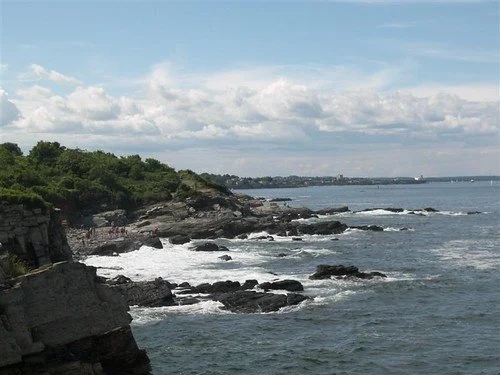
Just before we got pregnant, I’d been in Maine with a friend. We hiked, sailed, surfed in the frigid Atlantic. The ocean had been my respite after a long few month teaching high school English at an under-resourced private school, lost in landlocked Southwest Ohio. I was drowning in lessons and grading for six preps, six different English classes taught to six different levels of students across three grades. And all of this during a pandemic, of course. I became obsessed with escape. I daydreamed about the salty sprays of ocean water settling in the creases of my face. The relief of each caught wave, the release of riding cosmic energy to the shore. That trip, the time spent in and on and around the water, was the last gift I’d give myself before I became someone else, myself but no longer me.
Later, I’d see those waves in my mind as a refuge during every contraction. During pregnancy, I imagined them whenever I felt the overwhelming loss of control that came with every pound gained, every modified yoga pose, every pint of frozen custard I devoured despite my best intentions. I reminded myself that pregnancy was transformation, a birthing process of its own. Losing control was the purpose, grace in the face of that loss the goal.
But if it took my son only nine months to become a fully-formed human baby, it took me years to become a fully-formed mom. My marriage taught me how to live with another’s happiness and make it as much a priority as my own. We adopted Winnipeg, a precocious beagle mutt who gave me my first taste of sleepless nights, cleaning up soiled sheets, and midnight poops. A few years ago, on vacation in Dublin and over bowls of green and red curry, my husband and I argued quietly about having a child. He did not want one. I wanted the possibility of one—a desire that had found me in my loneliness during the months of my husband’s second deployment down range. In Maine, letting the waves rock me and my board back and forth, I felt, for the first time, brave enough to try. We were pregnant within a week.
I wish I could say I achieved the goal, the grace in letting go. That completeness in transformation meant perfection. But my vanity and impatience is something I have to contend with every day. I can, at times, be forgetful of who I am now, caught up in the dream of “bouncing back” to whoever I was before. Two months postpartum, I’m only starting to understand what my body was able to do, just now beginning to appreciate its journey. I continue to have concerns about my shape and size, but less so. More important are the concerns I have about my son’s shape and size. His eating, sleeping, and pooping. I have become less of myself to make room for him, and it is a kind of dying that makes me more. More of the goodness I worried I wouldn’t be when I discovered I was pregnant. More selfless. More secure. More sure of my maternity and the instincts it drives.
In the last weeks before my son’s birth, I began swimming at our local YMCA. Swimming at 5 a.m. with just a teenager watching guard and two white haired women breast stroking up and down their lanes. The first time I did a flip turn, my body punished me for it, so I swam like a novice, pausing and pushing off the wall at the end of each lap. I wanted to swim faster. I swam as long and as hard as I could until one day my body wouldn’t let me—another way the pregnancy enforced its control. What I wanted was for my lungs to burn; what my son needed was for me to rest.
I slowed each stroke, a reluctant sacrifice. In that quieter tempo, I sensed my baby swimming with me. His turns and flips and kicks. We were swimming together, and for the first time, I felt our connection with the clearness I’d longed for in those pink lines. It’s the same connection I feel now when I tickle his toes that look just like mine, or kiss his chin—it’s my chin, too.
What the anesthesiologist actually said was, “Happy Birthday, Momma,” and I understand him now. Pregnancy is a period of physical transition, but it takes far more than nine months and a solid labor plan to birth a mother. There are days of regression, just like my son has, when I cry and miss the womb-like security of the life I had before. But then I snuggle my son close to my chest and listen to the sound of waves with him—my Spotify algorithm another reluctant sacrifice of parenthood—watching his little body expand with every inhale. I’m swimming in a sea of diapers and spit-up, finding respite in kissing away his salty tears and the rhythmic yet unpredictable tides of our shared life. One day, I’ll take him to the ocean, but for now, we’ll listen and dream of it together.
Erikka Durdle is a writer, educator, and baseball enthusiast. She is a graduate of Southern New Hampshire University’s Mountainview MFA and was the recipient of the program’s Safford Book Prize for best Fiction thesis and the Lynn Safford Memorial Prize. Erikka is working on her first novel from the corner of her newborn’s nursery in Southwest Ohio. She dabbles in multi-tasking and burning homemade cookies. You can follow her on twitter @durdlealoha. This was originally posted in November 2021 and we are re-posting to provide readers an opportunity to read “during the pandemic” entries.
Crackpot Gumbo: A Gourmet Tour of Lee Harvey Oswald’s New Orleans
By Harry Hantel

“The sandwich and the assassin” - Harry Hantel
I’ve always loved New Orleans. Both my parents are from there, and the city standard for good times and good food has always resonated with me.
Besides my family connections to the Big Easy, I also appreciate the city’s shadowy connections to the assassination of John F. Kennedy. With that in mind, I set out to make my most recent trip a fact-finding mission of sorts.
Could I get to the bottom of the end of American Camelot, or would I be too distracted by the bottom of my glass? Would my hunger for the truth outweigh my hunger for fried seafood?
But why should I have to choose? Consider this a handy guide for anyone who thinks there’s more to life than figuring out who killed JFK; there’s also the meals you eat while you ponder the question.
Stop 1 - Harrah’s Casino
There’s only one casino at which to legally gamble in New Orleans and that would be Harrah’s. I make a point of always stopping in for a few hands of blackjack and some spins at the slot machines. I rarely win and this time wasn’t much different. Maybe I was distracted since just across the street is a freshly opened Four Seasons. Before it was a Four Seasons, however, Harrah’s neighbor was the International Trade Mart. The Trade Mart was owned by one Clay Shaw AKA Clay Bertrand. Shaw was the only man in history ever formally brought to trial for Kennedy’s murder, as depicted in Oliver Stone’s JFK. Shaw was a known CIA associate and possibly had direct dealings with Lee Harvey Oswald during the latter’s stay in New Orleans in 1963. Sure, we all love to gamble, but is anyone consistently playing with higher stakes than the Central Intelligence Agency?
Stop 2 - Bar Marilou
My brother and I made it to Bar Marilou on a Wednesday night. The Central Business District bar is connected to the Ace Hotel down the street. The drinks are fantastic and the scene is hip. The water smelled strange the night of our visit, so we stuck to liquids of the fermented variety. Just a couple blocks away, across Lafayette Square, is 544 Camp Street. The unassuming office building stands on the site of the old Newman Building, home to Guy Banister (Retired FBI agent) and a group of CIA-trained Cuban exiles. Perhaps more delicious than the drinks at Marilou, is the detail that Lee Harvey Oswald handed out pamphlets for his Fair Play For Cuba Committee (he was the only member) that listed 544 Camp Street as his contact address. Maybe it was just the booze, but it didn’t sound like a coincidence.
Stop 3 - Felix’s Oysters
I did mention seafood, didn’t I? Don’t let anyone tell you that you should avoid the chain oyster spots in New Orleans. I would never blame anyone for preferring a delicate west coast oyster to the cow tongues of the Gulf, but hot sauce and a buttered saltine closes the gap significantly. Felix’s Oysters in the French Quarter is solid, unassuming, and fair-priced. Oysters Rockefeller—molluscs grilled and topped with garlic, herbs, butter, breadcrumbs still in the shell—always satisfy, though nothing can satisfy the gnawing sense that the government was hiding something even as the Rockefeller Commission claimed otherwise.
Was Oswald the key? If he was, Felix’s was as good a spot as any to think things over since he was a food runner there that fateful summer of 1963. Thinking about Lee Harvey Oswald’s claim that he was “just a patsy” before his execution on live television, it was too much. One lone nut? Fine. These things happen. But then Jack Ruby came along. So two lone nuts? Technically three if you count Sirhan Sirhan. Suddenly, I lost my appetite. We’d finished the oysters, anyway.
Coda
I only scratched the surface of New Orleans’ many connections to JFK’s death. The Magic Bullet was fired in Dallas, but the plan was set in motion long before, and Oswald a NOLA resident that summer prior to that fateful autumn.
I hadn’t made any breakthroughs in the case and I hadn’t made any progress connecting those unconnectable dots. I hadn’t really learned anything new at all.
What I do know: Oswald and the CIA both had a busy summer in the Big Easy prior to Kennedy’s final motorcade ride, and even when retracing the steps of 20th century’s greatest supposed assassin, one gets a little hungry along the way. The mystery will still be there after lunch.
Harry Hantel is a writer living in Los Angeles and a graduate of the Mountainview Low-Residency MFA in Fiction or Non-Fiction.
A Guide in the Jungle: A Writer's Letter to His Young Son
By Daniel Barrios

Dear Hijo,
It’s been sixteen months since I became your father, though those who aren’t parents might say a year and five months. Before I was a parent, I would have.
I’ve become wiser since your birth, but my wisdom did not fall on my lap. I married your mother just after I graduated college with a bachelor’s in Creative Writing. Yikes. I was twenty-four and my ambition landed me a job in education. So much for the bohemian writer’s life. We welcomed you a week shy of our first wedding anniversary. You weighed in at a healthy six pounds and ten ounces. This was pre-COVID-19, and there were no masks worn, except for the medical professionals. The hospital did not provide me with scrubs. As I watched you being brought into the world in my college sweater and former man-bun, I asked myself two things: How will you look to the world? And how will I look with you to the world?
The first question was gratified the minute you arrived. There was a beautiful pungent scent that filled the delivery room. Unlike anything I’ve smelled before. After that smell, I knew I was your dad. You looked like both of us. Her wide eyes. My round nose. Her soft skin. My devious smile. This was blissful confirmation that you were our baby, and we were your padres. The only issue rested in my second question. How did we look as young parents with a baby boy? Did we look like mature twenty-five-year-old adults who knew what they were doing? Or did we look like another young couple who didn’t use a condom, a couple of sinvergüenzas?
Did I have to look a certain way to be a father? And what way was that? Height? I’m certainly no Tyrion Lannister. I’m also not a six-foot gigante. I’m somewhere in the middle. A place where my own high school students sometimes wondered who the teacher was, but tall enough to reach the high shelves in the kitchen for your mom (yes, on my tiptoes but nonetheless). A blessing and a curse. Did my youthful and stature disqualify me from society’s consensus of what fatherhood should be?
Perhaps I shouldn’t care how society views me. Or your mom. Or you. It would be on thing if society was fair and how someone looks didn’t affect how they’re treated. It’s too bad that type of society doesn’t exist. If you believe people don’t judge you based on the way you look, you are as ignorant as the dog who begs for his master’s bones while his own bowl is full of fresh meat.
In a Twitter thread on a goofily masculinized baby “manual” for dads in which infant care is compared to vehicle maintenance from my school peer and Assignment online editor Aaron Calvin, he points out that “the bar for dads is so extremely low, it really sucks.”
I couldn't agree more. Fathers in our society are somehow stigmatized as not being able to care for their newborns the way mothers can. In the manual Calvin references, babies are described like cars so that men can understand how to care for them. It’s silly, but this is a step in the right direction, a great resource.
Que resource?
What about the dads who didn’t receive a baby manual? How are they supposed to navigate the unknown terrain of parenthood? The same way they do anything else: By doing it.
Nothing about being your father has been easy. In graduate school, the workshops don’t teach you how to nurse an overexerted baby on the cusps of turning purple to sleep. They don’t teach you that swaddling and rocking and shushing will not work, as the manual claims, as ways to calm a cranky baby. Babies aren’t one size fits all. Formulas and juices and whole milk won’t work all the time either. You were unpredictable until you weren’t.
The manual advises to go for walks. The one thing the manual doesn’t say is that if you live in a sketchy neighborhood, you probably don’t want to walk. And if I wasn’t raised in the 10303 zip code, I wouldn’t walk around past 8pm at night either. However, we bundled and shrouded and covered you in your stroller and walked you to sleep every night because there was no other way. The narrow sidewalks and passers-by smoking joints didn't phase me, your mom, or you. After a steady ten-minute loop in the neighborhood, we heard your snores harmonizing with the North Shore’s gusty winds. That’s how we put you to sleep.
Another method the manual suggests is going for a drive. A spectacular idea! What about the parents who do not have enough money for a car and depend on the city bus like your great-grandparents did their entire lives on Staten Island? How do those parents go for a drive when some of them were taking cabs back to public housing from picking up milk and apple juice with limited WIC benefits? Your great-grandparents never owned their own car and did not have the luxury of snoozing your grandfather on the highway when he was a fussy baby.
“Parenting really just unlocks a whole new level of bizarre interactions with our messed up world,” Calvin said.
I’m starting to understand why your mom and I didn’t get one of those baby manuals. I mean, I don’t want one anyway. I don’t care for cars and see them simply as a way to get from point A to point B. You were born in the same hospital as me. You are Mexican, Dominican, Puerto Rican, and American. When you come of age, my only wish is that you become comfortable enough with who you are to accept your role in society. My role will hopefully serve as a guide in the jungle.
As I reflect on my own shortcomings, I know I’m always learning how to live in this society, accepting my role while learning its definitions. A millennial who had to choose between a wedding or a house. Mom and I made photos of the wedding for you. We’ve got uncle Yordan eating everything. Your mom’s parents are singing and dancing. Your dad with a devious smile and a blue suit. We are still saving for our future house, trying to create some semblance of an American Dream.
My russet skin does not dictate who I am or what I will become but our family’s culture does to some extent. As you settle into your own skin, and understand where your father came from, do be consumed with anger at this unjust world as I once was. Instead, Hijo, let’s rejoice. When you were born, I had questions. As we grew older, I began to think less about my questions and more about what your questions will be.
Con amor,
Always and Forever,
Papi
Daniel Barrios is a writer from Staten Island, NY. He’s currently studying fiction at the Mountainview Low-Residency MFA program.
A Questionable Gut Compass
By Dalton James

“Are you ever in a bad mood?” asked The Hip Gentleman. He smirked and crossed his arms, amused by the seeming tranquility of my inner waters. “Always upbeat. Always smiling. How do you do it?”
The Hip Gentleman, a Williams College professor, asked me this while we worked the counter of a single-screen cinema in the Berkshires. He taught biology during the day and at night he volunteered at the theater, which was historic but struggling. He sported a trendy haircut and the air of a savior. I just worked there for the money.
What Hip Gentleman didn’t know was that my inner waters were turbulent. Every moment, I struggled to tread water within that churning whitewash. My gasps for air often caught sea spray and ocean foam. Normally, I laughed and kept to the surface of things, might say something like, “Another day in paradise, brother!” People don’t like it when you share anything challenging, anything of substance. As though your vulnerability threatens their own sealed chest of sorrows. His questions were meant to be a simple greeting, something seeking no real response. But regardless of intention, his words implied my life either lacked turmoil—which was absurd considering our human condition—or that I was hiding it well—which was absurd considering the degree to which my life was unraveling. So I decided to speak candidly.
“My dad died suddenly in 2017. He was fifty-eight. Strong, though his organs apparently were not. His brother died at fifty-six. How much time does that leave me?”
Kernels in a cup.
Oil in a kettle.
“I cried on the way to work. I cried in meetings. I cried on the way home. A few months later,[1] I was fired.”
The Hip Gentleman leaned against the counter. His arms remained crossed, but his eyes were wide and unblinking. Internally, I could tell, he screamed for an escape. He regretted asking his question. I could see it in his twitching gaze, in his fingers drumming his elbows. Normally, I stopped well before someone got to this point, but whatever was inside me was coming out and there was no stopping it. My emotional regulation membrane had been ruptured.
“My wife quit soon after I lost my job. We wanted to move, get a fresh start. She’s an artist and, after searching for affordable art towns, we settled on North Adams, Massachusetts. Life was so affordable we decided to go jobless for a year. We’d coast on savings and focus on painting and writing. I was convinced that if I got a few stories published, my self-worth would skyrocket. Instead, I exhausted my dad’s life insurance funds getting four stories placed in publications you’ve never heard of.”
Butter in the pot.
Cleaner on the counter.
“When it came time to find a job, though, a real job, none of this part-time minimum wage slacker shit, I couldn’t. Not from community colleges, libraries, or even doggy daycares. Things fractured between my wife and I. She lost interest in me. Turned her gaze outward. I was in her way. I was useless. Depressed. I was drunk and stoned every night for two years—and you know nights kick in early here in the winters.”
I couldn’t tell if The Hip Gentleman was still listening and I didn’t care. It felt good to spill my guts, especially to a man who saw me as just another local simpleton.
“I cry every night, sweeping up this theater alone. I cry every night on the way home. My dad’s dead. I’m broke with no prospects. My wife is leaving me, which pretty much kills off the children I’d imagined for us, doesn’t it? I have no friends here. My family lives in Florida. I’m a thirty-two year old man scraping by with this fucking job. Where do I go from here?”
The Hip Gentleman responded to my breakdown with polite sympathy, but he was clearly relieved when customers arrived for the next showtime. I never saw him greet someone so heartily. I suppose he needed to dive into someone else to escape my outpouring.
*
Soon after this conversation, I quit the theater job and moved away. The Hip Gentleman would never know that I moved back to Florida before earning my Wilderness First Responder certificate in North Carolina. He would never know that I worked as a wilderness therapy guide in Utah and met a girl there, that we soon moved to San Diego. My estranged wife and I are still in the process of divorcing. I can never tell how close it is to being finalized. It is a guillotine poised perpetually over my tired neck. My-soon-to-be-ex-wife and I are still friends, though. It would be impossible to bury twelve years of memories, memories that made me who I am today. No matter our conflicts, I will always be grateful for her influence in my life. Despite our joint efforts, however, the Massachusetts probate court continues to reject our application. They need different forms. They need us to file in a different county. I told them I’m in California now, that Danielle is bouncing from art residency to art residency. They said tough luck. Together, we’ve been working toward divorce for almost a year now.
I met Tessa while living in my Mazda and crawling through the wreckage of my marriage. A month later, we discovered our compatibility while sharing free work housing during the rise of COVID-19, both of us stuck in quarantine for several months together, often the only two people in the house. Her sun-flower energy mitigated my depression, made me feel valued and capable. As we grow closer I can tell she wants my heart, open and full, but sadly that part of me is gone. Similar to how my dad’s death left a crater in my world, so too has divorce left a crater in my heart. Sex and companionship—great!—but I’ve lost access to unguarded love. How could I ever trust my love again, especially after once feeling so certain? My internal gauges must be faulty. My gut compass cannot be trusted. Waves of guilt crash over me when I think about how she’s fallen for someone in serious disrepair.
My dad, though, had been married twice. His first wife cheated on him with her college professor. On the day before my marriage, he pulled aside his second wife, my mom, and told her she was the love of his life. They’d been divorced for ten years, but on the eve of my wedding he asked her to run away with him. I wish I could ask him more about that. I think it would give me hope, knowing there could be real love after heartbreak.
If the majority of my life provided stability and purpose, I think I’d be able to healthily parse through my recent bout of losses. But that has never been the case and still isn’t. Despite my time working, I don’t have much to show for it. My Mazda needs repairs faster than I can afford them. I can’t foresee owning a house or property. I can’t even afford health insurance. Before my dad died, the VA hospital told him he needed a pacemaker, but he could never afford one. Several months later, he died from a heart attack in his sleep. I’m afraid I see myself going down that route, broke with a failing body and no insurance to help.
In recent daydreams I’m living on the water. I’ve built a tent platform on a jon boat, just big enough for a cooler, a sleeping bag, and a place to sit. I picture waking up on foggy mornings, alone, simmering in the mystery of what lies ahead. There are no voices out here, only me. Nobody to worry about but myself. A fish jumps. Water rolls outward. A heron swoops low and I can hear the wind in its feathers. A gator eyes me from where it suns on a log. At the slightest disturbance, it thrashes its tail and vanishes into tannic waters. As I study the water in vain, I hope that the gator’s flight does not mirror some truer purpose behind my boat excursion: am I merely avoiding my challenges instead of addressing them? Is vanishing a part of the grieving process? If not, should it be?
I’m not sure why solitude and nature are calling to me so convincingly, but I feel a deep need to be alone. Maybe I need nature to neutralize my emotions and resentments. Maybe isolation would fossilize my feelings and allow me to study them objectively. My gut is telling me to become small and vanish among the cypress knees that puncture the still faces of Florida waters. But if I continue to trust my internal compass, one that has failed me repeatedly in the past, does that make me a fool? I’ve wondered recently the degree to which I’m responsible for my struggles. Can one detect their own contributions toward self-sabotage? Have I learned to like feeling sorry for myself?
I believe my father was unable to deliver vital information to me before he passed. I believe I was supposed to inherit some secret to adulthood. Instead, I’m stuck in a mysterious limbo, one where all relationships and occupations exist in a state of continuous decline. Fortunately, I have a loving family to return to. My mom has turned my childhood home into a flourishing lakeside retreat, and I know that I am all always welcome when life beats me down. But returning home sets off alarms in my head, despite all of the love and support that I’d receive. Returning home would mean I’d given up, that I’d failed in some way. I’d seen the world and had been unable to wrangle it to a manageable trot. I’d been bucked, again and again, until the pain of crashing convinced me to just stay down. My family doesn’t understand my resistance to returning home, and neither do I, really. I suppose I’m afraid it’ll signal the end of my story. Comfort and predictability has a way of putting time on fast-forward, and time is already moving fast enough for me.
I try not to think about my dad’s lost wisdom or what he looks like buried underground. I try not to think about how my children will never meet him, and that’s if I have children at all, being a thirty-three year old divorced man seeking solitude. I try not to think about my writing, if anyone even cares, and I try not to think about money and my lack of it. But most of all, I try not to think of all the ways in which I’d let Danielle down, and how those same traits lie dormant within me still, waiting to disappoint my next lover.
Last week, I boogie boarded at La Jolla while Tessa went for a long run. Rare storms off the coast scared the usual packs of surfers, and I had what seemed to be the entire Pacific to myself. I kicked through choppy waters for peaks that broke beautifully and for me alone. It was my first time catching real waves. Rather than dumping me over the falls, I shot down the faces of these waves as if they were moving slides. I paralleled the beach at high speeds with my face mere inches from the water. I looked up every now and then to see if people were witnessing my exhilaration, but they weren’t.
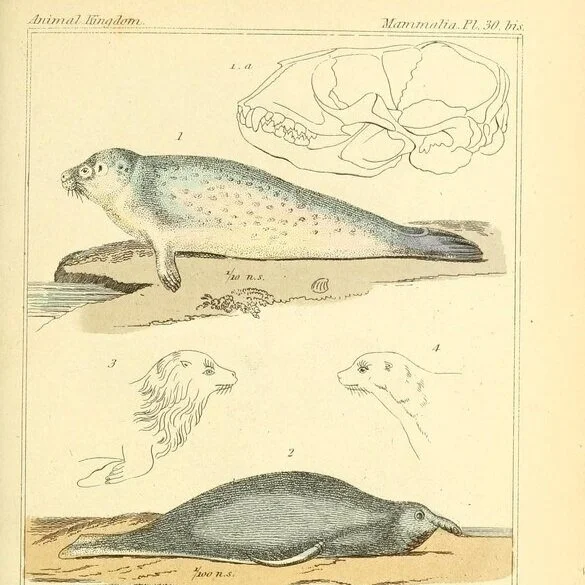
On shore, a dead seal had washed up with its face eaten off. Some remained in patches among exposed slabs of blubber. People paused their walks to gawk and take pictures. They didn’t notice the living seal bobbing up around me. He played in the waves and patrolled the shallow waters until I wondered if he were sending me a message, perhaps a warning. Had he been chased in by sharks? Killer whales? But I stayed in the water. I felt like I belonged, just another curious mammal. Rain began to fall and people retreated to their cars. The entire ocean was mine. I shredded steel-gray waves and caught seafoam in my smile, while on the horizon, heat lightning flickered and reminded me of home.
Dalton James is a graduate of the Mountainview Low-Residency MFA Program, and his fiction has appeared in J Journal, the Chariton Review, Sixfold, and Archipelago, an anthology. He currently lives in San Diego, but Florida will always be his home.
My Hispanic Characters Should Be Allowed To Speak
By Daniel Barrios

“"The old man looked at him with his sun-burned, confident loving eyes." by Sebastián-Dario
When I applied for an MFA in creative writing, I was living in the projects. I didn’t think about student diversity, I didn’t research faculty, and I wasn’t reading. I was living in my grandparent’s two-bedroom apartment with my six-month pregnant wife.
What I did think about was getting out, about not taking up too much space on the twin mattress my wife and I slept on. Some nights I slept on the floor to keep us all comfortable. Keeping the crumbs off abuela’s counter and stalking Zillow’s web listings for studios under one thousand on Staten Island.
With those things in mind, I mindlessly applied to only one MFA program.
That was it.
When I received an acceptance letter, I realized my son wouldn’t have to grow up in the projects like me.
Today’s much better. We live in a one-bedroom basement of our own and our boy is swirling across the kitchen tiles. We’re still in the same neighborhood, but we’re happy. I’ve been reading a lot and winter residency’s workshops kicked my ass.
Having to gently remove my son’s hand from my fingers, I checked my phone and saw the peer workshop list. I didn’t think much of the names and got to reviewing their work in between bottle feeds and diaper changes. One of my mentors once told me “the game needs more of us!” and I didn’t know what he meant until I was the only brown person in my workshop. Including the workshop facilitator, everyone in the workshop was white.
I wouldn’t have cared but the piece I submitted for the workshop was spelled with Spanish. And up until my third residency, I didn’t think much about how language affected the text. I wrote what I knew. Many expressed how they had to look things up. Que bueno, I thought.
The overall consensus was that my characters didn’t need to speak as much Spanish, or instead of speaking the Puerto Rican dialogue, just write in exposition. Others thought the Spanish worked well. Mitad y mitad.
Okay, I almost said, but remembered I had to stay quiet the entire workshop.
So my Hispanic characters aren’t allowed to speak? I said to myself as I bit down on my tongue. I felt silenced.
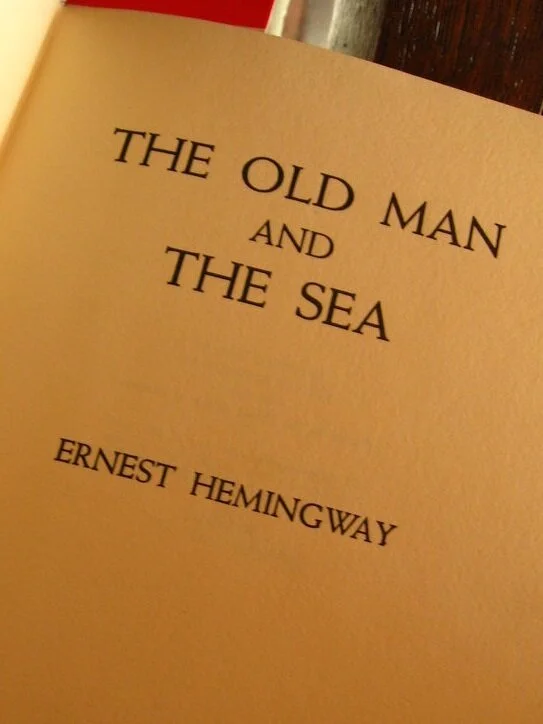
Around the same time as my manuscript was being probed, I was reading Hemingway. Specifically, The Old Man and the Sea. Cool, I thought. A Spaniard protagonist named Santiago who lives in Cuba and fishes. A white man writing about Hispanic culture. As I kept reading, I found Spanish. If I weren’t a native speaker, I would have needed to look up every Spanish term that Hemingway employed. As it stands, I looked up one.
On the first paragraph of the first page, “Salao, which is the worst form of unlucky,” is used to characterize Santiago. We understand that Santiago’s Cuban culture will be utilized to give him his identity. Outside of the Cuban context, this word translates to “salty.”
As the plot advances, we are in an epic shark scene with Santiago: “Ay,’ the old man said. “Galanos. Come on galanos,” Galanos are mentioned three times on this page. The repetition is indicative that this language is essential to the character. This is his world.
On the final page, after Santiago has returned to shore, a tourist asks about the remnants of his catch. “Tiburon,’ the waiter said. ‘Shark,”. Hemingway makes it clear that people in the environment use Spanish just as the protagonist does.
This novella won Hemingway the Pulitzer for fiction in 1953 and the Nobel Prize in 1954. If a white man from Illinois was allowed to use Spanish to develop his characters and the Cuban Gulf Stream, I think a brown kid from New York should be allowed to use as much Spanish as his characters’ lives demand. Another mentor once told me to “know my audience.”
I’m stilling wondering who makes up that audience, exactly. If you do read my words, I appreciate you. What I do know are my characters, the worlds they inhabit and the lives they live. I know that Spanish is part of their being, and without it, they would not be human. To this effect, my stories reflect a humanization that is often ignored or overlooked. Latinx people, as Hemingway was rewarded for recognizing, are worthy of writing as fully human.
Daniel Barrios is a writer from Staten Island, NY. He’s currently studying fiction at the Mountainview Low-Residency MFA program.
Faculty Picks: Rebecca Schiff on short stories by Abigail Ulman, Tracy O'Neill on Marie NDiaye's novel of unknowing


I know a book has gotten to me when I start texting my friends asking if they’ve read it. “You read Hot Little Hands?” “Have you by chance read Abigail Ulman’s story collection?” I want to discuss it and I want to discuss it now. I want everyone to know that in this world of James Bond remakes and tepid bestsellers, there’s a writer daring to say something new, to tell us what she sees, to describe things I’ve felt but haven’t yet articulated. In nine poignant, sexually frank stories, Abigail Ulman articulates what it’s like to be young and female so accurately that this book could almost be a primer. (A primer for what, I’m not sure.) Ulman’s stories have range—a twenty-two-year-old culture blogger decides to have a baby instead of finishing the book she’s under contract to write; a Russian gymnast’s visit to the U.S. takes a disturbing turn—but somehow they feel personal, too. I loved “Head to Toe,” in which two Australian teens get so bored with late adolescence that they go back to horse camp; and “The Pretty One,” a story that flips the conventional script of longing and obsession so that the fixated one is the female narrator, and the pretty one is a male bar-back with “black converse, tight gray jeans, a yellow T-shirt inside out, and a bunch of curly brown hair pushed to the side of his forehead.” A lifetime of descriptions of female beauty hadn’t prepared me for what it might be like to lust, along with the narrator, for a male object, to see how closely her crush is tied to the boy’s beauty, to understand exactly why she’s afraid to screw it up. I’d stumbled upon the female gaze, and I long to gaze with Abigail Ulman wherever she next turns her head. — Rebecca Schiff
As a kid, I never checked out scary films on trips to the local video rental store in Merrimack, NH, and I once told a man I was dating that watching a zombie movie felt, to me, like watching the two-hour cardio session of several people who'd not dressed for the occasion. Nevertheless, I find myself of late allured by a particular style of horror defined by a high-wire plot of unknowing. Recently, I began reading My Heart Hemmed In by Marie NDiaye (translated from French by Jordan Stump), who won the Prix Goncourt in 2009. The story of a couple who have become deplored by their small community without any seeming reason for it and who are shocked by the sudden appearance of a strange wound on the man's abdomen, the novel balances lucid prose with mysterious unease. Its conceit mobilizes and turns on its head our desire to find rationale for the infliction of cruelty, asking us to consider the everyday horror we enact as we mark and withdraw from others, and as we believe that the presence of horror suggests horror is deserved. — Tracy O’Neill
Rebecca Schiff and Tracy O’Neill are members at the Mountainview Low-Residency MFA in Fiction and Non-Fiction.
On Character
By Terri Alexander

Last Friday evening, I found myself reading in Harper’s Magazine a short story by Joyce Carol Oates, “The Unexpected.” In the story, an aging, famous writer is attending a book event in her hometown when she is blindsided by the wrath of former classmates. In one conversation, a woman named Olive, or Olivia (the writer cannot remember), tells her, “You’re remembering wrong. In everything you write, you remember wrong.” And also, “That’s why you write such lies – to change the way things were, when you couldn’t change them any other way.”
The “all characters fictitious” legal disclaimer, boilerplate language for virtually all novels and story collections, states, in part, that “any resemblance to real persons, living or dead, is purely coincidental,” and gives license to mine our lived experience for material. From auto-fiction to science fiction, writers’ real lives frequently co-mingle with their work. However, we are taught that to use an actual person in a work of fiction is an ethical no-no. Characters, then, are built in the gray area between the real world and the imagined.
Joyce Carol Oates does not reveal to the reader to what degree, if at all, the author acknowledges her characters were based on people from her past. It prompted me to wonder if the protagonist had a psychological blind spot, as hinted at in the story’s title, or if her characters were less veiled than she believed. Another possibility entirely is that the characters were erroneously making it all about themselves when the famous writer perhaps didn’t have them in mind at all.
The reader also doesn’t know how much of Oates herself is represented in the main character. It can start to feel like a psychological jigsaw puzzle. As a novice fiction writer, I have some underlying fear that my stories make my own personal issues transparent to the professors, students, and editors who read my stories. Today, we seldom allow a work to stand on its own, but insist on considering it through the lens of its creator. How much of it is true? Who hasn’t read a work of fiction so compelling that we’ve flipped to the author bio for clues as to how much of the story could be based in fact?
Writers of fiction have a rare freedom to build worlds and characters without limits, and yet there is the frequently recited advice to “write what you know.” My best characters tend to be shaped by snippets I take from a wide sample of relationships, interactions, and observations from my own life. I get an uneasy feeling when I recognize that a character I’ve written is based too much on one person. If that person read the story, would she recognize herself in it? If the answer is yes or maybe, I’ve gotten too close to that ethical boundary. In a 1983 interview with the Paris Review, Raymond Carver’s advice was this: “A little autobiography and a lot of imagination are best.”
At the end of Joyce Carol Oates’ “The Unexpected,” the writer meets a former classmate who had a huge crush on her, and in fact still does. He discloses to her, “I’ve discovered enough of myself in your fiction to keep reading, and to keep hoping.” The protagonist is astonished at his words, and yet as the degree of his worship is revealed, she becomes more and more attracted to him, admitting to herself that he was meant to be her soul mate all along. In the last paragraph, the protagonist walks home with her admirer. Oates writes, “The sky overheard appears to be impacted with clouds, light comes from all sides, there are no shadows.” I finished the story and immediately googled, “Joyce Carol Oates personal life.” There was no obvious correlation, and I wasn’t surprised – the character in Oates’ story was completely alive on the page.
Terri Alexander is a graduate of The Mountainview Low Residency MFA in Fiction and Nonfiction.
Naked
By Marjorie Frakes

Washing my face was the worst part of every day. I'd stand at the mirror, admiring my effort, feeling fully myself, before splashing on water, soap, and/or whatever magical concoction I was currently trying. My effort, sometimes an hour's worth, swirled down the drain, and my naked, red, blemished face stared back at me. I denied ownership and flipped off the light.
The causes varied. Helpful friends told me what I was doing wrong. They used a particular product and look at them. It was probably something I was eating. Stress, maybe. My favorite: the oft-recurring belief that it was punishment for vanity. I'd wanted to be beautiful probably from infancy, and this seemed a plausible and succinct way of letting me know that that was not part of the big plan for me.
More important than clothing, my makeup bag became my arsenal and my armor. Mornings were terrifying. I'd get up early early early, especially if I was traveling, and hurry through my shower. Communal sinks were also terrifying, and I'd try for a corner spot, ignoring the beautiful faces at the sinks beside me, paranoid by their glances. Makeup on, I'd smile, but now a few more people knew my secret, and I assumed word would spread.
A sentence in a book haunted me, and haunts me still. Subject, plot, and content have departed, but one sentence remains: a description of a minor character as "a woman with bad skin." How dare whomever? But that was accurate, I was sure. If anyone was going to remember anything about me, it was going to be that.
I dated, by some miracle, though not much. And the highest level of intimacy I could offer was my naked face. Camping trips were not fun. One boyfriend told me I was beautiful "real", and I tried to believe him. Another encouraged me to accept myself, and I went out to breakfast one morning with a completely naked face. But I was cowered under a ball cap, and it wasn't quite the victory I (or he) had been hoping for. Also, my face was almost clear. I had my limits.
Right before my wedding, I made my first trip to a dermatologist. "Yes, you have acne," she said, staring at my face, neck, and for some incredibly horrible and recent reason, chest. "Shsssh!" I wanted to say. I was prescribed topicals that burned my skin and bleached my towels. But it was an improvement. My portrait neck wedding dress looked stunning, and my skin looked acceptable.
I ditched the topicals eventually. They hurt. I was accepted and loved and generally cushioned from exposing my naked face to anyone other than my husband. I used natural products and natural makeup, and most days were okay. On bad days, however, I noticed I held my head differently. I looked at the ground or tossed my hair (if it was long enough) in an attempt to distract. I was less talkative, and I tried to exit the conversation as quickly as possible.
And my chest. How can I even discuss this? This, certainly, was some sort of wrath thing. It was a ploy to keep me buttoned to the top button, always. Google search: high neck swimsuits. No, this was not okay. During my annual checkup I told my doctor it was ridiculous and I was tired of pretending it was okay. I was thirty-six, because I am a very slow learner.
Three years after this pharmaceutical panacea, I still don't love my naked face. I'm older now, with bags under the eyes and wrinkles telling stories. But my skin is soft and smooth, and the somewhat constant visitation of at least one blemish is forgiven, seeming almost whimsical. In this I'm lucky, I know. My chest is clear, and scoop necks, v-necks, and a low plunge are the balloons that celebrate this wonder. Please forgive me.
I can still take an hour on my face, but now it's more likely to be a smoky eye. Made up me is me, and ever shall be. After a day of skiing, my husband and I remove our ski gear. "Dinner?" he asks. I look at my wide, naked eyes. "Gimme a minute," I say, reaching for my eyeliner.
Marjorie Frakes is a current degree candidate at The Mountainview Low Residency MFA in Fiction and Nonfiction.
Faculty Spotlight: Katherine Towler

Katherine (Katie) Towler is an author and creative writing teacher and currently a faculty member in the Mountainview MFA program. Her first book, Snow Island, was a a Barnes and Noble Discover Great New Writers title and her latest book, The Penny Poet of Portsmouth, was named a Best Book of 2016 by Entropy Magazine, Longreads, and Book Riot. She was kind enough to answer some questions about her books and her writing process, as well as give some useful advise for new writers.
—WL
When did you first realize you wanted to be a writer?
Like most writers, I was a reader before I was a writer, and it was being a passionate reader that made me want to be a writer. By the age of eight, I was spending hours on the couch reading. My younger sister complained throughout our childhood that she couldn’t get me to go outside with her because I never wanted to put down the book I was currently reading. Books were my refuge and my friends, my transport to other worlds, my window on what was possible in life. With a good book, I was never alone. Books made me forget the things that plagued me as a child, like gym class. When I started writing, I found that writing was a similar experience of leaving common life behind and being absorbed by an act that felt so vital and alive. I started writing poems when I was 10 and shortly after that began carrying a notebook around with me which was a writing journal of sorts. When I was 13, I declared I was going to be a poet when I grew up, though I turned out to be more of a prose writer than poet.
Who are some authors who have inspired you?
An early book that completely captivated me as a young reader was Jane Eyre. I still love the Brontes. I am inspired by much of what I read, including the work of my students. It is endlessly fascinating — and challenging and inspiring — to see how other writers create real worlds and compelling characters, and how they use words. I learn from reading as widely as I can (poetry, fiction, nonfiction) and encourage anyone who wants to write to do this. You can learn so much from reading different genres and writers whose concerns are far from yours. To further answer your question, some of the writers whose work has most stayed with me over the years and guided me are Willa Cather, Henry James, Alistair MacLeod, Edna O’Brien, Alice Munro, Virginia Woolf, Marguerite Duras, Edith Wharton. And then there are the poets and memoirists, but I’ll stop with this fiction list.
Your debut novel, Snow Island, the first book in a trilogy, tells the story of Alice Daggett, a sixteen-year-old girl struggling with the sudden death of her father. How did the idea come to you? Also, how long did it take to complete?

In the late 1980s, I spent a couple of months one spring living on my own on an island in the center of Narragansett Bay. The year-round population was 125 people and 300 deer. It was a strange little isolated community. I was captivated by the place — how quiet and empty it was, and how nothing ever happened (except the arrival of the ferry and the mail). I was particularly intrigued by the people who had chosen to live there, many of them clearly drop-outs from life as most Americans know it. Today things are different. You can be connected to the world via the internet from almost anywhere. It’s harder to get lost. But back then, the isolation on the island was real and profound.
One of the people who most intrigued me was the woman who ran the island store. She was also the postmistress and the manager of the water company. She was a tough character in her seventies who had lived on the island her entire life and had managed to get married and divorced three times without leaving the place. I wondered what she was like as a girl and what it was like for her to grow up in this insular community. She became the inspiration for my main character, Alice Daggett, in the first volume of the trilogy.
I started out writing a short story about Alice as a teenager. I planned to write a collection of stories that would span the 20th century and have a running theme of the different wars and how the island community was impacted by them. Alice couldn’t be contained to a short story, though, so I turned her story into a novel and then, having drafts of the other stories still hanging around, turned them into the next two volumes of the trilogy. It took me eight years to write Snow Island. I wrote a bit faster with the next two volumes, but the whole project, including publication time, took nearly 20 years. I had no idea what I was getting myself into.
What are some of the lessons you learned completing that first book?
Probably the biggest lesson I learned was that it takes as long as it takes. Each book has its own life, each writer her own process. I revised extensively, often chapter by chapter. The craft books I read back then all advised writing a complete draft straight through without stopping, but I was unable to do this. I kept going back and making changes. I couldn’t go forward until I had revised the first chapters over and over, and then I often had to go back and revise them again. My writing process was my dirty secret. I was so obviously, it seemed, writing a novel the wrong way. What I realized eventually is that there is no “wrong” way, there is only your way. Whatever it takes to finish your book is what it takes. I learned plenty of other lessons from writing that first book about pace and voice and dialogue and structure, but the most important thing I ultimately learned was to trust my own process.
Tell us more about that writing process. Are you an outliner? Do you have an idea of how the whole story will go or is your writing more open-ended?
My writing tends to be more open-ended. I don’t outline. I carry the idea for a story around in my mind for a long time. The shape of it keeps morphing and changing. I have a plot of sorts, though mostly what I have are a setting and characters. These come first for me. My writing has always been strongly rooted in place. I need a sense of place to anchor me imaginatively and a compelling cast of characters. I need to know my characters as real and complete and believable before I can get them to act. Plot tends to be the last thing I think about.
With nonfiction, it’s different, of course. If you are writing a memoir, you have the outline of the story given to you, but you still need to uncover the real story. Developing voice and character (your own and those you may portray in the memoir) is significant work that must be done with a memoir as it must be done in fiction.
Your latest book, The Penny Poet of Portsmouth: A Memoir of Place, Solitude, and Friendship, is about your friendship with the late poet Robert Dunn, as well as a meditation on an artist’s connection to a place. What led you to write this book?

Robert Dunn was an unusual character who lived most of his life in Portsmouth, NH. He rented a room in a house close to downtown from an elderly woman and did not own a car, telephone, television, or, when they came along, computer. He was a brilliant thinker, a wonderful poet, and a voracious reader. He sold his little hand sewn books of poems on the street for a penny. I got to know Robert, to the extent that anyone got to know him (he was a very private and somewhat solitary person), when I moved to Portsmouth in 1991, living by chance in the house next door to his. I admired Robert tremendously for existing so completely outside the system. His life was performance art of a sort. He was one of the most principled people I have ever met. He owned next to nothing and chose to live largely without money. This freed him to devote his time to writing and reading and thinking.
At the end of Robert’s life, when he was critically ill, I became involved in helping to care for him. The choices he had made, which I had so admired in the past, looked different now. He was isolated and had no resources. He was forced to rely on others when he didn’t want to. For some reason, he relied on me more than anyone else and essentially appointed me his next of kin in Portsmouth. I went through an intense experience of being with him when he was close to death, thrust into the role of a family member. After his death, I needed to write about this experience in order to process it and understand it.
As the book evolved, it became a book about me as much as it was a book about Robert and our friendship. I ended up writing about the choices I have made as a writer and how Robert challenged me in my thinking about those choices. I wanted, too, to write about Portsmouth, a city that has changed so much since the early 1990s. Robert was emblematic of the “old” Portsmouth, a rough around the edges port town that embraced characters like him. I wanted to capture that Portsmouth, the place I so loved before money and gentrification took over in a big way.
As a writing teacher, is there any advice you would like to give students, something that they should always keep in mind while writing?
Don’t be in a hurry. Let the writing take the time it needs to take. Build in time for the work to evolve. This may mean writing a draft of a novel, then letting it sit for a year before looking at it again. Time spent thinking about a piece of writing, or not thinking about it at all, just letting it quietly percolate somewhere in the back of your mind, can be as important as the actual hours at the desk. Not writing can be just as important as writing. You want your imagination to remain nimble, capable of going to unexpected places. You want to be able to surprise yourself and the reader. If you force the writing, if you push yourself to finish that draft because it simply has to be finished by tomorrow, you can become too cramped in your thinking and, hence, in your writing. Do everything you can to free yourself. Maybe this means taking frequent walks, meditating, doing yoga. Maybe it means taking trips. Maybe it means having other passions that completely absorb you, so for days or weeks you forget the writing entirely. Whatever it is, pay attention to giving yourself and your writing the freedom to grow and change, to go anywhere, to be fluid, to emerge. Allow yourself to be anyone on the page.
![K. Towler [credit: JONATHAN WIGGS/GLOBE STAFF]](https://images.squarespace-cdn.com/content/v1/543d9b11e4b0847bb28295dc/1558047391105-9DLM4FMLCMGVFG7WHZ4D/KT.jpg)
K. Towler [credit: JONATHAN WIGGS/GLOBE STAFF]
Last thing: Anyone who knows you, knows you to be a dedicated birdwatcher. How did you get into birdwatching and what do you love most about it?
I started paying more attention to birds when I went to Florida for the first time about 20 years ago. My husband and I signed up for a bird walk at a wildlife refuge, thinking, sure, we like birds. The guide put her two thousand dollar binoculars around my neck and said, “I want you to use these.” Smart guide. She knew that if I saw the birds through those brilliant lenses, I would be hooked. I was.
Bird watching is very meditative. You walk slowly and must train your senses to be acutely aware of what is around you. You must listen for the songs and watch for the slightest signs of movement in leafed-out trees. When I go bird watching, I forget myself entirely. It sometimes feels miraculous. My petty complaints are gone, my stupid preoccupations, my doubts and regrets. The endless clock of life, the list of things to be done, disappears. Birding is similar to writing in many ways. It’s entirely absorbing, a “flow” state at its best. But birding takes me outdoors, something I find increasingly essential for my sanity these days. It’s an antidote to all that time spent in my head writing. For me a perfect day contains both — a morning at the desk and an afternoon out walking and looking for birds. This makes me something of a renegade birder, since the best birding is often at dawn, and birders pride themselves on being out by first light, but I can get out early on the weekends when I take a break from writing. Spring migration is currently under way, and I am watching a Baltimore Oriole through my kitchen window. What a creature of exquisite beauty. The number and variety of bird species is staggering. There are over 10,000 species worldwide. I will never get to them all, but I want to see as many as I can.
In the Secret Parts of Fortune (Excerpt of a Novel)
By Kevin P. Keating

For three consecutive nights someone with a fondness for fire and poetic spectacle has been burning the mailboxes on Île Saint-Ignace, one of the celebrated wine islands of the Great Lakes, and now, on the first Friday in September, twelve hours before the official start of the annual Barge Party, a dark tendril of smoke comes creeping across a cloudless summer sky, curling curiously around the old lighthouse, probing its copper weathervane, its obsolete lantern room and its great, pale gray blocks of fossiliferous limestone excavated a century ago from the abandoned quarry at the center, at the very heart of the island. In secret the perpetrator plants the seeds of discord, cultivates a diseased garden of strife, an unbalanced botanist who does his best work at that extraordinary moment just before sundown when tourists gather at the water’s edge to admire the fleeting bloom of soft colors above the blue burst of lake. He works quickly, too, using materials close at hand, easily obtainable, inconspicuous—a box of matches with long wooden sticks, a rag soaked in alcohol and stuffed into a wine bottle filled with motor oil and gasoline. Poor man’s grenade, weapon of protest, of resistance, of insurrection. With a skillful strike of a match behind a cupped palm, he ignites the homemade wick, and then with a smirk, a stealthy smile, a sideways sneer of sinister achievement, he disappears down a shady lane, some say on foot, others say on a bicycle, its chain well-oiled for a silent getaway, the tires inflated to the recommended pressure for maximum escape velocity.
Since no one has witnessed these criminal activities, and since no one can say for certain whether the guilty party is male or female, much less know what the culprit is thinking, it is perhaps imprudent to use masculine pronouns, but most of the islanders insist the villain is a sociopathic teenage boy from the mainland, a canal rat, an undereducated punk with a terrible green glance brimming with class envy and testosterone-driven rage. Michael Bettelheim has seen his neighbors stomping out smoldering bundles of bills and the evening edition of The Observer, has heard them cursing in the streets, making ugly and unsubstantiated claims, leveling accusations, promising to deliver swift justice. In town and on the ferry, they offer him passively hostile frowns and, having worked their suspicions into convictions, turn their backs on him in what seems to be a ritual display of baronial anger. Cruel caricaturists, unapologetic snobs, they refuse to consider the possibility that one of their own prim and priggish children might be responsible for these crimes. The residents are beginning to panic and have planned an around-the-clock neighborhood watch. Vigilantism, reprisals, strategic counterattacks are no longer beyond the realm of possibility.
On these pressing matters Michael says nothing and concludes nothing. He has successfully purged his mind of all toxic ideas, all neurotic nonsense, but now, while making the thirty-minute crossing aboard the General Zaroff from Île Saint-Ignace to the mainland city of Jolliet Harbour, he is forced to reconsider the precise meaning of the smoke. Its literal meaning is becoming increasingly clear to him, but its trajectory, its final destination, its ultimate outcome remains uncertain. Rather than dissolve in the prevailing winds and assume an ethereal and indeterminate form, the smoke, as it rises above the warty hackberry trees that crowd the island’s leeward side, only darkens as it inches closer to the mainland. It starts to look, at least from Michael’s vantage point, like a deep and brutal scar, as if the invisible incisors of some ravening, celestial beast has ripped through the protective layers of the earth’s atmosphere. Eternal night gushes from the angry wound. Can it be a minatory symbol, a promise of divine retribution, a hint that the time fast approaches when Michael, for his moral cowardice, for his inability to take meaningful action, will fall prey to some cosmic injury? The stakes have proven too high, too imponderable for rational calculation.
He runs a hand along the hood of the army green jeep and tries to assure himself that life is good and the world is on its proper course. Heavily rusted and rough to the touch, the jeep, one of several in his uncle’s fleet of classic cars, is long overdue for a meticulous restoration. Michael strikes a match against the back of his boot and lights a cigarette, the last of his secret vices. He walks to the ferry’s stern and rests his elbows on the railing to take advantage of the unrestricted view from horizon to horizon. As he watches the gulls bank steeply in the sky, he feels a vibration in his back pocket. Tomorrow marks the one-year anniversary of his sobriety, and all day long his phone has been buzzing with messages from well-wishers, old friends, former bandmates, fellow dipsomaniacs on the mend, not to mention his degenerate cousin Horace to whom he hasn’t spoken since last year’s Barge Party. But what baffles Michael most is the amount of time it has taken for his mother to call. Burdened by a sense of filial duty, he closes his eyes and prepares himself for the usual tense conversation.
He spins the cigarette butt into the churning wake and through a ring of smoke says, “Hello, Mom.”
For a moment he hears only her raspy breathing, and with each passing second his mother’s menace seems to multiply. In her moody, churlish silence he detects a dangerous combination of self-interest and political paranoia.
“Do you see the smoke, Michael? Can you smell it?”
Her voice has a frightening, melodious pitch, as if she just finished screaming at some quaking subordinate, the head gardener maybe, a housekeeper, or possibly her own reflection in the endless dark depths of a cracked mirror.
Michael fights the temptation to roll his eyes, a childish habit and one that his mother can invariably detect, even over the phone. She has a name for this power, Love’s Telepathy, and firmly believes she is in touch with invisible forces. She claims to possess a talent for reading signs and wonders, the out-of-season flowering of a tree, the unexpected infestation of water snakes on the pebble-strewn shore, the arrangement of Tarot cards on an oval table in a candlelit room, the macabre procession of gibbering ghosts in bad dreams, a crazy coil of black smoke unspooling above the lake. She feels no need to sift through the contradictory evidence or to keep an open mind about matters of guilt or innocence. For her even hard facts tend to be superfluous, and she can usually get her man, as it were, simply by concentrating on the crime in question and entering into the desperate and dangerous labyrinth of pure speculation.
“So nice of you to check in, Mom. How are you?”
But he knows, before she utters another word, that she has been drinking. Instead of her usual glass of Riesling or Pinot Noir, she has developed a habit of plundering the family cellars for bottles of ice wine. An epicurean pleasure, as she describes it, but in recent days her drinking has spread beyond the cocktail hours and the post-dinner nightcaps into high-noon lunchtime sloshes. Michael can picture the scene quite clearly in his mind, Ciara Campbell Bettelheim sitting alone at a corner table in the winery’s tasting room, pouring the syrupy liquid into a crystal cordial glass that she carries in her crocodile handbag. With all the solemnity of a private ritual, she taps her manicured nails against the sparkling flute, her fingertips stained with the blood of the grape, and admires the wine’s full body and lush color, the same decadent shade of amber as those well-bred island girls, perfect athletes, walking advertisements for the booming tourist industry, who frolic on the beach, kicking over sandcastles and playing volleyball. The Bettelheim Family Cellars produce some of the finest Cabernet Franc grapes in the region, so say the connoisseurs in their fancy culinary magazines, and Michael, in the days before his widely publicized downfall, was once the happy beneficiary of this modest bit of fame.
“Arson,” says his mother, “is such an egregiously cowardly act. What do you make of it?”
He pretends to consider the question and runs a hand through his hair, neatly cut, edged and parted in a razor slash. His new corporate look. “I really don’t know…”
“Well, I know, Michael. I know you’re not out of the woods. Not officially. Smooth sailing, that’s what you want, isn’t it? That’s what we all want for you right now. A few more hours and you’re a free man. Until then you don’t need any more trouble in your life.”
“There’s nothing to worry about, Mom. Nothing that concerns my interests, anyway. Or yours.”
“You sound awfully sure of yourself. Has the word ‘saboteur’ ever crossed your mind? You do understand why I’m obligated to ask, why I’m compelled to ask? The police want to implement a curfew. They have direct orders from the chief to keep an eye on tourists, guests, aliens. Everyone on the island is a person of interest, residents and strangers alike. No one is above suspicion.”
Unable to suppress a sardonic smile, Michael says, “That should be our family motto—nemo est extra suspicionis.”
“Yes, darling, our family has learned so much from the Romans.”
Kevin P. Keating is a graduate of The Mountainview Low Residency MFA in Fiction and Nonfiction.
Paradise on Edge (Excerpt)
By Arlene Quiyou Pena
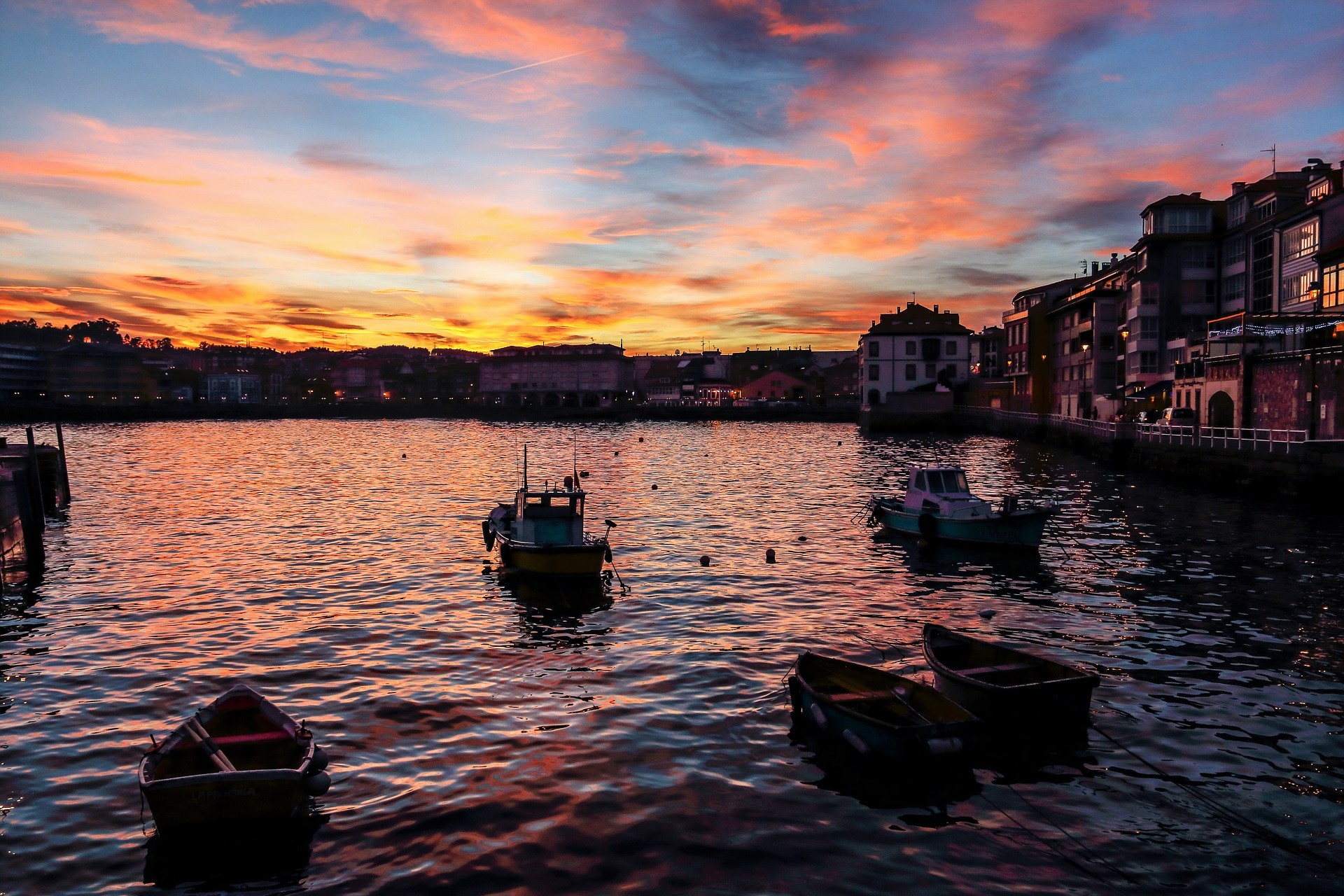
Jacob didn’t miss Port-of-Spain, the bumper-to-bumper traffic commute to his office at the bank, or the starched button-up shirts and ties that had come to define his orderly life. Now retired, he grew his hair longer and delighted in his daily walks to the sea. The sun was rising as Jacob reached the midpoint of the hill in front of Neville’s house. He opened the gate when he saw a lamplight in the window. The small house stood nestled between Tilly’s wild orchids, red ixora plants, and the vegetable garden at the back. The mango tree branches drooped with the weight of the ripe fruit as the sparrows feasted on the discarded ones rotting on the ground. It had rained heavily the night before, and the purple honeycreepers drank the dew off the leaves. Since Tilly had died a year ago, her husband, Neville, sat at their bedroom window, seldom leaving his home as the overgrown foliage threatened to devour the house.
“Morning,” Jacob called out as he walked up the stone pathway. Neville’s head peered around the curtain of his bedroom window; he waved and then quietly pulled back out of view. Jacob had sat next to Neville in primary school and could recall the tall bony nine-year-old who made the girls laugh. Now the two men sat in front of the living room’s great bay window.
“Hazel came by yesterday to check up on me,” Neville said. “Boy, when you going to marry her?”
“What make you think she wants to get married?”
“Women want to get married,” Neville said. “Only we men like to play the fool.”
“Times change,” Jacob said. “You don’t see how these young girls treating the young boys today?”
“You not so young,” Neville said. “And neither is she. You better be careful someone don’t snatch her up from right under your nose.”
“Eh-eh, you trying to give me some competition?”
Neville laughed. “At my age?”
“Who you think you fooling?” Jacob said. “You had your eyes on her since you were sixteen years old.”
“Sound like you jealous?”
“Nah!” Jacob said.
Voices from the garden diverted their attention. They looked out the window and watched as five young men dressed in ill-fitting clothing move through the garden like locusts.
“What the ass is this?” Jacob said. The two men stood and hurried out to the porch.
Neville called out to the approaching men. “Get off my property!”
When Jacob walked down the front steps towards them, the young men, their arms loaded with vegetables and mangoes, ignored him and strolled past the trampled plants and out through the gate.
“What kinda behavior is this?” Jacob shouted after them. “We don’t tolerate stealing in Mari Village. Where you fellas come from? You want some fruit ask for it. Don’t steal!”
After Jacob closed the gate behind them, one of the young men stopped and pointed a long stick at Jacob’s throat and squinted at him.
“Man, the fruit rotting on the ground and you quarreling? I come from this island, just like you. So watch yuh self.”
Jacob stared at the young man as he strolled up the hill to meet the others. He picked up a broken orchid plant with its tangled roots exposed and bleeding and recalled his neighbor’s recent complaint about hearing somebody in her yard the night before last. He didn’t know if these fellas were responsible for any wrong doings on the hill, but their brazenness exemplified an ugliness plaguing the island.
“In our day, them fellas could never get away with that shit. We would’ve run them outta the village,” Jacob said. “Boy, what happen to us?”
“We got old and tired,” Neville said.
Jacob felt uneasy as he continued down the hill toward the seawall. He walked along the beach away from the fishermen’s boats. He stopped and removed his khaki shorts, red faded tee shirt, sneakers, and walked into the sea in his bathing trunks. The water reached his mid-thigh as he stood on a sand bar. He thought of the young man who had pointed the stick at his throat. Was this the new heir to Mari Village? He shuddered. He raised his hands above his head and shouted, “I’m not old and tired!”
But he had felt threatened by the young men. In his youth, he had avoided trouble, but when arguments escalated to fights, Jacob never backed down. He recalled a schoolboy’s scuffle with Neville where both of them had nursed bruises and hurt feelings. In the end, Neville had become his brother. Now, Jacob no longer recognized the island of his youth. He had stopped buying the newspapers. He didn’t want to read any more stories about murders or botched kidnappings.
Enveloped in the cool water, he wondered what he had done with his time. He had no wife, and no children to whom he could pass on his history. He wondered what his life would have been like if Hazel had stayed in Mari village. He had held onto his memories of her during his marriage and divorce from Mona, and his relationships with Teresa and Camille. He remembered Hazel pale blue dress, and a satin bandeau that held her dark curly hair away from her face. It was at the church’s bazaar. Jacob had watched her from the side of the bandstand as he tried to summon his courage to ask her to dance. Her mother was in charge of the cake booth, and when Hazel wasn’t dancing with the young boys who sought her attention, she stood behind the table and moved in time to the calypso music. He had inched his way closer to the booth and looked into the glass cabinet at four large cakes - chocolate, coconut with cream icing, pineapple and cherries, and sponge. He glanced at Hazel and saw her looking at him. He had hesitated, unsure of what to do next. He recalled feeling the perspiration dripping down the center of his back. “Yuh want to dance?” Jacob asked. She looked over at her mother who had nodded her approval. He held Hazel’s hand and took her to the dance floor; the tone of her voice and her smile had enchanted him. Yet, within months after meeting Hazel, Jacob had heard that her mother had sent her to live in New York. He had seen her only once in the last forty-five years, a chance encounter ten years ago at a carnival fete where he met her husband. Now Hazel was back.
*
Four months earlier, when she returned to Mari Village for her mother’s funeral, he had arranged to meet at her home. He had arrived minutes early and sat in his car. He surveyed the house, which he had avoided after Hazel left. The curved coconut tree that had once stood at the entrance was gone, but Miss Myrtle’s precious vegetable garden bloomed. He looked into the rearview mirror, and wondered if his face revealed his lost years. He grabbed the bottle of wine he had brought for her and exited the car. He saw her on the front steps leading to the veranda and embraced her. He felt her body stiffen, and then she relaxed into him. He followed her into the house, and had expected to see her husband, but he sat alone with her in the kitchen as she prepared the dishes for their lunch. She looked lovely, he had thought. He traced the profile of her face, the fine lines on her forehead and slight creases along the side of her nose. Her beaded earrings brushed against her bare shoulders as she took the macaroni pie from the stove and place the dish on the counter. She told him that she was happy many of her mother’s friends had come to the funeral.
“I thought I would’ve seen you there,” Hazel said.
“I couldn’t get out of a meeting. I heard it was a good service.” Jacob hadn’t forgotten his humiliation when Miss Myrtle had asked him to leave her yard so many years ago.
“How long you staying in Mari?”
“A couple of months. I have to fix up the house before I put it up for sale.”
He followed Hazel to the veranda and helped her place the dishes of stew chicken, fried plantains, and raw cut vegetables to the table. He had stopped drinking alcohol, so she filled his glass with coconut water. They sat across from each other and talked about the changes on the island, her years working as a guidance counselor in Brooklyn with high school students, and his work in the village council.
“I remember meeting your husband?” Jacob said. “I forgot his name.”
“Kenneth.”
“Right.” Jacob nibbled on slices of guava cheese. “I thought I would see him today.”
“We’re divorced.”
“Oh? How long ago?”
“Some years now.”
Jacob’s mind buzzed. He wanted to ask her more questions about the divorce, but Hazel had pushed her chair away from the table and took the dirty plates and utensils to the kitchen. He stayed on the veranda and watched the sea glittering like a sequined tapestry undulating in the wind. He thought of their last week together on the beach before she had left Mari Village all those years ago when they were teenagers. He had kissed her for the first time, awkward and curious. Now, he rejoiced in the death of her marriage and felt energized with the possibility of a new life with her.
*
Jacob felt the heat of the sun on his face now and dipped his head under the water. He saw Hazel’s house in the distance. He picked up his clothes from the beach and crossed the road. When he entered the house, Hazel handed him a bath towel. He placed his arms around her waist. The smell of the freshly baked bread reminded him of Christmas, familiar and reassuring. Jacob held onto Hazel, as if he could conjure up those missing years of their youth. He noticed an open suitcase on the floor in Hazel’s bedroom and her clothes folded neat on the bed.
“You going on a trip?” Jacob asked.
“Cassie’s wedding in New York.”
“Oh yes, I forgot. Talking about wedding,” Jacob said. “Neville asked me when we’re getting married.”
Hazel laughed. “Tell him to mind his own business,” Hazel said. “Besides, our relationship is probably closer than most marriages.”
“Don’t know how you can say that,” Jacob said. He was changing back into his tee shirt and khaki shorts. “We don’t live in the same house. We eat breakfast and some dinners together, but then we head back to sleep in our own beds.”
“So?”
“You take off to New York for weeks at a time, and I don’t know what you doing. In my book, when you love someone, you get married and share your life with them.”
“We’re still getting to know to each other.”
“I’ve known you since you were fifteen.”
“That’s a long time ago,” Hazel said. “We are not the same people.”
“I never stopped loving you.” When she didn’t reply, Jacob kissed her on her forehead. “I have to open the store. Mrs. Graves is coming in late this morning.
Arlene Quiyou Pena is a graduate of The Mountainview Low Residency MFA in Fiction and Nonfiction.
Pan
By W. Jade Young

There was a logic in his belly that made everything he said the truth. He used it to build people into heroes, to make them feel glorious, to draw followers to his empty church. I fell into the rhythm of his tatta-tat cadence without noticing I’d begun to march. I was nineteen, he was older.
The first words I said to him were, “I will fucking cut you.”
This pleased him. He laughed from his gut and told me we would be friends.
And so, it came to pass.
His friends became my friends. He told me beautiful half-truths about them, made them gods. He told them beautiful half-truths about me, made me their equal.
*
We were pretenders; it was our bread. We were actors and storytellers and fakes. We wrote backstories, wore costumes, painted faces, spoke in voices that didn’t belong to us. Once, twice, three times a month we were not ourselves. We were fairies or monsters or sorcerers or knights. We wielded swords made of PVC pipe that left black bruises for days, shot each other with 25-pound bows and padded arrows that left welts. We killed each other again and again.
I was always a different me, but he was always the same him.
*
When we weren’t pretending, we were reliving our pretend lives. We ate dinner together, everyone, after we went back to being us. At dinner, he would spin our straw stories into gold, make us grander than we were. We knew they were lies and exaggerations, but who was harmed in the making of heroes? Who benefitted from the dulling of our adventures? The listeners were treated to the bard’s performance, and the heroes were made to feel invincible, infallible.
I began to love the other mes more than I loved the me I was. Those mes were daring; they were just, instead of just me.
*
We took his words with us to other games, other groups, other friends, and told them for ourselves. They were never as shiny, but they filled us with warmth. We sprinkled the borrowed words like fairy dust on our same-old lives and thought happy thoughts.
He was Peter Pan. He taught us to fly.
We stopped searching for our own truths because his was all we needed. It was good to have someone as all-knowing so we didn’t have to ask any questions or form independent thoughts. It was a relief to know my opinions were wrong, that he would help me form new ones.
*
He was fat, his truth-belly spilling over his belts. No matter the level of physical exertion, no matter the weather, he sweated through the pits and down the backs of all his shirts. The reason for this last was because of the incomparable pelt of thick, wiry hair that covered him from neck to ankles.
He had two girlfriends, both young, beautiful, smart, strong. They were girlfriends with each other, too. This, I was told, was polyamory, but whatever name they gave it, I never understood the physical draw he had. He was another Pan, old Pan—half-god, half-goat—patron of sexual energies and fucker of innocent things.
I never wanted anything more than his stories of me.
*
I had seen the other side of him, the monster-man who whipped words around himself like a lasso and tied people wrist-to-ankles. They were deserving of his dark power. They were terrible or mean or damaged or misguided or weak or confused or easy.
He knew the tender places inside a person just by looking. He knew where the foundational fissure would be, where to place pressure so the structure came down with one strike. He left people dazed and wondering why they hated themselves and how he had known. They left less than human, stripped of their skin, bleeding disgracefully.
He told their stories, too. They were villains. They were conquests.
They weren’t us, so it was okay.
*
It was sudden when the luster wore off, or else it was bitterly slow. We were give-and-take, he and I, ten years of together. We were colleagues, coauthors, roommates, best friends.
I had come to him already shattered by the one man who should have protected me above all else. I had been collecting shards of myself, trying not to cut my articulate fingers on my own sharp edges. I’d been a ghost, and he had performed my séance. He showed me the fractures in my own foundation and told me they were not irreparable. He helped pour concrete for a new one, helped secure beams, hammer in hand.
Sometimes I cry when I think of how much better he made me before he broke me.
*
There is a depth of sorrow that, when you reach it, you stop being the same person. You make inhuman sounds. You make inhuman faces. Your body forgets how to move like you, your mind forgets how to think like you.
You descend into a singularity of every weakness, every inability, every flaw of your own character. The crying goes on for days, but feels like moments. You can’t remember the last time you bathed or loved or felt anything other than nothing. You are a mass of tears, held together by raw heartstrings only. Your soul evaporates, illusive heat-vapor on tarmac.
It leaves you only shards.
The blessed never know this. Me, I’ve known it twice.
W. Jade Young is a current degree candidate at The Mountainview Low Residency MFA in Fiction and Nonfiction.