RESIDENCY RECOLLECTIONS

There are no days more full than those we go back to. ― Colum McCann
Jemiscoe Chambers-Black—For many of us, the week-long residency at the Mountain View Grand Hotel in Whitefield, NH is something that we cherish. It’s a magical place, a retreat, where like-minds enjoy being away from the pressures of adulting, and rather, focus on nothing but their stories. Because we feel so strongly about our time together, we here at Assignment decided to ask some of the current MFA Candidates, the alumni and faculty what they missed, learned and loved about past residencies.
After attending three residencies, I can say with certainty that what I’ll miss most after my fourth residency week in January are the people. I’ll miss leaving the rest of the world behind to spend a week in the company of writers, people who intrinsically understand the challenges and rewards of practicing the craft of writing. I’ll miss the opportunity to dig deep into short stories in morning workshops. I’ll miss the chance to learn together from visiting agents and editors. I’ll miss the student and faculty readings. I’ll miss it all, but the community fostered by the staff and faculty—and my fellow learners—rests at the heart of what I love most about residency. ~ Margaret McNelis
My favorite moment of every residency is the Friday night slideshow. I’m always touched by the photos of students learning, writing, sharing, and enjoying each other’s company. The thoughtfulness and joy on everyone’s faces reflect the magic of residency. You can see the shift in photos taken early on in the week, to those taken toward the end. Friendships have been made. Confidences have grown. Dreams have been born. And cohort bonds have all become stronger. Plus, there’s always at least one cute alpaca pic. ~ Jo Knowles, Faculty
My family called my first week of residency, worried I’d careened off a mountain on my drive up after they didn’t hear from me for days. I told them I’d found my people. I couldn’t remember going to any other gathering where everyone else was just as passionate about the same thing as me. It just felt right. ~ Eric Beebe
The Mountain View is dead quiet at 4am. We walk the silent halls, my coffee cup is stained purple with red wine and his smells of cinnamon whiskey. We pause in front of a painting of hunting dogs.
“It’s weird how every floor has the same pictures,” I say.
“They’re not exactly the same,” he says. “The painting on the second floor has twelve dogs. This one has eleven.”
We rush down the stairs.
“See," I say, not sure if I'm victorious or disappointed. "Eleven." ~ Sarah Foil
When I think about the four residencies I attended, the thing that sticks out most vividly is the mornings: 28 in total. Leaning over to the personal-size coffee maker (that I brought to every Residency) on the nightstand, flicking it on, and slowly coming to and watching the light slink across the walls and ceiling while my favorite coffee from home-brewed, making my room smell like morning. Then, sipping the dark roast with a billow of half and half, gazing out the windows at the sunshine-yellow clapboards of the Mountain View Grand, and around the room, which I set up just how I like it, reviewing the day’s schedule. Each morning, the cusp of bringing new learning into my mind and spirit. Each morning, looking forward to strengthening friendships with other writers. Each morning, giving myself permission to take my writing as seriously as everyone else already did. ~ Shawna-Lee I. Perrin
My favorite memories from Residency all center on how we, as colleagues, pushed one another to continuously perfect our writing and to hone our work into stories that deserved to be read. One semester, after having my piece workshopped, a colleague approached me for a personal discussion of the work.
“How do you come up with such creepy material?” she asked.
“I have no idea,” I said. “But I’m glad it made you feel creeped out. It was supposed to.”
“I was creeped out,” she said, “but it was the wrong kind of creeped out. It was the I-don’t-want-to-read-this-anymore creeped out, not the wow-this-is-wrong-that-I-enjoy-this-stuff kind of creeped out. If you want to hold your readers’ attention, work on making your material more subtle and more complex.”
Every word I’ve written in the almost two years since have been filtered through this piece of advice. ~ John Will
One special pleasure was the peer workshop group I shared with Lydia Peele. It was a mix of nice personalities and uniformly strong manuscripts. All such workshops provide to their leaders a mix of don't-do-that and yes-do-this in the storytelling, and it was great fun, over and over again, to find so many beguiling examples of yes-do-this. ~ Richard Adam Carey, Faculty
I call the top moments in my life: "Patronus moments." It's lame and nerdy as hell, but I think of them whenever I'm really sad and I need the extra boost of remembering a better time. Expecto Patronum is actually Latin for "bring out my protector," so it felt appropriate both for me and the other characters in the Harry Potter universe. These moments include bid day in my sorority, when I got my littles, my time in Budapest, the Twenty One Pilots concert, Leadershape, and now: residency.
I'd cried for an hour when I first got the letter from Lisa telling me that I'd been accepted into the program. I don't have the words to explain the amount of shock and gratitude I felt, but I knew it was one of those rare moments where I'd get a taste of what it means to finish first. Residency exceeded any possible expectations I could've dreamed of and more. I'm surrounded by a group of wonderful, inspiring, dynamic people who all share a love of what matters most to me: writing. It's such a wonderful program, and I couldn't possibly praise it enough. At least I'll have the next two years to try. ~ Morgan Green
Every time I return home from a residency, I miss that insular feeling of being holed up 24/7 with other writers and lovers of books. I relish forgetting about the rest of the world, even as we think and write about our concerns for its fate. I love the deep immersion, the thinking and talking only about our craft. What a gift that is. And really, now that I've experienced it first as a student, then as faculty, I can say it is a necessity. ~ Amy Irvine, Faculty
Strangely, what I liked most and what I liked least about Residency are the same thing: Peer Review. It was painful. Being the newest of the bunch, I was scheduled at the end of the week, so I could get acclimated before entering “the box.” I’d come to the program because I needed help with my writing; I was stuck, but couldn’t figure out why. As I participated in my classmate’s peer reviews, something in my mind began to gel until I realized what I was stuck on. I write a great nonfiction landscape, but it’s just that—a landscape. It’s sterile and devoid of emotion because even though I’m in the story, I’m absent. I write around me rather than in me. When my turn in “the box” came, my mentors and peers were wonderful, and the overall theme was that my story was missing in my writing. I realized that either I needed to open up and expose myself and my family, or I needed to switch to fiction. I was overwhelmed with the fear of being vulnerable. When I came out of “the box,” I didn’t think anyone was more surprised than me when I started crying and couldn’t stop. It was a painful experience, but it was also a week of growth and insight. And as scary as it is, I’m sticking with nonfiction. ~ Debi St. Jeor
Hush
By Krista Graham

If I don’t say it out loud it’s not real
So I won’t speak it
Just fold it like a quilt and hide it
In a chest
My chest
I close the lid
Be Still
I open and let in the light
Retrieve the quilt
Unfold it tenderly lay it on my shoulders and
Feel its weight
My weight
I sit under it awhile
Weep
I let the warmth of it melt what is frozen
And in the thawing I feel
More than nothing then something then everything
And there are tears
My tears
I let myself rain
Krista Graham is a graduate of The Mountainview Low-Residency MFA in Fiction and Nonfiction. Visit her website at www.peninmyhand.com.
BOOKS
Love Medicine by Louise Erdrich
Review by Justin Taylor, Mountainview Faculty

This past school year, I used an anthology in a few of my writing classes that I had never used before. It was The Oxford Book of American Short Stories, edited by Joyce Carol Oates, and to be honest with you, I was not persuaded of its efficacy as a teaching tool. The selections are refreshingly offbeat, and the sheer range of the thing (1700s-2000s) is something, but the book contains a lot of typos, formatting mistakes, and errors of fact (particularly in the biographical notes for the included writers) that left me constantly second-guessing my primary course text, which is the one thing a teacher doesn’t want to have to worry about. Oates/Oxford should have hired a proofreader and a fact-checker, or, if they did, they should have fired them. Oh well.
Still, there were some stories that I encountered for the first time in The Oxford Book that not only yielded fruitful classroom discussions and creative responses, but stuck with me after the school year ended. One such story is “Fleur” by Louise Erdrich, about a woman reputed to be a witch, and the supernatural revenge she may (or may not) have taken on a group of men who violated her. The story, which is less than ten pages long, is masterful in the way it handles point of view, as well as in the way it balances candor and subtlety. It left me eager to read more Erdrich, so I picked up Love Medicine, her debut novel, first published in 1984 (then revised and expanded in 1993, and again in 2009).
Love Medicine takes place over roughly half a century on (and off) an Ojibwe Reservation in North Dakota. A family tree included in the front matter lays out five generations of Kashpaws, Morrisseys, Nanapushs, and Lamartines, many of whom will get to narrate one or more chapters at some point in the sprawling saga. On the family tree, a legend explains that different symbols are used to distinguish “traditional Ojibwe marriage,” “sexual affair or liaison,” and “Catholic marriage,” as well as “children born from any of the above unions” from “adopted children.” Such scale might overwhelm some readers before they’ve even begun, but don’t be scared off! The novel, for all its technical daring (leaps forward and backward in time, characters phasing in and out of primary-protagonist status) is remarkably lucid and emotionally potent. It’ll have you hooked within five pages, and in full-on binge-mode within fifty.
I loved it so much I forced myself to slow down around the three-quarters mark, because I wasn’t ready for it to be over yet. Happily, it turned out that this was a needless precaution, because Erdrich has written several more novels set in the same community, including the Pulitzer finalist The Plague of Doves, the National Book Award-winning The Round House, and a novel called Four Souls that, as far as I know, hasn’t won anything but which caught my eye because its protagonist is Fleur Pillager, i.e. the title character of the story that first introduced me to Erdrich’s work, so I’m going to read it as soon as I find a copy. (Fleur appears in Love Medicine too, but only briefly.)
Philip Roth called Love Medicine “a masterpiece, written with spellbinding authenticity” and Toni Morrison rightly noted that its "beauty...saves us from being completely devastated by its power.” To these accolades I only wish to add a brief teacherly note. Love Medicine is recommended for one and all, but it will prove especially useful for students exploring that gray and intimidating borderland between the novel, the “linked collection” and the “novel-in-stories.” I’ve seen Love Medicine described as all three of these things, but Erdrich herself seems to regard it as a novel, while at the same time regarding its component parts as stories rather than as chapters. (The title story of The Red Convertible, her Collected Stories, is a chapter from this novel.) This makes sense if you think about it, given how many books she’s written about these people and this place: are not the novels themselves mere chapters in some larger book? In any case, if you’re looking for a model, Love Medicine is among the best you’ll find, because it will give you permission not to follow anyone else’s, but rather to build your own.
Justin Taylor is a Mountainview MFA faculty member, as well as the author of Flings, The Gospel of Anarchy, and Everything Here Is the Best Thing Ever.
FLASH FICTION WINNING STORY
Treadmill
By Michael Hendery

It appears I have forgotten my pants. Of course I remembered my nose hair trimmers, but not my chinos. Blast. I only have -- twelve minutes to get to the clinic from the gym. Too little time to go home. Maybe Glenn brought an extra pair. He was on the StairMaster. No, not even dentists would do that.
Let’s see, Mrs. Gurley is my first patient. She never makes eye contact. Even if she fixates on the fresh-cut dahlias I put out yesterday, in time she will surely notice my bare legs. They are a kind of shocking-pale white that would stand out even more against my brown leather club chair. I should have gone with the linen swivel. It came in eggshell.
I have a throw blanket on the couch, but it’s itchy and draping it across my lap would require an explanation. She might think I peed myself. I could say I am chilly, but that might conjure up Mrs. Gurley’s hypochondriasis. She already fears she contracted Ebola from those college students with the clipboards at Forsyth Park. Plus, it’s August in Savannah. No one is chilly.
So what if I show up to our session in my blue dress shirt, my loafers, and my little, neon-green running shorts? We could have a laugh. I’ve never seen Mrs. Gurley laugh. This could be a lesson in self-deprecation, in self-compassion even. She is deficient in both of these qualities. Maybe this would be a turning point in therapy for her. For months, she has elevated me to such an impossible standard. She wishes the world was full of people like me. If she saw how I am capable of making such an embarrassing oversight -- no, her husband just died last month. She still needs me to be indefectible.
"No one calls her at home, not since the days after the funeral, after she told everyone that she was not going to be divvying up Mr. Gurley’s estate anytime soon."
We could do a phone session, but it’s too late to reach her at home. She’s so damn punctual. And she told me she doesn’t have a cell phone. She said she has gotten along fine for seventy-three years without one, and all she’d subjecting herself to is texts from her kids and grandkids asking for money. That’s what they saw her as -- a printing press, as she put it. I think she meant a minting machine.
No one calls her at home, not since the days after the funeral, after she told everyone that she was not going to be divvying up Mr. Gurley’s estate anytime soon. Her daughters were waiting for him to die, for months. They figured the occasion would be a big payday for them -- her youngest, Susie, in particular. Vultures.
Mrs. Gurley is considering traveling to Europe in the coming year, now that she does not have to contend with her husband’s wheelchair and his loathing of airport security protocol. She wants to go to Venice first, then Zurich or London. Why does the word gondola refer both to the boats and the cable cars? she wondered last session.
I have seen Mrs. Gurley for nearly a year now, twice-weekly. She pays in cash, full fee. She does not want these sessions to be billed through Medicare. It’s none of the government’s business what goes on between her ears. She asked me not to keep a record of her visits. I don’t keep a record of anyone’s visits, so that has been easy.
The monthly revenue I get from Mrs. Gurley is almost exactly the child support payment I have to make to my ex-wife for my own little vultures. Those horse riding lessons are courtesy of Mrs. Gurley. Band camp, Girl Scouts, Irish Dancing, all paid for by Edna Gurley. We have never missed a session. We even met on Christmas Eve. She brought me an almond roll with a tiny plastic container of powdered sugar to sprinkle on top. It was a nice gesture, but I never eat or drink anything that a patient gives to me, not after learning Dr. Bruce was poisoned by a vanilla chai latte.
It’s not that I believe Mrs. Gurley is capable of such direct expressions of hostility. She prefers to punish others with her discontent. She was married for forty-four years to a man she detested. She dropped out of college soon after they met, cared for the kids’ basic needs, but never enjoyed their company. She did not want to give Mr. Gurley the satisfaction that she was a happy spouse or mother. I doubt she’ll make her way to Venice. That could be too gratifying for me.
Her children ask her for money because she has nothing else to offer them. Her eldest moved to Atlanta and voted Democrat in the last election. Even worse, Susie moved to Asheville. She doesn’t talk about her. She believes the world has come unraveled -- there is not enough God in public spaces, and we have lost too many of our traditions in this country. We are not even allowed to be proud of our southern heritage. It has become a dadgum free-for-all in this country, she said once, before apologizing -- not for her sentiment, but for her passion.
Eight minutes. It takes six to get to the office. I could skip the session and be out a hundred-and-forty dollars, but Mrs. Gurley is not the forgiving type. Who knows how much this would end up costing me?
Glenn is over on the treadmill, and his locker looks open. I envy dentists -- they can stick their hands in a patient’s mouth when they don’t feel like talking. And they could position themselves to only be seen from the waist up.
Glenn and I are about the same size. His inseam might be an inch or two longer. Mrs. Gurley would hardly notice.
Michael Hendery is a current degree candidate at The Mountainview Low Residency MFA in Fiction and Nonfiction.

Fangirling & Fanboying: Sweetbitter, Binary Star, Guster is for Lovers

Guster at the house of blues, courtesy of front row boston.

sweetbitter.
Lisa Janicki -- Not surprisingly, there’s a theme of consumption in Stephanie Danler’s Sweetbitter, which takes place largely in an upscale NYC restaurant near Union Square. There’s the eating, obviously, and the drinking and the snorting coke, maybe just as obviously. But there’s also being swallowed up by a new place, its inhabitants, and its rhythms. Some days, the city where you live is on your side: you go from A to B in one continuous movement: you breeze through turnstiles and catch every train; it’s all green lights and walk signals. There’s a welcome loss of self in times like these. Through Tess, Sweetbitter’s narrator, we experience this through the eyes of a server: “Specks of dust taking off from bottles, shadows darting onto the floor, glasses listing over the edges of counters and caught just in time…The reflex was to see beyond my line of vision, to see around and behind myself. The breath between consciousness and action collapsed. No hesitations, no projections, no order. I became a verb.” That passage is immediately followed by the best description I’ve ever read of what it means to be in the weeds during your restaurant shift. And how once you’re there, suddenly wrecked and paralyzed by your own surroundings, you can’t get back to the other side, you can hardly remember it. Danler presents to us these varieties of consciousness, and how slipping back and forth between the two can happen in an instant and is seldom in our control.

Lost Ground.
Eric Beebe -- About every Memorial Day I dig through my stacks of old CDs (yes, some of us still have such things) for Lost Ground, an EP by the band Defeater. The band made a name for itself with, aside from its myriad of talent, a distinct narrative style to its lyrics. Frontman Derek Archambault has so far written the lyrics to each new installment of the band’s music as different characters’ perspectives in a story linking all of them together. In Lost Ground, we are reintroduced to a homeless WWII veteran who plays the role of singing sage to the protagonist of the band’s album Travels. But the EP starts from this man’s adolescence, with a song titled “The Red, White, and Blues” kicking off his story as he drinks himself into oblivion before shipping off to war. Through six tracks, the EP takes us along the timeline of this man’s life. In the end track, “Beggin’ in the Slums,” our hero—returned home as a veteran and forsaken by his countrymen—spends his days playing guitar to passing crowds for change, and he sees the young man from Travels, on the run, and recognizes a look in his eyes he once knew as his own. With admittance of the time he’s lost, that he’s amounted to all he will, he finds hope that this young man will do better, somehow for the both of them. Because they both know the same thing: people deserve better.

Binary Star.
Nadia Owusu -- I should have found Sarah Gerard’s short but intense novel Binary Star to be disorienting. It is structured less like a novel than like a long prose poem. It’s about astrology and anorexia, capitalism and addiction, love and self-hate. It’s about all of these things at once, sometimes all at once in one sentence. Time is undefined. The past and the present collide without notice. Dialogue is unmarked and undifferentiated from thought. And yet, I was transfixed. The novel did not, despite its unconventional structure, feel confused. It was beautiful and raw and thoroughly original. Rather than being experimental for experimentation’s sake, one gets the sense that Gerard followed the architectural principal that form should follow function. Binary Star is about a woman and a world in chaos. The fact that the novel attempts to wrench the reader out of his or her literary comfort zone only serves to heighten the emotional power of the story.

The Laughing Monsters.
John Vercher -- There’s nothing funny about Denis Johnson’s The Laughing Monsters. It is described as “a high-suspense tale of kaleidoscoping loyalties in the post 9-11 world”, but the end result is, almost impossibly, something far more complex. Johnson’s slim novel is told from the first-person perspective of Roland Nair, a government operative (for which government, we’re never quite sure) on assignment in Africa to track down his former colleague, Michael Adriko, an African native with whom Nair has had some dirty dealings. During their reunion, Michael introduces Nair to his fiancée, Davidia, whose lineage involves Michael’s military past. What follows is a tumultuous journey that leads Adriko and Nair on a path to capitalize on the fears of post-9-11 terrorism with an ill-conceived plot designed to separate bad people from their money. While Johnson adroitly manages the tension of the plot, it’s the machinations of Nair’s mind that cause the greatest discomfort. He is a misogynist, a racist, and while he proclaims a love for Michael, he’s simultaneously looking for a way to steal his fiancée from under his nose. It is in this aspect where Nair’s characterization is most captivating, as his desires for Davidia spiral into obsessiveness in a manner that makes you question his sanity, and perhaps the reality of his perceptions. He is the most unreliable of narrators from which you can’t turn away. And while I found it somewhat difficult, at times, to separate the prejudicial ideations of Nair from the possible perspective of the author (Johnson did in fact spend time as a journalist in Africa prior to writing Monsters), the sentence structure is in fine form and the dialogue is masterful.
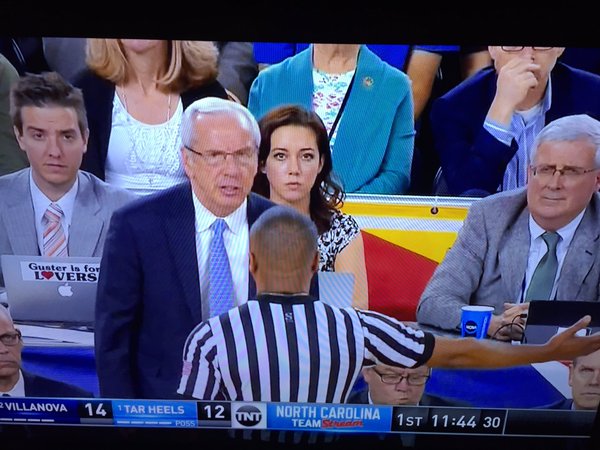
Guster is for lovers.
Daniel Johnson -- It's no well-kept secret that I am a tragic Guster superfan. In truth, I'm a little unsure whether recommending this band is a moment I was made for, or (much more likely) one I should have actively avoided, as there's just no chance I'll be able to articulate what makes theirs such timeless, quintessential, unbiasedly exceptional music. Regardless, here we are--you, me, and Front Row Boston's recording of Guster's January 15, 2016 homecoming concert at Boston's House of Blues, released in May of this year. The video is just over an hour long, comprised of 14 songs from their Night One set (I was at Night Two), spliced with commentary from vocalists/guitarists/bassists/everything-elseists Ryan Miller and Adam Gardner on their band's twenty-five year career. They formed in 1991, right down the road from the House of Blues, at Tufts University, where three of its remaining original members attended undergrad. So what's it like when they come back to Boston, when they come home? "It's always sort of emotional when we come back and play the place where we started--I mean, it's crazy," says Ryan. Adds Adam: "You can feel it, when we play, you can feel it in the crowd, you can see when you're looking out there ... Boston is the place that built our career." Such is the electricity with which they play during this show: beneath their characteristic lightheartedness, there's a palpable wattage of gratitude, sincerity, nostalgic revelry. It's no clearer on display than during their opus from Keep It Together, "Come Downstairs and Say Hello." These guys are object lessons in the rare sort of artistic brotherhood that endures and evolves (for a quarter of a century!), and as a fan, seeing that sort of synergy between them, strong as ever so late in the game, is intoxicating: to witness this concert for the first time or the hundredth is to understand a little better what lasting relationships at their strangest, funkiest, and most harmonious should look like. This is why--as we were reminded during the TNT broadcast of this year's NCAA Championship Game--Guster is for L<3vers.

100 Love Sonnets.
E.B. -- While City Lights’s translated collection of Pablo Neruda’s poems, The Essential Neruda, offers a grand overview of his work—his odes, his communist beliefs, his musings on Machu Picchu—it was his love poems that hooked me. Most notable to me was his poem “XII,” from his Cien sonetos de amor (100 Sonnets of Love). It’s impossible not to be enthralled by Neruda’s use of language, albeit translated, that touches upon senses that make reading his love poems feel nothing short of an aphrodisiac. Now, having tracked down and read Cien sonetos from cover to cover, I only find myself more impressed with it. Each poem is titled simply with the Roman numerals marking its place in a progression of Neruda’s musings. The emotions wax and wane, rise and fall, like the moon and waves he drew upon for symbolism. His use of natural imagery and picturesque landscapes blend with romantic sentimentality; whereas lesser writers would butcher such a mixture, this is Neruda’s chief triumph. He draws upon one image or another knowing full-well the associations they brought with them and carefully balanced these associations to create sex on paper. In a time when postmodern thought has cast more doubt than ever on what love is or even whether it exists, Neruda’s work calls out to demand its reality and prove that it’s something floating at will between our senses and psyche. It says we don’t need to know what love is or how it is, just to know it’s there and—most of all—feel it.
Fangirling & Fanboying: Ottessa Moshfegh, Luke Mogelson, Nuruddin Farah

from the cover of homesick for another world: stories
Benjamin Nugent -- In his essay "Michael", John Jeremiah Sullivan points out that Michael Jackson’s best songs have the peculiar catchiness of schoolyard chants. You’ve got to be starting something, Hey girl with the high heels on, Billie Jean is not my lover, I’m bad, I’m bad, you know it, etc. One of the reasons I love Ottessa Moshfegh’s forthcoming collection, Homesick for Another World: Stories, out next January, is that she too is a master of the taunting cadence, only Moshfegh’s schoolyard abuts a high school or a liberal arts school: “The deluxe shopping center on Route 4, where the fattest people on earth could be found…”; “But having held my dick in her hand, she seemed to feel she’d earned the right to belittle me as much as possible”; “The shoulder pads nearly hit his ears, as he had basically no neck.” Lesser writers don’t trust the reader to engage with narrators who express contempt, so their narrators are artificially aw-shucks and nonjudgmental. But Moshfegh knows that people make fun of other people to shield themselves from their own self-loathing, fear and loneliness, and she knows how to twist a story at the end so that the mask of disgust falls away and we see the desolation that was always lurking behind.
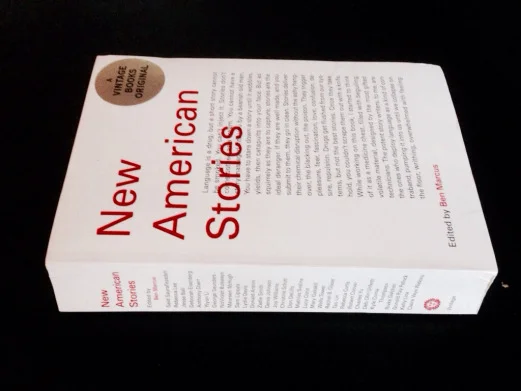
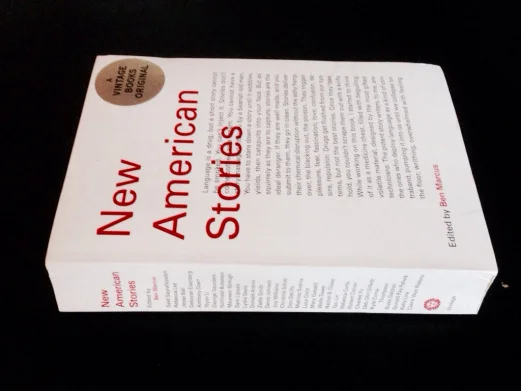
New American Stories
Daniel Johnson -- Why is it that all the world has yet to acquire a copy of New American Stories (2015), the 750 page anthology edited by Ben Marcus, and gorge themselves on it? Contained therein are over twenty-five pieces of short fiction--including installments by Don DeLillo, Mary Gaitskill, Wells Tower, and Kelly Link--that matter now, not only because they're individually outstanding with regard to their contributions to the endurance of the short story form, but also because, collectively, they're a clip of what the American voice sounds like now. It's The Unprofessionals, but more sweeping in scope. And sure, I'm quite aware this is a terrifically cliché way to talk about any book. But what else is there to say about the most quintessential curation of contemporary stories available? Perhaps that Marcus's intro is knockout: "The potent story writers, to me, are the ones who deploy language as a kind of contraband, pumping it into us until we collapse on the floor, writhing, overwhelmed with feeling." Perhaps, too, that the book as a physical object is gorgeous (see left), and simply feels like something substantial when you hold it. It's got the weight and paper gradation of a Bible. Just saying.
John Vercher -- As a new(ish) father, I find that certain books, movies and the like affect me on an emotional level they wouldn’t have pre-rugrats. Marlin finally reunites with Nemo? My chin crinkles. “Cat’s in The Cradle” plays on the radio? The eyes start to burn a bit. And don’t even get me started on that scene from Interstellar when McConaughey watches the video messages from his children back on Earth. So it went for me with Celeste Ng’s 2014 debut novel Everything I Never Told You. Lydia Lee, the teenage daughter of James and Marilyn, is missing. Her fate is revealed to readers by the end of the first chapter: “Lydia is dead. But they don’t know it yet.” Despite the innards-twisting tension that Ng so deftly ratchets before divulging Lydia’s fate, it’s her family’s reactions to their loss and the memories conjured by it that deliver much of the novel’s emotional resonance. Ng writes with the painful beauty of a parent’s perspective as they bear witness to the cruelty of which children are capable. It’s stories like these that stop me cold, make me set the book down long enough to find my sons and hold them, with the hopes of protecting them from the world.
Sarah Eisner -- My mother often writes me lengthy emails about her childhood in Savannah, Georgia, and sometimes asks me questions about the way I remember mine in suburban California. I tend to respond like I’m less interested than I am, like I don’t know that I’m privileged to have a mom who wants to relive my life and share her own, like I don’t realize that someday I’ll wish I asked her everything I could. So when she mentioned that I should read The Rainbow Comes and Goes—a back and forth correspondence between Anderson Cooper and his mother, Gloria Vanderbilt—I told her it wasn’t my thing, thinking it was another lame celebrity memoir. It arrived on my doorstep on Mother’s Day anyway. I was surprised to find how deeply satisfied I was with the way Rainbow explores motherhood, ambition, identity, aging and grief, framed within a unique narrative of a very particular kind of American privilege and pain. The relationship between Anderson and Gloria illustrates the way families remember through parent and child, and inspired me to ask my mom a few more questions.

from the cover of bright lights, big city
Eric Beebe -- After far too long, I finally picked up Jay McInerney’s Bright Lights, Big City and got to making up for the lost time it spent buried in my reading list. It quickly shot into place among my favorite books. The novel gave me the feel of following thoughts rather than plot, but with no lack of an arc to show for it—just gems of true consciousness that seem universal to human experience: “No. Stop this. This is not your better self speaking. This is not how you feel.” The universality of the protagonist’s thoughts is one of the novel’s greatest triumphs; it’s only aided by the way McInerney's style allows us to feel we know the character so well. In a world where we’re constantly pummeled with the differences, assumptions, and enigma surrounding baby boomers, millennials, or whichever generation, it’s an extreme relief to read work which—touted as definitive of one age and place—feels purely, innately relatable in its humanity. Bright Lights, Big City isn’t just a coming-of-age novel, or a New York novel, or an eighties novel. It’s a story about the disillusionment and disappointments that can strike anyone, anywhere, at any time, and the fleeting efforts we make to cope. Rumor has it that The Paris Review’s sitting on a forthcoming interview with McInerney, and after this, I’ll be counting down days.
David Moloney -- Luke Mogelson’s first collection of stories, These Heroic, Happy Dead—a title borrowed from the E.E. Cummings poem, “next to of course god america I”—would have you know that when veterans return from war, there’s no glory awaiting them. Rather, what happens is a continuance of trouble and violence. What is especially empathetic about these stories is how Mogelson not only focuses on the veterans, but also the people close to them: mothers, neighbors, and co-workers. In “Visitors,” a mother, Jeanne, loses her son a second time when he returns from war and kills a man in a bar fight. Jeanne is in denial, as she believes her son merely “had to go away again.” But Mogelson doesn’t condemn his characters for feeling wronged. Instead, he allows them to act out their anger and anxiety---as in “Human Cry”---only to find them in a worse way. The protagonist in “Human Cry” explores his own involvement in a man’s death and how he subsequently dealt with it with a self-imposed isolation from the world. But the full extent of the isolation isn’t understood until Mogelson switches point of view in the final page, revealing the protagonist’s bizarre and embarrassing actions to the reader---he’s been living in the man’s home, the man he is responsible for killing. These Heroic, Happy Dead is a book of war stories---perpetual war---and the consequences of sending men to kill and then asking them to return to family, work and normalcy no different.
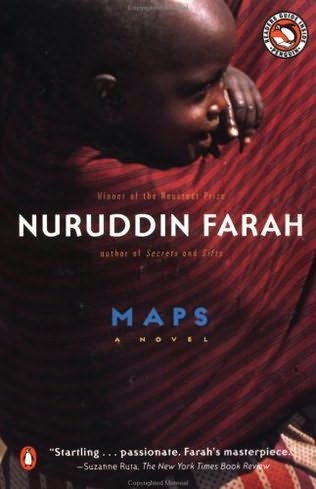
from the cover of maps
Nadia Owusu -- In Nuruddin Farah’s rich and lyrical novel Maps, a young boy by the name of Askar bears witness to the violent redrawing of Farah’s native Somalia and neighboring Ethiopia post-colonialism. At the same time, he must make decisions about who he wants to be and what he is willing to fight for. Although the political and geographical context of this novel is specific, there are many parallels between Askar’s wars (internal and external) and the wars that are currently being waged, from the Sudans to Syria. Examining themes like religion, class, and community, Maps reminds us that identities and borders (particularly, perhaps, in Africa) are fluid and rarely easily defined.
Ted Flanagan -- The recent paperback reissue of Richard Price’s The Whites drops the hardcover’s unfortunate author attribution of “Richard Price writing as Harry Brandt” in favor of simply his name, which any devotee of Price would have known by the end of paragraph one. Consider the opening lines: “ ... a quarter past one in the morning and there were still far more people piling into the bars than leaving them, everyone coming and going having to muscle their way through swaying clumps of half-hammered smokers standing directly outside the entrances. He hated the no smoking laws.” The book has all the Price-ian staples. Its protagonist, Billy Graves, is a conflicted veteran police detective, now working a kind of overnight bunco-cum-broken-windows squad in NYC, all the while stewing about a case from his past involving a triple-murder suspect Graves could never pin with the crime. And then there’s the mysterious stalker, intent on destroying the Graves family. The change on the paperback cover just goes to show that a Price novel, even one intentioned to be a simple whodunit penned under a pseudonym, will always be a Price novel. If there’s a writer living today with a better ear for honest, human dialogue, or a more pathological inability to see every character in anything but full 360-degree, four dimensional view, who illuminates the wider world around us by focusing on the narrow world within his characters, and turns up the heat slowly, so you don’t realize you’re in hot water until it’s too late, I don’t know who they are.

Fangirling & Fanboying: This Week's Recs from Assignment

Enclosed: Facebook activists, but opposite
Benjamin Nugent -- I’ve used a metal detector to extract a lead .59 miniball from the dirt near Manassas. I’ve sipped whiskey from a party cup at the site of one of the last charges of the Army of the Potomac. I’ve been to the Chancellorsville gift shop and seen the bookshelf that’s divided into three sections: Northern, Southern and neutral. But until recently I was fairly ignorant about what came after the Civil War. So I picked up Black Reconstruction in America, by W.E.B. Du Bois, and The Metaphysical Club, by Louis Menand. Du Bois is interested in the masses: why, he asks, did five million poor whites support a war on behalf of eight thousand rich whites to keep four million blacks enslaved? It’s required reading for the Summer of Trump. Menand is interested is the intellectual foment that attended and followed the war. His book is set in the salons of Cambridge, Baltimore and Chicago. There are characters like Zina Peirce, who believed that adultery should be punished by execution or life imprisonment, and her philosopher husband, Charles, who cheated on her a lot. It serves as a reminder of how hard it is to find role models in the nineteenth century; even the most ardent abolitionists espoused some pretty appalling views. Their heroism resides in what they did, not in what they said. Sort of like Facebook activists, but the opposite.
Eric Beebe -- Ever since reading “The Weirdos,” I’ve grabbed any piece of Ottessa Moshfegh’s work I can. Her short stories fit my tendency to read in twentyish-minute bursts, but when I heard about her novel, McGlue, I had to see what she did with the extra length. The book follows the title character’s inner monologue, picking up where he’s accused of murdering his shipmate and best friend, Johnson. McGlue’s constant state of impairment by both alcohol and head injury keeps clarity to a foggy minimum, and that was perhaps my favorite aspect of the whole story. Being tied to his altered reality, I learned to stop trying to distinguish the corporeal from hallucination and simply accept what he saw in front of him. The dichotomy between these two forces becomes integral to the plot as the weight of events leads McGlue to seek escape by any means necessary, even if it kills him. The resulting feel falls somewhere between reading The Things They Carried and watching Reservoir Dogs while our narrator teeters back and forth between blacking out and drying out. Moshfegh doesn’t hand us just any drunken sailor; she gives us a man floating between two worlds, battling with himself over which to choose, if he can at all.
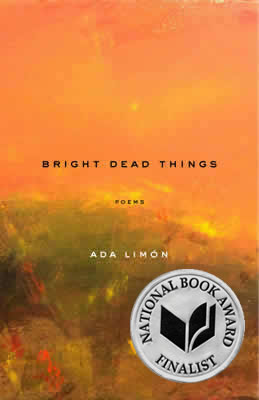
From the cover of Bright, Dead Things
Lisa Janicki -- My favorite poem in Ada Limón’s collection, Bright Dead Things, is “Downhearted,” which begins, “Six horses died in a trailer fire. / There. That’s the hard part. I wanted / to tell you straight away so that we could / grieve together.” She’s a city girl who moved for love to the south, where even the tragedies are foreign. She bumps up against new idioms and “tornado talk”— the subtle stuff that’s peculiar to regions and can be so disorienting to transplants (“All the new bugs.”). And from these small moments, she elaborates larger impressions of her existence. She had imagined herself differently in this new life—more agreeable, more open to its magic, more like a child. But when our grown-up selves allow us to become children again, it’s often in a way that’s less magical and more sullen: in “The Last Move,” she writes, “This is Kentucky, not New York, and I am not important.” I root for Limón as she cleans her big new house and tries to like gardening, though it seems clear she’d rather be in her Brooklyn apartment. I root for her because she threw it all in for love, because she moved to Kentucky for it, because she had no Plan B. And mostly I root for her because I get the sense that she’s resurrected herself before, and she’s about to do it again: “What the heart wants? The heart wants / her horses back.”
David Moloney -- You’d think Olive Kitteridge would be the focus of Elizabeth Strout’s novel in stories titled in her name. But we’re instead given thirteen stories that concern themselves more with the residents of the small, coastal New England town of Crosby, Maine. Olive is a math teacher there, and she seems to have had all the book’s characters in class at one point; she always finds herself crossing paths with them when they’re stalled in a threshold of self-destruction. It’s these characters that are most central to the novel. Whether it’s a former student who contemplates suicide on a beach, an anorexic teen, or even her own husband falling in love with a much younger employee, Olive---through her staunch and sometimes misplaced contemptibility for weak people---says what we’d only wished to have the courage to say. She tells the anorexic girl in “Starving,” after giving sound advice about never giving up, “I know you’ve heard all this before, so you just lie there and don’t answer. Well, answer this: Do you hate your mother?” Olive isn’t always right (sometimes far from it); that’s when the book is at its best. The stories are so human, so New England, and in the closing moments, we know Olive did her best, and we know she never gave up—and isn’t that all we can do?
Nadia Owusu -- I first encountered Lydia Davis two years ago. I was thoroughly confused. What was I reading? Were these monologues? Prose poems? Scenes? “She is the master of the short story,” declared the instructor of my workshop as she assigned three of Davis’s stories to me. “But, where are the stories?” I fretted to myself as I diligently did my assigned reading, certain that I had made some sort of mistake. Don’t get me wrong: I liked what I was reading. I just couldn’t easily categorize it. Later, once my obsessive, ‘I need to make sure I’m doing the assignment right’ voice was quieted by a glass of red wine, I was able to admire the way that Davis was able to imbue such brief moments, untethered by much context or character development or setting or structure, with such feeling and meaning. This month, I worked on my upper body strength by carrying around her Collected Stories. In making my way through it, I tried to give some thought as to how she does what she does and why it works. I found myself particularly admiring how she takes her characters’ specific circumstances and in a matter of a few pages, or in some cases even just a few sentences (Davis’s stories are known for being minimalistic and very brief), makes them universal, raising and exploring difficult questions about the things in people’s hearts and heads that are often heartbreakingly left unsaid.

From the cover of Crimes in Southern Indiana
Ted Flanagan -- Reading Frank Bill’s gut-punch collection of loosely-linked stories, Crimes in Southern Indiana, is to bear witness to a nihilistic muscularity of prose one might expect of the love child of Jim Thompson and Donald Ray Pollock, if such a thing were possible. Bill’s slim collection packs a weight far beyond its pages, delivered at a high-velocity. His characters hint that their squalid, violent lives are the result of choices, often (as in drugs or alcohol or regret) the righteous reward for their own. But also, as in poor teenaged Josephine, who’s own grandfather, Able Kirby, sold her into sex slavery to a local gang—some pay debts incurred by someone else. The opening story, Hill Clan Cross, follows two drug dealers avenging their losses against two associates who got all entrepreneurial with the gang’s drugs, a big no-no in a desolate landscape where the only thing thicker than blood are dollar bills. From there, the book accelerates through the bleakness and darkness until the titular story, the collection’s last, in which Mitchell, a local police detective, attempts to help Crazy, a member of the notorious gang MS-13, which has populated the ranks of workers in a chicken processing factory. For me, that’s the brilliance of the collection. Crimes in Southern Indiana, as it insinuates itself, whispers amongst the brawling, crashing, and exploding backdrop that this isn’t just Indiana. It’s the 21st century Animal Farm, decrying not Fascism, but a distant offspring of it.
John Vercher -- Addiction has a name, and that name is “Scotty.” He’s an incubus and succubus for men and women alike, dangerous in his charm and seduction, fulfilling all cravings while reaping wanton destruction. Scotty is, literally, crack cocaine. He is funny, repulsive and impossible to ignore. In his PEN/Faulkner award-winning novel Delicious Foods, James Hannaham tells the story of Eddie, his mother Darlene, and her relationship with Scotty. It is a story of tragic loss and horrific violence infused with irreverent humor. The novel explores the depths of maternal love pitted against chemical dependence in the shadow of the titular farm where both Eddie and Darlene find themselves held captive. Hannaham’s stark and concise prose is instantly engaging, and doesn’t shy away from the horror of the subject matter while avoiding the melodrama that could easily overcome it. In between the braided flashbacks of Darlene’s youth and the tragic events that lead to her eventual addiction, we’re treated to Scotty’s dark humor and cruel charisma. He’s a twisted conscience in a novel of painful truths about desperate acts and the systematic racism that lead to them. Delicious Foods is at once heartbreaking and breathtaking with richly textured characters that has stayed with me long after the final page.

From the cover of Vitals.
Daniel Johnson -- You've got enough to read (and if you're really interested in what I'd recommend, check out my weekly selections at The Paris Review Daily's "Staff Picks"). Meanwhile, let's talk obscure music. Like many of their fans, I discovered MuteMath when they debuted their first single, “Typical,” on Letterman’s Late Show in the summer of 2007. The band’s performance—and particularly that of drummer Darren King—stunned Ed Sullivan theater such that once the music stopped, all Dave could say was, “How bout that drummer!” Eight years later, in the Fall of 2015—one guitarist, a Transformer’s theme and two underappreciated records since Letterman—MuteMath started its own label, Wojtek Records, and released their first self-produced studio album: Vitals. King’s percussive energy and Roy Mitchell-Cardeńas’ critically acclaimed bass-playing have been at the forefront of most of their music; Vitals, however, is unquestionably frontman Paul Meany’s opus. It’s all vocals, all keys. The result is something like a contemporary eighties record, if only, say, Earth, Wind and Fire had grown up in bluesy New Orleans, where Meany and the rest hail from. Both the album’s single, “Monument,” and “Light Up” share the insane vocal range of “September”; both have that same wedding-reception-banger vibe. And though the album feels at times like a throwback or an homage to Meany's influences (The Police being a big one), it's actually a welcome step into the future for the band: Vitals is heady and joyous and wonderfully hypnotic in a way that most MuteMath is not. Meany has said himself that, when composing a work, he wants the end product to be “a picture of something dark, but it should be framed in light.” This is their first album that’s more frame than picture--just listen to "Stratosphere," my favorite of all eleven tracks: "The sun has lost its gravity / and severed my connection to the starlight. / I never meant to have to start all over / without you."
A Digital Ghost Story
by Nadia Owusu

I have been haunted for five years and six months. The voice first came to me through my Blackberry and then through my iPhone. Mostly there is just raspy breathing and incoherent whispering. Sometimes the voice hums my name and laughs. Sometimes there is nothing but background noise—horns honking, a fork clanking against a plate. Once I heard a baby cry and then the call was ended.
Occasionally, I am haunted through my Gmail. The sending address is always different. It is always a man’s name like Fred or Robert or Carl followed by seven or eight numbers. The messages are not especially interesting. Often there is just a question. What did I have for lunch? Was I enjoying the beach weather? Recently, Larry7678919 wanted to know what I thought about the Republican presidential debate. In 2013, the emails were mostly one-sentence directives. Let love in. Don’t be afraid of what you really feel. Open up to new possibilities.
I assume that the voice on the phone and the words in my Gmail are from the same person. It might be the guy I went on one date with in the summer of the year that I got the first phone call at 1:30 in the morning. The guy’s name is Rob. It’s not really Rob, but I don’t want to use his real name because he has a wife and two children now. I know this because I looked him up on Facebook. I was looking for evidence. I don’t know what kind of evidence I expected to find on Facebook, but you have to start somewhere.
On our date, Rob told me that, years earlier, he had stalked a woman who he was too afraid to ask out. He didn’t do anything to her, just followed her around as she ran errands and met friends for brunch. When he told me this, his voice was gurgling in the way that comedians’ voices gurgle when they are telling a joke that they think is really clever. We were eating lasagna and drinking white wine on the patio of a restaurant in the West Village. It had been one of those sticky New York days when you feel like you are breathing in dirty steam instead of normal air. But, now that the sun had set, there was a breeze that tickled the romantic candlelight at our table. The breeze and the perfect crescent moon made everyone happy and beautiful with rustling hair and luminous skin. But, Rob looked like he had smoked a lot of pot. His eyes were red and half-closed.
The stalking happened before he knew how to talk to women, he said. He didn’t have trouble with that anymore because he had taken a weekend-long seminar with a man who wrote a book about picking up women at parks and bookstores. I met Rob at the Guggenheim. I was annoyed that he approached me to let me know that I furrowed my brow when I looked at paintings and that might give me permanent wrinkles in the future. But, after that, he started talking about Analytic Cubism in a way that was endearingly nerdy. Later, I learned that the book about picking up women written by his seminar instructor encourages readers to say something mean instead of something nice as an opening line. This is supposed to change the power dynamic and make the woman feel as though she needs to impress the man. I think that is stupid advice. I agreed to go out with Rob because of the endearing nerdiness and because I liked the idea of telling people that I met a man at the Guggenheim. It had nothing to do with him informing me that I was going to be wrinkly.
I did not go on a second date with Rob. He said “Stop being so uptight” when I told him that all the talk of stalking was making me uncomfortable. Then, he said, “Why do women have to make everything such a big deal?” I got up from the table without saying another word to him. I walked home, looking over my shoulder whenever I heard footsteps close behind me. The breeze no longer felt enchanting. Now, it felt ominous. A shiver worked its way up my spine despite the heat. At home, I told my roommate the story, laughing. I left out the part about being scared.
Rob is at the top of my list of potential haunters. Also on the list are:
1. The guy I worked with at the Pizzeria Uno at South Street Seaport during my freshman year of college. He got my phone number off the schedule that was posted on the staff changing room door and called me to tell me he loved me. I told him that I was flattered but I did not love him. He told me that he would wait until I did. Two weeks later, he started dating the pretty hostess with very large breasts, but sometimes he looked at me when he kissed her hello or goodbye.
2. The ex-boyfriend who showed up in front of my job to say that he was getting married to the woman he cheated on me with unless I told him not to. I did not tell him not to. I had let him break my heart for long enough. He got married at City Hall and texted me a photo of his smiling wife. I texted him ‘congratulations.’ I really wanted to text him ‘you’re an asshole.’
3. The creepy yoga teacher from the studio I used to go to on the Lower East Side who asked a lot of students out, including me. He could easily have gotten my information from the registration system. He got fired for masturbating in the acupuncture room.
4. A robot.
The calls generally come between 1:30 and 3:30 in the morning. They come from a blocked number. I answer because what if it is my brother calling me from Ghana or my friend Pascal calling me from jail? My brother sometimes forgets about the time difference between Accra, where he lives, and New York. Pascal is one of the kindest souls I have ever known when he is sober, but he gets too drunk and fights people in front of bars.
The only thing I ever say to the voice on the phone is ‘hello’ and ‘who is this?’ and ‘stop this.’ I say these things several times, then I listen for a few seconds before hanging up. I never respond to the emails.
I do not believe in ghosts, but sometimes I wake up in the middle of the night with a feeling that something is in my room, floating above me or standing silently in a corner. I have had this feeling since I was a little girl who was afraid of the dark and had to sleep with a nightlight. It is a thumping of heart, a tightness of throat. Recently, I jolted awake and saw a man-like thing sitting in the armchair by my bed. When I turned on my lamp, the shape of the man became a pile of unfolded laundry. Fear is an unpredictable and, at times, irrational emotion. It can be caused by dangers both real and imagined.
The number one lesson in the book about how to pick up a woman is to keep her wanting. Smile at her but then talk to her friend instead. Pretend that you have somewhere important to be so that she thinks that she has to sparkle to convince you to stay. Very slowly increase physical affection. Wanting is perhaps the opposite of fear, but they are both urgent forms of anticipation. The book aims to teach men to create in women the kind of wanting that works like a phobia—a type of persistent fear (want) of a being, object, or situation that the affected person will avoid (pursue) in a way that is disproportional to the actual danger (appeal) posed.
My ghost is a seemingly benign presence. It never threatens or rages. Sometimes, months will go by in which I won’t get a call or an email. Then, the familiar ringing in the dead of night, the realization that I have been waiting for it. The goal of a haunting is the same as the goal of a seduction: to become embedded in the consciousness, to not be forgotten.
Perhaps this is why I am convinced that my ghost is the voice and words of a man who failed to seduce me. Perhaps this is why, once in a while, a summer breeze against my back as I walk home at night makes me pick up the pace, makes me turn to see who is at my heels, makes me, still, just a little afraid of the dark.
Nadia Owusu is a current degree candidate at Southern New Hampshire University's Low Residency MFA in Fiction and Nonfiction.
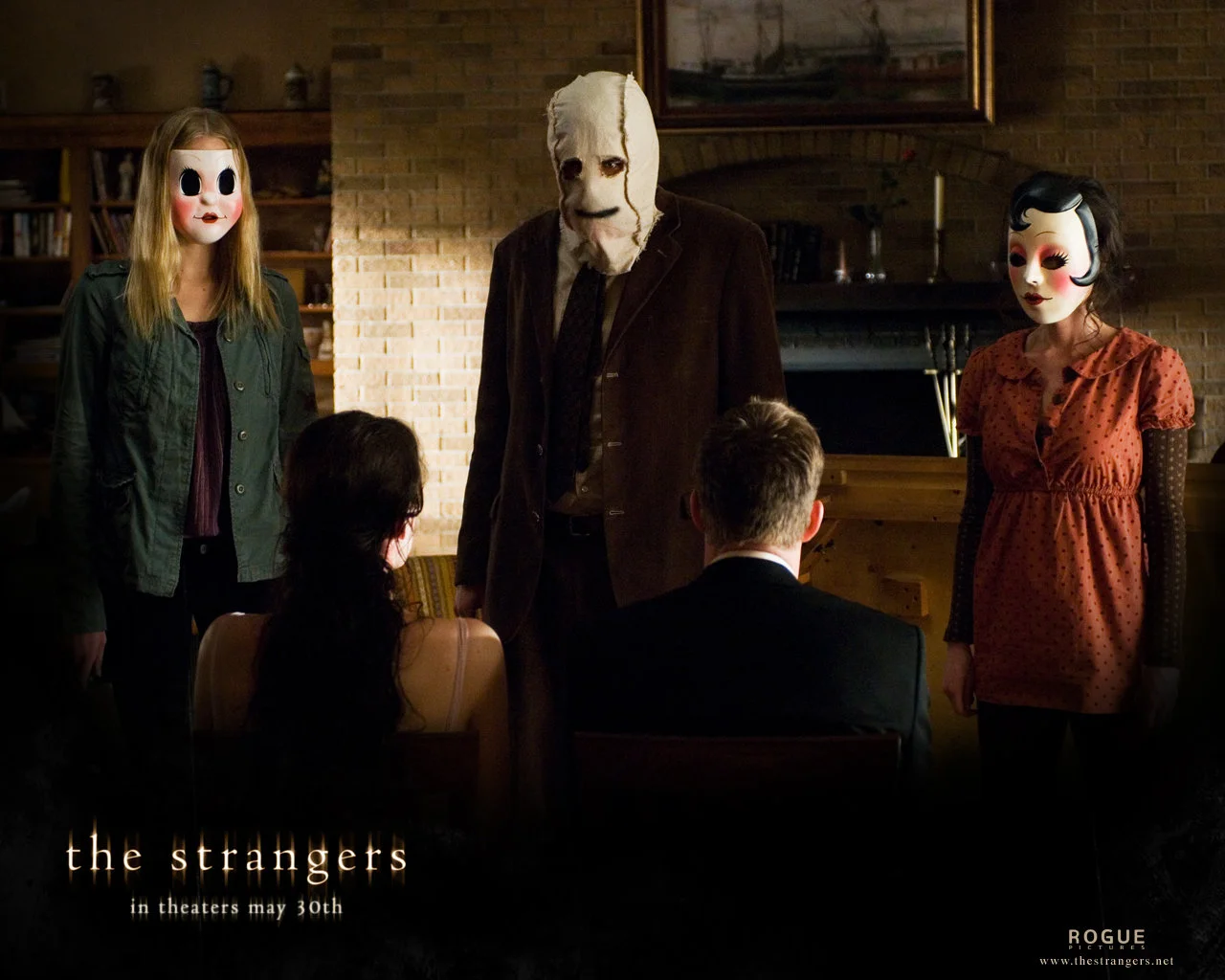
On Loving Contemporary Horror Movies
And so what’s the final temple? What’s our last defense from horrible death? After we have left our homes, all that we’ve got are our bodies. Which is why, so often, possession films are the most terrifying of all: The Exorcist, The Exorcism of Emily Rose, The Shining (sort of), The Conjuring. The reason we’ve seen such an oversaturation of these stories in recent years is because the horror industry has exhausted all its precedent anxieties. We’ve reached the end of a cycle in which the horror movies have systematically broken our sanctuaries down, violated them, reminded us we aren’t ever safe.
by Daniel Johnson

The Strangers (2008)
The most common response I get when I tell people that I studied horror films for my undergraduate degree is, simply: “No you didn’t.”
It’s true and it’s not. My Horror Films Studies course was only one three-credit elective toward the completion of my Film minor. Sometimes I deliver that line as if my degree thesis was, say, an analysis of how the graphic reportage of the Vietnam War contributed to the terror surrounding The Texas Chainsaw Massacre. I do this, in part, because I’ll take any chance I can get to seem eccentric; it’s a fast-paced world out there, after all, full of people far more interesting than I am.
A fraction of the truth is that I’m particularly smitten by the genre because I associate the fear it elicits with the thrill of being young and dumb and in love. When I was in high school, such was the move: invite a girl to your place, share a blanket, and watch a scary flick on the couch in the basement, under the exposed guts of your house, pipes that would writhe and groan in uncanny rhythm with the silences in the movie. Lights off, obviously. Just she and I and the electric blue of the PG-13 hellscape on the old tube TV, a couple of Diet Cokes. This was my introduction into the realm of filmic terror.
It was also how I started seeing my first long-term girlfriend. Our initial dates were viewings of Disturbia and Cloverfield—two of those hedged, quasi-horror, quasi-thriller films that served to ease us into the genre before going full-on Rosemary’s Baby. We took it slow.
Those nights, beneath the blanket, we’d rub socked feet, lean into each other as cameras panned down dark hallways, excruciating and unhurried. If I was lucky, her shirt would have slid up during a jump-scare so that, when I put my hand back where it had been before we both reacted, it would be resting against the soft skin of her lower back. Some of my first exposure to intense, blue-balling sexual tension went just like that: my arousal, as well as the possibility of embracing its source, intensified at the same rate as manufactured fear.
With the same girlfriend, whenever we were at her place—a ranch home full of Catholic, conservative, God-fearing Italians—we’d have to play board games or watch rom-coms on the couch with her mother, who often chose the movie, and who could only handle leaving us alone for the duration of a bathroom break. We could hold hands. No blankets. She left the lamp on.
About halfway through Hitch or Just Friends, she’d feed us homemade, ultra-breaded marinara dishes made brick-heavy by all the cheese. My girlfriend and I would reluctantly eat on separate couch cushions while we watched the rest of the movie. We did this out of respect. My lap would grow warm from the heat of the food on the plate; I’d sweat in places I really didn’t want to be sweating.
I’m still convinced her mother was some sort of overprotective super villain. It was brilliant: she only made food that she knew would give us the meat/lactose sweats, so that whatever immediate attraction we felt for each other would be absolutely bludgeoned to death. The sexiest thing about those nights was the shit I would take when I got home that mercifully rid my body of maybe half the dairy I’d consumed for dinner.
To be clear, I wasn’t (and am not now) opposed to some good old fashioned family fun. I wasn’t (and am not now) a dog. But in that specific environment, under the shadow of my girlfriend’s mother, in the glow of a movie which likely had some ideologically rigid and self-righteous portrayal of love, trapped in home-cooked sweat, it all felt constricting. It felt like something that hadn’t yet taken shape was being viciously and unfairly molded by someone who had, all her life, suffered her various terrors. All her daughter and I wanted to do with each other was embrace terrors of our very own, twist ourselves in them. We wanted to use them to get weird with our unexplored, pubescent bodies.
Horror films were crucial to this sort of young, suburban passion. They were a superficial, straight-to-DVD rabbit-hole into the warped kingdom of my sexuality. At my house, what ended up happening beneath the blanket was always in stark contrast to the banality of the Diet Cokes, the buffalo-plaid couch, the artisanal, colonial décor of my suburban New England home. It was a netherworld made accessible by even the cheapest jump-scares.
She and I eventually moved on from the Cloverfields to more realist contemporary horror. Our staple was The Strangers: Scott Speedman and Liv Tyler alone together in house that wasn’t theirs, fucking on the table after Liv turned down Scott’s proposal for marriage. Three masked strangers with knives dog them through the night, mechanically breaking them down with horrifying foreplay: knocks on the window, record players mysteriously turned off in the other room, the front door left wide open. All of which led up to the slowest, gentlest, most terrifying stabbing sequence I’ve ever seen.
*
The ‘suburban’ modifier to that passion is perhaps its most important quality. In the short length of a year following the September 11 attacks on the World Trade Centers, vacancy rates in Lower Manhattan more than doubled. Families fled to places like my hometown: good public school systems, vast green commons, neighborhoods labeled as "Estates." I remember the influx of people, the municipal scramble to develop more cul-de-sacs, more condos, all the DPW trucks with their hazard lights flashing, fleets of them parked on top of berms outside vacant lots.
Over the course of the next decade, the horror industry exploited the safety America projected onto the suburbs. For those of us who were already there, like myself, the walls had closed in on our world a little bit. We understood then that we might be in the suburbs for the rest of our lives. At the time, after the attacks, we didn’t know how long those, our lives, would even last. We had less of a possible escape than we did before, and there seemed to be a doomsday clock on our American existence.
An example of how the horror/terror genre was always a step ahead of us: a film like Cloverfield exacerbated our fear of faceless, monumental terrors sacking our metropolises and burning them to the ground. The logical escape from that is an exodus to the suburbs. That’s where films like Disturbia, The Strangers and It Follows come into play; there are serial killer neighbors hiding in plain sight, and whatever it is that’s chasing us won’t stop just because we moved to a cul-de-sac. So okay, we’ll stay inside. But then our houses are haunted in films like Insidious, Paranormal Activity, and (my favorite campy-slogan example of this) When a Stranger Calls: “The call is coming from inside the house!”
And so what’s the final temple? What’s our last defense from horrible death? After we have left our homes, all that we’ve got are our bodies. Which is why, so often, possession films are the most terrifying of all: The Exorcist, The Exorcism of Emily Rose, The Conjuring. The reason we’ve seen such an oversaturation of these stories in recent years is because, within the last decade, the horror industry has exhausted all its precedent anxieties. We’ve reached the end of a cycle in which movies have systematically broken our sanctuaries down, violated them, reminded us we aren’t ever safe, the way masked sociopaths do to beautiful, nearly-married couples on vacation.
Perhaps that’s why it always felt like the awareness and discovery my ex-girlfriend and I experienced with regards to our bodies was a profound sort of transcendence. In beating the genre’s most unbeatable gambit, we came to appreciate it. I went on to study it.
This cycle is starting over. Earlier this month, Robert Eggers released his critically acclaimed directorial debut, The Witch. It calls itself a “New England Folktale,” in which a Puritan family is exiled from a settlement in 1630, only to move out to the banks of a forest, where they’re under siege from woodland witches. They struggle with their own fears of a fundamentalist God. We’re returning to the origins of American horror, to the forms it took when it secured its foothold in our country’s earliest people: when sexuality meant witchcraft, and believing in God meant believing that we were the devil.
*
Another response I tend to get when I tell people I studied horror films for my undergrad degree: something to the effect of, “Why?”
Fair question. A lot of them are unadulterated garbage. As a genre, though, and as a complete corpus of filmic art, they’re not deserving of such a reductive dismissal. Sometimes the psychology behind them is painfully on-the-nose, but at least they offer an accessible window into some complex ideas. They start conversations. They deserve their place in academia. A lot of them are kind of hot.
And yet, over time, my visceral lust for the genre has leveled off. There’s still all that hormones-on-parade history that textures those films with a certain nostalgic ecstasy. But as I've grown up, I've carved spaces for horror in tamer traditions.
Every Halloween, now, I get together in my basement with most of my fantasy football league—some years as few as three of us, others as many as twelve men and women. After I shut the porch light off at 9:00, we bring whiskey and beer and the remaining trick-or-treat candy to the basement and watch three horror movies on Netflix that we’ve never seen before. Lights out, obviously. Sometimes blankets, a better TV than before. We revel in the tradition, in the terribly-delivered lines that become part of our shared vernacular. Occasionally, we’re all genuinely scared. Even when we're not, there’s always a palpable energy in the room, something alive and slightly dangerous.
It’s no surprise to me that the folks with whom I watch sports are exactly those who appreciate the subtle nuances of sharing a horror film together. In his short essay for The Paris Review Daily, “Nauseating, Violent, and Ours,” Chris Bachelder (The Throwback Special) writes this about sports as a shared experience:
“I’ve spent some time wondering why I still watch and care about sports, particularly football, and I grasp at the idea that an avid interest in sports might be connected to a desire to belong. We could debate whether this is a justifiable and edifying expression of this desire, but the desire itself seems vital and real. In caring about sports, we join others in caring deeply about something over which we have essentially no control, our lucky socks notwithstanding. The stakes are not genuinely high, but they feel high, and worthy of our passions. Our powerlessness as passive viewers is mitigated by our sense of belonging, as it is by the comfortingly orderly rites and rituals of seasons and spectatorship. We experience occasional joy and wonder, frequent disappointment, and, in some cases, anguish and horror. All of this we experience communally, even when we watch alone.”
Why horror films? Five years ago, I would’ve told you it’s because they make for great dates. I still believe they do. But these days, it’s all about exactly what Bachelder posits: like sports, being terrified is a shared experience. Emotions are wrenched out of us by the spectacular. And it doesn’t really matter what in particular we feel. It doesn't to me, at least. What matters is the experience of feeling something, together.
Daniel Johnson is a graduate of Southern New Hampshire University's MFA in Fiction and Nonfiction. He currently works at The Paris Review.

Beyond the Pale
by John Vercher

Laurie broke my heart. She didn’t mean to. I know that now. I’m sure I knew it then. But still.
My parents transferred me to the public high school after four years in two separate parochial schools. This is to say I knew no one. The first day seemed interminable. Class after class, I extended my hand to introduce myself and met with hard stares and warnings to not get caught in the parking lot alone when the bell rang at the end of the day. That all happened before lunch. Noon came, and I exited the food line, tray in hand and looked out across throngs of unfamiliar faces. They glared back. I weaved my way through the tables in the hopes that someone would slide a chair out for me instead of pushing the empty ones in. I ate alone and wished the day away.
Alphabetical seating arrangements left Laurie and me in the last seats of our respective rows of Algebra I. Blonde bangs hovered above her forehead, a waterfall that flowed out from the sawtoothed strands of her crimped hair. Before class began, she laughed with her friends and her braces glinted in the glow of the fluorescents overhead. Her laugh lines almost, but not quite concealed a mole next to her nose, a beauty mark, perfect in its imperfection. The second bell rang and as the students finished their murmurs and turned forward, she glanced back at me.
I opened to a random page in my book and hoped she hadn’t seen me. I felt her look away. Certain I was in the clear, I went to resume my stare.
She’d been watching me. This day was looking up.
The curtains pulled back and the movie trailer of our relationship played on the screen of my mind’s eye. Berlin sang “Take My Breath Away” over footage of me as I scrawled my first note to her. Will you go with me? Check yes or no. Sorry So Short. Cut to our own table at lunch. Cut to holding hands in the hallway. Cut to prom. As I stared off into space, I caught movement in my periphery. She looked at me again. This time neither of us looked away. My glasses, thick enough to see the future, had slid down my oil-slicked nose, and I pushed them back up. I finger combed at the duckling soft hair on my upper lip, smiled my gap-toothed smile (my braces wouldn’t come for another year) and just when I thought I the day couldn’t end any better, she went ahead and said it.
“You have a really nice tan,” she whispered.
The movie reel sputtered. The celluloid melted. The film broke.
* * *
In the countless times I’ve thought about that day, I haven’t figured out what I honestly expected Laurie to say. The truth is, I never expected her to say anything, at least not to someone like me; someone who collected comic books, played with action figures a little longer than he should have, and spent lost weekends with Sonic the Hedgehog and King Hippo. Someone whose clothes were less cool than his glasses, and with a complexion that resembled the terrain of a topographical map. I never thought about the fact that I had brown skin, a wide nose, and straight hair. I was a biracial geek before it was hip to be either. No wonder Laurie stared. To be fair, I shared her confusion, about what I was and about who I was. And though my struggles with identity had begun long before that day, Laurie still ended up my first.
With one statement, Laurie became the first person to make me realize that there was something else about me that people, particularly girls, would see before they noticed the barely-there moustache or my questionable fashion sense. That afternoon was my big bang, the event from which all other questions of my identity sprung forth. It was the beginning of a high wire act, on which I walked with a constant teeter, only able to take a step before I re-assessed my footing, before I found a balance between what I liked and what I was supposed to like. How I talked and how I was supposed to talk. Who I loved and whom I was supposed to love. As if being thirteen weren’t hard enough.
* * *
“I kind of have it all the time,” I said.
“Are you Italian?”
“Nope.”
“Spanish?”
I shook my head. She cocked hers with tight-lipped confusion. Her bangs didn’t move.
“So…what are you?”
“I’m black,” I said.
“Both parents?” she asked.
Laurie had exclaimed it with such surprise that a few students ahead of us turned. My face went hot, embarrassed at their watching, humiliated by her disbelief. My throat felt dry and I managed a nod.
“Huh,” she said, and turned back around.
* * *
My sons are three and one. My wife is white. Beyond the pale of her skin, my oldest boy looks little like her. He shares my wide nose, my gapped teeth, and my straight hair. My one year old has my wife’s features and her complexion. The frequency with which I’ve thought about that afternoon increased exponentially since I first found out we were pregnant.
My three year old might meet his own Laurie. She won’t stare at his skin color. She won’t list all the possible races and ethnicities she thinks he could be (because that’s a thing to do), and she won’t bark in disbelief when he names the only one she didn’t guess. They’ll pass notes, hold hands and maybe he’ll even bring her home to meet his folks. That’s when the questions will start, both his and hers. She won’t understand why I look so different. He won’t understand why it matters.
I know what to teach my sons about who they are, but not about who the world expects them to be. I want to infect them with mine and their mother’s rampant idealism, with the notion that we all crawled from the same soup, that we are all human beings but I know that doing so leaves them vulnerable to pain. I know that as much as we don’t want it to matter, despite the declarations that we live in a post-racial America, it does matter. I want my sons to understand the struggle, but I don’t want them to experience it. And I don’t know if that’s right.
I know that Laurie didn’t mean anything by what she said. I do know that even at our young ages, the fact that she thought it was okay to ask those questions isn’t okay, that it’s representative of a problem ever present almost thirty years later. I also know that while I want my boys to know why Daddy is nervous when he gets pulled over, they won’t ever have to be. I know that while I’ll be concerned when they’re out late with their friends, I won’t be worried because their pants are a little baggy or they wore a hoodie that night. I won’t be worried about these things, because while they look like me, they don’t look enough like me. For that I am glad.
And because I am glad, I am ashamed.
John Vercher is a graduate of Southern New Hampshire University's MFA in Fiction and Nonfiction. His piece, "Homewood," won the 2014 Assignment Student Contest, and can be seen in Issue #1.

Chill, Baby
by Nadia Owusu

There was, as is often the case, no warning that the G train would not be running past midnight. No flyers or posters. No announcements on the A train telling passengers not to bother getting off to transfer. Nothing. The woman on the microphone at the Hoyt-Schermerhorn Street station sounded thrilled about this inconvenience even as she apologized for it.
I was pissed off because nobody came into the restaurant for dinner that night so I didn’t make any money. I only had two thirds of my rent that was due in a week. I was going to have to pick up shifts during finals. I stood around all night polishing wine glasses and folding napkins instead of studying for my statistics exam. Tonight would be another sleepless one. There would probably be crying. I usually cried when I studied for math tests because I’m very bad at math. Doing things that I’m very bad at makes me sad about all the things in the world that I will probably never really understand, like electricity and Einstein's general theory of relativity.
During my shift, the bartender I was in the process of breaking up with had gotten drunk and annoying. He flirted all night with that blonde woman from across the street, and not just in the compulsory bartender way. She came to see him every night, even in this snowstorm. Usually he was polite to her, but disinterested. She had thick, square, acrylic French-manicured nails. She wore sticky pink lip gloss. She always started out her evening with a Sex on the Beach. Her voice sounded like her acrylic nails on a chalkboard. But, he leaned over the bar and looked into her eyes. He probably talked to her about his art, how he’d dropped out of law school for it. I did not like the thought of him sharing that part of himself, the part I liked, with her. So what if I had ignored his phone calls for three days? I was supposed to be the one ending it, not him. And now the stupid G train wasn’t running.
I kicked an empty forty bottle that someone had discarded on the platform. It was still wrapped tightly in a brown paper bag. It rolled unsatisfyingly for a few seconds then stopped at a middle-aged Rasta’s feet. He had his head tipped up as though waiting for further instruction from the MTA. I was not holding my breath for any such thing. We were, I knew, on our own.
“Chill, baby,” he said.
I hate it when random men call me ‘baby,’ especially when they’re telling me what to do. I might have told him as much. I thought about it. I was in the mood for it. But I had kicked a bottle at him so I didn’t exactly hold the moral high ground. I scowled at him instead.
“I hear ya,” he said, even though I hadn’t said anything. “How we supposed to get home?”
“Yeah,” I said.
There was a bus that would get me close enough to walk to my apartment. Not as close as the G train, but closer than the A train. I had never taken that bus but I knew it existed because my friend Sarah who lived down the street was always going on and on about how she took it everywhere. She talked about taking the bus the way people talk about juice detoxes and meditation which is weird because there’s nothing about the bus that is healthier than the train. At least nothing I can think of.
Outside, the snow was still coming down in heavy, sharp white pellets. It was the kind of snow that made opening an umbrella look pitiful. I buttoned the coat button that pinches the skin under my chin. I had to do that so my hood would not blow off in the whooshing wind. Google on my cellphone told me that the bus stop was six blocks away. The bus, I thought, better be running as usual. My brain said this in threatening tones. I needed the universe to know that I meant business.
What’s nice about walking in a snowstorm when you’re somewhat unreasonably miserable is that it makes your misery more reasonable. I don’t mind snowstorms when I don’t have to go anywhere except down the street to my favorite hole-in-the-wall for a hot toddy, or when I can stay indoors reading books and making soup. I do mind them under most other circumstances.
There were very few cars out that night; very few pedestrians. Downtown Brooklyn didn’t feel peaceful though. It felt abandoned. It felt like everyone was safe and sound at home except for me. I blamed a lot of people for this. I didn’t care if my reasoning was irrational. I was not interested in considering association versus causality. Perhaps this tendency is why I was having such a hard time with Statistics II.
It was my landlord’s fault for raising the rent by $150 when I was already struggling to pay it. I knew that this would happen when the hipsters moved in. I blamed those hipsters and their rich parents. I blamed my parents for not being rich. I blamed the university I attended for being so expensive. I blamed financial aid for not covering my whole tuition. It was the bartender’s fault for flirting with that blonde woman and making me jealous enough to stay at the restaurant for an hour after closing time to drink whiskey with him. The MTA was the worst institution that ever existed. Never mind that it ran trains and buses twenty-four hours a day so that I didn’t have to own a car. The G train wasn’t running right now. I also had a bone to pick with the mathematicians who developed theoretical and applied statistics.
I was walking with my head down so that the snow didn’t attack my eyeballs. They’re very sensitive. Walking in that way made it difficult to see where I was going. I had to stop every block to check whether or not I had arrived at the corner where I was supposed to turn left. My sense of direction is very poor. I was standing on Atlantic and Nevins when something large and brown leapt past me and into the street. A bus, perhaps my bus, rolled over it. The bus kept going, leaving the street empty and white again, except for a mangy mutt that was now bleeding red into the snow.
The mutt was silent. I rushed over to where it was lying. Its belly had been crushed and split open. The sight of its exposed flesh and guts filled my lungs with freezing oxygen. It—he—was dead. As far as I could see, there hadn’t been anything or anyone chasing him, nothing to spook him. I wanted to touch his nose but as I bent down and reached out my hand, I started to shake.
“Hey sweetheart,” called out a man wearing a backpack with a hard hat tied to it, “you okay?”
I don’t like it when off-duty construction workers I don’t know call me ‘sweetheart,’ but it didn’t seem important in that moment.
“There’s a dead dog in the road,” I yelled at him.
“Why?” he asked.
That the mutt had been hit by a bus was not the answer to that question. It was only a consequence.
“I don’t know,” I yelled. I didn’t need to yell. He wasn’t very far away. Maybe I wasn’t yelling at him.
I felt ridiculous standing in the street now, so I joined the construction worker on the sidewalk. The two of us stood in silence, looking at the mutt.
“That’s the way it is sometimes,” he said after a while. “It was probably the snow.”
What he meant by that last part, I did not know. But, I nodded and started walking towards the bus stop again. This time, I let it snow into my eyeballs. The snowflakes didn’t feel as sharp as I imagined. They just felt like cold water. I blinked and let them drip onto my cheeks. I had to accept that the storm would keep storming until it was over. And when I got to the bus stop, the bus would come or it wouldn’t. There would be reasons for whatever happened just as there must have been reasons for the mutt in the road. But, I might never know them. And they wouldn’t necessarily mean that any of it made sense.
So Go the Ghosts
I think the common misconception with Schrödinger’s experiment is that its findings can encourage indecision. But choosing to make no decision, to take no measurement, to send no text, are still in themselves active resolutions. I’ve consciously left the ghosts of those affairs in the box, cryogenically frozen, petrified in amber. They’re still there. In having done so within the Schrödinger framework, I elected for their life. Rather, I chose life and death and everything else; I elected for their infinity.
by Daniel Johnson

Last spring, I reacquainted myself with Schrödinger’s paradox, the early 20th century thought experiment in which scientists--namely, the Austrian physicist Erwin Schrödinger--sealed both a housecat and a vial of radioactive material inside a metal box to illustrate and examine the effects of quantum indeterminacy. Attached to the interior of the box was a small hammer rigged with a random timer; should the device trigger, it would shatter the vial, releasing nuclear fumes into the vacuum and suffocating the cat. Because the box was metal, and because the death-device was random, it was impossible for observers to know the outcome unless they opened it. And so Schrödinger suggested that, while the box remained closed, the cat existed in two states: dead and alive. His theory was that whoever opened the box and found the cat dead had been the one who, in a sense, killed it.
I was, at the time, spending the majority of my time tending to my family cat. Her name was Bonnie, and she was dying. For the better part of a decade, she had slept in the crook of my arm. She had trouble staying warm. The shelter we adopted her from thought she might have had a chromosome defect that resulted in abnormally thin, soft skin. She was the runt of the litter.
At the end, Bonnie had a bum leg that kept degenerating until she couldn't walk the stairs. Bonnie was my friend. I had shared almost half of my life with her: gray-fogged mornings before the bus ride to high school, afternoon naps when I was too hungover to pet her, evenings of reading marathons, of her chewing the corners of dust jackets and nudging me for attention. During those last days of her life, I worked from home, and when I held her, walked her upstairs, placed her at the foot of my bed and watched her fall asleep just to make sure that's as far as she'd fall, I grieved like she was already dead.
And so, Schrödinger. I pre-mourned my cat's death by spending midnight hours at the kitchen table, reading discussions about quantum mechanics on strange forums at the back ends of the Internet. I followed most the users who dedicated so much time trying to calculate the odds that Schrödinger's cat would be alive when the box opened. Bonnie would be asleep at the foot of the chair, tail wrapped around a wooden leg, belly rising in harsh New England moonlight that shone through the window over the dripping sink.
My fascination with the experiment, though, peaked with the Spring 2015 issue of The Paris Review, in which a character in Mark Leyner’s “Gone with the Mind” (now available in book form) alludes to the experiment in one of my favorite closing lines to a piece of short fiction (emphasis mine):
“Life’s harrowing fucking slog—we’re driven by irrational, atavistic impulses into an unfathomable void of quantum indeterminacy—but, still…it’s nice to have a friend, a comrade, a ‘paracosm,’ whatever, to share things with.”
And so, Bonnie.
*
I was in the room at Franklin Vet Clinic when Dr. Parker squeezed the euthanasia into the rubber tube feeding Bonnie's bloodstream. My hand was on her rib-cage. She breathed deeply, arrhythmically on a threadbare blue towel that was monstrously frayed at the edges. Everything was uncomfortably exposed in swipes of colorless morning light from a window over the examination table. I felt her tiny pulse halt as the final sleep coursed through her body after the doctor and her aide asked one too many goddamn times if I was sure, if I had considered the alternatives carefully enough to be certain this was the right choice. They made it sound like the alternatives were infinite.
I don't think I'm ever more conscious of how uncertain I am than when I try to feign the opposite. And so not only did an uncomfortable awareness of the pathology to the whole procedure rake fire through my throat—the small gasp of the needle, the stainless steel slab that smelled like cleaning products and served as my beloved companion's deathbed—but it also made me feel like I was assuming more and more agency in its execution. As is the case with many people who elect to put their pets down, I was convinced for a while that I had done the killing.
The idea of exchanging my decision for one in which I preserved Bonnie inside a sealed box is psychotic and sad. But I’m not beyond believing that, in my grief, I found some solace in the simple theoretical absolution of a cat that was both dead and still alive—still, somehow, with me—at the same time. I’d invoke Schrödinger whenever I hallucinated her ghost: black blurs of matted fur in my bedroom doorway, the phantom pat of paws on my carpet.
*
Lesser such heartbreaks followed in the summer. I was, around that time, on-and-off dating a string of women who were all committed to other men. With each of them, I absconded to hotel rooms in the New England country. If any of them were house-sitting for a relative, I made love, fucked, whatever, in beds that explicitly belonged to someone else.
It wasn’t always intense. There were smaller days. On the weekends we could get away, we went for riverside walks, read Ben Lerner’s poetry out loud to each other, made bets on who could better sear a blackened salmon for supper, picnicked in mountain valleys, fell asleep listening to evening rainstorms. Mostly, though, our relationships existed in the text messages and emails we back-and-forthed every day for the better part of a year. I shared things with them, told them about Bonnie. I fell in love.
After a while, as these things go, the nights when I felt good about the affairs became vastly outnumbered by the ones when I felt less so. I would eventually pressure each of them to leave their partners. They stopped responding altogether, which a friend recently told me is a modern love phenomenon called "ghosting." They all disappeared.
I never once messaged them asking why exactly they had gone away. And even if I did, I knew any attempt to find out would have ensnared me in the observer’s paradox: by trying to measure the outcome, I might affect its absolution—a mini Schrödinger on my shoulder, offering admonitions. A text might have ushered our relationship to a definitive, punctuated end. Whether they had reconciled with their men, or found someone else, I didn’t want to know. I wasn't ready for that. In a way, I disappeared too.
Schrödinger’s logic is abstract, but it holds. When you reduce the jargon of it all, you get a tautology and a platitude: we won’t know for sure until we know for sure, and sometimes not knowing is the safer state. Ignorance is bliss, etc. I once spent a whole night searching for any online evidence that Schrödinger had been heartbroken prior to conducting his experiment. Jury's out.
I had never been ghosted before. Handling such a sudden loneliness left me wayward. I took off to the Midwest, where I lived for a while in a friend’s study. I walked her dogs through dairy fields, gardened for her, bird-watched for sandhill cranes in soybean farms. I lived at the margins of other people's lives because it was clear I was a self-destructive time-bomb when I existed at center of mine. Sometimes my friend would let me talk to her about Schrödinger, about how I so obsessively believed the essence of his experiment was inseparably linked with all my most recent ghosts. For the most part, I tried to forget about him, move on from all of it.
I live in New York City now. People here ask me why I’m not dating, why I haven’t downloaded Tinder, why I stay after hours at the office, why I bring work to the bar. Mostly I don’t answer. I’m content, and it’s hard to talk about ghosts. There's no lighthearted way to articulate that I’m still learning how to gracefully repopulate—navigate, even—a world affected by all this absence.
*
So much of it had been well off my mind until a few weeks ago, when I heard news about the cosmic superstorm, and the gravitational ripple that all but confirmed Einstein’s theory of general relativity. I’ve been trying, as we all should, to understand the incredible magnitude of what this means.
All of it may suggest that the probability of plural realities and multiverses is more likely than ever. And so perhaps most fascinating about the impact of those two black holes coming together is the way its scientific implications echo religious sentiment. A hopeful reading of the multiverse theory offers a comfort not so unlike the idea of the afterlife, should you believe in it: whatever dissatisfaction we have with the current reality can be mitigated and even justified by the idea of salvation in that “Something After.” Now, it’s coupled with what one might call a “Something Adjacent,” a single reality—or billions of them—moving parallel to ours onto which we can superpose our most desired personal storylines. Theoretical places where the ghosts we carry just might be alive yet.
And so—again—Shrödinger. Of the infinite possible outcomes, our world is merely one of them. We’re just a random, mildly grizzly scene—“a harrowing fucking slog,”—that the universe came upon after it peeked inside its own box.
After the news, I thought first of Bonnie. After she died, my family received in the mail a glossed postcard from Dr. Parker, along with a handwritten note of condolence and a transcription of the prose-poem “The Rainbow Bridge,” one of the more famous consolatory pieces of writing regarding the death of a pet. In the poem, Rainbow Bridge is a destination for the departed—both a literal bridge and the place beyond it, two realities no longer gapped—described as an other-worldly meadow where “those who were hurt or maimed are made whole and strong again, just as we remember them in our dreams of days and times gone by.” There was a fairytale drawing in the corner of the postcard: a wooden bridge, some fluffy trees, a vast green country, blue skies. A reality where our ghosts are both dead and alive, where Bonnie tumbles between states, between that reality and the ones in my dreams.
I thought then of my affairs. In the throes of my Schrödinger fascination, I had spoken to each woman about different worlds where they weren’t with other men, where we were, in some actuality, together and uninhibitedly so. Ours were connections that transcended singular worlds, I said. Plainly, the most insufferable pillow-talk. But this was how I had justified their decision to leave me in boxes, locked in the dark metal chamber of other-manhood. It’s how I rationalized my decision to stay there. I told myself it was possible that I existed as a haven for them in their complicated and otherwise unhappy relationships. My very presence in their lives suggested a multitude of other worlds. That might have given them some sort of hope. It definitely gave them attention.
Most days, in the midsummer thick of grief, and of virtual and occasionally physical passion, it seemed like reason enough to stick around. In the days since the discovery, I’ve found myself wondering again whether I was right, replaying the memories, enduring weeping fits when I think of the way Bonnie looked at me from my lap as we drove her to the vet that spring morning, as if that wave of gravity bent me back through time.
*
I think the common misconception with Schrödinger’s experiment is that its findings can encourage indecision. But choosing to make no decision, to take no measurement, to send no text, are still in themselves active resolutions. I’ve consciously left the ghosts of those affairs in the box, cryogenically frozen, petrified in time. They’re still there. In having done so within the Schrödinger framework, I elected for their life. Rather, I chose life and death and everything else; I elected for their infinity.
This, however theoretically, stripped from those relationships a lot of the ugliness inherent in affairs. Over time, whatever love I felt for each woman has returned to its unspoiled, uncarved state, like the glimmer of poetic possibility before the pen touches the page. It exists now in its purest, quantum form: boxed away, stuffed in some corner attic of the heart, left to crust over until I haul it to a landfill, or reopen it to find something still breathing.
There are moments when I feel like this is as close to acceptance, closure, forgiveness, any of it, as I can get. There are others when I wonder if it’s more like desperation, or the unwillingness to let go, let die. But anyways, you can’t keep a ghost with a stranglehold, or with any conscious grip at all. You just let it be. It’ll stick around until it won’t. You’ll know it’s gone when you feel it pass through the walls of your room, your apartment, the twilit cityscape, the atmosphere—cardboard thin, all of it.
Ghosts go quietly, graciously. They’re like fireworks that don’t combust until the uncatalogued reaches of the universe, where black holes collide and gravity is a tidal thing, eroding us in waves.
Daniel Johnson is a graduate of Southern New Hampshire University's Low Residency MFA in Fiction and Nonfiction. He's currently interning at The Paris Review.

Winners and Losers
by David Moloney

A five year old’s birthday party at a Taekwondo school sounded like a bachelor party at an opera house. It didn’t make sense to me. I imagined kids clumsily kicking foam dolls, or throwing limp-wristed punches at padded walls, getting barked at by dudes in doboks until they collapsed in defeated tears. I didn’t imagine it was a place where a room of four- and five-year-olds would have barrels of fun.
There were twenty or so kids who attended. The school's Master told us to remove our children’s footwear upon entry. My daughter May ripped off her socks without hesitation and hurried over to the group. The kids sat on a blue mat and we parents were scattered throughout three rows of bleachers. The Master announced that we would have a day of fun and games in honor of Oliver, my nephew, the birthday boy.
The first game was dodge ball. I wondered how May would do with losing. May is dainty, cautious, and sweet. She would have been my first target in middle school gym class. The way the kids were so unsure of themselves made me remember the days of slinging the ball at the weaker kids first, the ones you knew would just stand still and frozen. I looked over the kids and I could instantly pick out the ones who would lose first, and the ones I would have hid behind early in the game.
Halfway through the game, a small boy lost and one of the instructors guided him off the mat. He cried. The parents in the bleachers exhaled a cohesive “awe” as he ran to his father. The instructors kept the music playing and the game going. The kids still in the game gave no attention to the boy crying. They played on, and no one else cried when they lost. The boy sat on his father’s lap and never rejoined the party.
May pirouetted her way around the bouncing ball. She twirled and skipped carelessly, as if she may not have even been part of the same game. She made it to the final four. When the ball finally found her, she walked off the mat smiling without searching me out in the bleachers.
*
There’s a growing concern among millennial parents about the absence of dodge ball in school. I’ve heard the argument that kids need to learn how to lose, that not everyone can be winner. My uncle Billy calls it the “pussification of America.” I’ve been entangled in this argument and I’ve championed the need for dodge ball, the need to “un-pussy” America. I’ve laughed in reminiscence about head-hunting the slower kids, the dainty kids, the kids like May.
The first thing my family mulled over at the after party was the dodge ball game and the crying boy. There was a collective praise from my siblings, my father, and my uncle Billy, about the way the crying boy was handled by the instructors.
“See how they didn’t even look at him?” my father asked. “That’s how you do it.”
This sort of praise was expected from my family. I am one of four children, and growing up, there was always a respected competitiveness amongst us. No one ever wanted to lose, even if the sport or spelling bee or game of flashlight tag didn’t include siblings. We always wanted to dominate. It came from the top down. My father wasn’t easy on us in games. He was notorious for the line, “I’ve never lost a game of (insert game here).” That included games against his children. He never let us win.
*
A string of snowy days the week after the party brought me to dusting off our Wii and setting it up for May. We sampled the games to find out which ones she was coordinated enough to play. She picked up Swordplay quickly, the game where two Mii’s battle on a platform with light saber type weapons until one gets knocked into the water below. May beat the A.I. fighters quite easily. Then, she challenged me to a duel.
Up until this point, our game-playing experience had been cooperative contests against a common enemy: get all the chickens back in the coup away from the hungry fox, build a rainbow so the Ponies can run underneath to a star dusted freedom. But now, I held the controller and stood against her.
May’s idea of trash talk was to make fun of my Mii’s ordinariness.
“Look at your eyes,” she said, “they don’t sparkle like mine.” She had insisted, when making her Mii, to have the eyes that were diamonds.
Best of three rounds, and without thinking I beat her round one. Her Mii fell into the water and she spun to me in disbelief. She yelled, “Daddy,” and in that moment I realized the position I’d put myself in.
She then told me she was going to kick my butt in genuine confidence.
The next round, May swung up and down a few dozen times and my Mii fell into the water. She cheered.
Round three I made sure to make May work for it. I blocked her wild slashes until her arms were tired and the swings became tiny chops. I brought myself close to the edge and May gave a final sweeping blow.
When you’re the one of the kids in gym class with a good arm and good hands, when you can flatten to the floor under a high throw, leap over a bouncing ball, you love dodge ball. You count down the minutes through math class until you can roll around and smash a red ball off kid’s foreheads.
When you’re a kid and you’ve lost hundreds of games of chess to your father, trying to out-maneuver him, figure out why you can’t beat him, and, then, finally win on one foggy morning in a camper at Lake Sebago, the victory stays with you like a proud scar.
But when you have the say on whether or not someone else wins or loses, when you control the outcome, the game changes. You’re a giant gripping the ball as swarms of easy-target little people run around your feet. You’re a teacher. You have knowledge of cause and lasting effect, of inevitable outcome.
As my Mii floated in the air with his normal-looking eyes, stayed suspended there for a moment, then plopped into the pixelated water below, I knew this first allowance of victory wouldn’t be my last. I’ll shelve the ball until she is ready to throw it back.
David Moloney is a current MFA candidate at Southern New Hampshire University's Low Residency Program in Fiction and Nonfiction.
Leikmót, 2015
by Eric Beebe
Photo Courtesy of Hurstwic.
When Matt invited me to Bill’s house for leikmót, I decided I’d bring a pie. I felt like I owed some offering in exchange for the welcome Matt had extended to me from Hurstwic, a group of modern-day warrior-scholars of ancient Scandinavian tradition. I had attended and participated in a few of their combat training sessions before, but I paled in comparison to Matt. I liked Viking history and the culture of the Norseman. He practically lived it. He’d refused to shave his beard for about a decade, and his skin was decorated with tattoos of runes and symbols linked to Odin. When we first became friends I could see myself striving for the same, but then years passed, and I accepted my place in this century while he held the link between the periods tighter than I could even hold a sword.
I made the pie with wild boar and apple and acorn, striving for whatever historical relevance I could muster. The day of the event, Matt drove us to Bill’s house. Bill was head of Hurstwic, and he hosted the leikmót and annual Winternights Feast in his backyard. I remember thinking his home bore surprising Colonial influence for what I half-expected to be a Nordic longhouse. His driveway wound through a thicket of trees like some hidden path to a wise man from a fantasy series.
The other visitors hailed us from the back porch. I recognized few faces and introduced myself to the rest with trepidation. After only making training on a couple occasions, it was hard to feel worthy among the more dedicated at this yearly ritual. Even their conversation was alien to me. Talk with friends and family always seemed such a contest of who spoke first and loudest. But these men and women around me took time with their words, letting spans of silence pass between them in peace, enjoying the October air.
Within the hour, Bill called all to order with an opening speech. He gave the history of the leikmót as a contest of might, speed, and cunning held with annual feasts before days grew short and larders keenly measured. Bill announced there would be prizes for the most impressive competitors.
We played knattleikur first. Like much known of the Norse, many fine details were lost outside of the sagas, but what resulted was some distant relative of rugby and hockey. The Swift Wings of the Valkyrie faced off against The Old Berserkers, blocking runs, stealing balls, and trying to trip each other with their staves. The Swift Wings won a bag of Icelandic candy. Everyone broke after the contest to cast a silent vote on an MVP.
There were then shield- and spear-throwing competitions. I watched Matt throw a shield every conceivable way for optimum yardage. Reynir, our resident Icelander, hit truer with each consecutive spear he threw. I couldn’t hit anything with a shield, and my spear-throws were far from any of our target’s imaginary vitals.
After archery and barrel-fighting drills, we prepared to feast. I helped two other guests bake flat disks of bread beneath the pot over Bill’s fire pit, where he had been cooking stew over the open flame. We just warmed my pie in the kitchen stove. Wooden bowls were brought out for us to serve ourselves, and we gathered in a circle to eat. Plenty complimented my pie, but I found it too bitter after parboiling the meat in an IPA and wondered how they could enjoy it. Bill’s stew was much more appealing to me, but I waited and waited for someone else to lead the charge before daring to grab seconds. We washed our dinner down with beer and Brennivín, Icelandic schnapps traditionally imbibed with rotted shark meat.
As we finished the meal, two attendees brought out a wooden chest and a hula-hoop wrapped in decorative tape. Bill explained Nordic reverence for rings and oaths taken on them and held the hoop out between us to grasp in unison. With our hands locked in place he convened Hurstwic’s bi-yearly meeting of associates. We talked as much about the blessings native Icelanders sent us from their ancestors as we did the groups P.R. and marketing.
With talk of business done, Bill conveyed the day’s prizes: Icelandic licorice candies, certificates, and stones. In Iceland, Matt had told me, the locals protected even their smallest stones. They were a part of cultural history, the spirit of the land.
“Rocks don’t grow back,” he had told me.
But now Bill awarded stones from famous sites of the sagas to a number of the games’ participants, and somehow even I’d made the cut. He handed me one the shape of a rounded triangle he said came from the site of knattleikur in the saga of Gísli Súrsson. I told him it was going on my mantle.
We concluded the meeting, and Bill insisted we leave our dishes and take any leftover beer and skyr, yogurt still made from Nordic bacterial cultures and once used to extinguish fires. He gave out books that he and a colleague were ready to pass on. Matt and I were keen on his offers and last to leave. As we toted paper bags of our spoils back to his SUV, I carried my stone in my shirt pocket. We set course for home with a vessel full of weapons, bodies pleased by the ache of exhaustion, and a piece of Iceland’s soul resting over my chest.
Eric Beebe is a current MFA candidate at Southern New Hampshire University's Low Residency Program in Fiction and Nonfiction.

Table for Four
by Sarah Eisner

We don’t always eat together—a necessary downside to our dual entrepreneur, Silicon Valley household—but we try to often, and tonight we do. We eat in the faded drape of winter evening light, all of us returned to each other from our busy days, at the dinner table. We eat in the same seats as always: ten-year-old Wilson across from me, eight-year-old Ben across from my husband, Noah.
Wilson is eating oiled broccoli with his fingers. Noah wipes his hands on a paper towel and says, “Hey buddy, use your fork please.”
Wilson is mid-chew, and Ben giggles and says to his dad, “You didn’t.” Ben is jolly, and right—we all love to eat with our hands. We take an irrational pride in not being formal, and we don’t dine so much as heartily consume.
Noah picks up his fork and spears a floret. “You got me,” he smiles at Ben.
“Hey,” Wilson says. “Let’s play thumbs up, thumbs down.”
We nod and Wilson starts. “Soccer,” he says. Our thumbs go up. We’re all on teams. Noah and I play in the co-ed adult league, our version of church, on Sundays.
“Donuts,” Ben says. He often dreams about chocolate glazed. I like apple fritters and the other two just eat plain.
Technically, it’s Noah’s turn next, but Wilson interjects.
“Divorce,” he says.
I look at Wilson across the table, surprised, though maybe I shouldn’t be, while getting my thumb in a low down position.
***
Until I was twelve, my family ate dinner together. I don’t mean usually, or on most weeknights. I mean every night. In our suburban family room in Concord, California, we sat in the same seats—Rick across from Mom, and Dad across from me.
With a classical music record on low and the TV off, we ate slowly, with our utensils, and we discussed our days as we listened to each other, just like studies—not yet conducted—now recommend.
Dad got home from San Francisco every night at five-thirty. At six o’clock, give or take five minutes, Mom would call Rick and me to the table by clanging her oversized, festive wall-mounted dinner bell, though our little house hardly called for such fanfare. We were usually just a few feet away doing homework or playing Chinese Checkers. Once seated we were not, under any circumstances—aside from the threat of death, destruction, or bladder emergencies—to get up, especially not to answer the telephone. That was fine with me, until boys started calling in junior high. I loved dinnertime and moved toward it like a sanctuary throughout my days.
The only part I didn’t like was saying grace. At six-o-five-ish, we held hands around the table, four voices together, and said thank you God for our food, Amen. I had no use for the flimsy promises of church or God and Jesus. I had faith in dinnertime, and the reliable calm of Rick, Mom, and especially Dad.
Every night we sat at the monumental oak table Dad had restored from a cast-off Boeing office desk, once used for blueprints of warplanes, jets, and cruise missiles. The surface was smooth enough to bowl on. Its deep drawers now held decks of cards. In California, earthquakes came, and the table sheltered us, Dad leading us with controlled urgency to duck, cover and hold on beneath our breaded veal cutlets and his single nightly Anchor Steam beer.
Then one September evening in 1986 after a dinner I don’t remember, the earth didn’t move, but Mom told us Dad was going to.
“We love you both very much,” she said, somber but composed, “but your dad and I have decided to get a divorce.”
Dad didn’t say a word. I suspect he couldn’t. He bowed his head and brought his white cotton handkerchief to his eyes. We’d given it to him, Rick and I, for Christmas.
I looked at Rick. Rick looked at Mom. “Can I go to Craig’s now?” Rick asked.
Mom told him to be home in an hour. She understood the disorientation, his nine-year-old desperation to escape. I sat there a bit longer, watching Dad try to lower the handkerchief, breathe, and raise it again, but Rick’s anxious exit marked the last time we all four sat at that table together. It’s the last thing I remember until I watched Dad labor to heft the table—that amber altar of my childhood—into a U-Haul six days later.
My dad’s wedding gift to us was the worn, oatmeal-crusted table we sit at now. I plan to keep it always.
***
“So,” Wilson says. “You and Dad won’t divorce, right?”
I don’t think Wilson is overly worried about Noah and me. But, with Noah’s divorced and remarried side too, Wilson has eight grandparents. He has three close friends that split their weeks even-steven, and not always amicably, between Mom and Dad. Over the years he has asked me questions: “Did Grandma ever love Grandpa?” and, “Does Ethan’s mom hate his dad, now that they’re divorced?” And I wonder how often he imagines what he could lose.
I’m not overly worried. My relationship with Noah is good. We are devoted to each other, our kids, and also to our soul-crushing business affairs. Our love and care for our startups, our employees, and to some extent our investors, is intense and heady. What makes us solid is that we have our own lives while loving one another without omission.
We’ll be mulling around making peanut butter and jelly for school lunches—I assemble, Noah cleans up—and he’ll say to me in front of the kids, “It’s amazing how many cities you’ve launched,” or to the kids in front of me, “Boys, Mom’s in the news again.” And I will pull him into my chest and promise myself to make more than five minutes to lay with him that night.
But lately, in what has seemed like a series of small misfortunes I couldn’t control, it’s become clear that I will lose my company. Now that it’s in jeopardy, I’m surprised to find myself wondering about the permanence of everything else. When my business fails—when I lose one of the routine mirrors I rely on to see myself—what else might I lose?
“Right Mom?” Ben says. He smiles at me, raises his eyebrows.
I reach across my near-empty dinner plate to rearrange the decaying nectarines in the bowl at the center of the table and look at Noah. He crosses his eyes at me and sticks out his tongue.
“Nope,” he says. “No divorce for us.”
“No,” I say. And I mean it.
While I don’t say it, I also mean “probably not,” and “I will work hard to prevent it.” Because a parent cannot say to a child: “We are a family. Husband, wife, brother, sister. This is our home. We live together, love each other, and we are forever. Thank you God for our food Amen.” Then say: “Actually, no. We are not a family. Ex-husband, ex-wife, part-time son and part-time daughter. Together, we have no home, Mom and Dad don’t love each other, and we will take turns with you. Let’s eat at the counter.” Or, a parent can say these things. Mine had. When they did, they taught me things about permanence and faith.
They taught me that the spoil of a marriage can be a gradual mellowing, a plum that goes soft inside before the bruise appears on the surface. It can sit protected in the silver coiled fruit basket for days before the small flies circle and one or the other of you finally reaches over, feels the rot, and says oh! And in this knowledge I am lucky, even thankful for what I gained, by the breaking of my home.
Sarah Eisner is a current student at Southern New Hampshire University's MFA in Fiction and Nonfiction.