On Loving Contemporary Horror Movies
And so what’s the final temple? What’s our last defense from horrible death? After we have left our homes, all that we’ve got are our bodies. Which is why, so often, possession films are the most terrifying of all: The Exorcist, The Exorcism of Emily Rose, The Shining (sort of), The Conjuring. The reason we’ve seen such an oversaturation of these stories in recent years is because the horror industry has exhausted all its precedent anxieties. We’ve reached the end of a cycle in which the horror movies have systematically broken our sanctuaries down, violated them, reminded us we aren’t ever safe.
by Daniel Johnson

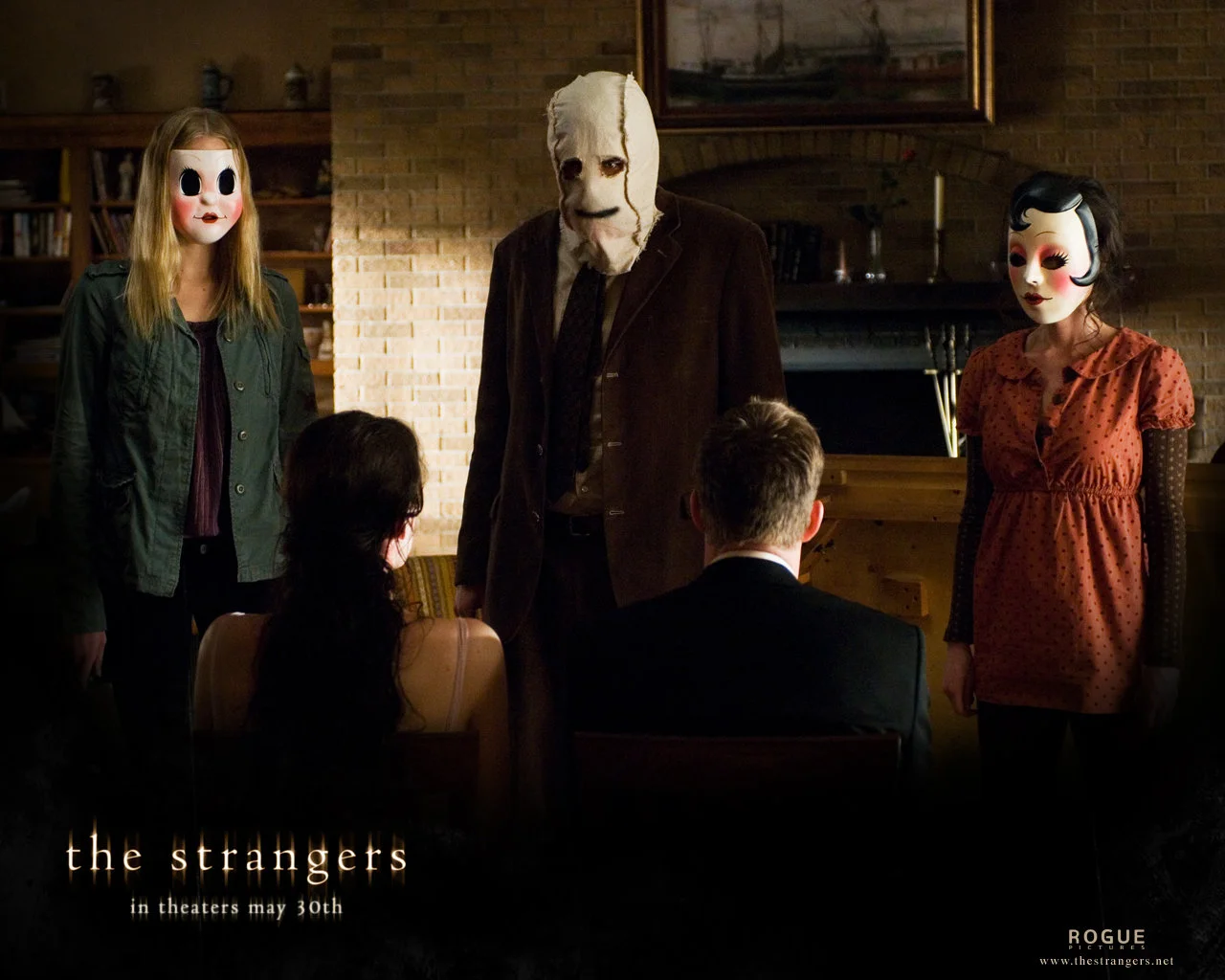
The Strangers (2008)
The most common response I get when I tell people that I studied horror films for my undergraduate degree is, simply: “No you didn’t.”
It’s true and it’s not. My Horror Films Studies course was only one three-credit elective toward the completion of my Film minor. Sometimes I deliver that line as if my degree thesis was, say, an analysis of how the graphic reportage of the Vietnam War contributed to the terror surrounding The Texas Chainsaw Massacre. I do this, in part, because I’ll take any chance I can get to seem eccentric; it’s a fast-paced world out there, after all, full of people far more interesting than I am.
A fraction of the truth is that I’m particularly smitten by the genre because I associate the fear it elicits with the thrill of being young and dumb and in love. When I was in high school, such was the move: invite a girl to your place, share a blanket, and watch a scary flick on the couch in the basement, under the exposed guts of your house, pipes that would writhe and groan in uncanny rhythm with the silences in the movie. Lights off, obviously. Just she and I and the electric blue of the PG-13 hellscape on the old tube TV, a couple of Diet Cokes. This was my introduction into the realm of filmic terror.
It was also how I started seeing my first long-term girlfriend. Our initial dates were viewings of Disturbia and Cloverfield—two of those hedged, quasi-horror, quasi-thriller films that served to ease us into the genre before going full-on Rosemary’s Baby. We took it slow.
Those nights, beneath the blanket, we’d rub socked feet, lean into each other as cameras panned down dark hallways, excruciating and unhurried. If I was lucky, her shirt would have slid up during a jump-scare so that, when I put my hand back where it had been before we both reacted, it would be resting against the soft skin of her lower back. Some of my first exposure to intense, blue-balling sexual tension went just like that: my arousal, as well as the possibility of embracing its source, intensified at the same rate as manufactured fear.
With the same girlfriend, whenever we were at her place—a ranch home full of Catholic, conservative, God-fearing Italians—we’d have to play board games or watch rom-coms on the couch with her mother, who often chose the movie, and who could only handle leaving us alone for the duration of a bathroom break. We could hold hands. No blankets. She left the lamp on.
About halfway through Hitch or Just Friends, she’d feed us homemade, ultra-breaded marinara dishes made brick-heavy by all the cheese. My girlfriend and I would reluctantly eat on separate couch cushions while we watched the rest of the movie. We did this out of respect. My lap would grow warm from the heat of the food on the plate; I’d sweat in places I really didn’t want to be sweating.
I’m still convinced her mother was some sort of overprotective super villain. It was brilliant: she only made food that she knew would give us the meat/lactose sweats, so that whatever immediate attraction we felt for each other would be absolutely bludgeoned to death. The sexiest thing about those nights was the shit I would take when I got home that mercifully rid my body of maybe half the dairy I’d consumed for dinner.
To be clear, I wasn’t (and am not now) opposed to some good old fashioned family fun. I wasn’t (and am not now) a dog. But in that specific environment, under the shadow of my girlfriend’s mother, in the glow of a movie which likely had some ideologically rigid and self-righteous portrayal of love, trapped in home-cooked sweat, it all felt constricting. It felt like something that hadn’t yet taken shape was being viciously and unfairly molded by someone who had, all her life, suffered her various terrors. All her daughter and I wanted to do with each other was embrace terrors of our very own, twist ourselves in them. We wanted to use them to get weird with our unexplored, pubescent bodies.
Horror films were crucial to this sort of young, suburban passion. They were a superficial, straight-to-DVD rabbit-hole into the warped kingdom of my sexuality. At my house, what ended up happening beneath the blanket was always in stark contrast to the banality of the Diet Cokes, the buffalo-plaid couch, the artisanal, colonial décor of my suburban New England home. It was a netherworld made accessible by even the cheapest jump-scares.
She and I eventually moved on from the Cloverfields to more realist contemporary horror. Our staple was The Strangers: Scott Speedman and Liv Tyler alone together in house that wasn’t theirs, fucking on the table after Liv turned down Scott’s proposal for marriage. Three masked strangers with knives dog them through the night, mechanically breaking them down with horrifying foreplay: knocks on the window, record players mysteriously turned off in the other room, the front door left wide open. All of which led up to the slowest, gentlest, most terrifying stabbing sequence I’ve ever seen.
*
The ‘suburban’ modifier to that passion is perhaps its most important quality. In the short length of a year following the September 11 attacks on the World Trade Centers, vacancy rates in Lower Manhattan more than doubled. Families fled to places like my hometown: good public school systems, vast green commons, neighborhoods labeled as "Estates." I remember the influx of people, the municipal scramble to develop more cul-de-sacs, more condos, all the DPW trucks with their hazard lights flashing, fleets of them parked on top of berms outside vacant lots.
Over the course of the next decade, the horror industry exploited the safety America projected onto the suburbs. For those of us who were already there, like myself, the walls had closed in on our world a little bit. We understood then that we might be in the suburbs for the rest of our lives. At the time, after the attacks, we didn’t know how long those, our lives, would even last. We had less of a possible escape than we did before, and there seemed to be a doomsday clock on our American existence.
An example of how the horror/terror genre was always a step ahead of us: a film like Cloverfield exacerbated our fear of faceless, monumental terrors sacking our metropolises and burning them to the ground. The logical escape from that is an exodus to the suburbs. That’s where films like Disturbia, The Strangers and It Follows come into play; there are serial killer neighbors hiding in plain sight, and whatever it is that’s chasing us won’t stop just because we moved to a cul-de-sac. So okay, we’ll stay inside. But then our houses are haunted in films like Insidious, Paranormal Activity, and (my favorite campy-slogan example of this) When a Stranger Calls: “The call is coming from inside the house!”
And so what’s the final temple? What’s our last defense from horrible death? After we have left our homes, all that we’ve got are our bodies. Which is why, so often, possession films are the most terrifying of all: The Exorcist, The Exorcism of Emily Rose, The Conjuring. The reason we’ve seen such an oversaturation of these stories in recent years is because, within the last decade, the horror industry has exhausted all its precedent anxieties. We’ve reached the end of a cycle in which movies have systematically broken our sanctuaries down, violated them, reminded us we aren’t ever safe, the way masked sociopaths do to beautiful, nearly-married couples on vacation.
Perhaps that’s why it always felt like the awareness and discovery my ex-girlfriend and I experienced with regards to our bodies was a profound sort of transcendence. In beating the genre’s most unbeatable gambit, we came to appreciate it. I went on to study it.
This cycle is starting over. Earlier this month, Robert Eggers released his critically acclaimed directorial debut, The Witch. It calls itself a “New England Folktale,” in which a Puritan family is exiled from a settlement in 1630, only to move out to the banks of a forest, where they’re under siege from woodland witches. They struggle with their own fears of a fundamentalist God. We’re returning to the origins of American horror, to the forms it took when it secured its foothold in our country’s earliest people: when sexuality meant witchcraft, and believing in God meant believing that we were the devil.
*
Another response I tend to get when I tell people I studied horror films for my undergrad degree: something to the effect of, “Why?”
Fair question. A lot of them are unadulterated garbage. As a genre, though, and as a complete corpus of filmic art, they’re not deserving of such a reductive dismissal. Sometimes the psychology behind them is painfully on-the-nose, but at least they offer an accessible window into some complex ideas. They start conversations. They deserve their place in academia. A lot of them are kind of hot.
And yet, over time, my visceral lust for the genre has leveled off. There’s still all that hormones-on-parade history that textures those films with a certain nostalgic ecstasy. But as I've grown up, I've carved spaces for horror in tamer traditions.
Every Halloween, now, I get together in my basement with most of my fantasy football league—some years as few as three of us, others as many as twelve men and women. After I shut the porch light off at 9:00, we bring whiskey and beer and the remaining trick-or-treat candy to the basement and watch three horror movies on Netflix that we’ve never seen before. Lights out, obviously. Sometimes blankets, a better TV than before. We revel in the tradition, in the terribly-delivered lines that become part of our shared vernacular. Occasionally, we’re all genuinely scared. Even when we're not, there’s always a palpable energy in the room, something alive and slightly dangerous.
It’s no surprise to me that the folks with whom I watch sports are exactly those who appreciate the subtle nuances of sharing a horror film together. In his short essay for The Paris Review Daily, “Nauseating, Violent, and Ours,” Chris Bachelder (The Throwback Special) writes this about sports as a shared experience:
“I’ve spent some time wondering why I still watch and care about sports, particularly football, and I grasp at the idea that an avid interest in sports might be connected to a desire to belong. We could debate whether this is a justifiable and edifying expression of this desire, but the desire itself seems vital and real. In caring about sports, we join others in caring deeply about something over which we have essentially no control, our lucky socks notwithstanding. The stakes are not genuinely high, but they feel high, and worthy of our passions. Our powerlessness as passive viewers is mitigated by our sense of belonging, as it is by the comfortingly orderly rites and rituals of seasons and spectatorship. We experience occasional joy and wonder, frequent disappointment, and, in some cases, anguish and horror. All of this we experience communally, even when we watch alone.”
Why horror films? Five years ago, I would’ve told you it’s because they make for great dates. I still believe they do. But these days, it’s all about exactly what Bachelder posits: like sports, being terrified is a shared experience. Emotions are wrenched out of us by the spectacular. And it doesn’t really matter what in particular we feel. It doesn't to me, at least. What matters is the experience of feeling something, together.
Daniel Johnson is a graduate of Southern New Hampshire University's MFA in Fiction and Nonfiction. He currently works at The Paris Review.

Beyond the Pale
by John Vercher

Laurie broke my heart. She didn’t mean to. I know that now. I’m sure I knew it then. But still.
My parents transferred me to the public high school after four years in two separate parochial schools. This is to say I knew no one. The first day seemed interminable. Class after class, I extended my hand to introduce myself and met with hard stares and warnings to not get caught in the parking lot alone when the bell rang at the end of the day. That all happened before lunch. Noon came, and I exited the food line, tray in hand and looked out across throngs of unfamiliar faces. They glared back. I weaved my way through the tables in the hopes that someone would slide a chair out for me instead of pushing the empty ones in. I ate alone and wished the day away.
Alphabetical seating arrangements left Laurie and me in the last seats of our respective rows of Algebra I. Blonde bangs hovered above her forehead, a waterfall that flowed out from the sawtoothed strands of her crimped hair. Before class began, she laughed with her friends and her braces glinted in the glow of the fluorescents overhead. Her laugh lines almost, but not quite concealed a mole next to her nose, a beauty mark, perfect in its imperfection. The second bell rang and as the students finished their murmurs and turned forward, she glanced back at me.
I opened to a random page in my book and hoped she hadn’t seen me. I felt her look away. Certain I was in the clear, I went to resume my stare.
She’d been watching me. This day was looking up.
The curtains pulled back and the movie trailer of our relationship played on the screen of my mind’s eye. Berlin sang “Take My Breath Away” over footage of me as I scrawled my first note to her. Will you go with me? Check yes or no. Sorry So Short. Cut to our own table at lunch. Cut to holding hands in the hallway. Cut to prom. As I stared off into space, I caught movement in my periphery. She looked at me again. This time neither of us looked away. My glasses, thick enough to see the future, had slid down my oil-slicked nose, and I pushed them back up. I finger combed at the duckling soft hair on my upper lip, smiled my gap-toothed smile (my braces wouldn’t come for another year) and just when I thought I the day couldn’t end any better, she went ahead and said it.
“You have a really nice tan,” she whispered.
The movie reel sputtered. The celluloid melted. The film broke.
* * *
In the countless times I’ve thought about that day, I haven’t figured out what I honestly expected Laurie to say. The truth is, I never expected her to say anything, at least not to someone like me; someone who collected comic books, played with action figures a little longer than he should have, and spent lost weekends with Sonic the Hedgehog and King Hippo. Someone whose clothes were less cool than his glasses, and with a complexion that resembled the terrain of a topographical map. I never thought about the fact that I had brown skin, a wide nose, and straight hair. I was a biracial geek before it was hip to be either. No wonder Laurie stared. To be fair, I shared her confusion, about what I was and about who I was. And though my struggles with identity had begun long before that day, Laurie still ended up my first.
With one statement, Laurie became the first person to make me realize that there was something else about me that people, particularly girls, would see before they noticed the barely-there moustache or my questionable fashion sense. That afternoon was my big bang, the event from which all other questions of my identity sprung forth. It was the beginning of a high wire act, on which I walked with a constant teeter, only able to take a step before I re-assessed my footing, before I found a balance between what I liked and what I was supposed to like. How I talked and how I was supposed to talk. Who I loved and whom I was supposed to love. As if being thirteen weren’t hard enough.
* * *
“I kind of have it all the time,” I said.
“Are you Italian?”
“Nope.”
“Spanish?”
I shook my head. She cocked hers with tight-lipped confusion. Her bangs didn’t move.
“So…what are you?”
“I’m black,” I said.
“Both parents?” she asked.
Laurie had exclaimed it with such surprise that a few students ahead of us turned. My face went hot, embarrassed at their watching, humiliated by her disbelief. My throat felt dry and I managed a nod.
“Huh,” she said, and turned back around.
* * *
My sons are three and one. My wife is white. Beyond the pale of her skin, my oldest boy looks little like her. He shares my wide nose, my gapped teeth, and my straight hair. My one year old has my wife’s features and her complexion. The frequency with which I’ve thought about that afternoon increased exponentially since I first found out we were pregnant.
My three year old might meet his own Laurie. She won’t stare at his skin color. She won’t list all the possible races and ethnicities she thinks he could be (because that’s a thing to do), and she won’t bark in disbelief when he names the only one she didn’t guess. They’ll pass notes, hold hands and maybe he’ll even bring her home to meet his folks. That’s when the questions will start, both his and hers. She won’t understand why I look so different. He won’t understand why it matters.
I know what to teach my sons about who they are, but not about who the world expects them to be. I want to infect them with mine and their mother’s rampant idealism, with the notion that we all crawled from the same soup, that we are all human beings but I know that doing so leaves them vulnerable to pain. I know that as much as we don’t want it to matter, despite the declarations that we live in a post-racial America, it does matter. I want my sons to understand the struggle, but I don’t want them to experience it. And I don’t know if that’s right.
I know that Laurie didn’t mean anything by what she said. I do know that even at our young ages, the fact that she thought it was okay to ask those questions isn’t okay, that it’s representative of a problem ever present almost thirty years later. I also know that while I want my boys to know why Daddy is nervous when he gets pulled over, they won’t ever have to be. I know that while I’ll be concerned when they’re out late with their friends, I won’t be worried because their pants are a little baggy or they wore a hoodie that night. I won’t be worried about these things, because while they look like me, they don’t look enough like me. For that I am glad.
And because I am glad, I am ashamed.
John Vercher is a graduate of Southern New Hampshire University's MFA in Fiction and Nonfiction. His piece, "Homewood," won the 2014 Assignment Student Contest, and can be seen in Issue #1.
Chill, Baby
by Nadia Owusu

There was, as is often the case, no warning that the G train would not be running past midnight. No flyers or posters. No announcements on the A train telling passengers not to bother getting off to transfer. Nothing. The woman on the microphone at the Hoyt-Schermerhorn Street station sounded thrilled about this inconvenience even as she apologized for it.
I was pissed off because nobody came into the restaurant for dinner that night so I didn’t make any money. I only had two thirds of my rent that was due in a week. I was going to have to pick up shifts during finals. I stood around all night polishing wine glasses and folding napkins instead of studying for my statistics exam. Tonight would be another sleepless one. There would probably be crying. I usually cried when I studied for math tests because I’m very bad at math. Doing things that I’m very bad at makes me sad about all the things in the world that I will probably never really understand, like electricity and Einstein's general theory of relativity.
During my shift, the bartender I was in the process of breaking up with had gotten drunk and annoying. He flirted all night with that blonde woman from across the street, and not just in the compulsory bartender way. She came to see him every night, even in this snowstorm. Usually he was polite to her, but disinterested. She had thick, square, acrylic French-manicured nails. She wore sticky pink lip gloss. She always started out her evening with a Sex on the Beach. Her voice sounded like her acrylic nails on a chalkboard. But, he leaned over the bar and looked into her eyes. He probably talked to her about his art, how he’d dropped out of law school for it. I did not like the thought of him sharing that part of himself, the part I liked, with her. So what if I had ignored his phone calls for three days? I was supposed to be the one ending it, not him. And now the stupid G train wasn’t running.
I kicked an empty forty bottle that someone had discarded on the platform. It was still wrapped tightly in a brown paper bag. It rolled unsatisfyingly for a few seconds then stopped at a middle-aged Rasta’s feet. He had his head tipped up as though waiting for further instruction from the MTA. I was not holding my breath for any such thing. We were, I knew, on our own.
“Chill, baby,” he said.
I hate it when random men call me ‘baby,’ especially when they’re telling me what to do. I might have told him as much. I thought about it. I was in the mood for it. But I had kicked a bottle at him so I didn’t exactly hold the moral high ground. I scowled at him instead.
“I hear ya,” he said, even though I hadn’t said anything. “How we supposed to get home?”
“Yeah,” I said.
There was a bus that would get me close enough to walk to my apartment. Not as close as the G train, but closer than the A train. I had never taken that bus but I knew it existed because my friend Sarah who lived down the street was always going on and on about how she took it everywhere. She talked about taking the bus the way people talk about juice detoxes and meditation which is weird because there’s nothing about the bus that is healthier than the train. At least nothing I can think of.
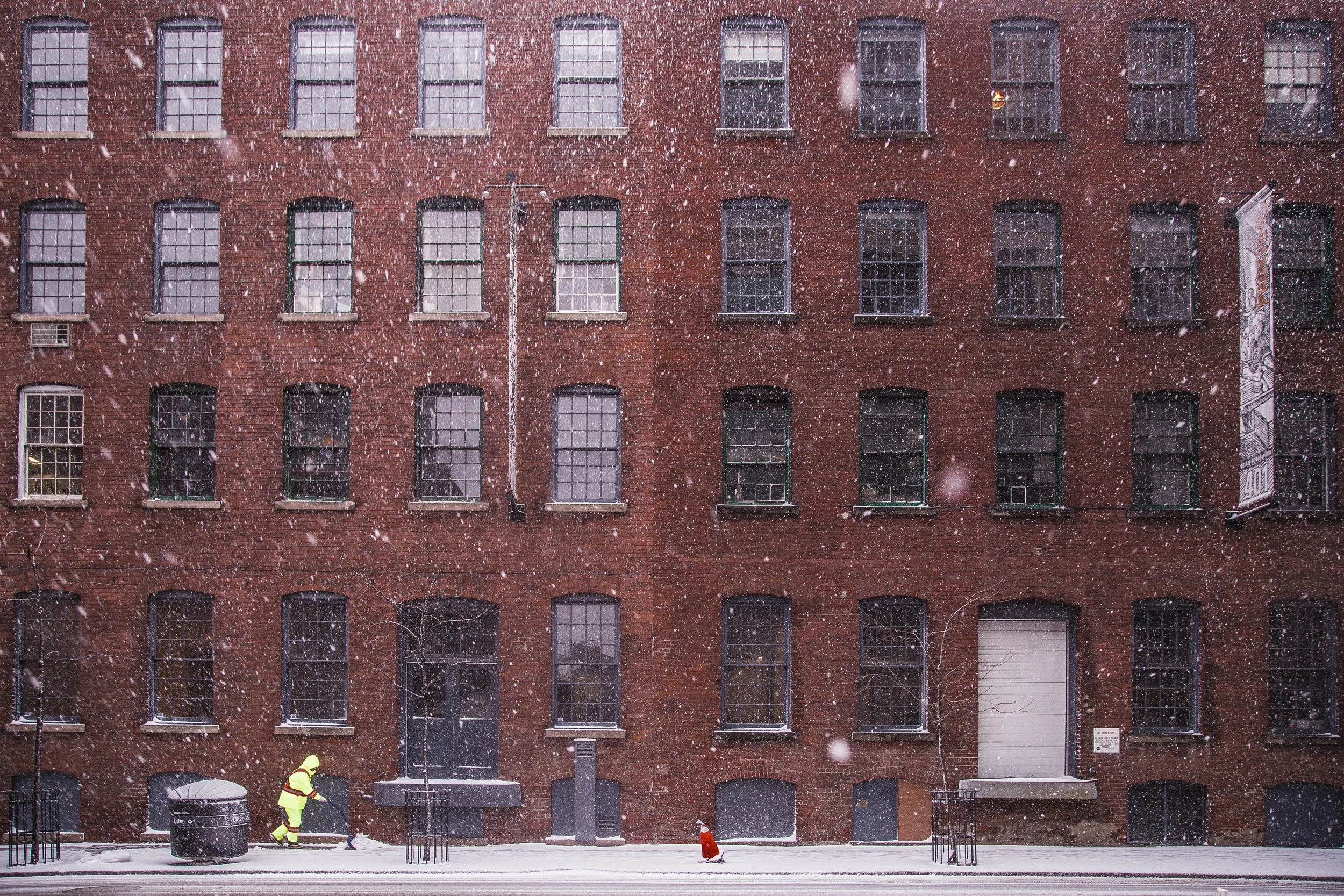
Outside, the snow was still coming down in heavy, sharp white pellets. It was the kind of snow that made opening an umbrella look pitiful. I buttoned the coat button that pinches the skin under my chin. I had to do that so my hood would not blow off in the whooshing wind. Google on my cellphone told me that the bus stop was six blocks away. The bus, I thought, better be running as usual. My brain said this in threatening tones. I needed the universe to know that I meant business.
What’s nice about walking in a snowstorm when you’re somewhat unreasonably miserable is that it makes your misery more reasonable. I don’t mind snowstorms when I don’t have to go anywhere except down the street to my favorite hole-in-the-wall for a hot toddy, or when I can stay indoors reading books and making soup. I do mind them under most other circumstances.
There were very few cars out that night; very few pedestrians. Downtown Brooklyn didn’t feel peaceful though. It felt abandoned. It felt like everyone was safe and sound at home except for me. I blamed a lot of people for this. I didn’t care if my reasoning was irrational. I was not interested in considering association versus causality. Perhaps this tendency is why I was having such a hard time with Statistics II.
It was my landlord’s fault for raising the rent by $150 when I was already struggling to pay it. I knew that this would happen when the hipsters moved in. I blamed those hipsters and their rich parents. I blamed my parents for not being rich. I blamed the university I attended for being so expensive. I blamed financial aid for not covering my whole tuition. It was the bartender’s fault for flirting with that blonde woman and making me jealous enough to stay at the restaurant for an hour after closing time to drink whiskey with him. The MTA was the worst institution that ever existed. Never mind that it ran trains and buses twenty-four hours a day so that I didn’t have to own a car. The G train wasn’t running right now. I also had a bone to pick with the mathematicians who developed theoretical and applied statistics.
I was walking with my head down so that the snow didn’t attack my eyeballs. They’re very sensitive. Walking in that way made it difficult to see where I was going. I had to stop every block to check whether or not I had arrived at the corner where I was supposed to turn left. My sense of direction is very poor. I was standing on Atlantic and Nevins when something large and brown leapt past me and into the street. A bus, perhaps my bus, rolled over it. The bus kept going, leaving the street empty and white again, except for a mangy mutt that was now bleeding red into the snow.
The mutt was silent. I rushed over to where it was lying. Its belly had been crushed and split open. The sight of its exposed flesh and guts filled my lungs with freezing oxygen. It—he—was dead. As far as I could see, there hadn’t been anything or anyone chasing him, nothing to spook him. I wanted to touch his nose but as I bent down and reached out my hand, I started to shake.
“Hey sweetheart,” called out a man wearing a backpack with a hard hat tied to it, “you okay?”
I don’t like it when off-duty construction workers I don’t know call me ‘sweetheart,’ but it didn’t seem important in that moment.
“There’s a dead dog in the road,” I yelled at him.
“Why?” he asked.
That the mutt had been hit by a bus was not the answer to that question. It was only a consequence.
“I don’t know,” I yelled. I didn’t need to yell. He wasn’t very far away. Maybe I wasn’t yelling at him.
I felt ridiculous standing in the street now, so I joined the construction worker on the sidewalk. The two of us stood in silence, looking at the mutt.
“That’s the way it is sometimes,” he said after a while. “It was probably the snow.”
What he meant by that last part, I did not know. But, I nodded and started walking towards the bus stop again. This time, I let it snow into my eyeballs. The snowflakes didn’t feel as sharp as I imagined. They just felt like cold water. I blinked and let them drip onto my cheeks. I had to accept that the storm would keep storming until it was over. And when I got to the bus stop, the bus would come or it wouldn’t. There would be reasons for whatever happened just as there must have been reasons for the mutt in the road. But, I might never know them. And they wouldn’t necessarily mean that any of it made sense.
So Go the Ghosts
I think the common misconception with Schrödinger’s experiment is that its findings can encourage indecision. But choosing to make no decision, to take no measurement, to send no text, are still in themselves active resolutions. I’ve consciously left the ghosts of those affairs in the box, cryogenically frozen, petrified in amber. They’re still there. In having done so within the Schrödinger framework, I elected for their life. Rather, I chose life and death and everything else; I elected for their infinity.
by Daniel Johnson

Last spring, I reacquainted myself with Schrödinger’s paradox, the early 20th century thought experiment in which scientists--namely, the Austrian physicist Erwin Schrödinger--sealed both a housecat and a vial of radioactive material inside a metal box to illustrate and examine the effects of quantum indeterminacy. Attached to the interior of the box was a small hammer rigged with a random timer; should the device trigger, it would shatter the vial, releasing nuclear fumes into the vacuum and suffocating the cat. Because the box was metal, and because the death-device was random, it was impossible for observers to know the outcome unless they opened it. And so Schrödinger suggested that, while the box remained closed, the cat existed in two states: dead and alive. His theory was that whoever opened the box and found the cat dead had been the one who, in a sense, killed it.
I was, at the time, spending the majority of my time tending to my family cat. Her name was Bonnie, and she was dying. For the better part of a decade, she had slept in the crook of my arm. She had trouble staying warm. The shelter we adopted her from thought she might have had a chromosome defect that resulted in abnormally thin, soft skin. She was the runt of the litter.
At the end, Bonnie had a bum leg that kept degenerating until she couldn't walk the stairs. Bonnie was my friend. I had shared almost half of my life with her: gray-fogged mornings before the bus ride to high school, afternoon naps when I was too hungover to pet her, evenings of reading marathons, of her chewing the corners of dust jackets and nudging me for attention. During those last days of her life, I worked from home, and when I held her, walked her upstairs, placed her at the foot of my bed and watched her fall asleep just to make sure that's as far as she'd fall, I grieved like she was already dead.
And so, Schrödinger. I pre-mourned my cat's death by spending midnight hours at the kitchen table, reading discussions about quantum mechanics on strange forums at the back ends of the Internet. I followed most the users who dedicated so much time trying to calculate the odds that Schrödinger's cat would be alive when the box opened. Bonnie would be asleep at the foot of the chair, tail wrapped around a wooden leg, belly rising in harsh New England moonlight that shone through the window over the dripping sink.
My fascination with the experiment, though, peaked with the Spring 2015 issue of The Paris Review, in which a character in Mark Leyner’s “Gone with the Mind” (now available in book form) alludes to the experiment in one of my favorite closing lines to a piece of short fiction (emphasis mine):
“Life’s harrowing fucking slog—we’re driven by irrational, atavistic impulses into an unfathomable void of quantum indeterminacy—but, still…it’s nice to have a friend, a comrade, a ‘paracosm,’ whatever, to share things with.”
And so, Bonnie.
*
I was in the room at Franklin Vet Clinic when Dr. Parker squeezed the euthanasia into the rubber tube feeding Bonnie's bloodstream. My hand was on her rib-cage. She breathed deeply, arrhythmically on a threadbare blue towel that was monstrously frayed at the edges. Everything was uncomfortably exposed in swipes of colorless morning light from a window over the examination table. I felt her tiny pulse halt as the final sleep coursed through her body after the doctor and her aide asked one too many goddamn times if I was sure, if I had considered the alternatives carefully enough to be certain this was the right choice. They made it sound like the alternatives were infinite.
I don't think I'm ever more conscious of how uncertain I am than when I try to feign the opposite. And so not only did an uncomfortable awareness of the pathology to the whole procedure rake fire through my throat—the small gasp of the needle, the stainless steel slab that smelled like cleaning products and served as my beloved companion's deathbed—but it also made me feel like I was assuming more and more agency in its execution. As is the case with many people who elect to put their pets down, I was convinced for a while that I had done the killing.
The idea of exchanging my decision for one in which I preserved Bonnie inside a sealed box is psychotic and sad. But I’m not beyond believing that, in my grief, I found some solace in the simple theoretical absolution of a cat that was both dead and still alive—still, somehow, with me—at the same time. I’d invoke Schrödinger whenever I hallucinated her ghost: black blurs of matted fur in my bedroom doorway, the phantom pat of paws on my carpet.
*
Lesser such heartbreaks followed in the summer. I was, around that time, on-and-off dating a string of women who were all committed to other men. With each of them, I absconded to hotel rooms in the New England country. If any of them were house-sitting for a relative, I made love, fucked, whatever, in beds that explicitly belonged to someone else.
It wasn’t always intense. There were smaller days. On the weekends we could get away, we went for riverside walks, read Ben Lerner’s poetry out loud to each other, made bets on who could better sear a blackened salmon for supper, picnicked in mountain valleys, fell asleep listening to evening rainstorms. Mostly, though, our relationships existed in the text messages and emails we back-and-forthed every day for the better part of a year. I shared things with them, told them about Bonnie. I fell in love.
After a while, as these things go, the nights when I felt good about the affairs became vastly outnumbered by the ones when I felt less so. I would eventually pressure each of them to leave their partners. They stopped responding altogether, which a friend recently told me is a modern love phenomenon called "ghosting." They all disappeared.
I never once messaged them asking why exactly they had gone away. And even if I did, I knew any attempt to find out would have ensnared me in the observer’s paradox: by trying to measure the outcome, I might affect its absolution—a mini Schrödinger on my shoulder, offering admonitions. A text might have ushered our relationship to a definitive, punctuated end. Whether they had reconciled with their men, or found someone else, I didn’t want to know. I wasn't ready for that. In a way, I disappeared too.
Schrödinger’s logic is abstract, but it holds. When you reduce the jargon of it all, you get a tautology and a platitude: we won’t know for sure until we know for sure, and sometimes not knowing is the safer state. Ignorance is bliss, etc. I once spent a whole night searching for any online evidence that Schrödinger had been heartbroken prior to conducting his experiment. Jury's out.
I had never been ghosted before. Handling such a sudden loneliness left me wayward. I took off to the Midwest, where I lived for a while in a friend’s study. I walked her dogs through dairy fields, gardened for her, bird-watched for sandhill cranes in soybean farms. I lived at the margins of other people's lives because it was clear I was a self-destructive time-bomb when I existed at center of mine. Sometimes my friend would let me talk to her about Schrödinger, about how I so obsessively believed the essence of his experiment was inseparably linked with all my most recent ghosts. For the most part, I tried to forget about him, move on from all of it.
I live in New York City now. People here ask me why I’m not dating, why I haven’t downloaded Tinder, why I stay after hours at the office, why I bring work to the bar. Mostly I don’t answer. I’m content, and it’s hard to talk about ghosts. There's no lighthearted way to articulate that I’m still learning how to gracefully repopulate—navigate, even—a world affected by all this absence.
*
So much of it had been well off my mind until a few weeks ago, when I heard news about the cosmic superstorm, and the gravitational ripple that all but confirmed Einstein’s theory of general relativity. I’ve been trying, as we all should, to understand the incredible magnitude of what this means.
All of it may suggest that the probability of plural realities and multiverses is more likely than ever. And so perhaps most fascinating about the impact of those two black holes coming together is the way its scientific implications echo religious sentiment. A hopeful reading of the multiverse theory offers a comfort not so unlike the idea of the afterlife, should you believe in it: whatever dissatisfaction we have with the current reality can be mitigated and even justified by the idea of salvation in that “Something After.” Now, it’s coupled with what one might call a “Something Adjacent,” a single reality—or billions of them—moving parallel to ours onto which we can superpose our most desired personal storylines. Theoretical places where the ghosts we carry just might be alive yet.
And so—again—Shrödinger. Of the infinite possible outcomes, our world is merely one of them. We’re just a random, mildly grizzly scene—“a harrowing fucking slog,”—that the universe came upon after it peeked inside its own box.
After the news, I thought first of Bonnie. After she died, my family received in the mail a glossed postcard from Dr. Parker, along with a handwritten note of condolence and a transcription of the prose-poem “The Rainbow Bridge,” one of the more famous consolatory pieces of writing regarding the death of a pet. In the poem, Rainbow Bridge is a destination for the departed—both a literal bridge and the place beyond it, two realities no longer gapped—described as an other-worldly meadow where “those who were hurt or maimed are made whole and strong again, just as we remember them in our dreams of days and times gone by.” There was a fairytale drawing in the corner of the postcard: a wooden bridge, some fluffy trees, a vast green country, blue skies. A reality where our ghosts are both dead and alive, where Bonnie tumbles between states, between that reality and the ones in my dreams.
I thought then of my affairs. In the throes of my Schrödinger fascination, I had spoken to each woman about different worlds where they weren’t with other men, where we were, in some actuality, together and uninhibitedly so. Ours were connections that transcended singular worlds, I said. Plainly, the most insufferable pillow-talk. But this was how I had justified their decision to leave me in boxes, locked in the dark metal chamber of other-manhood. It’s how I rationalized my decision to stay there. I told myself it was possible that I existed as a haven for them in their complicated and otherwise unhappy relationships. My very presence in their lives suggested a multitude of other worlds. That might have given them some sort of hope. It definitely gave them attention.
Most days, in the midsummer thick of grief, and of virtual and occasionally physical passion, it seemed like reason enough to stick around. In the days since the discovery, I’ve found myself wondering again whether I was right, replaying the memories, enduring weeping fits when I think of the way Bonnie looked at me from my lap as we drove her to the vet that spring morning, as if that wave of gravity bent me back through time.
*
I think the common misconception with Schrödinger’s experiment is that its findings can encourage indecision. But choosing to make no decision, to take no measurement, to send no text, are still in themselves active resolutions. I’ve consciously left the ghosts of those affairs in the box, cryogenically frozen, petrified in time. They’re still there. In having done so within the Schrödinger framework, I elected for their life. Rather, I chose life and death and everything else; I elected for their infinity.
This, however theoretically, stripped from those relationships a lot of the ugliness inherent in affairs. Over time, whatever love I felt for each woman has returned to its unspoiled, uncarved state, like the glimmer of poetic possibility before the pen touches the page. It exists now in its purest, quantum form: boxed away, stuffed in some corner attic of the heart, left to crust over until I haul it to a landfill, or reopen it to find something still breathing.
There are moments when I feel like this is as close to acceptance, closure, forgiveness, any of it, as I can get. There are others when I wonder if it’s more like desperation, or the unwillingness to let go, let die. But anyways, you can’t keep a ghost with a stranglehold, or with any conscious grip at all. You just let it be. It’ll stick around until it won’t. You’ll know it’s gone when you feel it pass through the walls of your room, your apartment, the twilit cityscape, the atmosphere—cardboard thin, all of it.
Ghosts go quietly, graciously. They’re like fireworks that don’t combust until the uncatalogued reaches of the universe, where black holes collide and gravity is a tidal thing, eroding us in waves.
Daniel Johnson is a graduate of Southern New Hampshire University's Low Residency MFA in Fiction and Nonfiction. He's currently interning at The Paris Review.
Winners and Losers
by David Moloney
A five year old’s birthday party at a Taekwondo school sounded like a bachelor party at an opera house. It didn’t make sense to me. I imagined kids clumsily kicking foam dolls, or throwing limp-wristed punches at padded walls, getting barked at by dudes in doboks until they collapsed in defeated tears. I didn’t imagine it was a place where a room of four- and five-year-olds would have barrels of fun.
There were twenty or so kids who attended. The school's Master told us to remove our children’s footwear upon entry. My daughter May ripped off her socks without hesitation and hurried over to the group. The kids sat on a blue mat and we parents were scattered throughout three rows of bleachers. The Master announced that we would have a day of fun and games in honor of Oliver, my nephew, the birthday boy.
The first game was dodge ball. I wondered how May would do with losing. May is dainty, cautious, and sweet. She would have been my first target in middle school gym class. The way the kids were so unsure of themselves made me remember the days of slinging the ball at the weaker kids first, the ones you knew would just stand still and frozen. I looked over the kids and I could instantly pick out the ones who would lose first, and the ones I would have hid behind early in the game.
Halfway through the game, a small boy lost and one of the instructors guided him off the mat. He cried. The parents in the bleachers exhaled a cohesive “awe” as he ran to his father. The instructors kept the music playing and the game going. The kids still in the game gave no attention to the boy crying. They played on, and no one else cried when they lost. The boy sat on his father’s lap and never rejoined the party.
May pirouetted her way around the bouncing ball. She twirled and skipped carelessly, as if she may not have even been part of the same game. She made it to the final four. When the ball finally found her, she walked off the mat smiling without searching me out in the bleachers.
*
There’s a growing concern among millennial parents about the absence of dodge ball in school. I’ve heard the argument that kids need to learn how to lose, that not everyone can be winner. My uncle Billy calls it the “pussification of America.” I’ve been entangled in this argument and I’ve championed the need for dodge ball, the need to “un-pussy” America. I’ve laughed in reminiscence about head-hunting the slower kids, the dainty kids, the kids like May.
The first thing my family mulled over at the after party was the dodge ball game and the crying boy. There was a collective praise from my siblings, my father, and my uncle Billy, about the way the crying boy was handled by the instructors.
“See how they didn’t even look at him?” my father asked. “That’s how you do it.”
This sort of praise was expected from my family. I am one of four children, and growing up, there was always a respected competitiveness amongst us. No one ever wanted to lose, even if the sport or spelling bee or game of flashlight tag didn’t include siblings. We always wanted to dominate. It came from the top down. My father wasn’t easy on us in games. He was notorious for the line, “I’ve never lost a game of (insert game here).” That included games against his children. He never let us win.
*
A string of snowy days the week after the party brought me to dusting off our Wii and setting it up for May. We sampled the games to find out which ones she was coordinated enough to play. She picked up Swordplay quickly, the game where two Mii’s battle on a platform with light saber type weapons until one gets knocked into the water below. May beat the A.I. fighters quite easily. Then, she challenged me to a duel.
Up until this point, our game-playing experience had been cooperative contests against a common enemy: get all the chickens back in the coup away from the hungry fox, build a rainbow so the Ponies can run underneath to a star dusted freedom. But now, I held the controller and stood against her.
May’s idea of trash talk was to make fun of my Mii’s ordinariness.
“Look at your eyes,” she said, “they don’t sparkle like mine.” She had insisted, when making her Mii, to have the eyes that were diamonds.
Best of three rounds, and without thinking I beat her round one. Her Mii fell into the water and she spun to me in disbelief. She yelled, “Daddy,” and in that moment I realized the position I’d put myself in.
She then told me she was going to kick my butt in genuine confidence.
The next round, May swung up and down a few dozen times and my Mii fell into the water. She cheered.
Round three I made sure to make May work for it. I blocked her wild slashes until her arms were tired and the swings became tiny chops. I brought myself close to the edge and May gave a final sweeping blow.
When you’re the one of the kids in gym class with a good arm and good hands, when you can flatten to the floor under a high throw, leap over a bouncing ball, you love dodge ball. You count down the minutes through math class until you can roll around and smash a red ball off kid’s foreheads.
When you’re a kid and you’ve lost hundreds of games of chess to your father, trying to out-maneuver him, figure out why you can’t beat him, and, then, finally win on one foggy morning in a camper at Lake Sebago, the victory stays with you like a proud scar.
But when you have the say on whether or not someone else wins or loses, when you control the outcome, the game changes. You’re a giant gripping the ball as swarms of easy-target little people run around your feet. You’re a teacher. You have knowledge of cause and lasting effect, of inevitable outcome.
As my Mii floated in the air with his normal-looking eyes, stayed suspended there for a moment, then plopped into the pixelated water below, I knew this first allowance of victory wouldn’t be my last. I’ll shelve the ball until she is ready to throw it back.
David Moloney is a current MFA candidate at Southern New Hampshire University's Low Residency Program in Fiction and Nonfiction.
Leikmót, 2015
by Eric Beebe
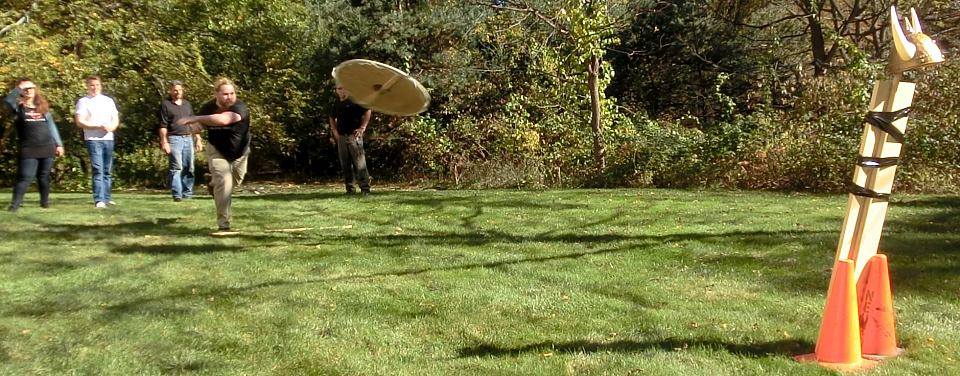
Photo Courtesy of Hurstwic.
When Matt invited me to Bill’s house for leikmót, I decided I’d bring a pie. I felt like I owed some offering in exchange for the welcome Matt had extended to me from Hurstwic, a group of modern-day warrior-scholars of ancient Scandinavian tradition. I had attended and participated in a few of their combat training sessions before, but I paled in comparison to Matt. I liked Viking history and the culture of the Norseman. He practically lived it. He’d refused to shave his beard for about a decade, and his skin was decorated with tattoos of runes and symbols linked to Odin. When we first became friends I could see myself striving for the same, but then years passed, and I accepted my place in this century while he held the link between the periods tighter than I could even hold a sword.
I made the pie with wild boar and apple and acorn, striving for whatever historical relevance I could muster. The day of the event, Matt drove us to Bill’s house. Bill was head of Hurstwic, and he hosted the leikmót and annual Winternights Feast in his backyard. I remember thinking his home bore surprising Colonial influence for what I half-expected to be a Nordic longhouse. His driveway wound through a thicket of trees like some hidden path to a wise man from a fantasy series.
The other visitors hailed us from the back porch. I recognized few faces and introduced myself to the rest with trepidation. After only making training on a couple occasions, it was hard to feel worthy among the more dedicated at this yearly ritual. Even their conversation was alien to me. Talk with friends and family always seemed such a contest of who spoke first and loudest. But these men and women around me took time with their words, letting spans of silence pass between them in peace, enjoying the October air.
Within the hour, Bill called all to order with an opening speech. He gave the history of the leikmót as a contest of might, speed, and cunning held with annual feasts before days grew short and larders keenly measured. Bill announced there would be prizes for the most impressive competitors.
We played knattleikur first. Like much known of the Norse, many fine details were lost outside of the sagas, but what resulted was some distant relative of rugby and hockey. The Swift Wings of the Valkyrie faced off against The Old Berserkers, blocking runs, stealing balls, and trying to trip each other with their staves. The Swift Wings won a bag of Icelandic candy. Everyone broke after the contest to cast a silent vote on an MVP.
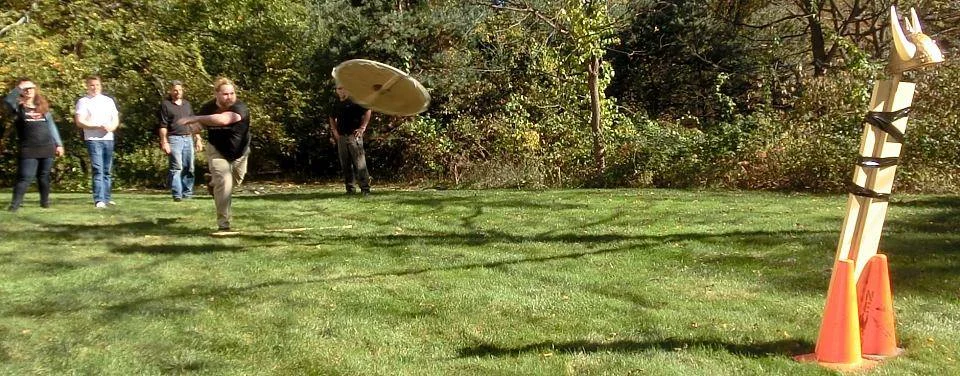
There were then shield- and spear-throwing competitions. I watched Matt throw a shield every conceivable way for optimum yardage. Reynir, our resident Icelander, hit truer with each consecutive spear he threw. I couldn’t hit anything with a shield, and my spear-throws were far from any of our target’s imaginary vitals.
After archery and barrel-fighting drills, we prepared to feast. I helped two other guests bake flat disks of bread beneath the pot over Bill’s fire pit, where he had been cooking stew over the open flame. We just warmed my pie in the kitchen stove. Wooden bowls were brought out for us to serve ourselves, and we gathered in a circle to eat. Plenty complimented my pie, but I found it too bitter after parboiling the meat in an IPA and wondered how they could enjoy it. Bill’s stew was much more appealing to me, but I waited and waited for someone else to lead the charge before daring to grab seconds. We washed our dinner down with beer and Brennivín, Icelandic schnapps traditionally imbibed with rotted shark meat.
As we finished the meal, two attendees brought out a wooden chest and a hula-hoop wrapped in decorative tape. Bill explained Nordic reverence for rings and oaths taken on them and held the hoop out between us to grasp in unison. With our hands locked in place he convened Hurstwic’s bi-yearly meeting of associates. We talked as much about the blessings native Icelanders sent us from their ancestors as we did the groups P.R. and marketing.
With talk of business done, Bill conveyed the day’s prizes: Icelandic licorice candies, certificates, and stones. In Iceland, Matt had told me, the locals protected even their smallest stones. They were a part of cultural history, the spirit of the land.
“Rocks don’t grow back,” he had told me.
But now Bill awarded stones from famous sites of the sagas to a number of the games’ participants, and somehow even I’d made the cut. He handed me one the shape of a rounded triangle he said came from the site of knattleikur in the saga of Gísli Súrsson. I told him it was going on my mantle.
We concluded the meeting, and Bill insisted we leave our dishes and take any leftover beer and skyr, yogurt still made from Nordic bacterial cultures and once used to extinguish fires. He gave out books that he and a colleague were ready to pass on. Matt and I were keen on his offers and last to leave. As we toted paper bags of our spoils back to his SUV, I carried my stone in my shirt pocket. We set course for home with a vessel full of weapons, bodies pleased by the ache of exhaustion, and a piece of Iceland’s soul resting over my chest.
Eric Beebe is a current MFA candidate at Southern New Hampshire University's Low Residency Program in Fiction and Nonfiction.

A Peek Behind the Curtain
by Ted Flanagan

When you die, and death doesn’t take, the return to Earth, a different kind of being born again, is a jarring experience. When you’re about to die, the transition seems distracting.
I’m guessing here. I’ve never died and come back, nor died and failed to return (yet). I’m a paramedic. I see this all the time, but I don’t understand it any better today than I did when I started two decades ago.
Once, a partner of mine asked a severely burned man if he had anything he wanted her to relay to his family. It seemed like a kind thing to do. Distraught over a custody battle with his ex, the man had doused himself with gasoline and lit a match. We were about to paralyze every muscle in his body, put a tube down the rapidly expanding, heat-ravaged tissues in his throat, which were swelling now because of the hot air and flames he’d inhaled. We were in a highway rest area far from this man’s home, from the home he’d never see again.
The idea was to keep a patent airway, oxygen in, carbon dioxide out, maintain the delicate pH balance in his body, keep the apparatus of life pumping, although the degree and extent of the burns made this moot, at best.
“You’re going to die,” my partner told him.
“That’s cold,” said a state trooper standing nearby.
“Do you have anything you want us to tell your family?” my partner said.
The man said his legs hurt.
I had a young patient from a factory explosion once, a worker who’d accidentally mixed two chemicals that can’t be mixed, now missing both legs below the knee, his chest and back seared by the blast wave and heat. Same thing: tube about to go in, patient survival questionable, leaning toward negligible. No last words, just screaming in intense pain. His legs, he said, his legs were killing him. He lived for a few hours in the hospital, but the damage was too great and his heart gave out.
Both of these patients disappeared behind the curtain of death, and I wish I could say that after nearly twenty years as a paramedic I had a better idea of what waits beyond that curtain. But I don’t.
During the Civil War, Dr. Samuel Gross was one of the Surgeon General’s most trusted advisors. Gross was one of the founders of what we would consider modern trauma surgery. Thomas Eakins painted his official portrait. There is a statue of him that once stood in the National Mall in Washington, DC, but has since been moved to Philadelphia.
Gross came up with my favorite definition for clinical shock He called it “the rude unhinging of the machinery of life.” It’s poetic in a way the medical profession is not these days.
From a purely objective standpoint, death is just that. The final breakdown of the machinery, the millions upon millions of biochemical interactions that take place every moment of our lives stopping in a moment of finality. Sometimes, when a patient’s heart beats too fast, we have to interrupt the process, give a drug called adenosine, which stops the heart for a few seconds, allows it a kind of reset. This brief period of standstill can be uncomfortable. A stopped heart, after all, is one half of the definition of clinical death.
The absence of the beating for some patients, no matter how short, is a moment of discovery. It’s the realization of a loss so profound, I think, as to overwhelm. Babies nuzzle their mother’s breast as much for the continued reassurance of that beating heart as for nourishment.
I’ve had elderly patients wail, bellow primal screams from the depths of their spirits, when the heart that’s thrummed inside their chests for seventy, eighty, even ninety years takes a five second hiatus. It’s their peek behind the curtain, and there are differing degrees of ready for that peek. Once in a while, I get the chance to bring someone back to our side of the curtain, and I’m still waiting for someone to report back on what’s out there. I’d probably settle for confirmation that out there even exists.
The closest I’ve come is one patient who went into cardiac arrest in our ambulance a few years ago. He was the service desk manager for a local car dealership. He’d been having chest pain for a couple days. The nametag on his work shirt was a white oval with red script that said Mick. This wasn’t our patient’s name.
We discovered he was having a heart attack. En route to the hospital, his heart stopped. We were on him in a second. When he regained consciousness, he said he’d watched us work on him from above, somewhere up near the ceiling.
I used to take naps on that same stretcher, crowded in on the sides by the narrow-gauge tubular black metal rails and the flat red paddle levers that raise and lower them. I’ve stared at the vanilla-colored plastic ceiling, a liner, really, insulating us against the cold metal skin of the box we rode in.
Look up and you see two rows of recessed lighting in column, pins for the moveable oxygen ports, an improbable scuff mark. If spirits gathered in my ambulance on their way to or from the Abyss, this box built in Georgia by the low-bidder on our ambulance contract hardly struck me as the place a benevolent God would choose as the portal for one of His creations.
Ultimately, I wanted more. I felt cheated, by this patient, and all the others who came back without information, without intel.
I wanted stories of tunnels of light and dead relatives waiting with open arms, vast green fields and infinite feast tables prepared by those who’ve gone before us.
All he saw was a few tired paramedics putting the hinges back together on his machinery of life.
Ted Flanagan is a graduate of Southern New Hampshire University's MFA in Fiction. He is a contributor to Cognoscenti, a branch of WBUR, Boston's NPR station.

Table for Four
by Sarah Eisner

We don’t always eat together—a necessary downside to our dual entrepreneur, Silicon Valley household—but we try to often, and tonight we do. We eat in the faded drape of winter evening light, all of us returned to each other from our busy days, at the dinner table. We eat in the same seats as always: ten-year-old Wilson across from me, eight-year-old Ben across from my husband, Noah.
Wilson is eating oiled broccoli with his fingers. Noah wipes his hands on a paper towel and says, “Hey buddy, use your fork please.”
Wilson is mid-chew, and Ben giggles and says to his dad, “You didn’t.” Ben is jolly, and right—we all love to eat with our hands. We take an irrational pride in not being formal, and we don’t dine so much as heartily consume.
Noah picks up his fork and spears a floret. “You got me,” he smiles at Ben.
“Hey,” Wilson says. “Let’s play thumbs up, thumbs down.”
We nod and Wilson starts. “Soccer,” he says. Our thumbs go up. We’re all on teams. Noah and I play in the co-ed adult league, our version of church, on Sundays.
“Donuts,” Ben says. He often dreams about chocolate glazed. I like apple fritters and the other two just eat plain.
Technically, it’s Noah’s turn next, but Wilson interjects.
“Divorce,” he says.
I look at Wilson across the table, surprised, though maybe I shouldn’t be, while getting my thumb in a low down position.
***
Until I was twelve, my family ate dinner together. I don’t mean usually, or on most weeknights. I mean every night. In our suburban family room in Concord, California, we sat in the same seats—Rick across from Mom, and Dad across from me.
With a classical music record on low and the TV off, we ate slowly, with our utensils, and we discussed our days as we listened to each other, just like studies—not yet conducted—now recommend.
Dad got home from San Francisco every night at five-thirty. At six o’clock, give or take five minutes, Mom would call Rick and me to the table by clanging her oversized, festive wall-mounted dinner bell, though our little house hardly called for such fanfare. We were usually just a few feet away doing homework or playing Chinese Checkers. Once seated we were not, under any circumstances—aside from the threat of death, destruction, or bladder emergencies—to get up, especially not to answer the telephone. That was fine with me, until boys started calling in junior high. I loved dinnertime and moved toward it like a sanctuary throughout my days.
The only part I didn’t like was saying grace. At six-o-five-ish, we held hands around the table, four voices together, and said thank you God for our food, Amen. I had no use for the flimsy promises of church or God and Jesus. I had faith in dinnertime, and the reliable calm of Rick, Mom, and especially Dad.
Every night we sat at the monumental oak table Dad had restored from a cast-off Boeing office desk, once used for blueprints of warplanes, jets, and cruise missiles. The surface was smooth enough to bowl on. Its deep drawers now held decks of cards. In California, earthquakes came, and the table sheltered us, Dad leading us with controlled urgency to duck, cover and hold on beneath our breaded veal cutlets and his single nightly Anchor Steam beer.
Then one September evening in 1986 after a dinner I don’t remember, the earth didn’t move, but Mom told us Dad was going to.
“We love you both very much,” she said, somber but composed, “but your dad and I have decided to get a divorce.”
Dad didn’t say a word. I suspect he couldn’t. He bowed his head and brought his white cotton handkerchief to his eyes. We’d given it to him, Rick and I, for Christmas.
I looked at Rick. Rick looked at Mom. “Can I go to Craig’s now?” Rick asked.
Mom told him to be home in an hour. She understood the disorientation, his nine-year-old desperation to escape. I sat there a bit longer, watching Dad try to lower the handkerchief, breathe, and raise it again, but Rick’s anxious exit marked the last time we all four sat at that table together. It’s the last thing I remember until I watched Dad labor to heft the table—that amber altar of my childhood—into a U-Haul six days later.
My dad’s wedding gift to us was the worn, oatmeal-crusted table we sit at now. I plan to keep it always.
***
“So,” Wilson says. “You and Dad won’t divorce, right?”
I don’t think Wilson is overly worried about Noah and me. But, with Noah’s divorced and remarried side too, Wilson has eight grandparents. He has three close friends that split their weeks even-steven, and not always amicably, between Mom and Dad. Over the years he has asked me questions: “Did Grandma ever love Grandpa?” and, “Does Ethan’s mom hate his dad, now that they’re divorced?” And I wonder how often he imagines what he could lose.
I’m not overly worried. My relationship with Noah is good. We are devoted to each other, our kids, and also to our soul-crushing business affairs. Our love and care for our startups, our employees, and to some extent our investors, is intense and heady. What makes us solid is that we have our own lives while loving one another without omission.
We’ll be mulling around making peanut butter and jelly for school lunches—I assemble, Noah cleans up—and he’ll say to me in front of the kids, “It’s amazing how many cities you’ve launched,” or to the kids in front of me, “Boys, Mom’s in the news again.” And I will pull him into my chest and promise myself to make more than five minutes to lay with him that night.
But lately, in what has seemed like a series of small misfortunes I couldn’t control, it’s become clear that I will lose my company. Now that it’s in jeopardy, I’m surprised to find myself wondering about the permanence of everything else. When my business fails—when I lose one of the routine mirrors I rely on to see myself—what else might I lose?
“Right Mom?” Ben says. He smiles at me, raises his eyebrows.
I reach across my near-empty dinner plate to rearrange the decaying nectarines in the bowl at the center of the table and look at Noah. He crosses his eyes at me and sticks out his tongue.
“Nope,” he says. “No divorce for us.”
“No,” I say. And I mean it.
While I don’t say it, I also mean “probably not,” and “I will work hard to prevent it.” Because a parent cannot say to a child: “We are a family. Husband, wife, brother, sister. This is our home. We live together, love each other, and we are forever. Thank you God for our food Amen.” Then say: “Actually, no. We are not a family. Ex-husband, ex-wife, part-time son and part-time daughter. Together, we have no home, Mom and Dad don’t love each other, and we will take turns with you. Let’s eat at the counter.” Or, a parent can say these things. Mine had. When they did, they taught me things about permanence and faith.
They taught me that the spoil of a marriage can be a gradual mellowing, a plum that goes soft inside before the bruise appears on the surface. It can sit protected in the silver coiled fruit basket for days before the small flies circle and one or the other of you finally reaches over, feels the rot, and says oh! And in this knowledge I am lucky, even thankful for what I gained, by the breaking of my home.
Sarah Eisner is a current student at Southern New Hampshire University's MFA in Fiction and Nonfiction.
On the Porch
by Nadia Owusu
Five years ago, all members of my extended family who could arrange time away from work and school flew to Ghana in order to attend my grandmother’s seventy-fifth birthday. I was the last to arrive because I was defending my graduate school thesis in New York three days before the party. This meant that I would journey from the capital, Accra, to Kumasi on my own.
I chose the leather-seated bus with a very large Lamborghini logo spray painted on the back of it, along with the inscription, “Dolce Vita”. My other choices were “King of Krunk” and “Let Jesus Return Magnified”, both with Ferrari logos. I was much too tired from my day-long flight to reckon with Lil John or the Second Coming.
The man taking tickets eyed me and my yoga mat.
“Where are you going?”
“Kumasi.”
“What are you going to Kumasi for?”
“I’m going to visit my Grandparents.”
“Are you a Ghanaian?” he asked, squinting at me.
The woman behind me, baby tethered to her chest, sucked air through her teeth at this inessential exchange.
“Why are we standing here?” she asked.
“Yes, I am,” I replied, maneuvering past him and onto the bus.
I was weary of this constant questioning, in ways subtle and aggressive, of my claims on this country, this continent, this place where I was born and raised. In America, drunk guys in bars—made expert by tequila and entitlement—would vigorously argue with me that there was no way that I was really African. I didn’t look it. My English was too good. In Ghana, I was treated like a tourist by strangers and like an esteemed guest from another world by my family.
Yes, Armenia and Turkey are responsible for the shape of my eyes and the bump of my nose; and America has occupied my voice. But with my first breath, I pulled Africa into my lungs. Its spirit dissolved in my blood and sparked my heartbeat.
On the bus, I sat next to an elderly woman with kind eyes who was devouring a bag of kelewele. She offered me some and I accepted. Grandma always served kelewele to the steady stream of people who stopped by to say hello as she held court on her front porch.
This is my granddaughter,” she pronounced to her guests during my last visit to Ghana. “Charles’s daughter.”
Everyone nodded as though it had all been settled, then. My father had gone to America and the result was Grandma’s new house with marble floors and central air and this foreign looking daughter who couldn’t speak Twi.
I watched as the bustle of the capital was replaced by abundant green vegetation and red clay earth. I fell asleep and awoke in the hub bub of the market in Kumasi. Market women called out to potential customers, naming their wares.
Shoppers raised their voices in protest at prices that they deemed too high. Taxi drivers prowled for fares. A little boy rode through the market on his father’s shoulders, waving at everyone and laughing when they waved back. My father used to carry me through this market like that. As I hopped off the bus, it felt like coming home.
At the house, Grandma was on her porch arguing with the housegirl, Afua, who had forgotten to put a mosquito net in the room where I was to sleep. My Aunt Jane was sitting next to Grandma on a stool, pounding cassava to make the evening meal of fufu and groundnut soup.
“My granddaughter is not used to the mosquitos-oh,” Grandma said. “Do you want her to catch Malaria?”
I wanted to remind Grandma that I had already ‘caught’ Malaria twice. I wanted to tell her that I didn’t want a mosquito net. I didn’t want any special treatment. But my protests had never worked before, so I kept them to myself.
I kissed her on her cheek and squeezed her hand. I smiled in apology at poor, patient Afua.
“So, you have come to see your old grandmother. Your grandfather is asleep, but he will not remember you anyway.”
My grandfather had Alzheimer’s. Before he got sick, he would always call me by my Ghanaian name, Adjoa. Once, when we went to a hotel for lunch and the waiter wanted to know where I was from and what had brought me to Ghana, Grandpa looked at him as though that was the silliest question he had ever heard.
“She’s my granddaughter,” he said. “Can’t you see the resemblance?”
But, when I visited two years ago, Grandpa asked Grandma who this Ethiopian woman was who had moved into his house. My tawny colored skin and big-curled hair are common features of people from the Horn of Africa. I remembered the look on that waiter’s face. I forgave Grandpa the confusion.
“Are you thirsty?” Grandma asked, “I’m thirsty but Afua, useless girl, keeps forgetting to bring my drink.”
“Would you like some water, Ma?” asked Auntie Jane.
“Did I urinate in your bed? Why am I being punished?” Grandma bristled.
Auntie Jane looked confused.
“She wants a beer,” I explained. “When she says she’s thirsty, it means she wants a beer. I’ll get it. I could use one too.”
“Finally,” smiled Grandma, “a real Tuffour.”
Tuffour is her maiden name. It is also her highest compliment. She had never called me a Tuffour before—“American,” “sort of Arab,” her “precious half-caste granddaughter,” but never a Tuffour. Everyone chuckled at what was, to them, just typical Grandma. But I could barely contain my glee.
In the kitchen, I helped myself to a handful of kelewele. Then, two beers in hand, I went to claim my seat on the porch.
Nadia Owusu is a current student at Southern New Hampshire University's MFA in Fiction and Nonfiction. She is the winner of Assignment's 2016 Student Contest, and will have an essay featured in Assignment Issue #2: Warzone.
Staff Pick at The Paris Review: Justin Taylor's "So You're Just What, Gone?"
"So You're Just What, Gone?" in The New Yorker. 2015.
My preparation for the Q&A with Justin Taylor that will feature in our Warzone issue has involved a substantial amount of research. I've read and reread his two story collections (Everything Here is the Best Thing Ever and Flings) and his novel (The Gospel of Anarchy). I've also dedicated many a midnight Internet rabbit-hole to devouring his digital archives, which I'm both proud and terrified to report I've nearly exhausted. They're quite extensive.
My favorite piece of Taylor's is his most recent short story, "So You're Just What, Gone?", which appeared in the May 18, 2015 issue of The New Yorker. You can read some of my thoughts on it here, at The Paris Review Daily. I'll be interning (and staff-picking) at the Review for most of the winter/spring.

In Which I Finally Find Out What a Bodega is
by Daniel Johnson

I contracted food poisoning once before, around this time of year in 2014. I had just gotten back from an alumni weekend at my alma mater with my then-girlfriend, who had insisted (she was insistent) we dine at a less-than-reputable sushi garden before the evening’s dockside bar crawl. I know: the poisoned-by-sushi thing is so exhausted a narrative that, most times, I’ll explain the virus entered me via the White Russians I drank at the little Mexican food joint where myself and all the other alums played song trivia. Because who dares to drink White Russians from a taco truck, or at all, really. I’ll say it was around that time when I remember the margarita-colored strands of lights strung along the marina started to twinkle in a nauseating way, when it was high tide hot saliva-wise.
My mother took care of me then. I was still living at home and she was (still is) a practicing nurse. She brought me ginger ale and applesauce and key lime Jell-O with plastic flatware while I shit the bed in my sleep and vomited napalm into the toilet whenever I managed to crawl—literally crawl—to the bathroom. It was a horrorscape, but she navigated it with grace and tenderness.
At night, she replaced dampened cold washcloths on my forehead while I endured some of the most terrible fever dreams I’ve yet had. In one of them, I set my garage on fire and beat my cat nearly to death, after which I held her crooked paw and wept both in dream and reality. My mother told me they were just the combination of dehydration, fatigue and medicine. She said, as all mothers do, that they were just dreams.
I didn’t believe her. A little over a month before I got sick, I had started working with a dream analyst who also doubled as my writing mentor. I made this decision so as to, perhaps, gain access to some spiritual cavity of my subconscious that might be beneficial to my creative process. We corresponded via email and she had noted the re-occurrence of feline imagery in my nightmares. She told me I should most likely interpret the cat as the Jungian archetype of The Dark Mother, who is particularly present in men’s dreams and damaging to their independence. She said, more or less, that The Dark Mother grows increasingly dangerous as young men get older: she represents the part of the son that will forever carry and be hindered by the burdens of his mother, i.e. (at the risk of sounding overly oedipal) the part of me that, in 2014, was hesitant to move out of my childhood home because I was unsure as to how happy and fulfilled my mother was in her marriage to my father. I asked my mentor what she thought of the cat-beating and the arson. She told me it was her strong suspicion that I might be blaming my mother for my homebound, postgrad waywardness.
It’s true that I found it hard not to fiercely resent her while she took care of me during those miserably ill days. The psychology behind her bedside supervision, within the context of my dreams, felt manipulative and transactional. I was partially convinced my mother had fostered my dependency on her during my recovery so as to further keep me under her roof. Her role as compassionate mother was totally contingent upon my participation as her ailing son; maybe, I thought, she preferred buttressing that identity over facing her possibly blurry one as a wife. It seemed to me some sort of infantile regression: I was incontinent and eating foods for the toothless. I began to deny her care. I asked her to let me rest alone, so she did. I got better.
Today, I have food poisoning again. I’m home from work—from a new job in Manhattan that I adore—convalescing alone in my Brooklyn apartment. I’m watching sitcoms on my Macbook and using pillows to block out the natural light from my windows. When I look at the birch trees stenciled on my wall, I get dizzy and turn over. I drink water in sips.
The likely cause: in a late-night attempt to discern what the goddamn hell ‘bodega’ means and what’s so special about them, I stopped by a corner deli and ordered a grilled chicken sandwich that tasted neither like it was grilled nor chicken. I’m new in town (I moved here last week) and don’t yet know the places to frequent or to avoid. Safe to say, I’ll be more selective when purchasing a hot meal from establishments where I can also stock up on, among other miscellany, fabric softener, sleeveless undershirts and Midol.
I don’t at all mind recovering alone. I’ve been told this is a distinctly feline eccentricity: when they’re sick, cats disappear, curl up on the corner shelf in the storm cellar and lick each wound until they’re ready to come upstairs. Perhaps this urge to be alone was what I was really raging against two years ago, in that fever dream in which I attacked my cat. In retrospect, I’d like to think I wanted and failed to be gracious about simply letting my mom be a mom by doing what she’s good at and nursing her kid back to health.
Dream jargon can be tricky like that. It’s often poignant, but in a really conspiratorial and over-prideful way. I like key lime Jell-O, after all, and my parents’ marriage is just fine: when I called today to let them know I had food poisoning again, they had to cut the conversation short. They were headed up to Maine, where they’ll shop for antiques in novelty stores and watch reruns of Wings by the light of a gas fireplace.
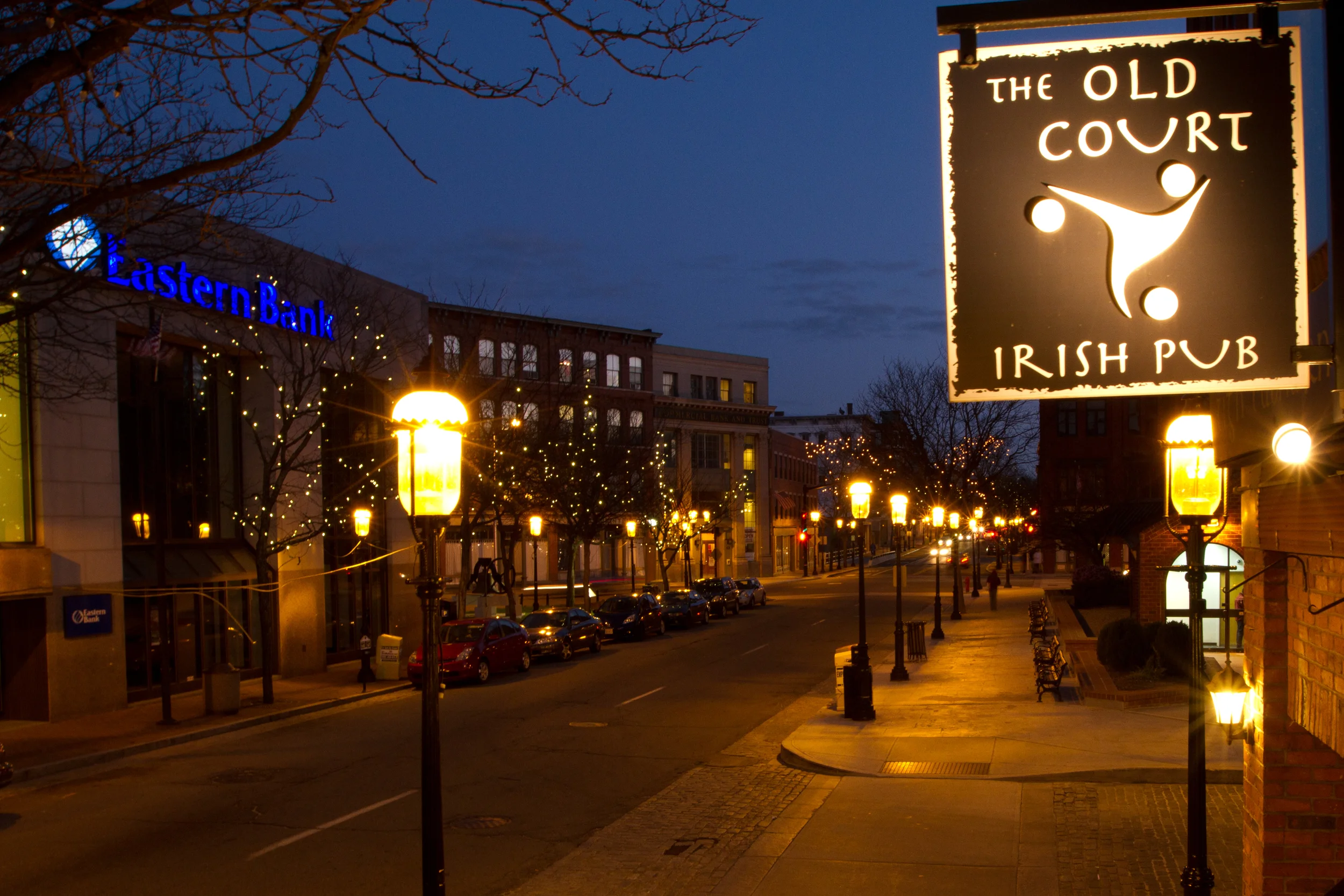
Letter from the (Web) Editor: Assignment's Winter Reading at The Old Court

During the past year, what I've noticed most in the writing submitted (accepted or not) to Assignment is the haunting presence of place-as-character in nearly every piece. We're still a small, local publication with traffic mostly in northeastern New England. Our contributors are primarily based out of the Massachusetts-New Hampshire area. We've had contributions written about the backyards of Manchester NH, the marinas of Newport RI, the barcrawled thoroughfares of the Merrimack Valley in central MA. In each piece, there's this overwhelming sense that the story's keystone character is not the narrator's consciousness, but the setting through which it travels. This is true for our first print issue as well: post-9/11 Manhattan (more specifically, a Portugese restaurant), the slums and suburbs of Pittsburgh, and the changing neighborhoods of Brooklyn dominate their respective stories.
Because of this, we had the idea to unite Assignment's Bay Area (Boston's Metrowest) writers for a small reading at someplace local. There, we'd celebrate some of the mag's Massachusetts-infused writing. I'm thrilled to report that myself, Online Only contributor David Moloney and good friend of the magazine Ted Flanagan will each read from some of our work on December 30, 2015 at 7:00PM at The Old Court (upstairs) in downtown Lowell, MA. The three of us are, also, either a current student or graduate of Southern New Hampshire University's MFA in Fiction and Nonfiction, which most notably saw two of its faculty members nominated for 2015 National Book Awards. Assignment's editor and SNHU MFA's director, Benjamin Nugent, will moderate the event. Admission is free, but we'd love it if you'd buy a beverage from the bar to support the venue.
Whenever I'm at a reading, I'm reminded of the last lines of Ben Lerner's 2011 novel, Leaving the Atocha Station. It is my favorite paragraph in all of American literature (it's also my favorite novel). The story chronicles the various relationships and artistic misgivings of its protagonist, Adam Gordon, an American poet, during his time abroad in Madrid on a prestigious research fellowship. In the final scene, Adam is preparing to read some of his recently published poems to a large audience in a skylit art gallery owned by one of his peers. Earlier in the story, he read at this same gallery, but did so while battling a crippling episode of panic.
Much of the novel's conflict is anchored in Adam's anxiety, as well as his warped perception of himself and how others in turn perceive him. Each of these internal tensions is at times exacerbated and mitigated by the language barrier between he and his Spanish friends. He often leans on his inability to translate English thought into Spanish speech as a conversational exit strategy when things get awkward. It also functions as the excuse he uses to rationalize why he can neither communicate with nor understand the depths of the several Spanish-speaking lovers he takes during his tenure abroad. The concepts of both concrete and abstract translation--literal and figurative--thus factor heavily into Adam's character arc: he struggles to translate the inner workings of his soul into his physical self, into the physical moment, into his relationships with others, into thought, into speech, into English, Spanish etc.
One of Adam's friends/lovers, Teresa, spends a great deal of the novel translating the poetic contents of his notebook into a cohesive Spanish chapbook. She eventually uses the press at the art gallery to publish the finished product. It is, arguably, the grace with which Teresa shuttles between her Spanish and Adam's English--her world and his previously inaccessible internal one--that has ushered the novel to this conclusion. Teresa is at Adam's side in Atocha's final scene, as the two of them prepare to read to the audience at the release party for the chapbook. The last paragraph is only two lines:
'Teresa would read the originals and I would read the translations and the translations would become the originals as we read. Then I planned to live forever in a skylit room surrounded by my friends.'
In those penultimate moments before the reading begins, the barriers that once separated Adam from Teresa and his other Spanish-speaking peers shatter with absolute finality. Perhaps, too, this helps bridge the gap that disassociated Adam from himself. In that gallery, he experiences some form of self- and communal love, and so the novel ends.
Whenever I attend readings I am, without fail, transported to Adam's skylit room described here. It is (and readings are), above all, a place of profound and unfiltered community. And so at the end of Assignment's setting-heavy year, there's no other environment where I'd rather celebrate our publication and its supporters than at this reading, in that figurative skylit and eternal place.
We at Assignment hope to see you at The Old Court on Dec. 30. We'll be upstairs, in a barlit room, surrounded by our friends.
- Daniel Johnson
We would like to thank The Old Court for hosting us. If you’re attending, please be sure to buy a beer and tip the bartender.
Please contact Daniel Johnson, Assignment's Web Editor, with any questions. For more details, refer to the event's Facebook page here.
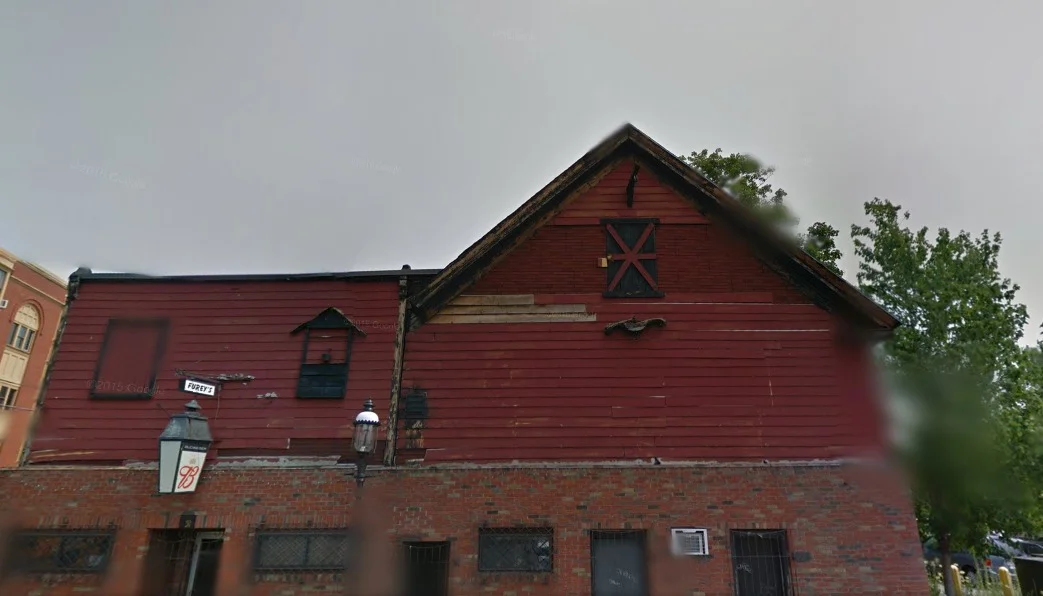
Saturdays at Furey's
by David Moloney
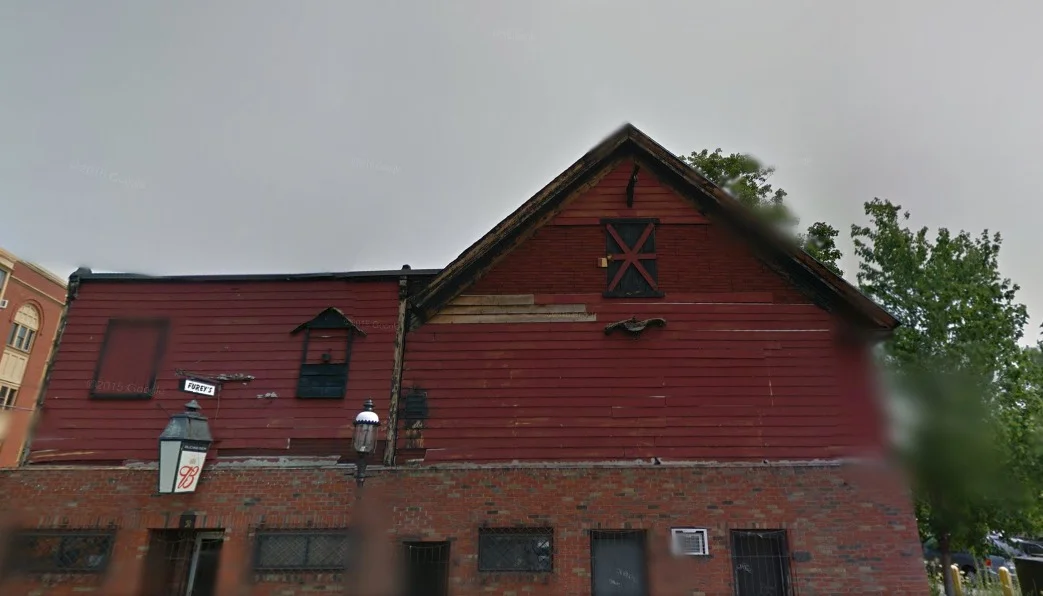
Whenever we would pull up along the littered sidewalk outside Furey’s Cafe on the outskirts of downtown Lowell—me in the passenger seat of the mini van, my father driving—I always got a sense the brick building was closed. There was nothing on the outside inviting customers to stop in, no neon signs, doors propped open, teasing music to passersby. The black doors in the front of the building were gated and padlocked.
We went on Saturday afternoons. I’d follow my father inside the side door and I’d hurry past smoking patrons seated in the shadows of the café and up to a stool at the bar. Peg, the bartender, would fill me up a coke and start the grill behind her. She was the mother of a kid who was in the same bowling league as me, so the connection with someone I knew made the entrance to the otherwise dark bar on a well-lit Saturday not so strange. Any anxiety I might have felt was also mitigated by the safety of my father’s presence, who had brought me along, as if he thought showing me his money drop-off for the bar’s weekly football pool would make it all cool and familiar to me, as if introducing me to the men he drank with and the bartender who answered the phone when my mother called asking where he was would help me settle in while he paid his tab and checked his numbers.
Peg made huge fatty burgers over an open flame, a tall mound of twice fried hand-cut French fries with a pickle laid across the plate. I’d get it well done; my father would order a beer. The TVs mounted to the ceiling were all on a sports game or car race of some kind. The owner, Al, stood at the end of the bar, seemingly uninterested in anything but the TV in front of him. He would take drags on what seemed like six cigarettes at a time, filling the tiny bar with lung crushing smoke.
There was a regular, Brian, who leaned on the bartop and always welcomed us when we came in. He made me laugh, and I lingered his way when my father got caught up in conversation. He wasn’t shy about cursing in front of me or telling me crude jokes He prided himself on not putting a comb or brush to his hair in six years. When I first met Brian, he was in the midst of the uncombed streak that I found impressive, as much as a twelve-year-old boy could be impressed. His hair was short, seemingly cut on the regular, so when I asked him if the barber ever put a comb to his hair he told me no. He forbade it.
Some Saturday’s, once we left Furey’s—my father with his squares sheet that would go up on our fridge, me with a full stomach—we’d stop by his friend Lyman’s house on Temple Street. Lyman was a heavy set Irish man with a small apartment filled with baseball cards and clunky, primitive, pre-Bose surround sound speakers. He drank beer with my father, talked about sports, put Top Gun’s opening scene on, and cranked the speakers to show their might. I watched Sosa chase McGuire, then McGuire chase Sosa, with Lyman and my father.
Even after I stopped riding in the minivan to Furey's with my dad, after I once went there myself with a friend promising him the best burger in Lowell, I probably still thought about Brian and Lyman more than I realized. In my early twenties, I sported a similar hairstyle as Brian, made claim to an uncombed streak that would have made him proud. And though mine lasted only two years, I went the step further by never getting a haircut. At the time, I felt the misguided, immature pride I imagined, during my youth, Brian must have felt. I made sure to let everyone know about it. I’d sit with my long, curled hair, knotted, with a beer, and watch Top Gun on a cheap surround sound set, an attempt to relive the days in Lyman’s living room. I cursed Bonds each time he made it look easier than Sosa and McGuire ever had.
I never really processed why I was following the footsteps of men like Brian and Lyman. Maybe if my father brought me to an artist’s studio when I was twelve instead of a bar or a man’s lonely apartment, say, to pay down his layaway on a painting of the Lower Locks canal, I may have taken up painting, drank tea, and smoked a lot. Instead, I grew out my hair, drank in bars, bet on football, and enjoyed my burgers only over a flame.
My father surely didn’t anticipate me being impressed by these men. He could not have seen that in my youth I was dissecting my accompaniment as his attempt to impress upon me the traits he sought out in a friend or companion. The visits to these places preyed on my pubescent values; sexual humor, good food served by a mother, the sanctimony of beer, sports, loud noises. It was not his fault, but a culmination of factors that all seemed to work together, to formulate a brain soft and pliable, like fresh Play Dough. A poorly assembled, in-person guide on how to make friends.
When I turned thirty, I did some self-reflection into who I was and how did that happen. Thirty is a milestone year and as a male in a telescopic, individualized culture, I found myself in a state of reflection I couldn’t shake. I am in no way claiming the things that shape us can be found in the people we met as kids, or can be narrowed down to a few Saturdays from the thousands of days from our childhood. But impressions, being impressed upon--those can have a lasting effect, one that can shape us into something we never intended.
There was one cold, weekday night some time ago when I drove through downtown Lowell, past the canal, the mills. The restaurants and bars were all but empty and I saw Brian stumbling on the cobbled streets of Lowell, the buildings serving as a wind tunnel, directing him ahead, his hair wild and uncombed in the breeze. He’d taken up smoking. A part of me wanted to pull up next to him, offer him a ride and ask him how long the streak lasted for. But I’d been drinking myself and there was no eagerness to extend my trip. Brian would be out of the way, I told myself. There was no way he wouldn’t be.
My Brief Affair with an '85
by Eric Beebe

Back in 2005, Lowrider Magazine was full of three things: scantily-clad women, classic cars inches off the ground, and the wisdom of the men who had attained both. Between the hype of Grand Theft Auto and my love of rap videos, I assured myself at twelve that these three things were the keys to success. The dream was fixing up El Dorados, Impalas, and Coup DeVilles to cruise low and slow around town.
My grandma’s old ’85 Chevy S-10 was the closest thing within reach to a real lowrider. It was lower to the ground than most trucks like it I’d seen and would technically be an antique by the time I could drive it. The cab’s sun-bleached maroon interior was full of trash, and the ash tray still held an old cigarette butt or two from the years my grandma drove it. The grill was a matte grey plastic begging me to be replaced with metal and chrome. There was still a warped, dented section of the back bumper where my uncle Donald had once backed it into the barn my grandparents used to store trash and their lawn mower. I planned to restore it with his older brother, Kenny.
Worktimes flexed around Kenny’s night-shift sleep cycle and my juvenile aversion to scheduling. Set plans didn’t always succeed, but sometimes when I made spontaneous appearances at my grandparents’ house looking to work, my grandma would wake her son from his slumber. But our definitions of that work didn’t always align. I was a teenage idealist that saw every chain-link steering wheel and 8-ball shift knob in a magazine as something I could add to my ride, which might eventually make the S-10 worthy of car shows, music videos and a spot in Lowrider. Kenny, on the other hand, saw the semi-functional, forgotten machine losing its battle with rust under a tarp tent. When he taught me how to cut through steel with the blue- white blast of an oxy-acetylene torch, our thoughts were polar opposites. Mine: I can totally chop the top of the truck with this! His: there’ll be lots of bolts too rusted to unscrew.
One day Kenny and I removed the liner from the truck’s bed to reveal years of dirt and sediment piled over the neglected metal beneath. A nest of twine from one rodent or another lay balled up against the wheel well, so all I could think about when he handed me a broom was rat shit. He told me to get sweeping while he worked on the engine. I brushed the dirt out in shovel- worthy loads while my uncle screamed at parts under the hood and beat them with a wrench if they stumped him.
By high school, I had given up on the truck. I couldn’t pin it down to one reason why. Any time Kenny brought it up, I was always too busy with homework or the football team. I’d only joined to follow some friends, and after my parents’ coaxing. At that point the only people in school who cared about their cars the way I had were the same ones who bought the most expensive sports gear they would outgrow in a year, or the ones the shop teachers had to cut off after too many classes. The workings of cars remained arcane at best to me, and any less was menial labor. I found more satisfaction in the creative power of pen and paper than a wrench. My teenage libido found more pleasure in internet porn than it ever did with the ladies of Lowrider.
Once it became apparent I’d moved on, my grandparents paid to have the S-10 fixed as a gift. I wore the truck down, busted the illegal brake job from Kenny’s chosen mechanic, gave the back bumper an uncanny experience with a boulder instead of a barn, and drove it over every parking lot median I didn’t care to abide. I eventually handed the truck down to my brother with the door strips falling out and decals peeling off its sides.
By the time it was my youngest sister’s turn to inherit it, she all but refused. Between my dad using it for hauling mulch and the family history it had, we didn’t sell the S-10, but it barely had a purpose anymore. We gave it a spot behind the unkempt berry bushes in the back corner of our family’s property, where year by year it recessed into a canopy of birch and oak, nearly invisible to the world.

Two National Book Award Nominations, and a New Novel
Crossposted from our MFA in Fiction in Nonfiction homepage
These first few weeks of autumn have brought some exciting news to Southern New Hampshire University's MFA faculty. First of all, we’d like to congratulate to our newest faculty member, Angela Flournoy, whose debut novel, ‘The Turner House,’ has been long-listed for the 2015 National Book Award in Fiction. Also our affiliate faculty member Sy Montgomery, whose book ‘The Soul of an Octopus’ has been long-listed for the award in nonfiction. Angela and Sy are each one of ten finalists for the award in their respective categories.
Angela has also been nominated for The National Book Foundation's Five Under Thirty-Five award.
We’d also like to congratulate Chinelo Okparanta on the launch of her highly anticipated debut novel, 'Under the Udala Trees,' which came out this past Tuesday. The novel chronicles the story of two girls who fall in love against the backdrop of the Nigerian civil war. Chinelo was born in Nigeria and lived there until she came to the United States when she was ten. The Wall Street Journal says the novel ‘draws on the Nigerian folk tales from her childhood, and her family history.’ Kirkus calls Chinelo’s voice 'masterful.’
Acclaimed novelist Taiye Selasi, author of ‘Ghana Must Go,’ writes: ‘Under the Udala Trees interrogates constructions of womanhood, of nationhood, and of sexuality. In these elegant folds of restrained prose lies a searing condemnation: of violence, religion and patriarchy in modern day Nigeria. Raw, emotionally intelligent and unflinchingly honest, Under the Udala Trees is a triumph.’ Selasi joined Chinelo at the book launch event on Wednesday, September 23rd at Housing Works Bookstore Café in New York City at 7PM.