
Sitting In the Silence, an interview of Jami Attenberg by Maurice Carlos Ruffin

The Interview with Jami Attenberg.
The creator of #1000wordsofsummer.

In continuation of the new series featuring excellent newsletters by authors (either on substack or tiny letter) — here is another example by Maurice Carlos Ruffin, who kindly authorized us to run this piece (which just went out to his subscribers) at Assignment Magazine.
Craft assignment: Read your favorite author newsletter and construct your own epistolary essay, either in the relatively intimate, informal language of these types of newsletters — or in a more formal language, or like a political pamphlet, or like textbook chapter, or like a set of instructions. Enjoy! and see subscriber link below if you want to read more issues of the newsletter.
Author Bio for Jami Attenberg: Jami Attenberg has written about food, travel, books, relationships and urban life for The New York Times Magazine, The New Yorker, The Wall Street Journal, the Sunday Times, The Guardian, and others. She is a New York Times bestselling author of seven books of fiction, including The Middlesteins and All Grown Up, and, most recently, a memoir, I Came All This Way to Meet You: Writing Myself Home. Her work has been published in sixteen languages.
Her debut collection of stories, Instant Love, was published in 2006, followed by the novels The Kept Man and The Melting Season. Her fourth book, The Middlesteins, was published in October 2012. It appeared on The New York Times bestseller list, and was published in ten countries in 2013. It was also a finalist for both the Los Angeles Times Book Prize for Fiction and the St. Francis College Literary Prize. A fifth book, Saint Mazie, was published in 2015 and has been optioned by Fable Pictures. Her sixth book, All Grown Up, was published in 2017 and was a national bestseller, appearing on numerous year-end lists. Her most recent novel was All This Could Be Yours (2019), and also appeared on a number of year-end lists, and for which Kirkus dubbed her, “poet laureate of difficult families.”
Her memoir, I Came All This Way to Meet You: Writing Myself Home, was published in January 2021 by Ecco Books and Serpent’s Tail (UK).
She lives in New Orleans, LA.
Author Bio for Maurice Carlos Ruffin: Maurice Carlos Ruffin is the author of The Ones Who Don’t Say They Love You, which was published by One World Random House in August 2021. His first book, We Cast a Shadow, was a finalist for the PEN/Faulkner Award, the Dayton Literary Peace Prize, and the PEN America Open Book Prize. Ruffin is the winner of several literary prizes, including the Iowa Review Award in fiction. A New Orleans native, Ruffin is a professor of Creative Writing at Louisiana State University, and the 2020-2021 John and Renee Grisham Writer-in-Residence at the University of Mississippi.
Hello to new subscribers and welcome to Sitting in Silence, a newsletter for readers, writers, and thinkers. The Interview has become a popular feature for the newsletter. I love talking to writers of all stripes regarding their journeys. They never disappoint. This issue’s conversation is with Jami Attenberg.
Jami Attenberg is the bestselling author of many books in multiple genres, including her latest, I Came All This Way to Meet You: Writing Myself Home, which is now out in paperback. You also know her as the creator of the worldwide writing phenomenon #1000wordsofsummer. She is a dear friend. Jami is one of the kindest people I know and works diligently for her community in New Orleans. We first met around the publication of her novel, All Grown Up, but I feel like I’ve known Jami for decades.
Special note: Sitting in Silence has an app now! iPhone users are invited to download the app today.
And now for our talk…
Maurice: What are your earliest memories of reading or writing stories?
Jami: My earliest memory of reading was actually off the back of cereal boxes, probably when I was around four years old. That was how I learned to read. I don't remember much about children's books necessarily, or even being read to, but I recall loving D'Aulaires Book of Greek Myths, being deeply fascinated with it, and also tearing through my mother's crumbling collection of Nancy Drew mysteries. My mother used to take me to the library for hours and I zoomed through everything in my age range. I also loved collections of old comics I would find at the library, like a hundred pages of Little Orphan Annie, and just being fascinated with learning her backstory. I started writing stories myself when I was five years old, and because I received praise for it from my teacher and my mother -- I think an early story won some kind of competition -- it made me want to write more. It was nice to feel like I was good at something. I also think I felt satisfaction at creating a beginning, middle and an end to something. I liked solving the problem of a story.
Maurice: Yeah. I think we underestimate the importance of encouragement in our writing lives. When did you know that you were a writer? Did you have early role models? What was an early move you made to create the writer we know today?
Jami: I don't know if there was a cross-the-threshold moment that I knew I was a writer exactly. And perhaps I don't even know what it means to be a writer, although I do know it's a thing you need to claim for yourself if you ever want to pursue it. People are afraid to say it out loud, but really anyone can do it, and enjoy it, and benefit from it, even if it's not what they do for a living. There is perhaps a leap from "trying to be a writer" and "being a writer" that comes with selling your work for a while, essays, short stories, journalism, a first book. But I know plenty of people who don't receive financial remuneration for their work that I would consider a writer.
I'm not really answering your question here though. So, let's see...I suppose in high school, I knew that I was good at it, better at it than anything else I was doing. It was the thing that interested me the most. I was editor of the school paper, participated in after school writing programs, and was very luckily in a community that had a solid educational program to support my interests. My first creative writing teacher was a man named Tod Lacey, and he was extremely encouraging. I think I wrote to impress him.
I got an undergrad degree in creative writing, but I did not necessarily pursue being a writer doggedly until my late twenties, early thirties. Not in that "always be submitting" way. I didn't feel like I fit into that conventional mold. The way I found my voice was through the zine scene and then also through the internet. Just really diving into voicey first person kind of stuff, it was helpful to finding my way to the way I write now.
Maurice: Can you talk more about your "diving into voicey first person kind of stuff?" I remember after we first met, and you graciously handed me a copy of All Grown Up. I recall lying in bed reading that one and thinking, "why do I feel like I'm completely inside this main character's head? Is this safe? Will I be able to make it back out? LOL" The point being that you have such a gift for putting intimacy on the page, which is so hard to do. It's such a pleasurable experience for the reader. And you do it so well in all of your books! How do you do it?
Jami: I just write the characters till they sound like someone I know or would want to know or maybe would meet sometime. I have been traveling these past two weeks and meeting and observing lots of new people and have been thinking about how everyone shows you their weirdness eventually. If you keep talking to people long enough, they'll let something slip. And that's the stuff I'm interested in. So, I just keep writing characters long enough until they show me their weirdness. I write conversations they have with other people even if I'll never use it in the final text, just to see what they would say. I put them in different situations that have nothing to do with the story I'm telling. I think it's just about churning out scenarios and bits of dialogue and letting them walk around and stretch their legs in the world, and that's how I can observe them and also get inside their head.
Maurice: You have a brilliant new memoir called I Came All This Way to Meet You: Writing Myself Home, which everyone is raving about. You've written many books in the past, but I believe this is your first non-fiction book. I imagine it's a different kind of challenge to produce that same sense of intimacy where you are the subject. Did you have to find your own weirdness to get it done? And the structure of it is fantastic. How did you decide on the structure of the book?
Jami: I am definitely weird, and the book is in part about that weirdness. All artists are weird, I think! My challenge was really to figure out how to dial it back enough to be consumable. In terms of the structure, I just dumped all the words I had into one big document and kind of dug my way out from there. I knew I had to create a bigger narrative arc out of all these smaller narrative arcs contained within these important moments and ideas from my life. It somewhat follows a linear timeline although I move around a bit within that timeline. Mostly I think it was about figuring out my personal growth arc, and how to represent that best -- sometimes that doesn't always follow a linear path, though. Important moments can show up in our lives and we often don't or can't recognize them till years later. Also everything in our lives -- past and present and future -- is sort of always happening at the same time anyway. I just felt my way around instinctively to figure out the best path for the information. In my mind there is a clear beginning, middle, and end to it all, though.
Maurice: Tell us about some of your favorite things.
Jami: You know I love books, love having piles of them everywhere in the house, but also I love giving books away so I can make room for new ones; that feeling of making room for the new is quite satisfying. I love writing, doing it and being done with it and then reading it and editing it and then re-reading it, because I love it when I write something beautiful or new (for me) or emotionally true; it really gets me in the gut when I'm at least a little bit good at my job. I love New Orleans, this city you and I both share, Maurice; for better or for worse, I love this complicated and beautiful town. I love big meals with friends, organizing them and having them both. I love really cold white wine on a hot summer day. I love swimming in the ocean. I love my little house. I love my dog.

Three Poems, by H. L. Dowless


The Newage Canny Courtesan
Queen of liars,
Playing the world for a fool,
Living life to her advantageous design by the hour,
With the bordello being her primary school.
Saying she legitimately works when she hasn’t,
Turning tricks for those who will and can foot her bills.
When she can’t deceive her parents,
She masterfully plays all of the deceptive deals.
Living a fantasy as a mythological princess,
Drifting along from day to day,
Tactfully ignoring her consequential incidences,
While she designs to have everything her own way.
She finds a man with a dream job or gilded salary,
Talking him into financing her delusional lifestyle.
Should he even glance her way sourly,
Then she visits another accommodating man for a while.
The flower of youth,
Combined with a flagrant display of suggestive innocence,
Sways even the most educated of minds,
Forsooth!
But honorable men must be dutiful tenements of their own
Circumstance,
Lest they become victims of this manipulating happenstance.
The many drinks,
The late night dinners,
The innumerable vigorous bedroom sessions
causing her to wince
And blink,
Her grotesque illusions of losers and winners,
Slowly motivates youthful flowers
to wilt and sink.
Then she shall find the entire world
so cold,
Everybody ignoring her urgent sway,
She withers,
And sulks,
As she molds,
While she sits one fine day all alone on a park bench,
Praying for a future redeeming day.
It’s a Long Way to Nowhere
I’m on a lifetime trip,
don’t know where I’m gonna go,
gotta get a grip,
need to take it slow.
Its a long way to nowhere,
even when I fly high in the sky,
moving from day to day without a care,
no natter how hard I try.
Where am I going to?
What town will I wind up in?
What am I gonna do?
Will I ever win?
My surroundings have changed so much,
everybody seems to die,
since I have failed to keep in touch;
don’t know the reason why.
Its a long way to nowhere.
I’ve been headed there for fifty four years,
drifting along without a care,
in spite of my dear mother’s tears.
Every move is only a dead end,
can’t build a stable life,
many insurmountable problems to attend,
times are filled with strife.
Its a long way to nowhere.
There’s no incentive to try.
I’ve lost the desire to even care.
How much more time might I buy?
I’m running deep down into the valley of light,
transcending through shades of gray,
though I try to fight it with all my might,
I only make it into the following day.
When will this great journey to nowhere ever end?
Will I find my fortune or my grave?
Where lies the ancient oracle I might attend?
How may I find my golden wave?
Its a long way to nowhere,
feeling good at the moment,
drifting along through thin air,
hoping for a revelation that is heaven sent.
When My Day Comes
When I have my final say,
will it fall on any ears?
When I have my last play,
will I receive any last cheers?
Will the night be thunder and lightning,
with the heavy rain falling down?
Will it be during day time brightness,
with butterflies fluttering all around?
Will they carry me through gardens of daffodils,
and o’er acres of enrapturing poppies?
Will my pal bearers shudder with chill,
or in the heat of the sun be hopping?
Will the angels welcome me in,
when I walk through the pearly gates?
If they don’t might I begin again,
before the passing time is too late?
If I don’t like the other side,
can I come back here?
One more pass through shall grant me a perfect try,
without any unreasonable fear.
Will I get another chance to be with you again,
my love?
May that sweet night never end,
my precious dove.
When they lower me down,
will I be there watching?
Might there be many a frown,
as my draped coffin is dropping?
Will you be there nearby,
my love,
with tears overflowing from each eye,
like rain falling from above?
When you have your final word,
have you thought about what you shall say?
Will it be the most delightful I’ve ever heard,
when they lower me down on that day?
Bio: I am a school teacher who you may meet anywhere, worldwide. I enjoy hunting, camping, fishing, hiking, big game hunting, archaeological excavation, and traveling, as well as living for the adventure of life in general. I am just as apt to meet you while on a huge cruise liner out on the high seas, as much as run into you while on land. I look forward to meeting YOU at the next art show, or literary event! Either I show up in person, or my work does. Stay tuned to my page for details as the time nears.
From Busted; a memoir excerpt by Sabrina Lee

A blizzard had just blown through Toronto the night my father surfaced. While I still had a head full of baby teeth, I remember that he rang the doorbell of our drafty, three-story stucco rental. I also remember that before we had a chance to see who it was, he was able to let himself in because neither of my parents could be bothered to lock the front door, even after we were robbed a year later. There was a menorah on the mantle and a Christmas tree tucked in the corner, away from the windows so our Rabbi wouldn’t spot it on his walk to Saturday services.
We had not seen my father since the summer. Now he stood at the threshold, his bronzed, hairless head spattered with melting snow. He didn’t say hello and he didn’t yell at my mom about the Christmas tree. Instead, he announced he’d slipped on the ice.
“I think my hand is broken.”
Then he stiffly lifted his injured arm like he was being sworn in. My mother made a face that at the time I didn’t recognize, but now understand meant she believed in the universe’s power to administer justice.
A loud silence bloomed between them in the foyer, so my three sisters and I did what kids do. We filled it: squealing and hopping around in our matching zip-up pajamas with pink plastic feet. We took turns pulling at our dad’s good hand, trying to lure him to the attic so he could see for himself that Boris and Morris turned out to be Boris and Doris and now there were ten mice instead of two. But we were sent to bed, and that night Sarah and I were cheated out of our usual routine. No story. No mom aglow from the Paddington Bear night-light and no dawdling in our room while Sarah and I did our best to make her laugh, which was surprisingly easy. Later that night I snuck out of bed to get an extra hug and was confused to find my mother’s bedroom door not only closed, but locked.
My father’s hand was not broken, and the next morning he was tasked with taking us sledding. Despite that according to my mother he was forgetful about sending money, we somehow always had expensive clothes like down snowsuits with real fox hoods. (Maybe she shopped on credit, something she did to excess when I was in high school to punish my dad whenever she found a phone number in his jeans pocket.) No matter how behind we were on our rent in Canada, we always looked like we had plenty of money. I realize now that my father likely relished this fact because more than he feared being poor, he feared seeming poor. Therefore, it must have been with some measure of pride that he led his four well-dressed daughters two blocks down the street to the local sledding hill.
He walked too fast and too far ahead to hold anyone’s hand, leaving us alone to drag the plastic sleds along the snow-packed sidewalks. From behind I watched him in his Adidas running shoes and grey wool overcoat with no hood. I wondered if his head was cold because even though the sky was a robin’s egg, the wind was sharp on my cheeks. Once we arrived at the bottom of the hill, already crowded with parents waiting for children to descend, I observed that my father was among the tallest. I remember thinking that very tall man is my father.
Looking back at how things played out that day, something that still confounds me is why anyone would place an immense stone water fountain at the bottom of what served as a sledding hill for more than half the year. I’d even bet whomever at the Toronto Parks Department made this decision was subsequently fired. But the fact is the fountain was there, and although my father was the kind of dad who instructed us as small children to cross the street against the light (which often included sprinting to “beat” the oncoming traffic), even he had enough sense to smell danger.
“You see that water fountain? DO NOT crash into it.”
We stared at him, still getting used to the sound of his voice.
Then, “Do you understand me?”
Jodie spoke for all of us and gave the desired answer, and soon we were scrambling up the hill, probably a hundred feet to the top.
Jodie and I descended first—I was too young for my own sled, or we didn’t have a fourth—and with my arms wrapped around her pillowy snowsuit and my head trying to peek above her right shoulder, we shared a gleeful if uneventful ride to the bottom. Miriam, a year younger than Sarah and equally capable, followed—bouncing out of her sled at the bottom and giggling as she dragged it away. There must have been other children descending the hill at that time, but those details did not make the cut as they had nothing to do with what happened next.
As soon as seven-year-old Sarah began her downward journey in the purple plastic toboggan, it was apparent she was having difficulty controlling it. Was there too much ice, the sled too big, or she too small? To this day she’s unsure, but soon she was flying with the sled swiveling at 90-degree angles against the hillside and threatening to turn completely backwards. And of course, it was heading directly for you-know-what.
Because Sarah is still with us, I have to surmise that the terrible cracking when she made impact was the sound of the sled and not her skull hitting the stone facade. She tumbled out as if from a car crash and remained there, lying face down in the snow, crying hysterically. Watching her I got a pinch in my chest, then something turned and tightened underneath my ribs like it does when something bad has happened and it’s about to get worse. Jodie and Miriam froze.
Not my father, however. He marched over to Sarah and as she lifted her head to meet his gaze, bent over and slapped her hard across the face.
“I told you not to hit that water fountain, idiot!”
Luckily my father was wearing mittens and no doubt Sarah’s giant fur hood shielded part of her face, so the physical insult was not as bad as the emotional one. Still, I think that’s when I started crying too, although silently, and reached for Jodie’s hand. It was the first time he or anyone had ever struck any of us, and I remember being scared that getting hit was something new I needed to be worried about. While at that point he was just a stranger visiting, I figured he’d be back.
Without another word, my dad turned away from us and headed toward home. Sarah called to him—begging him not to leave, promising never to crash into the water fountain again. But he trudged through the snow like he was late for an appointment and never looked back.
Sarah rolled onto her back, face pointed toward the sky and arms extended away from her torso to form a perfect T. She murmured “Daddy” over and over, even when she saw it was me kneeling at her side. I noticed one cheek redder than the other against the white snow, and in that instant something in my five-year-old gut shifted. At the time I didn’t understand, but it’s likely that was the moment when my center of gravity began tilting toward Sarah and away from my dad. She needed me; my father needed no one.

Sabrina Lee has been telling stories for most of her life. Previously a professional modern dancer and an Emmy-nominated documentary filmmaker, she recently put pen to paper at the urging of her siblings who feared the strangeness of their childhood would be lost. She’s currently pursuing an MFA from Mountainview’s Nonfiction Writing Program and her work has appeared in Duke Magazine and Hippocampus. Sabrina lives in Montana where she breathes plenty of fresh air and shares a lumpy backyard with a family of prairie dogs.
Android Memoirs, an essay by John Gerard Fagan

Android Memoirs – An Envision of the Future
By John Gerard Fagan
If the world somehow survives all the shite humans are doing to it just now – we don’t destroy the rainforests, fuck up the oceans beyond repair with plastic waste, eat all the fish and other defenceless animals, and create more deadly viruses that wipe us all out, then maybe, just maybe Artificial Intelligence will develop enough capacity to give us android writers who would open up a whole new level in the literary canon.
Yes there are novels, stories, and songs in existence today that were written by AI, and This Artwork Does Not Exist already has brilliant paintings done solely by AI, but what I am particularly interested in here is an AI that is a complete entity into itself and, while capable of a variety of fiction writing would be brilliant, one that is able to write a memoir about its own life would be the capacity to aim for.
Having just gone through the process myself writing my own memoir, Fish Town (2021), it is a lot different to writing a novel or a short story and in a lot of ways more complex, as you are mirroring the truth of the past with an imperfect memory. I lived in a Japanese village and felt, and was sometimes treated, like a Xenomorph that boarded his very own Nostromo, but my memoir about a stranger in a strange land is all together very human. An android would not only give us a completely different insight into another form of existence in the world from that of a human, and span far longer periods of time, but their memories would also be perfect. There would therefore be no grey areas and we would have access to something we have never had before. They could even come up with many new and creative ways in how to
write memoirs. I wrote Fish Town on my phone in free form with fragmented sentences, but an AI could give us a real taste of the avant-garde that is still readable and accessible on whatever devices we will be reading on in the future.
The possibilities in this field are endless for non-fiction books. We could have an astronaut android programmed with Kerouac’s style write a memoir about their solo space mission towards a black hole, a Bukowski-esque android living in the Antarctica writing about life in an Antarctica post office over hundreds of years, or even something like a droid programmed like C-3PO writing a memoir about living as a butler to generations of families.
This would not and should not be limited to humanoid androids – animal droids of all kinds could be designed and sent to live in the wild and give us richer insights of these worlds. Me Cheeta (2009) gave us a fictionalised autobiography written by a famous movie star chimpanzee who starred in several Tarzan movies; something that is fascinating but sadly impossible in reality. But an android could be able to do this for real. We could get massive insights into the lives of sea creatures. For example, a dolphin memoir told by an android dolphin who looks and acts like a dolphin but can communicate back to us this existence of living in a pod out in the Atlantic Ocean. Or even a honey badger memoir about its life fighting deadly snakes and generally not giving a fuck – that is a best-seller right there.
While the hat given to Guenter the monkey in Futurama (1999-2013), which makes it super intelligent and possess a human level of self-reflective consciousness, could be a possibility too and animals like Cheeta the Chimp of the future could possibly tell us about their lives via this method, I’m betting on the androids getting there first. And it would avoid any
malevolent animal testing, which would no doubt have to happen with an intelligence device of that kind.
If we make it to this kind of envisioned android future, where androids are used in beneficial literary ways, not as a T-1000 from the Terminator 2 (1991) film or the Nexus-6 in Do Androids Dream of Electric Sheep? (1968), then people should not be afraid of AI writing replacing them. The human memoir will always remain popular as, unlike the android kind, will be relatable on a level that cannot be replicated and can guide people through journeys they might take themselves in the future, or simply provide a mode of escapism. Androids could benefit literature and their memoirs will just add depth to the genre. If this ever happens, I hope it would be embraced.
Bio: My name is John Gerard Fagan. I am a Scottish writer and author of Fish Town, a memoir about living in Japan. I want to explore the possibility of humanoid androids adding to the literary cannon by writing their own memoirs and take it further with the idea of what animal androids could bring to the table too.
Craft in Brian Doyle's Mink River, an essay by Julie Gabrielli
Entanglement and Immersion in Brian Doyle’s Mink River
Introduction
This essay studies how four of Doyle’s inventive techniques create a language of animacy and entanglement: stories of ancestors impart timeless wisdom; character points of view alternate sentence by sentence; everyone in town is joined by the humble act of kneeling; and a bear and a crow share their unique perspectives. This study focuses on Part I, chapters 43 through 47 (68 – 73).
In the essay, “Politics and the English Language,” George Orwell observes that good writing requires deep inner attention and wordless imagination, but that “If thought corrupts language, language can also corrupt thought.” (Orwell) While Orwell warns about the ways that language can be used not only to reflect but also to control our worldview, writer Paul Kingsnorth goes further to assert that the abstraction of the written word is itself the problem—a stunning confession for a writer:
That language itself—or at least the kind of language we use, abstracted, boiled down into these ink marks—is part of the process by which we desacralize the world. That writing, especially, is a tool of ecocide. (Kingsnorth, “The Language of the Master”)
Kingsnorth points to the elevation of rational, analytical thought over intuition and other ways of knowing. The English language typically serves a mechanized, transactional worldview and prevents us from experiencing ourselves as interconnected with the living earth.
Scientist and writer Robin Wall Kimmerer’s diagnosis includes a speculation that English was coopted as a tool of commerce, removing it from “an ancient Anglo-Saxon intimacy with the land and her beings.” She writes, “It is said that we are known by the company we keep, and I wonder if English sharpened its verbal ax and lost the companionship of oaks and primroses when it began to keep company with capitalism.” (Kimmerer, “Speaking of Nature”)
In his essay, “Against Nature Writing,” lawyer and author Charles Foster advises writers to “try to use language in a way that subverts its colonial tendencies.” (Foster) In defense of anthropomorphism, he invokes the “vast amount of physiology and evolutionary history we share with nonhumans,” as well as acknowledging that consciousness is everywhere. “We can reasonably infer personhood where there is consciousness, and it is morally mandatory to do so.” (Foster)
Foster’s essay would make a fine roadmap to a close read of Mink River. Many of Foster’s suggestions can be found in Doyle’s prose. For example, the sensory immersion of non-human beings favors sound and smell and avoids metaphor. Readers can trust the world he creates, a world of empathy and respect, because we can trust his words, no matter how unadorned, and his language, no matter how strange. In fact, the stranger the better.
Immersive Engagement of Omniscient Narration
These chapters in Part 1 take place in the aftermath of twelve-year-old Daniel’s bicycle accident. Chapter 35, p.59 sets it up: Daniel rushes home late for dinner. He is fond of speed and risk-taking. The chapter tumbles to a breathless end with a fourteen-line, 181-word sentence of twelve strong-verbed clauses joined by buts and ands and even a few commas to narrate Daniel flying over a cliff. We are left gasping and hanging and wondering how he could survive such a terrible fall.
This event is an example of external causation, which author Matthew Salesses identifies as one way to challenge Western literature’s “project of the individual.” He writes that using human agency to drive plot conveys the idea that the world can be controlled and that the world belongs to us. (Salesses 56-57) Accidents remind us that anything can happen at any time.
The omniscient narration means the reader alone has seen Daniel’s accident. Seven of Doyle’s short chapters follow over eight pages. The others in town go about their lives, an attenuation of action that intensifies the lonely burden of responsibility.
Fortunately, chapter 43 relieves the tension by challenging our assumption of singularity: “One living being saw Daniel fly over the edge,” and that is “a young female bear on her early evening rounds.” (Mink River 68) Shared witness draws the reader and the bear into a relationship that reminds us we are not alone after all. Since we’re here, Doyle seems to say, let’s peek into this bear’s consciousness and see what we find. Doyle employs language to introduce us to the strangeness of bears: “Her name in the dark tongue of bears means eats salt, for her habit of scouring the beach for food.” (68)
The verbs in the first half of this short, one-paragraph chapter characterize this bear (emphasis mine): the bear saw Daniel; she read the New York Times (oh, really?); she is three years old; she scours the beach for food; she sharpens her claws on cedar trees; the walks miles to find the right tree; and she will mate soon for the first time. Most of the content is about eating, not unexpected for a wild animal. Her meals past and future scroll as elaborate lists of wildly diverse beings:
Today she has eaten six young ground squirrels, their mother, several dozen beetles, several hundred salmonberries, and a dead jay. The young squirrels were delicious. Later this evening she will eat two fledgling murres on the beach. . . . She has eaten shark, skate, ray, halibut, perch, cod, cormorant, pelican, gull, duck, heron, salmon, steelhead, tern, sea lion, seal, and gray whale. She has eaten bat, beaver, bullfrog, deer, dove, rabbit, raccoon, and robin. (68)
The second half of the chapter shifts consciousness following the sentence, “She will mate for the first time in about a month, with a bear whose name means only one.” Doyle bridges from third person plural to single sentences of alternating perspectives (emphasis mine):
They will be together for three nights and four days. She will give birth to female twins. He will never see the twins. She and the cubs will leave him in the pearly dawn while he is sleeping. He has never walked on the beach because he believes the roaring ocean is a bear of incomprehensible size. (68)
Finally, the male bear gets three of his own sentences about his birth, his mother’s untimely death, and his subsequent near-starvation. The paragraph ends with another shift of consciousness: “He grew so thin the year after his mother died that two loggers who saw him on a ridge one day thought he was a dog.” (69)
In the book, Building Fiction, Jesse Lee Kercheval distinguishes point of view as more than “a mere technicality, but the choice of who tells the story.” (Kercheval 22) Who tells the story in Mink River? It could be God or Mother Earth or even the river of the book’s title. Or maybe it’s the author Brian Doyle, imagined as an ebullient hiking companion in a Pacific Northwest rainforest.
Though admitting that an “effective authorial voice . . . can help unify a tale, creating a clearer sense of connectedness,” (24) Kercheval cautions against the distancing effect that omniscient narration can have, particularly with modern readers. (25-26)
Craft advice about omniscient narration leans heavily on keeping perspectives neatly sorted. Doyle ignores this with gusto. He cloaks the authorial voice in sensory engagement and action by attaching to his many characters with charming humor, irony, self-effacement, and tenderness—often all at once.
He begins Mink River with an omniscient, cinematic, aerial pan of the town, but within a page and a half, he attaches to an eagle swooping low to pick up—a piece of cardboard. He imagines the eagle as pompous and bombastic: “I am one bad-ass flying machine, this weird flat brown bird didn’t get away from me, no sir, nothing can elude my lightning deftness in the air…” (Mink River 12)
Townspeople are introduced as the eagle flies over. On the third page, the narrator lets us know that there are “so many stories, all changing by the minute, all swirling and braiding and weaving and spinning and stitching themselves to one another and to the stories of the creatures in that place, both the quick sharp-eyed ones and the rooted green ones and the ones underground and the ones too small to see. . .” (13) The sentence goes on for thirteen lines, nearly one whole paragraph, which ends with this question: “But you sure can try to catch a few, yes?”
Thus the reader is on notice that there are many tellers in this story and many listeners, not all human. Doyle’s is a many-voiced, many-eared world, a world of full immersive engagement. His omniscient narration flows from character to character as fluidly as the river at the heart of town.
The Indigenous Mind as Lens
Tyson Yunkaporta’s 2020 book Sand Talk introduces the modern reader to the nuances of the Aboriginal mind, which is rooted in relationships via oral storytelling. He proposes a way for two systems, oral and written, to act as backups for each other. “The only sustainable way to store data long term is within relationships—deep connections between generations of people in custodial relation to a sentient landscape, all grounded in a vibrant oral tradition.” (Yunkaporta 148) He describes five distinct lenses, or minds, that characterize indigenous relationships: ancestor-mind, kinship-mind, pattern-mind, dreaming-mind, and story-mind.
Ancestor-mind “is all about deep engagement, connecting with a timeless state of mind or ‘alpha wave state,’ an optimal neural state for learning,” in which one loses track of linear time and can access cellular memory. (151-152) Kinship-mind emphasizes connectedness: “In our world, nothing can be known or even exist unless it is in relation to other things. . . . We exist to form these relationships, which make up the energy that holds creation together.” (149-150)
Pattern-mind sees systems holistically and to understand complex problems. “It is about truly holistic, contextual reasoning.” (152) Dreaming-mind connects the physical and non-physical worlds through metaphors, connecting abstract and tangible knowledge through the arts and practical action. Story-mind maps knowledge to place, transmits it via narrative, and challenges “grand narratives and histories.” (151)
Together, these five minds guide thought and action from the understanding that everything is interconnected. The following five sections will demonstrate how Mink River applies indigenous minds to modern, written storytelling.
Ancestor Mind’s Collapse of Linear Time
In Chapter 44, Daniel’s father, Owen Cooney, records his narration of family history, a modern nod to oral storytelling. The sound of his father’s voice will have meaning to Daniel. Formally, Doyle’s prose evokes oral storytelling. The chapter is framed by two, single-sentence paragraphs at both beginning and end. The old story itself opens with two Irish phrases spoken by Owen’s great-grandfather Timmy Cooney and closes with another.
The two sentences making up the third paragraph act as an in-breath to prepare for the horrors narrated in the single breathless sentence of the fourth. Owen translates his ancestor’s Irish into soft, poetic phrases: “sailed on the sea of youth” and “shaggy cloak of age” and “remember those who vanished and . . . sing them.” (69)
The fourth paragraph is a single-sentence, relentless panorama of victims named only as familial subjects and objects: brothers, an old man, children, a mother and her daughter, a father, a wife, children again. Common nouns pile up with the corpses: town, shoulders, lives, coffins, painting, food, hands, cauldron, broth, scraps, meat, soup, doctor, months. “The Hunger” and “potatoes” each are used twice, subliminally highlighting the tragedy of starvation. The seven adjectives are limited to the first half: strong young, bent, old, mad, little, boiling, desperate. To balance, the first half has but three verbs: tell, carrying, and ate. The second half evokes unadorned desperation: ram, killed, save, died, opened, found, eaten, giving. (69)
The fifth paragraph is a symphony of repetition: “There were a thousand thousand thousand stories like those stories, he said.” (69) The incantation is prayerlike.
The sixth paragraph uses fifteen short sentences to tell a more detailed story of a man named Scanlon. The first three set the scene: “One time” and “when” and “where” and “It was late in the afternoon.” The specificity of details and economy of language befit a story about a real man in a dire situation. Timmy Cooney “was cutting wheat.” The man “was carrying a load on his back.” “The larks were whistling.” “It was his dead wife he was carrying.” He carried her “in a sugan on his shoulders, a carrying-chair made of rope and knotted tightly to his back. Their little son was walking with him. The wife was wearing a blue cloak and hood. . . .” Timmy Cooney offered Scanlon a glass of milk, which declined. The scarcity of adjectives, dead and blue, and one adverb, tightly, define the harsh reality of the scene. (68-69)
Verb tense is more complicated. Here, we have simple past, past progressive, pluperfect, and even future tense, as the storyteller tells another storyteller’s story of events that happened before the time of the story itself or that had not yet happened. This effect of layering time emphasizes its fluidity: “his wife had been a girl” and “she had died” and “the man had not eaten,” but “would overcome” and “could bury.” (69-70)
The chapter closes with its frame of two, one-sentence paragraphs. In the first, the boy drinks the milk and he and his father continue their journey. In the second, Owen quotes his great-grandfather’s Irish assessment of Scanlon: “his love did not waver.” (70) There are several ancestral lessons in this chapter—the importance of bearing witness, of honoring those who suffered through remembrance, and of offering kindness and generosity to strangers. Above all, the love of family as conveyed through story transcends time itself.
Kinship Mind and Belonging
Chapter 45 opens with a single-sentence paragraph: “Everyone is kneeling.” The construction of present continuous tense indicates a state of being. The second paragraph emphasizes the singularity of this moment with two invocations of time: “For an instant, for a split second. . . .” (69) The third paragraph details twenty-four people from thirteen families in sixteen unique places taking seventeen variations of kneeling on seven different surfaces. The form of a single paragraph collects them all in kinship, unified within a single community.
This kneeling has fantastic variety. Only three people kneel to pray. Daniel’s mother kneels beside his injured body. Several people are on their knees looking for something: boots or rope or a broiling pan. Two couples kneel in intimacy: one in love, the other transactional. Several are cleaning: washing hair, mopping vomit, scrubbing a kitchen floor. A son sorts and folds his and his abusive father’s clothes. Two other sons taunt and mock their own cruel father. Another father plays with his daughters, pretending to be first a bear, then a whale. The varied phrases “on her knees” or “on his knees” alternate with repetitions of “kneeling” and “knees,” in an incantatory sweep through town.
Proximity in the paragraph illuminates relationships. After the father plays with his daughters, “His wife Sara is kneeling in the bathtub washing her hair under the faucet. The child inside her is kneeling on her bladder.” (70) Repetition of other elements further links different people—via blankets or bent heads, prayer or beds.
We even glimpse Daniel’s “shattered knees wet with blood and mud,” and, mid-paragraph, the deceased nun’s knees that the priest has just touched with oil to bless her. These two are the only people in town in that moment unable to kneel, but they and their knees still belong. Everyone is family.
Paragraph three ends with a lovely exchange of care between the disturbed Anna Christie, who is “on her knees in the shallow water at the edge of the river,” and her daughter Cyra, who “has just knelt to wrap her mother in a blanket.” (71)
The chapter closes with two fretful single-sentence paragraphs. First, an incomplete sentence suggests that river’s whirl and song merges with Anna’s song through some deep hidden magic, to cause all the knees in town to “rise all at once from the mud the floors the beds the tubs all over,” then the narrator breaks from that stirring image to remind us with two words isolated into their own paragraph: “except Daniel’s.” (71)
The Interconnected Systems of Pattern Mind
Previous chapters (44 and 45) balanced the pace by alternating sentence and paragraph lengths from short to quite long, giving the effect of modulated breathing. In the single-paragraph chapter 46, the sentences devolve into the disconnected hyperventilation of confusion and panic, for example: “The doctor has a lantern. Daniel’s legs are blood and splintered bones.” (72)
Chapter 46 showcases Doyle’s gift for narrating multiple points of view both from above and within the action. Moses the crow is the de facto leader of Daniel’s rescue, given his privileged vantage of flight. Characters crowd into the salal and blackberry bushes on the steep hillside where Daniel has crash-landed. First, “Moses wheels sharply and drops like a stone when he is directly over Daniel’s body, to show No Horses the exact spot.” Then, No Horses “throws herself over the ledge of the path feetfirst and scrabbles wildly down the slope through salal and blackberry bushes.” In her desperation to find Daniel, “The bushes grab her angrily as she slams through them.” (71) So far, we have Moses the crow, No Horses the mother, and now some angry bushes. Next, family friend Cedar and the doctor join the action, and by the end, the young female bear from chapter 43 hauls Daniel up the slope.
The subjects of the first fifteen sentences of this paragraph are either Moses or No Horses, with one exception for the bushes. From sentence #16 to #32, the subjects alternate: doctor, Daniel’s legs, Moses, Cedar, No Horses, Moses, Cedar, doctor, Moses, No Horses, and so on until the odd sentence, #33: “The flashlight wobbles,” implying the flashlight has its own agency. The paragraph then ends in a ten-line rush of a single sentence whose phrases joined by ands and buts include all but Moses and the angry bushes: Cedar, doctor, Cedar, No Horses, Cedar, No Horses, Cedar, bear, doctor.
Strong, present-tense verbs emphasize urgency and characterize individuals. Moses the crow embodies upward energy and movement: he wheels, drops, shows, plummets, falls, lands, spins, shouts, sees. He shouts three different times; he leaps twice; he whirls thrice. Daniel’s mother No Horses’ downward, grounded energy stalls in stasis: she throws, scrabbles, aims, slams, stumbles, falls, sobs, runs, holds, shivers, crouches, does not know.
When the doctor and family friend Cedar appear, they take charge of the rescue. They find that “No Horses is curled over her boy her black hair a black tent in the black night.” (72) She is curled; she does not merely curl. This choice embodies her identity as mother-protector. Cedar’s take-charge verbs are flings, lands, skims, looks, peers, stands, turns. The doctor says, calculates, feels, finds, checks. Together, they brace, tape, and work to strap Daniel to a makeshift litter.
Some verbs are shared by multiple characters. Moses sees; Cedar looks, then peers. The doctor says; Moses says; Cedar says, multiple times. Nora feels (“Daniel’s heart hammering hammering hammering”) and the doctor feels (“in his jacket for his cigarettes”). Moses lands and Cedar lands. Though he alone can fly, Moses is included in the jumble of action, right along with the humans. All are part of the system, which by the end includes the bear. No Horses attempts to lift Daniel’s litter but it is the bear who picks him up and carries him to safety. (72)
A pattern of repetition further weaves these characters together. The adjective, black, modifies not only No Horses’ hair cited above, but also Moses: “He is blacker than the black night.” (71) No Horses “throws herself over the edge of the path feetfirst,” (71) then later Cedar “flings himself over the edge of the path feetfirst.” (72) Daniel’s “braids askew red black brown,”(71) are a callback from four previous mentions of his braids, in chapters 1, 15, 27, and 35; “red black brown” also describes three blankets in the previous kneeling chapter. No Horses “runs her hands over [Daniel] tip to toe,” and later, Cedar “skims his hands over Daniel tip to toe.” (72) The kneeling itself spills over from the previous chapter: No Horses “falls to her knees by her son’s body,” (71) then “Cedar lands on his knees next to No Horses and Daniel.” (72)
Dreaming Mind Decenters Humans
Chapter 47 is a single paragraph that opens with, “The bear is confused and excited and angry,” signaling a slip back to wild animal consciousness. It continues:
“She cradles the boy in her huge dark arms and rumbles uphill right through the bushes. This animal is broken, she thinks. It smells bloody. The blood makes her hungry. She remembers the ground squirrels. The word for ground squirrel in the language of bears is meat in holes.” (72)
In those few, short, simple sentences, we feel the bear’s emotion, smell via her sharp senses, and add another word to our bear lexicon. In this chapter, we will learn that the bear word for human being is killer brother; dead is no longer eats; beaver is meat in water holes; “the word for pear in bear is the same as the word for apple;” dirt is mother below us; and salmonberry is eye of spring. (73) Doyle imagines the bear’s consciousness with a linguist’s attention to detail that renders the animal both strange and delightfully relatable.
Adjectives attributed to the bear are limited to the first part of the paragraph: confused, excited, angry, huge dark, uphill, broken, bloody, hungry, black, different, upright, dead. Adjectives illuminate, but also require adjustments of view. “Her thighs ache from walking upright. Once she smelled a dead killer brother on the beach.” (73) Such stream of consciousness makes the bear endearingly distractable. Seeing her on hind legs is integral to this scene, but pausing to note the dead body on the beach offers momentary relief from the drama.
Once the bear is awash in smells, the distractions and adjectives cease. She is immersed in the moment, focused by pure sensation. Nouns and verbs only, subjects and objects. No abstraction, no embellishment.
She smells things that humans can smell and many that we cannot: “the doctor’s cigarettes in his jacket pocket”; “the sweat and salt of his boots”; “smears of jelly in Daniel’s backpack”; “oil No Horses used to clean her chisels and gouges”; “oil Daniel used on his bicycle chain”; “bread Maple Head was baking when Cedar left the house”; “rage and fish and ice on Cedar”; “drowned beaver on Daniel”; “pear and iodine on the doctor’s hands.” (73) The only interruption in that stream is a sentence to translate the word for beaver in bear language.
At the end, adjectives return in a flood clinging to Daniel’s broken, barely conscious body: “Daniel slides awake but his face is pressed so firmly into the thick sour dirty dense black sweaty bear hair that he can neither see nor hear nor speak.” (emphasis mine) (73) Daniel’s loss of sense is rendered with negated verbs. Adjectives and sensation, then, are set in opposition to each other. Adjectives are a tool of human language. Use them sparingly or not at all to facilitate sensory engagement.
Story Mind: Brian Doyle’s Craft
In an essay following Doyle’s passing, James Chesbro quoted Doyle, who was teased for his style: “People are saying, wow, a sentence will start on Tuesday and it doesn’t end ’til Friday. But I want to write like people talk. I want to write like I’m speaking to you.” This squares with speculation earlier in this essay that the omniscient narrator is a Doyle persona, a hiking companion spinning yarns. Chesbro remarks:
“Some may find Doyle’s run-on sentences to be an irritation, but that’s also part of his genius. When we don’t land on the deep breath of a period and instead skip by on another comma, we are looking at a subject with Doyle’s sustained gaze, and eventually he takes us to a fresh metaphor, or an unexpected insight.” (Chesbro)
In the five pages of Mink River studied, there are few metaphors. Four can be considered modifiers that do not refer outside themselves: in the bear’s chapter 43, “pearly dawn” and “roaring ocean” (68) may just be how bears see and hear the world. In the preamble to the grisly stories of starvation and death in chapter 44, Owen Cooney quotes two of his great-grandfather’s flowery metaphors: “sailed on the sea of youth” and “shaggy cloak of age.” Both metaphors comment on mortality before the story brings death close.
Doyle’s selective use of metaphors works to enhance rather than distance. In chapter 45, “Cyra’s long thin hands like birds landing gently,” (71) emphasizes the tenderness of her care for her disturbed mother. Immediately following, in the opening to chapter 46, Moses the crow “drops like a stone.” A daring choice courting cliché, it captures both the weight of gravity and the heavy emotion of the scene.
Doyle’s “sustained gaze” leads by example to demonstrate how such direct engagement honors the world around us with our attention. In his words:
“And I am here to hear thrushes in late winter and to gape at osprey and to taste my way judiciously through excellent red wines from countries where the sun shines. And to shuffle humming through the rain, gentle and ancient and patient and persistent and holier than we ever admit. And to hear and foment laughter, the coolest sound there is. And to witness grace under duress; that more than anything.” (Doyle, “The Stories that Save Us”)
In Mink River, Doyle courts grace through the joys of noticing. He celebrates the delight of what is possible by intertwining form and content. This weaving provides insights into the ways humans perceive and describe their environment by assuming interdependence with everything and everyone. His craft creates a world that is incapable of using language as a hyper-rational tool of ecocide. His characters are far too enmeshed in the place, and in each other. The generosity of this stance, his love and hope for the world, comes through on every page. Doyle writes:
“By now I am absolutely sure what I am supposed to do: sense stories, catch some by their brilliant tails as they rocket by, carve and sculpt them into arrows and fire them into the hearts of as many people as I can reach on this bruised and blessed planet. That’s all. That’s enough.” (Doyle, “The Stories that Save Us”)
In his five-paragraph essay, “The Greatest Nature Essay Ever,” is pure Doyle, a paragraph-long sentence that amuses and rouses and end with the breathless thought, “man, this is why I read nature essays, to be startled and moved like that, wow.” He conjures the imagined story, the deep emotions, the delights of craft: “Probably the sentences get shorter, more staccato. Terser. Blunter. Shards of sentences.” His essay slips and slides, builds then subsides, through humor to mystery and sadness, or some other “dark thread in the fabric, and there’s also a shot of espresso hope, hope against all odds and sense, but rivetingly there’s no call to arms. . . .” (Doyle, Orion)
This “hope against all odds and sense” is at the core of Doyle’s craft. He deploys his trademark wit to encourage readers to acknowledge complicity and rewards us with a sweet fizz of wonder, a renewal of love for the world.
Conclusion: De-Centering Humans in an Animate World
Robin Wall Kimmerer writes of a student who recognized that “speaking English, thinking in English, somehow gives us permission to disrespect nature.” Kimmerer agrees that to deny animacy has serious ethical consequences. She suggests using pronouns other than “it,” but acknowledges the dilemma presented by “he” and “she,” which view other beings through a human lens. “The arrogance of English is that the only way to be animate, to be worthy of respect and moral concern, is to be a human.” She goes on to observe that “grammar is just the way we chart relationships in language. Maybe it also reflects our relationships with each other.” (Braiding Sweetgrass 57)
Brian Doyle’s grammar builds relationships based upon mutual respect, trust, and humility. He invites us to imagine other perspectives and see through other eyes, as does Kimmerer: “We don’t have to figure out everything by ourselves: there are intelligences other than our own, teachers all around us. Imagine how much less lonely the world would be.” (58) This teeming, animate world is Doyle’s gift to his readers.
David Abram writes that we must “renounce the claim that ‘language’ is an exclusively human property.” (The Spell of the Sensuous 80) This squares with Doyle’s bear lexicon, which is both wonderfully imaginative and utterly believable. Doyle’s story reminds us that humans have always had communion with the animate world and demonstrates a way back into rich relationship.
In Mink River, Doyle went to the trouble of giving Moses the crow’s scenes a different tone than those with the young female bear. Moses has a light, frenetic energy, while the bear is dark, heavy, plodding. One is a creature of the air, the other of the earth.
David Abram illuminates the distancing effect of committing spiritual wisdom to the page and points to the power of oral culture to connect human beings with the living earth in all its wonder. He identifies a problem: “writing greatly densified the verbal medium, rendering it more opaque to the many non-human shapes that dwell out beyond all our words.” (Becoming Animal 265)
The passages of animal interiority in Mink River bring the reader into a different sort of embodied speaking. The story, its characters, and the action are intensely local, place-based, elemental. Doyle honors the tradition of oral storytelling with chapters in which Daniel’s father and grandfather each record family stories for him.
In the essay, “Singing to the Forest,” Paul Kingsnorth speculates about the ability of the novel to tell the kind of stories most needed now. As he writes, “most in the Western canon are examinations of the human psyche . . . They are studies of the individual human mind. But what about the mind of the world itself and how that manifests?” (Confessions 228) These chapters of Mink River give a glimpse into this world-mind, how strangely other it is, and yet how familiar.
Kingsnorth wonders whether it’s even possible for us to “unhumanize our views,” then strikes a hopeful note recalling that story writing is an act of projection into another’s consciousness. Why not “make the same imaginative leap and take ourselves out of our humanity? Is it harder to imagine a sensate landscape, or the worldview of another living being, than it is to imagine life on a Martian colony or in a fifteenth-century village?” (232-233) Throughout Mink River, Doyle has projected his imagination into other consciousnesses, drawing us into his animate, many-voiced world.
In Craft in the Real World, Matthew Salesses asserts, “Craft tells us how to see the world.” (Salesses 26) One might argue that the world Doyle wants us to see is a world that:
does not depend on conflict to drive plot: external causation decenters humans and reminds us that we are but one small part of the vast web of life;
revels oneness and connects characters to each other and to the reader through multiple narrators and contrasting points of view;
invokes the open-endedness and episodic continuity of cyclical time via looping, nesting, and intersecting stories within stories;
demonstrates the magic of the real with characters who accept animism as part of the everyday world;
modulates pace like breathing through the variability of sentence and paragraph lengths: long, multi-phrase sentences create breathlessness and speed up time, short sentences focus and linger, and digressive passages stretch out time;
questions the tyranny of commas;
represents simultaneity with many characters making the same gesture;
celebrates the incantatory, prayerful power of repeating words and phrases; and
uses metaphor sparingly. Some characters, bears for example, are usually too hungry to bother with metaphor. Crows may tend toward cliché, but that’s just how they are.
Salesses writes that novelist Milan Kundera “wants to decenter internal causation (character-driven plot) and (re)center external causation (such as an earthquake or fascism or God).” He writes also that author Julio Cortázar “categorizes his own and other ‘fantastic’ stories as simply more inclusive realities.” (Salesses 25) The inclusive reality of Mink River allows Brian Doyle to de-center human agency in favor of coincidence, randomness, and other-than-human actors. This humble stance re-centers all of life: crows, bears, salmon, bushes, flashlights, the river, and many more. Mink River immerses readers in an interconnected web of life, with human beings not at the top or in the center, but one among many in a world of wonder.
Sources
Abram, David. Becoming Animal: an Earthly Cosmology. Vintage Books, 2011.
Abram, David. The Spell of the Sensuous: Perception and Language in a More-than-Human World. Vintage Books, a Division of Penguin Random House LLC., 2017.
Chesbro, James M. “Brian Doyle once write, ‘stories are prayers.’ He has left us with many.” America, the Jesuit Review, 2 June 2017, https://www.americamagazine.org/arts-culture/2017/06/02/brian-doyle-once-wrote-stories-are-prayers-he-has-left-us-many.
Doyle, Brian. Mink River: a Novel. Oregon State University Press, 2012.
Doyle, Brian. “The Greatest Nature Essay Ever.” Orion Magazine, 30 Oct. 2008, orionmagazine.org/article/the-greatest-nature-essay-ever/.
Doyle, Brian. “The Stories That Save Us.” Notre Dame Magazine, Spring 2007, magazine.nd.edu/stories/the-stories-that-save-us/.
Foster, Charles. “Against Nature Writing.” Emergence Magazine, 21 July 2021, emergencemagazine.org/essay/against-nature-writing/.
Kercheval, Jesse Lee. Building Fiction: How to Develop Plot and Structure. The University of Wisconsin Press, 1997.
“Learning the Grammar of Animacy” Braiding Sweetgrass, by Robin Wall Kimmerer, Milkweed Editions, 2013, pp.46-59.
Kimmerer, Robin. “Speaking of Nature.” Orion Magazine, 12 June 2017, orionmagazine.org/article/speaking-of-nature/.
“Singing to the Forest.” Confessions of a Recovering Environmentalist and Other Essays, by Paul Kingsnorth, Graywolf Press, 2017, pp. 225–233.
Kingsnorth, Paul. “The Language of the Master.” Emergence Magazine, 18 May 2019, emergencemagazine.org/essay/the-language-of-the-master/.
Orwell, George. “Politics and the English Language,” April 1946. The Orwell Foundation, 22 Apr. 2021, www.orwellfoundation.com/the-orwell-foundation/orwell/essays-and-other-works/politics-and-the-english-language/.
Salesses, Matthew. Craft in the Real World: Rethinking Fiction Writing and Workshopping. Catapult, 2021.
Yunkaporta, Tyson. Sand Talk: How Indigenous Thinking Can Save the World. HarperOne, 2020.

Julie Gabrielli pours her restless imagination into fiction, architecture and grad students. Her architecture, writing and painting explore living in the threshold time of societal unraveling, environmental reconciliation and climate collapse. Julie lives in Baltimore with her heroically supportive husband, sharp-witted son and goofy singing dog Brody. When not teaching or writing, she obsessively listens to politics podcasts, works out, runs and sails. She is a graduate of the Twitter Academy of Snark.
Survival Techniques, an essay/newsletter by Chantal James

This is the first in a new Assignment Magazine series showcasing tiny letters/ substack newsletters by diverse writers. To subscribe to Chantal’s compelling series, see here: https://chantaljames.substack.com/p/survival-techniques?s=r
SURVIVAL TECHNIQUES
I have been on the survival tip and as you read this I trust you have been too. With the next gun massacre in this blood-soaked land occurring before the victims of the last have been laid to rest, while the pandemic continues to rage unchecked by the officials who have abandoned us to its grip for profit, it grows difficult to nurture in ourselves the belief that we will count ourselves among the living when it's all said and done. Fear and bottomless grief play with our ability to imagine ourselves continuing into the future. The truth is that it is not a game, because many of us know all too well that we are among those in greatest danger. To sustain my belief that I keep going I take stolen moments to work on the draft of my next novel, a discipline that holds me together as only the unifying force of narrative can. It is hidden work that brings the satisfaction of my knowing I can hold it close to myself for a while to come, as the only witness to the shapes it takes while it's yet unseen by an outsider's eye.
The poet June Jordan has called us to ask "And what shall we do, we who did not die?" I find the question to be central. We know that for now, for however long, we are fortunate to be still standing against mighty multiple onslaughts. To me this is an opportunity for us to boldly envision a world beyond this terror we have become far too intimate with. To conceive of and step into structures that hold us in community care and satisfy our material needs in ways policing never will. To extend ourselves to one another in support instead of looking away from suffering as it nears our proximity.
If possible I want to make an offering that gives us strength and hope to carry on empowered. Yes, the world is ending as it has often ended before and it is ending in novel ways nowadays too. Sometimes the urge to continue on comes in the form of a knowing that conditions do not have to be this dire. That there are other ways of being. And even that perhaps there is a world asking to be born from this, something we can build in homage to those who have passed from the earth. There is nothing that will raise them from the dead but how can we dare to imagine things so that perhaps sorrow is not so routine that we are forced to rush past it before even giving it its due?
Lastly as I send this to you I am sharing a recent review of NONE BUT THE RIGHTEOUS that humbly moved me. It's here if you want to check it out. My hope is that the opportunity to put fiction out in the world is one I can always use to give people I may never meet the kind of sustenance, a glimpse of beauty maybe even as they as a reader become immersed in a distant reality, that allows them to turn inward and assure themselves that just for this day it's worth sticking around, and that perhaps they have the strength to outlast just one more challenge, and that as they imagine surviving this one day by putting one foot in front of the other the horizon of the next day they will also survive emerges in their view.
Chantal James is the author of the novel None But the Righteous from Counterpoint Press. She lives in Washington, DC, and has been published across genres—as a poet, fiction writer, essayist, and book reviewer—in such venues as Catapult, Paste Magazine, Harvard’s Transition Magazine, The Bitter Southerner, and more. Her honors include a Fulbright fellowship in creative writing to Morocco, and a finalist position for the Alex Albright Creative Nonfiction prize from the North Carolina Literary Review for 2019
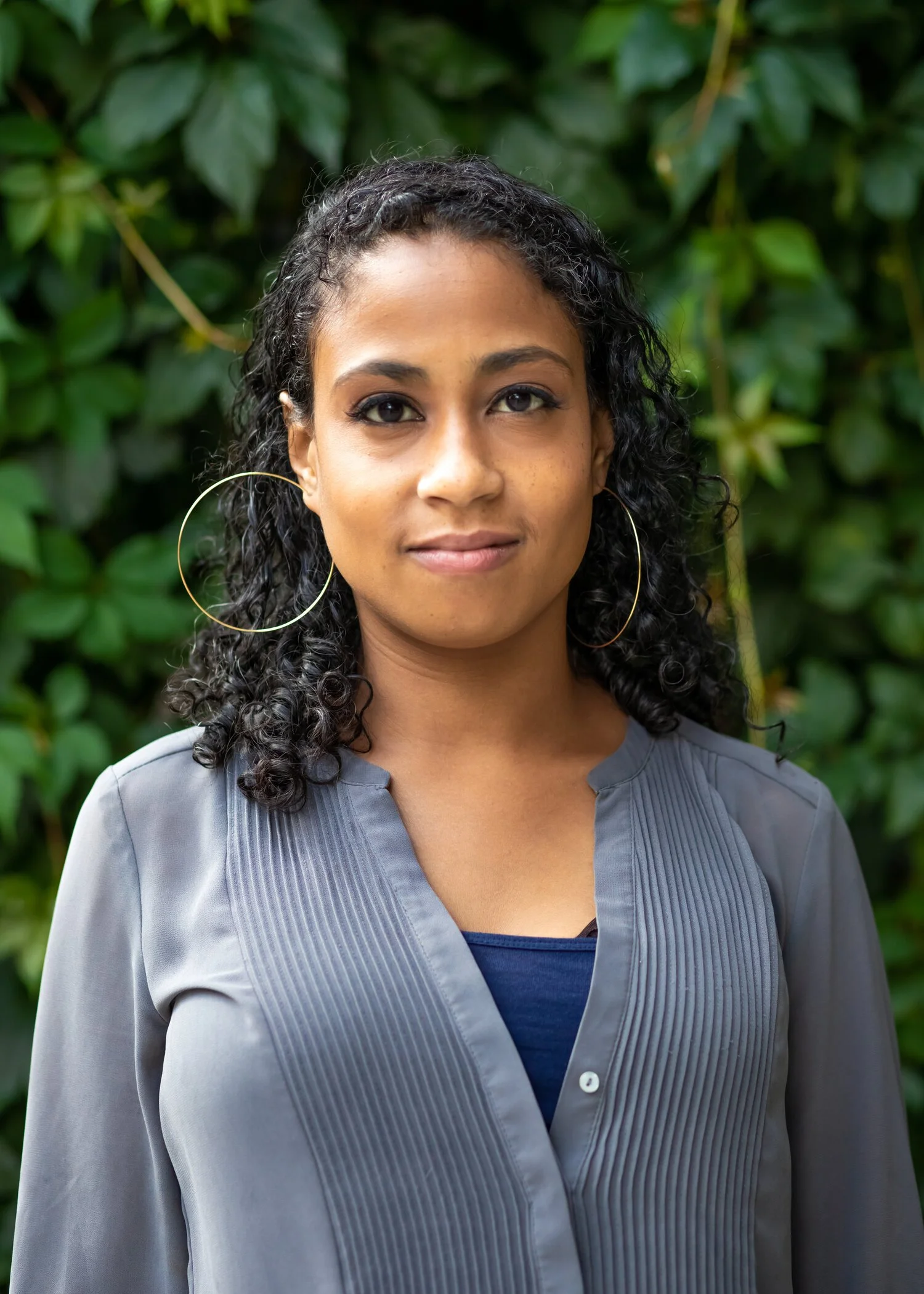
Interview with Kate Hope Day, by Paola Lastick


Kate Hope Day, author of IN THE QUICK: A conversation.
Kate Hope Day is the author of IF, THEN and IN THE QUICK. I recently had the privilege of interviewing Kate Hope Day and asking her about her writing process, how she balances research and writing, and what she has to say to the world.
PL: Previously you have said you had access to all kinds of books growing up. Was there a specific genre you felt a pull toward over other genres?
KHD: As a child I was drawn to speculative books like A WRINKLE IN TIME and THE LION, THE WITCH, and THE WARDROBE. Once I got a library card, I liked to take out books that incorporated supernatural elements, and I remember reading a lot of Lois Duncan. When I got older and started reading adult fiction, I drifted away from science fiction/fantasy, I think because I didn’t find enough women protagonists. That’s when I started reading the books on the shelves in my house, mostly nineteenth century British and American novels, PRIDE AND PREJUDICE, JANE EYRE, and THE AGE OF INNOCENCE. I studied that same time period in college and then focused on the Victorian novel for my PhD.
PL: How soon after you finished writing IF, THEN did you begin writing IN THE QUICK?
KHD: The idea for IN THE QUICK lived in my mind for at least a year before I wrote a word. June felt very alive in my imagination, but I was still revising my first novel, IF, THEN. I made a deal with myself. I could start writing IN THE QUICK when I finished the final draft of IF, THEN. It was a fantastic motivator.
Once I started writing, the first draft came quickly, and the writing and revising process took about two and a half years total, which is a big contrast to IF, THEN, which took over six years to complete.
PL: In the Quick there are a lot of technical details and world building that immerses the reader in June's world. When doing research for a book how do you know you have done enough research? How to you balance research and writing?
KHD: While I was revising IF, THEN, I did let myself do some research in preparation for IN THE QUICK. I knew part of the book would be set in space, in a scenario a lot like the International Space Station, so I watched a lot of YouTube videos from the ISS, read several memoirs of astronauts, and learned a lot about fuel cells, gyroscopes, and the nitty gritty details of daily life in space.
That said, I don’t do a lot of notetaking when I’m doing research. I just read or watch in a fairly unmethodical way, and trust that the right details will hang around in my brain until I need them. I think this prevents me from getting too absorbed with topics that may not even end up in the book. For IN THE QUICK I put away the books and videos while I worked on my first draft. Around the time I completed a full draft, I went to space camp (yes adults can go!) and participated in simulated launches and space walks. Because I already had a draft in hand, I was ready with a list of very specific research questions, many of which had to do with the physical experience of living in space. Most important was finding out what it felt like to wear a space suit, and what it was like to try to do basic tasks while in it (communicating, using tools, moving around).
PL: Many writers get stuck on having to create a perfect first draft. How do you turn off your internal editor long enough to get your first draft down?
KHD: When I start a project, I like to produce about 30k words before doing any active revising or editing. During this phase of writing it helps to set daily word count goals, 500 or 1000, depending on how much time I have in the day to write. If I’m trying to get to 1000 words for the day, or more, I can’t take time to fiddle with sentences or reorder paragraphs. So that first “draft” is really a series of freewrites, which can include anything and everything, in any order: thoughts about character and place, little snippets of dialogue or short descriptions of actions, lists of possible scenes, and so on. I try to stay as free and loose as possible, allowing things to unfold in whatever they want to unfold, and in this way I start to get a feel for the world of the book, who its main characters are, and the voice of the narrator. At around 30k words, that’s about as much mess as I can stand, and at that point I’ll start to think more in terms of scene, sequence, character arc, and structure, and will begin to make the first of many outlines for the book.
PL: It is often said that every writer has something they want to tell the world and it comes up subconsciously in our writing. Now that you have written two books, what do you think your message to the world is?
KHD: On the one hand, I think novels belong to readers and what readers find in my books is more important than what I intended to say with the book. It’s probably my training in literary
criticism that makes me shy from the idea of authorial intention. But of course I have preoccupations that come up again and again in everything I write, for instance, the lived experience of the human body, the tension between human mind and body, and the relationship between human beings and the natural world. In that sense my novels could be described as invitations to think about a set of problems or questions. For example, what does it mean to have human will and choice in the face of the vast power of the natural world? Or, what’s the value of chosen family?
Kate Hope Day is the author of If, Then. She holds a BA from Bryn Mawr College and a PhD in English from the University of Pittsburgh. She was an associate producer at HBO. She lives in Oregon with her husband and their two children. In the Quick is her second novel.

Paola Lastick is currently a student at the Mountainview MFA program at Southern New Hampshire University. Her writing has appeared on blogs as well as the newspaper, The Real Chicago. She lives in a suburb of Dallas with her husband, daughter, and three small yappy dogs.
Falling Back, an essay by Jenny Shank

Falling Back
by
Jenny Shank
8 a.m.
It's the morning after we've moved the clocks forward for daylight saving time during the year my son Sam is ten. At eight a.m., which feels like seven, I wake Sam to go to see Dedee, the reading tutor he's worked with for three years. He's grouchy at me. He doesn't want to go to Dedee's and he doesn’t want to go to Sunday school either, but I insist. He's bringing the snack. He yells, "You're a big, running-around ass with tiny legs." It's hard not to laugh but I hold it in, because he's taken care to choose the precise combination of words that show the ferocity of his anger. He has sensory processing disorder and dyspraxia, and he needs me to give him leeway, because transitions are hard.
We go to Dedee's condo. She's in her seventies and has seen all the literacy fads come and go—phonics, whole language, sight words. She knows what works. At her round dining room table, surrounded by books, reading highlighters, and whiteboards, she's built Sam up to reading at grade level and kept him there.
Then we go to Sunday school, even though Sam is now an avowed atheist. He'll finish all the kid sacraments this spring, so next year I'll let him quit. When I asked him about his day-long
confirmation retreat he said, "All we did was pray the Rosemary. It was all these Hail Marys and it was boring as hell."
I'm doing Pascal's wager from Pensées, basically, with my son—nobody knows if God exists but it makes sense to bet on it, given the potential reward. We get to Sunday school a few minutes late and the kids cheer when they see him arrive with the snack. At the very least we can fulfill our promises to others.
1 p.m.
In the afternoon, we drive to Target to look for sandals for Sam. We're going to visit the Great Sand Dunes during spring break. Before the first time Sam visited this national park when he was six, he asked, "Does it have big piles of sand that you can't even resist?" He wanted to love it as much as he thought he would, but the wind threw sand in his face, and hot sand scratched his feet so much, he couldn't enjoy himself. So we're trying again, more prepared this time. At Target, we run into a boy he knows from school and Scouts. "Are you getting ready to go to Noah's party?" he asks, holding up the large orange Nerf gun he selected for Noah.
His mom looks pained he's asked this, although it's perfectly sweet and innocent for him to assume Sam would have been invited. I like this mom, a tall, outdoorsy obstetrician with one crooked tooth, so I change the subject to spare everyone, and talk about the Sand Dunes.
I plan to leave the subject dropped, but after we walk away, Sam talks to me about how Noah didn't invite him to his party. In November, Sam had a big birthday celebration at a parkour gym called Apex—he invited twelve kids, including Noah—a chance to spark friendships, I'd hoped. Since then, Sam hasn't been invited to a single party. Sam claims Noah is copying him, having his party at Apex. Earlier this year, Aiden, another kid Sam invited to Apex, told him his dad wouldn't let him invite Sam to his own party because he was "too weird." Sam
hasn't been invited to a single friend's house this entire year. I used to email and call and chat and try to arrange things. But then I got tired of extending invitations parents would reject or ignore. They don't like my son. Even if they have valid reasons for their distaste, I don't care. I don't like them. I cut them out of my heart.
I rarely make friends among the mothers of his classmates. Screw the normals, I think. Most of the friends I've made since I was twenty are writers, confessed broken losers. Everyone is broken, but I don't like people who can't perceive or admit this. I don't like people who project a fear of deviation, who don't allow unusual kids near for fear this rogue asteroid will upset their child's orbit. Parents like this haven't learned, yet, how little is under their control. Sam spends most of his free time in his room or riding his bike around the neighborhood. Many kids with dyspraxia never learn to balance on a bike, so I'm thankful that Sam is a skilled cyclist, zipping anywhere he wants to go.
At Target, after we learn about Noah's birthday snub, I just want to buy Sam things. It's probably not the best idea, but it's what I can do. I buy him pairs of flipflops and water shoes, two pairs of pants—he only wears synthetic sports pants with elastic waists, fulfilling the fourth-grade dream of tracksuit life. I ask him if he wants anything else. He asks for gum and I say yes. Then he ups the ante and asks for the most expensive gum, the cube-shaped kind that comes in a little bottle. I say yes and tell him to get one for his older sister, too, to try to be even.
6 p.m.
That evening, Sam and I work on piano together for 20 minutes. We read. I get him to make an attempt at a poem for the Longmont Dairy cow poetry contest. He never wins, but we get a free bottle of chocolate milk for entering. His sister won second place one year and got
twenty bucks and her poem in the newsletter. She's good at so many things—school, sports, music, friends. I'm still trying to find something Sam can be good at.
With vinegar and a toothbrush, I clean the humidifier he uses every night. He likes the air in his room moist, like a jungle, even in the chill of winter.
I can't provide him with a single friend, but I can eliminate the pink slime that accumulates in the humidifier's basin. Perhaps we must live in sadness, but we don't have to live in filth and disorder. I can make his lunch. I can set out his clothes. I can tidy up his room. I've thrown out possessions he doesn't use. Each time the reality of his conditions hit me, it somehow makes it easier to part with things he used to wear or love. These objects bear the weight of discarded dreams, and with all we have to do every day, it helps to travel light.
Sam's SPD makes it almost impossible for him to clean his room—clutter bombards him with too much sensory information to process and jams his brain so he can't plan how to organize. So I eliminate stuff until it's hard to make it messy, and we can both pretend that he's cleaning his room when he picks up one gum wrapper and puts it in the trash. Nina thinks Sam doesn't deserve more help cleaning his room than she does, and I like to quote the line Clint Eastwood said to Gene Hackman in Unforgiven: "Deserve's got nothing to do with it."
Sam has filled his bedroom with sensory inputs: the humidifier, a lava lamp, various play putties that always become stuck in his rug and clothes, fidget spinners, an hourglass-shaped plastic trinket you can turn upside down to watch blue and magenta bubbles drop, gather, and mingle. His desk drawer is filled with gum wrappers because whenever he gets a new pack he chain chews through the whole thing, never thinking to trash the evidence. When he was younger, he stapled a string of paper loops together and hung them from the ceiling, dangling a paper monkey and a solar light from them. When I bought a memory foam pillow for myself, he
immediately stole it, and he uses it every night, enjoying its doughy density. In some ways, he knows what he needs.
9 p.m.
Sam turns on his nightlight that projects an image of angel fish in a coral reef onto the ceiling, and the mini LED track light with a setting that rotates between glowing red, magenta, purple, blue, green, and yellow every few seconds. We read together under the shifting colors before he goes to bed. With picture books, the effect is magical. Animals appear and disappear, go dark and bright, and flip their hues, depending on the color of light washing over them.
At some point today, he said I don't love him, and I told him I did, so much. He said when he's grown up, he'll never visit me. I told him then I would be sad. But really, that would be a triumph if he becomes so independent that he never has need of me again. When one of the only people who loves you in the world—who dependably cares about you—is your mother, a person whom you might argue had to love you, it's too much of a burden. He needs to push away. A mother can become monstrous if she's the only force in the universe. I don't want to lead him. I don't want to boss him. I don't want to loom over him.
I just want to smooth the way, unseen, like the elves who complete the shoemaker's work in the night, then disappear. I want him to be only aware of me when he leans back, when he stumbles, when he hurts, when he falls. I'm there, I'm there, I'm always there.

Jenny Shank grew up in Denver, Colorado, and earned degrees from the University of Notre Dame and the University of Colorado. Her short story collection Mixed Company won the George Garrett Fiction Prize and will be published by Texas Review Press in November 2021. Her novel The Ringer (The Permanent Press, 2011) won the High Plains Book Award in fiction, was a finalist for the Mountains & Plains Independent Booksellers Association's Reading the West Book Awards, was a Tattered Cover Book Store Summer Reading 2011 selection, and was a finalist for the Book Pipeline competition.
Her stories, essays, satire, and reviews have appeared in The Atlantic, The Guardian, Washington Post, Los Angeles Times, McSweeney's Internet Tendency, The Onion, Poets & Writers Magazine, Bust Magazine, Prairie Schooner, Alaska Quarterly Review, Santa Monica Review, Cincinnati Review, Michigan Quarterly Review, The Toast, Offline, Image, Printer's Row, Barrelhouse, Rocky Mountain News, Dallas Morning News, High Country News, PBS MediaShift, The Rumpus, 5280, The Huffington Post, The McSweeney's Book of Politics and Musicals (Vintage, 2012) and Dear McSweeney's: Twenty-Two Years of Letters from McSweeney's Quarterly Concern (McSweeney's, 2021). One of her stories was listed among the "Notable Essays of the Year" in the Best American Essays, three of her stories were nominated for the Pushcart Prize, and one received Special Mention in the 2018 Pushcart Prize anthology. She's won writing awards from the Center of the American West, the Montana Committee for the Humanities, the Society for Professional Journalists, SouthWest Writers, and the Barbara Deming Memorial Fund.
Jenny Shank was the Denver/Boulder Editor of The Onion A.V. Club for six years, and for four years she was the Books & Writers Editor of New West, which was named "Best Literary Blog" in the Westword Best of Denver issue. She was a Mullin Scholar in writing at the University of Southern California. She has taught creative writing at the University of Colorado, the Lighthouse Writers Workshop, and the Boulder Writing Studio, and she is on the faculty of the Mile High MFA at Regis University in Denver. She lives in Boulder, Colorado with her husband, daughter, and son.
Interview with Shahriar Mandanipour, by Karen Askarinam


When Your Next Word Could Be Your Last
Iranian author, Shahriar Mandanipour, spoke out against Iranian censorship.
Now he’s paying the price.
We think of certain occupations as dangerous: window washer for tall buildings; coal miner; fire fighter. In Iran, add to that list, writer. This reality is the material of Shahriar Mandanipour’s life and work, and of each story in the newly released collection, Seasons of Purgatory (Bellevue Literary Press, 2022), stories published (save one) in a batch in Iran during a brief window of semi-tolerance. That window closed in 2009. Shahriar’s two major novels (of his major works available in English translation), Censoring an Iranian Love Story and Moon Brow, are outlawed in Iran. So is Shahriar.
In 1994, Shahriar and 134 writers signed a petition opposing government censorship. Not long after, Shahriar and several fellow writers boarded a bus in Tehran headed, ostensibly, to a writing conference in Armenia. Late that night the bus driver, seeing his passengers asleep, set the bus on a course over a cliff and quietly jumped out. Unbeknownst to that driver Shahriar and another writer were awake and rushed to save the bus, which came to a stop with its front end dangling over a precipice. Shahriar lived to write another day in Iran, the country of his people, his language, and his culture.
However, at the end of a two-year Visiting Professorship at Brown University, from 2011 to 2013, during which time Shahriar gave several talks about Iranian censorship, he was advised, “You mustn’t come back.” It was a life and death choice.
Shahriar remained in the U.S., where he has continued to teach and write, cut off from his lifelong social communities as well as the professional communities he’d held dear throughout his career.
Did you study writing? When did you decide to become a writer?
“When I was in high school…I was sure that I would be a writer… I was reading literature as much as I could…[but] I needed some education in political science, and studied … at Tehran University.”
There are many animals in your stories. Can you speak about an example of that?
In “Shadow of the Cave,” A man …lives with a window that has a view of the zoo, and … notices that [unlike the animals] the people around him are intentionally in… cage[s]. At a deeper level, this goes directly to the regime…which treats people like caged animals.
You refer to your stories as dark. Do you see yourself as a writer of tragedy?
I don’t want to be a dark writer. I would like just to write a beautiful love story, not necessarily even a Hollywood happy-ending love story…not a romantic story…just a story written according to the rules of story writing aesthetics, the essentials of literature, character, setting mood, tone, the elements of craft. [But] the way that the world is, our situation, our existence in the world…”
Can you elaborate on that? Is there hidden hope in the darkness?
As much as you could see the darkness of the world, I think it means [there is] the possibility of … brightness. As much as you see the ugliness, I think it means you know that there is beauty –…That should be somewhere between the lines of my stories. You can write a tragic, bloody,
dark story beautifully because you know the beauties of art. Art explores what remains of the beauty in our world.
Is there something about Iran itself, beyond the specifics of censorship, that has a role in terms of darkness in your work?
Sure. I am affected by that, by living in Iran, [with] our history… there are parts … great conquest[ing] kings, like Cyrus, Nadar Shah, Shah Abbas– but they are the short tail of history…Iran was invaded…Turks, Mongols, Arabs. Our history is full of suffering… just walking in the streets it is all about mourning, sadness, dark clothes, dark flags…sad ceremonies …tears, misery, poverty, particularly in the era of the Islamic Republic, which is not really a republic at all.
You say you believe that a writer must go out in live in the world. How has your life (teaching, travel) affected your work and your process?
I served in the army as a second lieutenant during the Iran-Iraq War, an absurd war. About fourteen months at the front line. War is cruel, disgusting, and a great teacher for each soldier. It is not only about perceiving and feeling death. It is also about touching your existence. For example, when you patrol a minefield, you will figure out that each step could be the last moment you have feet; you feel that your heaviness can cause your death.
I [once] grabbed the wound of my best soldier, and he gripped my arm, asking his life from me. His blood pumped out among my fingers. Hours later, I must eat with that bloody hand.
I had a [writing] rule that I named the 3 to-4 second rule…in the bunker. I could hear the Iraqi shells being discharged. It took three, four seconds for a 120mm mortar shell to reach our line. If it landed on a trench, everyone inside would turn into chopped meat. So I had three to four seconds to add one more word to my story. One word in the distance between life and death, one word that could be my last, and the best word on a piece of paper of my life. In those few seconds, I grasped the weight and value of words. I felt the heart-beat of the words. It has been established in my mind. It has come with me.

Karen Askarinam is a writer living in Maryland. She holds an MA in Literature from American University. Karen has taught writing at the university level and continues to teach students privately and provide editorial services to fellow writers. She is currently earning her MFA in Fiction in Southern New Hampshire University’s Mountainview Program, where she is working on a novel about Iranian Jews in America.
This Hyphenated American Reading Life: May 2022

Last week, the unimaginable happened. 19 children were shot by a young man, age 18, who bought AR-15 rifles as soon as he legally could, with the widely-expressed intent of shootng a school, shooting others, even threatening to sexually assault different young women he met on the Internet. In the wake of this horror: June 11, a political protest and march on Washington DC to demand meaningful, national gun control (organized by some of the most visible survivors of the Parkland school shooting).
In honor of this upcoming march, I am posting a reading list (which originally appeared in Electric Literature) on the literature of political protest. Read, be heartened; know you are not alone in this mobilized grief.
10 Galvanizing Books About Political Protest
While putting together this list (which is obviously not comprehensive), I kept thinking of Brazilian activist, protestor, and educator Paulo Freire’s slogan: “Make the road by walking.” Each of these books creates a new road. Each raises questions about political protest and each has given readers and writers alike a path upon which to march.
American Woman by Susan Choi
Choi’s Pulitzer-nominated novel is an examination — or perhaps an exhumation — of a player in the Patty Hearst kidnapping, Wendy Yoshimura, upon whom Choi bases her focal character, Jenn Shimada. The novel casts a critical and trenchant perspective on the radical ideologies at work. In doing so, Choi places intimate relationships, particularly the friendship between Jenny and Pauline, at the center of an exploration of how political protest is lived and experienced on a moment-by-moment level.
Your Heart is a Muscle the Size of a Fist by Sunil Yapa
Yapa’s acclaimed, multi-cultural take on the 1999 World Trade Organization protests in Seattle is required reading for an idealistic, panoramic view of civil disobedience with the goal of greater inclusion and economic participation. The novel offers a tribute to those brave enough to step forward and take the physical risk of protesting.
We publish your favorite authors—even the ones you haven't read yet. Get new fiction, essays, and poetry delivered to your inbox.
A Small Revolution by Jimin Han
The talented, propulsive writer Jimin Han’s debut tells of a hostage situation set in the political turmoil of 1980s South Korea (including the Gwangju Uprising, an armed resistance response of the populace to government troops’ unprecedented attack and killing of peacefully protesting Chonnam University students). “There are many paths to revolution,” observes the elegant, though increasingly fraught, voice of Han’s narrator, Yoona.
Dr. Zhivago by Boris Pasternak
As anyone who has seen David Lean’s stunning 1965 adaptation knows, this novel boasts a ridiculously intricate, multi-generational plot. The book details, with emotional precision and care, the social context of the Russian Revolution, including the decadence and oppressive practices of the upper classes. The book follows families set adrift by the political protest of the October Revolution as well as the fates of the deeply-flawed individuals “making” the revolution (like the decadent, drug-addled Bolshevik who kidnaps the title character).
The Lowland by Jhumpa Lahiri
In her gorgeous and melancholy second novel, Jhumpa Lahiri achieves strikingly original characterizations of political protestors long after the protest — in particular, the radical-turned-academic philosopher Gauri, and the absent Udayan who only in death is revealed to be other than a strictly “peaceful protestor.” Never turning away from the bitterness and traumatic aspects of such political engagement, Lahiri follows the tragic arcs of her characters all the way out, like the wild New England coastline that forms the backdrop for the new lives they try to lead.
A Grain of Wheat by Ngugi wa Thiong’o
Written by Kenyan novelist Ngugi wa Thiong’o while he was still a university student, this novel juxtaposes the pain and disappointment of personal betrayals (brothers, spouses) with the larger community-wide dynamics involved in identifying “heroes” and “villains” of a revolution after the fact. The book draws on the history of the Mau Mau rebellion, a violent uprising that unsuccessfully attempted to throw off British colonial rule — but in the process exposed deep divisions within the Kikuyu community and exposed participants to harsh punishments by the British. The novel’s magisterial, intricate prose is still as fresh now as it was when it launched Ngugi’s international career; he’s since been shortlisted for the Booker and repeatedly considered for the Nobel.
Kiss of the Spider Woman by Manuel Puig
Argentinian writer Manuel Puig’s award-winning novel has been adapted into a play, musical, and 1985 film (for which William Hurt won an Academy Award). The book focuses on the relationship between two cellmates in an Argentine prison: Molina, a transgender woman, and political prisoner and torture survivor Valentin. It’s an unflinching look at how the most intimate and spontaneous-seeming interactions are rendered corrupt when made part of the machinery by which a repressive state (in this case, the 1964–1985 military dictatorship in Brazil) attempts to crush any form of resistance.
July’s People by Nadine Gordimer
Nadine Gordimer’s (at the time) futuristic depiction of the fate of South African whites after the projected fall of apartheid is an honest examination of the profound discomfort that lurks beneath “camaraderie” between liberal whites and people of color protesting for long-delayed justice. The novel was banned in post-apartheid South Africa because of its ostensible failure to sufficiently and clearly condemn the racism that made social upheaval justified.
Beloved by Toni Morrison
Morrison’s Sethe kills her own child rather than let her be returned to slavery, an act that reverberates throughout the novel. If slavery is understood as a political system, an infanticide like the one committed by Sethe (or Margaret Garner, Sethe’s real-world counterpart) can be considered a dbitter form of political protest. Morrison’s novel explores both the experiences leading up to making such a terrible choice, as well as the attempts to shape a meaningful life in the aftermath.
1984 by George Orwell
Perhaps more than any other novel on this list, George Orwell’s classic illustrates the idea of there being value even in protest that seems to change nothing. This slim novel (which sold out on Amazon immediately after the 2016 presidential election) was prescient on the subject of government surveillance, thought control by means of regulating “allowed” language, and the horrifying implications of using torture to secure obedience and allegiance. The book can still inspire us to moral courage and perseverance — even in a time of repression, fear, blustering, threatening and lying in the executive branch. Especially in such a time.
Interview with Jamie Ford, author of The Hotel on the Corner of Bitter and Sweet

This interview first appeared in Ploughshares online.
In his debut novel, published in 2007, decades after Reagan’s apology for the internment of Japanese-origin American citizens on American soil, Jamie Ford uses a sweeping, Titanic-like “frame” of the members of a young, current generation encountering a buried story that illuminates class and racial divides of the past. Henry, now elderly, reveals his own youthful experience of cross-cultural romance to his son, Marty, who is about to marry a white fiancée. One of the marvels of the book is that the sweetness of the gentle romance between Henry and his childhood love Keiko—really the sweetness of romance in general—is untainted by the bleakness of the political backdrop.
And yet, reading the book now, in Trump’s America, that bleakness is undeniable. As a member of a Muslim-American family, I read the scenes of bullying, shouting, burning, painting hateful slogans, and shooting with an immediate sense of dread, sorrow, and rage. I recalled the way it felt on the day after the election to look at any Muslim house with large windows or glass patio doors, remembering Kristallnacht; remembered the sight of the hateful Neo-Nazi, anti-Muslim slogans displayed hanging over the sides of bridges, or from the highway overpasses; the Trump rallies; Charlottesville. I thought of the two women who brought a dog into a mosque in Arizona last week, to defecate and urinate on holy ground, while they snatched up religious objects and pictures and spat on them, teaching their young children to do the same while chanting slurs.
In this sociopolitical climate, in which Ford’s Hotel on the Corner of Bitter and Sweet has remained on the New York Times best-seller list for an impressive and—yes—heartwarming 130 weeks, what sense can we make of the simultaneity of American curiosity, compassion, mutual respect, co-existing in a (book) world in which books such as ¡Adios, America! by Ann Coulter are also NYT bestsellers (albeit for 10 weeks)?
In order to gain some insight into the unique alchemy practiced by Ford as a writer of a book that, while making the plight of those excluded and discriminated against completely searing and unforgettable, is also simply just a compelling story, the kind of story that many different people (including Trump voters) obviously read and also loved—I interviewed him this winter.
Chaya Bhuvaneswar: How did you become a writer?
Jamie Ford: It started with a degree in art and design, and before that…before I was a writer I was real moody child. Even in late grade school through high school I wrote poetry, just so I had an outlet for an excess of emotion. I couldn’t turn off my feelings—at times my superpower, other times my kryptonite. I kept writing poetry and story ideas even in my sketchbooks. Maybe then in my twenties I realized fiction could be a useful medium just to process feelings. Really just to—it sounds odd, but I would just write to express how I was thinking, how I was feeling. In my early thirties I lost both of my parents—and I often say it, and sounds cheeky and dark—my writing career began when I wrote my parents’ obituaries. Everything I wrote going forward had a real emotional perspective. Young writers may not be able to write with emotional resonance because they haven’t been kicked around in life enough. That’s kind of my journey. My dad died from diabetes complications—it was a sudden turn, that was unexpected. Not long thereafter, my mom found out she had cancer and then she passed rapidly, with me and my brother being the primary hospice caregiver. She declined in three weeks and was gone. Within a year and a half I’d lost both parents and my last grandparent.
CB: I’m sorry—that is a lot of loss. Did your family know you as a writer?
JF: No, but my dad always wanted me to be a visual artist; my mom always wanted me to be a writer. After I went through that, those losses, I had never written anything historic but then I became obsessed with the landscape of their childhood.
CB: Can you talk about how you conceived of Hotel on the Corner of Bitter and Sweet?
JF: When I wrote the book, I meant it as a love story. I didn’t mean it as a statement of social justice. But I mistakenly assumed everyone knew about the internment. But then I quickly realized it wasn’t common knowledge and there are segments of society that really had no idea.
I was asked at the time if I thought it would ever happen again. I said no, but that answer has changed under the current administration. I do think there is a segment of society, they may not say it openly, but they would prefer to remain a demonstrably white dominant society, that there’s a comfort level there, going back to the 70s, when most minorities really struggled to reach middle class. I don’t know if it’s because people are just wanting to be comfortable, or to go back to the cartoon of the “good old days.” People want to go back to when Christopher Columbus was perfect and did nothing wrong. There’s a cognitive dissonance in holding multiple points of view and that holds for Trump and his supporters—they want to get rid of anyone else who wants to come here, they forget that their parents or grandparents came here.
I don’t think something like the internment could happen again because it’s logistically difficult. In World War II, the FBI could just go to banks and the banks would turn over Japanese names. Minorities were forced to live in certain neighborhoods. It was easier to round people up. It’s not so easy to do that now. It’s technically difficult. But if it was easy, I think there would be people who would champion that kind of activity. I do think though that this is the death rattle of a very racist generation and we’re almost through it. I visit high schools, etc. and for the most part kids don’t care. They don’t love or befriend one another based on cultural identity. It’s rather a unique expression of who they are, not something they use to beat each other over the head with. I’m hoping we’ll stop using race as an obstacle. I think we need to look at people as individuals for who they really are.
CB: Can you speak a bit about your writing process and rituals?
JF: I tend to work from an idea or a premise; I think of a beginning and an ending almost in the abstract; I sort of make up the middle as I go; I don’t outline. That being stated, I am exploring some new ways of working. I worked with a director this summer and she showed me a way of creating a nonlinear outline. She pushed me to think of themes, the most powerful themes of a story I want to tell, put them out there in no specific orders, and then take the box of scenes and move scenes around and see if there’s a better way to arrange those scenes. It was really useful. I went into it thinking it was going to be crazy, this vaporous idea from Hollywood. The next few projects will be done this way. It forces me to create a hard outline in that in the end, I play with the building blocks until I do have an outline. And I’ve never done that before—I’ve never worked from an outline.
CB: Any thoughts about working alone vs. with others, and where to find the others?
JF: I think everyone needs that one good reader, a wise reader. For some people that’s their partner, critique partner, or agent. For me It’s my wife. I haven’t found success in writing groups. I do have some other author friends whom I’ve bounced ideas off of and that works in an emergency. Maybe there’s someone who’s a total lone wolf, but I think we need someone to validate our convictions a little bit, someone who can be lovingly honest. I think that’s important.

Echappe, a novel excerpt by Nicole Haroutunian

Échappé
an outtake from CHOOSE THIS NOW, forthcoming from Noemi Press, 2024
By Nicole Haroutunian
When Berry refuses to let go of the bunched-up fabric of my skirt she has clenched in her fist, when she refuses to join the rest of the kids in her ballet class inside the studio, when she refuses to say what the problem is, I basically lose it.
I mean, I don’t, but sort of. I hiss, you love this class. What is the issue? Just get over there.
She stands frozen, her face impassive. I give her a little shove. Nothing. You’re a Not Scary Ghost! I say. Her small curly head pokes out of a hole I cut in a white crib sheet. I used iron-on letters to spell out NOT SCARY GHOST, per her request. It’s adorable. I try again. You have to go show the other kids your costume. It’s almost Halloween! It’s your special Halloween class! Look, Mario is dressed as a puppy! Look, Eliana is Elmo! Go.
She lifts a corner of her costume, sticking the sheet into her mouth and chewing. So, then I say, Do we have to leave? I turn around and walk toward the door. Usually this does the trick. Usually, she doesn’t really want to go. But today I guess she does because she just walks calmly toward the door right along with me. No digging in her heels. I hate myself for the tactical misstep. I give her one more chance to go in. Nothing. I have no choice; I have to follow through. That’s what the people on the internet say. She’s almost three; she can understand consequences. So, I grab her by the arm and tug her out the door. Now she’s crying. She was coming willingly; there was no reason for the tug. Behind me, fifteen caregivers avert their eyes.
I’m so mad, I’m vibrating—I feel it in my temples and in my teeth. But like Berry, I can’t quite articulate why. What is the problem with leaving dance class, exactly? I mean, there’s the money. The teacher is so good, she’s worth it, but it’s a feat of budgeting to make it work. As we skulk toward the stairs, I hear her guiding the tiny children through a series of moves, using the actual ballet words: plié, plié, échappé! We tried a dance class before this one where the teacher was all pizza-feet and diamond-legs and Berry, a purist, was appalled. I was fine échappéing that one. On the street, I look up at the holding-pen window, sure that there will be a row of parents up there watching me, watching to see if I’m still pulling Berry now that we’re outside, watching to see if she’s still crying. What a poorly behaved child, they’re thinking. Thank god my kid isn’t like that. What a poorly behaved mother. I don’t see anyone, but that doesn’t mean they’re not there.
On the ten block walk home, I catch sight of myself in the plate glass window of a shoe store. My hair looks ridiculous. I can see, even in the reflection, that I’m red in the face. I used to think this old, bedraggled look was a costume—new-mom-drag—and I’d cast it off, get back to normal soon enough. Now I wish I had a sheet over my head like Berry. Like those moms in the old photographs, sitting under blankets to prop up their kids for a studio portrait, a faceless piece of furniture. Except Berry wouldn’t stand for it. She doesn’t want me to dress like her. She’s vetoed all of my costume ideas. And I’ve let her!
We round the corner, almost to our place, and there at a charmingly off-kilter table at our local café, two women sit drinking their lattes, deep in conversation. In this window reflection, what I see on my red face is longing. The forty-five minutes while Berry is in dance class and I’m on the other side of the door, waiting in the adult holding area—the kids are two and three, so we’re supposed to stay on the premises in the event of potty needs or meltdowns or nosebleeds—those forty-five minutes are the only time during the week that I talk to other grown-ups. I work from home: before she wakes up, after she goes to bed, during copious amounts of screentime. I’m either with Berry or she’s at preschool—those precious two nine-to-three days a week—and I’m at my computer. That’s not really by choice, it’s by financial necessity. Or, financial privilege, or some combination of the two. It’s a privilege to work and be with her at the same time, is what I’m saying. It’s a privilege that no one called a social worker when I pulled my child by the arm from the dance studio like a monster. In any case, I used to have coffee with friends. Now I have forty-five minutes of dance class to talk to some people with whom most of what we have in common is kids the same age. But guess what? That’s enough!
I say all of this to Berry, who is two and three quarters years old.
We never go to this café ourselves because it’s too close to our apartment. I know if we do it once, we’ll never be able to pass it by without a meltdown again. I tell Berry that if you go there, they make you drink coffee, so each time we pass, she shouts, Coffee is NOT for kids! The last time I had an existential crisis in front of it was a mere two or three weeks ago. We were elbows deep in potty training. When Berry has to go, she has to go, and what a victory it is if she tells me with enough notice that I can whip out the travel potty, pre-loaded with a plastic bag. She said, Mama, time to pee! And all thrilled—even though, yes, we’d just left the house and she could have used the actual toilet there—I set up her commode on the sidewalk just behind a tree and then when she was done, I wiped her bum and gave her a high five. Then I realized that while she was behind a tree regarding the cars on the street, she was right in front of the café and this group of twenty-something guys were sitting there, noses scrunched. They were the kind of guys that, ten years ago, might have bought me a beer, might have actively tried to get me to go home with them at the end of a night of drinking. Now, they had no reason to notice me, generally, except when I had my kid pee right out in the open, a slim shield of glass between the bag of urine in my hand and their egg sandwiches. I wanted to think that, one day, they’d be where I was, too, but of course they wouldn’t be. They’d be at work.
We get to our building, haul up three flights, stagger through the door. I turn on Daniel Tiger because, although I don’t want to reward Berry and TV is still, somehow, a reward, I also really don’t want to deal. Within five minutes, she’s asleep on the couch. I wish I’d taken her costume off of her so it won’t be so wrinkled for actual Halloween next Wednesday. Watching her sleep, curled up and sucking her thumb, I remember how many times she showed up in our doorway last night, how she’s not going to bed earlier like she’s supposed to even though she dropped her nap, despite my best efforts to cling to it. She’s too tired for dance class. Too little to know that, unlike me. I text Taline. I am a terrible mother.
Awful, she responds.
I tell her what happened, how I behaved.
Wine?
I envy Taline, her wine. I’m too tired for wine. It makes me feel sick now. I have all the pre-Berry bottles of it lined up in the kitchen, little more than décor at this point. I curl up on the opposite side of the couch, across from Berry, bury my head in my arms. Maybe if I rest, too. But it’s like my bones are itching, like they want to climb out of my skin.
How would that be for a Halloween costume?
I try again. I match my breathing to Berry’s little snores. In and out. I press my feet against hers and she presses back, a small, sleepy dance. When she wakes up, I’ll ask: how about a pas de deux?

Here is the assignment, if you'd like: To deepen your understanding of a character you're writing about, imagine an "off-screen" moment they experienced before the events of the scene you're working on, open a new document, and put it down on the page. When you return to your actual project, you might find that you have a new way into the material.

Nicole Haroutunian is the author of the novel Choose This Now (Noemi Press, forthcoming 2024) and the short story collection Speed Dreaming (Little a, 2015). Her work has appeared in the Bennington Review, Post Road, Joyland, Tin House's Open Bar, and elsewhere. She is an editor of the digital arts platform Underwater New York, a cofounder of the reading series Halfway There, and has an MFA from Sarah Lawrence College. She lives in Woodside, Queens, in New York City.
Selected Poems, by Gale Acuff
When you die your body rots away be
-cause it's corrupt my Sunday School teacher
says and she should know, she's 25 if
she's a day, it's as if I'm rotting a
-way right now, too, and me only ten
years old, maybe I was born decaying
so I wonder at what point in life, mine
anyway, I was in between being
born and beginning to die, would that be
my birthday but right down to the milli
-second? Something tells me that she doesn't
know or if she does she'll never tell but
she did tell us children once that when we
croak then we'll have the answers to all we
ever wanted to know. But I don’t know.
I don't want to die but I have to but
I don't know exactly when, sometimes I
wish I knew but mostly maybe not, I'm
only ten years old and if I learned I'd
die at 90 I'd spend eighty years just
worrying, I know myself pretty well
or as well as any ten-year-old can
and I don't want to die and I think not
at all but at Sunday School they say that
if I don't then I can't go to Heaven
much less Hell or is that Hell or much less
Heaven, I always mix 'em up so I
don't want to die before I learn the truth
but I'll have to ask my teacher at school,
regular school that is, where God's no good.
Nobody wants to die but maybe that's
not true, somebody does, maybe lots, but
I'm not one of them unless I fail tests
at regular school and have to go home
with the bad news that I deliver at
the supper table when my parents ask
how school was today and answering Oh,
it's still there gets me only so far which
of course is not far at all and when I
have to have one of them sign my report
card and the letter-grades are lousy I might
get grounded and my allowance suspend
-ed for a month or both so then I wish
I was dead, or is it were, and I could try
harder but failure wouldn't be the same.
After Sunday School I hang around like
I guess God does when everybody's gone,
He's got the whole church to Himself again
and I hope He doesn't mind be being
here but it does seem holy, I have to
admit it and I'm only ten years old
and usually don't take religion
seriously in case my friends fun me
about it but then of course I might die
at any time and I don't want to so
my only out is eternal life, I
have to croak to get it, though, and I can't
live forever here on Earth nor hide out
in church, neither. Is God scared, too? Poor soul.
You can't go home again unless you're dead
and that means to Heaven where God made you
and put your soul into a baby body
and you were born and after some time here
you are or I am at least and to go
home you have to die so maybe every
Sunday when I walk home from church it means
that I'm failing, I'm living as I'm walk
-ing there but expiring as I double
back so four times a month I have to die
but I always rise again going home
and it's even the same for regular
school or when we go to the Foodway or
Korn Dawg King or miniature golf unless
I've got them reversed but that's religion.

Gale Acuff has had poetry published in Ascent, Reed, Journal of Black Mountain College Studies, The Font, Chiron Review, Poem, Adirondack Review, Florida Review, Slant, Arkansas Review, South Dakota Review, Roanoke Review, and many other journals in a dozen countries. He has authored three books of poetry: Buffalo Nickel, The Weight of the World, and The Story of My Lives.
Adaptive Morphologies, a short story by Lucy Zhang

The birds have begun to change shape. Their beaks are growing longer. “Because of Allen’s rule,” Anik says, nodding like it’s according to plan. “These larger appendages facilitate more efficient heat dissipation by maximizing surface area, like how you feel like tearing off your clothing when it gets hot,” he explains, although I don’t see how clothing is related. Anik shows me a picture of the heat exchange across the body of a Geospiza fortis, splotches of bright yellow and orange by its beak and legs, the only vascularized surfaces without any insulation of feathers. He acts like the heat dissipation limit theory is revolutionary, but to me, it’s just another manifestation of balance between what the earth gives and takes: the more heat your metabolism dissipates, the more energy you can consume. “So we’re going to have big-billed and big-legged birds—that’s pretty cool,” I conclude.
Anik just had his appendix removed. I drove him from the hospital to his house where I’m staying for a month to run errands and make sure he doesn’t irritate his incision or die. His appendix burst while we were visiting a farmer’s market for pluots. Anik needed someone to accompany him on outings, and I rarely had anything else to do on weekends. One moment we were scrutinizing green pluots from deep purple ones, and the next, Anik was on the ground, clutching his stomach while I tried to stay coherent in explaining the situation to the 911 dispatchers.
“Humans should’ve evolved without appendices,” Anik groans and shifts in his seat. It’s hard for him to sit. He curses his belly pain every other minute. “And wisdom teeth,” he adds. “Birds are lucky they adapt so quickly.”
I don’t bother telling Anik that the appendix is supposed to store bacteria beneficial to the health of our intestine’s flora. Humans can get by fine without a few organs. We continue watching the birds out the window. I joke about taking on rich, old, white people hobbies like bird watching, but my mood dampens quickly when Anik snarks about being too old to do much else. Neither of us has seen this type of bird before. Seven of them perch on the avocado tree Anik never waters. They’ve got bills the length of a child’s forearm, a brown plumage and cream-colored underbelly, mustard mohawk crest feathers, vibrant red eyes. “Like aliens,” I marvel. Anik shoots my observation down and lectures me for such a limited scope of imagination: not all forms of life need two eyes and a head and a central nervous system; what lives in outer space could be like nothing we’ve ever seen before.
“Is it worth thinking about aliens when we still haven’t figured out what’s up with the birds?” I ask. Anik shrugs and groans, the mild lift and drop of his shoulders pulling and loosening the flesh near his stomach. “Don’t push yourself,” I repeat even though he’ll forget again in a few minutes.
I met Anik a decade ago during my final few days of hospitalization for pneumonia. My stay was almost going to take longer until the doctors finally had some sense knocked into them to switch me from penicillin to clindamycin. My mom nearly lost it when the doctors told her they might need to perform surgery on an eleven-year-old, and she began her crazed research into alternate antibiotics before landing on clindamycin, at which point she commenced a single-sided barrage of phone calls and emails to the doctors and her insurance plan with NCBI links. I spent most of my time in the children’s play and craft room, which was pretty empty and lonely—I assumed the other kids were too sick to walk around. The staff prepared cardboard jewelry boxes for me to paint and cover with foam stickers. Anik walked in as I evaluated the merits of decorating a heart-shaped box with more hearts and glitter. He was a volunteer at the hospital, long retired and on a quest for work to keep his brain sharp. He treated me nicely, asking how I felt, if I needed anything, but I was too young to know how to demand things from others and nodded quietly. Anik was the only staff member I recognized; the nurses who checked up on my IV changed too often for me to associate a name to a face. I learned Anik hated his school days because they ate up all the time he could’ve spent on personal growth. “What’s personal growth?” I asked. I thought growth was aging. “It’s doing what you want,” Anik said. I liked Anik because he told me versions of truths I’d never heard before: anyone who says “we are here to help you” is lying and doing the bare minimum for a paycheck; most of the “quiet and sudden” heart attacks probably take the larger part of a day to kill their host (painfully and slowly); no one knows what comes after death but we do know everything that makes you operate ceases so there’s probably nothing, truly. These were my favorite moments—when I got to learn things that I thought distinguished me from my peers, a maturity spurt. Anik was also surprisingly good with his hands, and after he taught me to fold a paper crane, I tossed mine and kept his, the creases folded cleanly and crisply, wings flapping without a tear as I pulled the tail back and forth.
One of the birds begins attacking the neighbor’s bobcat who has crossed into Anik’s backyard. Anik never tells the neighbor to keep the cat indoors even though it’s an invasive species. He finds cats cute and elegant and can’t get over himself to tell off his neighbor about their pet preying on small animal populations. The other birds join in, grasping at the bobcat’s fur with their claws. “They must be building nests,” I say, tying my hair up into a ponytail. “They should just use yours,” Anik jokes. I lose a handful of hair every morning after combing it. The biological waste doesn’t serve much of a purpose besides clogging drainage systems and decomposing slowly—hair is built to resist decay after all; that’s why the dead who come back to haunt in horror movies still have their luxurious (if a bit greasy and dry) locks. “What if the cat kills the birds?” I ask. Anik is quiet for a moment.
“Well, they both seem like invasive species. Might as well let them duke it out,” he replies. I disagree—I think the birds are a part of this ecosystem, a result of strange combinations of selected genes and evolution. The cat will only continue to sink its teeth into more blue jays and hummingbirds whose corpses litter the corners of the fence. Anik no longer has a strong interest in biodiversity. I think he’s realized he’ll die before any of the weirder effects of global warming manifest and believes the most he can do is minimize his presence, quietly let the world adapt as he sits from behind a window lamenting his no-soda-or-Calpico diet.
Anik’s son, Sam, asked me to take care of Anik after the appendectomy. Anik refuses to live in a senior center because the “other oldies don’t know Bergmann’s rules from Allen’s rules.” Sam told me Anik thought I was “clever and honest, not like the whole two-faced bunch of them” and that Anik would shut down whenever a hired nurse came to check on him. “All those nurses did was poke and prod and ask how I felt for an outrageous sum—why waste words on greeting people you don’t care about anyway?” Anik often complains to me even though we both know Sam is paying me well. I don’t need the extra income but I wouldn’t take care of an old man for free. I’m not that selfless. I’ve told Anik this. “Of course not, you shouldn’t do anything for free,” he chortled.
I’m convinced we’re witnessing something very special in Anik’s backyard: birds Pokemon-shape-shifting themselves into mega efficient heat-dissipating creatures. Who knows what will be next. Flamingos with legs the height of a house? Bats with wings spanning the length of a plane? I hand Anik a mug of water. He’s supposed to stay hydrated so I fill his mug every two hours and he sips obediently. After setting the mug back down, he yawns. “Well, if they can evolve at a rate faster than the planet burns up,” he shrugs.
“I think it’s possible,” I tell him. The birds look majestic and curious, long having abandoned the cat and now pecking at tiny, unripe avocados dangling on the tree. Their beaks could probably split one through its center, seed and all. Their beaks could probably even snap the cat in half if they’re serious. I imagine them as next-generation dinosaurs.
“Hah, humans haven’t even managed to naturally select out wisdom teeth and appendices,” Anik says. I think Anik is being too harsh.
“That’s because modern medicine protects people from dying left and right,” I reply. We watch one of the birds cut an avocado fruit from the branch. It drops to the ground, whole.
“And so we live on.” He draws out the words like speaking drains all his energy, like he’d rather not.
I stay with Anik for the rest of the month, sleeping in the guest room, buying groceries with his credit card, helping him get out of bed and put on his shirt. I work from the dining room which receives the most natural lighting—more than anything I can get in my apartment. I live in a one-bedroom place on the second floor of my complex where I can hear my upstairs neighbors’ stomping and smell my downstairs neighbors’ pungent cooking. They use more turmeric than I can stomach. Then again, I can’t handle much: spicy food sends me to the toilet for hours, eggs cause my face and feet to swell, seafood gives me rashes. I decline most mixer invitations to restaurants; the gastrointestinal consequences aren’t worth a potential one-night-stand or date. Anik’s house is much nicer, albeit an older construction with no heating or air conditioning. The stone insulates the air pretty well. He also has a big kitchen and a wall full of cabinets which he uses to store his old gadgets: three adaptors to who-knows-what, manuals on Java and SQL, a digital multimeter, huge boxes that I haven’t bothered to dig into. I’ve only cleared enough cabinets to store my new purchases of rice, salt and vermicelli. The only food item I had found in the cabinets was a half-empty bag of pinto beans. Anik had been eating beans for most of his meals. “I don’t think the gas you get from all that fiber is going to make the healing process any easier,” I told him before dragging in sacks of plain white rice. He has been good about the changes in his diet. He compliments the bland soups I try to salvage with five-spice powder and sesame oil and finishes all of the diluted porridge whose volume I double with water when I’ve run out of cream of wheat and curry leaves. I’m not sure what he likes so much about beans besides the bowel movement bolster, but he stays mostly quiet when it comes to what I feed him which I take as a win.
Anik spends most of his time complaining about not being able to do anything, although he’s courteous only to do so after my work hours. The boredom drives him to run experiments on the birds’ behavior. From the corner of my eye, I see him organizing different cans of food: dried mung beans, soybeans, corn kernels, sunflower seeds, cracked eggshells. He stacks them by the backyard and drags over a lawn chair that squeaks and screeches as he sits. I shift my full attention to him, concerned he might collapse into the chair’s legs and concrete patio bricks. Anik picks up each can and shakes them before sprinkling the contents on the ground, waiting several minutes before proceeding to the next can. The birds flock over, pecking at the ground. They go for the sunflower seeds first, then the corn and beans, and finally the eggshells. Anik does this every day, and gradually, the birds begin to react to the sounds of the cans shaking. They can hear the difference and react most eagerly to the sunflower seeds. “It’s all the fat,” Anik explains, tossing another small handful—not enough seeds to occupy all the birds, but enough to be worth the fight. The birds who are crowded out try to shove their way in, and just as they do, Anik tosses another handful of sunflower seeds in the opposite direction. I shut my ThinkPad. The birds scatter.
“I don’t see how this extent of phenotypic plasticity could occur,” Anik says. Species that demonstrate the most efficient adaptations are typically the largest, most interconnected populations with the shortest generation times—in other words, pests. Anik taught me this years ago in the hospital when I had spotted a cockroach on a bookshelf. The birds don’t look like pests.
“Maybe they’re just pretty and the big beaks are for mating or tearing apart smaller birds instead of dissipating heat,” I suggest. One of the birds begins to stab its beak at a smaller one who’s in a prime location for gobbling up sunflower seeds. Anik scatters another handful to shoo the offending bird away, but the sounds of the seeds rattling against the metal can and landing on dirt fail to capture its attention.
“I don’t think it cares about the food anymore,” I tell Anik.
“That makes no sense. All animals are motivated by scarcity and resources as dictated by biology and evolution.” Anik scatters another handful of seeds to no avail.
I slide the door open and slip on a pair of flip flops and make my way over. I gently tug his sleeve and he lifts his hand for me to hold as he stands. We walk back inside together, him leaning on me, me struggling to stand upright against his weight. Anik used to play volleyball when he was in his thirties. He trained his vertical jump to make up for his height disadvantage, and the constant impact destroyed his joints. Anik still insists on walking and running around. I think his mental fortitude is the sole thing keeping him active because the doctors are stupefied that he doesn’t need painkillers.
“Are you going to let the bird die?” Anik asks me as I slide the door close.
“You need to take your antibiotics.” I pour the pills into the lid of a capsule and hand Anik a cold cup of water. He tosses the pills into his mouth and gulps them down before scrunching his face up.
“They shouldn’t taste like anything if you’re swallowing them whole,” I say. Anik exhales and his eyebrows relax.
“It’s hard to stamp out instinct.” The pills make Anik drowsy so I help him to his room for his nap. Old people naps, he calls them. They’re the type of naps you have to take else you’ll collapse mid-action which is quite hard to do in reality. I’ve seen Anik drop to the ground snoring while assembling pictures of Guillemots, the photographs scattering on top of his chest, rising and lowering to his breath. I nearly dropped my computer on my toe when I heard the thud of his body hitting the hardwood. I thought he’d died. I imagined the dust accumulating on my apartment desk, the lone framed picture of my mom’s pet chinchilla, a pair of ripped rubber gloves I insisted on reusing, the opened bags of dried kelp and wood ear, the container of miso with a spoonful dug out of an otherwise smooth and untouched surface. It would be nice not having to return so soon.
I help Anik lower his body to his bed. He’s surprisingly sturdy and hardly needs my assistance, although I support his upper back anyway.
“I’d wager those birds have fallen behind. Those huge crests and beaks and laser-like eyes—it’s not good to stand out in a human-manipulated ecology. Just look at all those mismatched white animals on a brown snowless background. Like the snowshoe hares! They might as well be waving a flag to all their predators without the snow,” Anik grumbles. Anik has himself all riled up. He glares at the ceiling and rubs the hem of his shirt between his fingers so hard I can see the white of his knuckles and wonder if he’s trying to light a fire with the friction.
“And then they die,” I say. Anik frowns. Sometimes I think he believes natural selection is unfair because humans have mostly worked around it with modern medicine. Other times, he seems distant—maybe even apathetic, like when he watches the neighbor’s bobcat bring back a finch in its mouth.
I leave the room and shut the door so my dinner preparations don’t disturb him. I swear the vent is a kitchen cryptid whose goal is to get me to lobby for a noise tax. The long-beaked birds outside are still polishing off the seeds, beans and corn, and the violent bird is still attacking the smaller one, who has begun to bleed from its wings and stopped thrashing. I wonder why it won’t fly away. I’ve always thought flight was the coolest capability of a bird’s anatomical design (and am constantly puzzled by penguins). After setting a piece of frozen chicken thigh on the counter to defrost, I slip outside and close both the screen and glass door so Anik doesn’t wake. I wave my hands and shout “go away” and “shoo” and “bad bird”, waiting for the larger bird to relent.

Lucy Zhang writes, codes and watches anime. Her work has appeared in The Offing, The Rumpus, EcoTheo Review, Minola Review and elsewhere, and was selected for Best Microfiction and Best Small Fictions. Her chapbook HOLLOWED is forthcoming in 2022 from Thirty West Publishing. Find her at https://kowaretasekai.wordpress.com/ or on Twitter @Dango_Ramen.
The Rich American, a short story by Paola Lastick
Back when he lifted his hand and waved goodbye to Palmira for what he thought would be forever, the city had been rundown and full of petty thieves and lowlife criminals. Now, thirty-nine years later, Inmer Bolivar thought the city magnificent. He was an American now and in Palmira that counted for something. It counted for everything. In America it had not counted as much as he had hoped. In America he had been nothing more than another foreigner chasing a dream. But in Palmira he was the dream. And as his years advanced, he had come to realize that a man must go where he is already appreciated. So, he emptied out his bank accounts and stuffed his meager life savings, fifteen thousand dollars, in old shoes and put them in a box filled with old clothes and couriered the box to his ancestral home in Palmira where shortly after arriving he took out his American passport, brought it to his lips for a kiss and tossed it into the red-hot flames of the fireplace.
He sat at a café now. He was truly short with a very brown face and small black eyes that slanted downward at the corners. His hair was black on top and deeply grayed at the temples. He wore a salmon-colored polo he tucked deep under the waist of a pair of ironed jeans that tapered to a point covering his ankles, the cuffs of the jeans resting over a pair of black leather loafers. He studied the menu, an unlit cigarette hanging from his lips. He lifted his head, his small eyes searched for the waitress. She saw him from the corner of her eye and nodded in acknowledgement as she walked over to where he sat.
“You are Inmer Bolivar,” the waitress said.
A smile came to the old man’s face. “You’ve heard of me?”
“Everyone has heard of you.”
“And what is it that you have heard? Good things I hope.” He unfolded the napkin and placed it over his lap and crossed one leg over the other as he leaned back on his chair. The cigarette bobbing up and down as his thin lips moved.
“They say you are an American.”
“Who is they?”
“They everyone,” the waitress said sweeping her arms across the room.
The old man looked and saw there were a handful of people in the café. People he did not recognize. The old man shook his head. “They lie.”
“You are not an American then?”
“I am from Palmira. I am like you.”
“You are not like me. Not like me at all.”
“I am more like you than I am an American.”
“You are not Inmer Bolivar then?”
“I am Inmer Bolivar. But I am not an American.”
The waitress looked at him curiously. She did not know what to make of him. She had heard the old man had arrived from the United States the night before and was now living in the house on top of the hill across the river. A house that had sat empty for years.
“Sit with me,” he said. With one foot he pushed the chair opposing him from under the table toward her.
She looked around. “I can’t.”
“Sure you can.”
“No,” she said smiling. “I can’t. I’m working.”
Inmer looked at the girl. Her brown hair. Her big brown eyes. Her milky smooth skin. She reminded him of his first wife. The wife that had given him four daughters he didn’t see anymore.
“Get me a beer then,” he said.
Back in the kitchen, peering through a small window above the sink at the girl and the American was Marco, the dishwasher. Marco was not a native of Palmira like the girl and the old man. He had moved to Palmira from San Cipriano three months prior and had fallen deeply in love with the girl. Up until the American sat in her section he had thought she loved him too, but as he watched her, he began to doubt. From where he stood, he could only see her back, but he could tell by the way she leaned on one hip and shook her head that she was smiling. She had been smiling the whole time. The American was smiling too. That he could see plainly. Of course, it was her job to smile he told himself. But he had heard things about the American he didn’t like, and the girl, to Marco, was too naïve to see what the old man was attempting to do.
Inmer drank his beer slowly. It felt good to be back home where the weather seldom changed and the breeze always carried the light earthy smell of the sugar cane fields that lined the edges of the town. This evening he was particularly happy. He hadn’t been happy when he had walked into the café, but after seeing the girl, he felt good again. He felt the years that had lain on his shoulders begin to lift.
The girl pulled the loose strands of hairs that swung at the side of her face and hooked them behind her ears. She had heard of the American from her mother who had said that in his youth he had been nothing better than a common thief and womanizer and had been well known in the small town. She looked at him from the bar across the room and didn’t think he looked like a thief or a womanizer. He looked old and quiet like an old dog that had lost his bone to a stronger dog. She dug her hand into the pocket of her apron and pulled out a fistful of crumpled pesos which she put on the counter and began to smooth out. It had been a slow shift and in all the ten hours she had waited tables that day she had only earned enough for bus fair and a loaf of bread. Meanwhile the American with his expensive leather shoes sat smoking his cigarette and drinking his beer from the bottle. She thought she should get to know him better.
The boy came out of the kitchen wiping his hands on his apron and approached the girl from behind.
“It’s getting dark. I can walk you to the bus stop.”
She picked up the bills from the counter of the bar and rolled them together and secured them with a rubber band then put them deep inside her bra. She said, “It’s not dark yet. It won’t be dark for another half hour.”
“It gets dark very fast,” he said.
She looked at the American who was watching her, and not wanting to give him the impression she was with the boy, she took off her apron and said in a loud voice, “Good night, Marco. I’ll see you tomorrow.” She walked slowly across the café by where the American sat. She smiled as she walked out the door.
The boy saw how the old man looked at the girl. He did not like that look. He knew very well what that look meant and he instantly found the American shameful. To think she could very well be his daughter. But what could you expect from a man who had lived all his life in America.
From where he sat, the American looked at the boy with interest. He could tell the boy was brooding in the far corner and the old man observed how he watched the girl as she walked past him and out the door. Only when the girl was out the door did the boy turn his gaze toward him. The American fixed his eyes intently on the boy and they made eye contact for a second, then the boy looked down and turned to go back into the kitchen. So that was the boy he would have to contend with, he thought. He was a handsome boy. Thick brown curls and a chin that tapered to almost a point below his thin lips. But he was not a man. Not yet anyway. A man could give the girl what she needed. A boy could not. If the boy had been a man the girl would not be worth the effort, but he was not a man.
The next morning Inmer woke to someone knocking on his front door. He was not expecting company. He had no family living in Palmira. His mother and father had died when he was fifteen and his only other family, an older brother, lived in New York with a German wife and three sons. He had no uncles or cousins or any other relatives living in Palmira or elsewhere. He put on a black t-shirt and went to see who was at the door and was delighted to see it was the girl from the café. She wore a tan skirt that fell just above the knees and a thin white shirt. Her hair was neatly combed and parted down the middle.
“Pleasant surprise to see you at my door,” he said. He stepped aside to let her in.
“I can’t stay,” she said. “I’m on my way to work and thought I’d come see you. I’m hoping you have work for me.”
“Work?”
“Yes, work. I clean and sweep and can cook. I cook exceptionally well.”
“I don’t need a cook.” The old man licked his lips. “I may have other things you can do for me around the house, I suppose.”
A white dog, a stray that had been coming up to the house since Inmer got there, came up behind the girl and put his wet snout on her ankle and began to sniff. The girl jumped.
“Don’t worry about the dog. He’s harmless,” he said. “The poor thing came by begging for food the day I got here. I should not have given him anything, but I gave him a piece of ham from my plate and now I can’t get rid of him. Please, come inside.”
The girl followed him into the living room where she sat with her hands tucked under her legs. She could see he had not yet unpacked. There were boxes stacked on top of each other all over the room.
“I should go,” she said. “I’ll be late for work and my boss won’t like that.”
“Stay,” he said. “Tell him the American insisted. He’ll understand.”
“I can’t,” she said. “Think about my offer. Will you?”
The man looked at her. She was beautiful. She was young too. He guessed her at nineteen, twenty, no more than twenty-two.
“How old are you?” he said.
“I’ll be twenty in the fall,” she said.
“Twenty is a great age. I remember when I was twenty.”
“Maybe it’s a great age for a man. For a woman it just means I’m too old to be taken care of and too young to care for myself.”
“You want someone to take care of you? Is that what you are looking for?”
“I didn’t mean it that way,” she said. “I just meant that it’s difficult to find work, that’s all.” But the girl had meant it that way and she was pleased he had picked up on it. She wanted him to imagine taking care of her.
“Where are your parents? Don’t they take care of you?”
“I live with my grandmother and she’s very old.”
“Come tonight. Perhaps you can help me unpack,” he said.
The girl was thrilled and hugged him. She pressed her body against his, her arms around his shoulders, and told him she was very thankful and that he would not regret giving her work.
When the girl left, Inmer closed the door and sank into the spot in the couch where she had sat. The dog lay at his feet. He thought of the girl. He wanted the girl. But could he have her? Would she want him to have her? He thought of the fierceness in which she had hugged him, and he was sure she was sending him a signal. When he was young he could read the signals well. He had read many signals. The signals had come from all over and it had been hard for him to refuse any of them. But now in old age he wasn’t sure he was reading her right. At any age, how can a man truly know what a woman wanted? All Inmer knew was that in the precise moment her body pressed against his he felt things he hadn’t in a very long time.
Men were predictable creatures, the girl thought as she walked down the cobbled street toward the café. This fact the girl had known well for many years living side by side with her three older brothers and seeing how girls would get their way with them. Marco, who also fit well into this theory, was firmly wrapped around her finger. She hadn’t wanted to hug the old man but had felt it necessary. She recalled his body, soft and weak, pressed against hers and the smell of his aftershave and she knew he would be reliving that hug for days. That made her smile. She liked him thinking of her. She wanted him to think of her. The more he thought of her the more she could control him. He had money. She knew he had money. A lot of money, and men, when well controlled, were more than generous with it.
At the café the boy couldn’t concentrate. He was thinking of the girl and of the old man and of how reprehensible the whole situation was. He couldn’t let the old man fool the young girl with his money. Marco had no money to offer the girl, but what he did have was a great love for her and that, he thought, should be enough.
“Hello Marco.” The girl said as she walked into the kitchen where Marco stood in front of the sink scrubbing a plate. She was beaming with absolute happiness.
“What’s got you in such a great mood. Haven’t seen you smile that wide ever,” Marco said.
“I’m very happy.”
“What makes you happy?” He immediately wanted to take back those words after he said them sensing he knew the answer.
“Do you really want to know?”
“If it has anything to do with that old man you can keep it to yourself.”
“What do you have against him?”
“He’s a dirty old man. I see how he looks at you.”
“Don’t tell me you’re jealous.”
Marco said nothing. He was certain she knew how he felt for her, but nothing of the sort had ever been discussed between them.
“I find him quite sophisticated, actually,” she said. She pulled her apron down from a nail that hung next to the back door and tied its strings around her waist.
“He is nothing but an old man with a dirty mind,” the boy said. “I think you shouldn’t be too friendly with him. Might get the wrong idea.”
“Don’t be silly,” the girl said. She walked behind the boy and put her hand on his shoulder. “I think he’s going to hire me to cook for him.”
The boy dropped the plate into the sink full of soapy water and turned around and grabbed her arm above the bend of the elbow. “You can’t work for him,” the boy said. “I see how he looks at you. He is not a good man.”
At this the girl smiled. The boy did not like the way she smiled.
“He is rich, Marco. He will pay me well.”
“Those are just rumors,” the boy said. “You don’t know it to be true.”
“He is from America. He has to be rich. I can feel it. Women can feel such things.”
That night and every night for the next month and a half the girl stopped by the old man’s house after her shifts at the café ended. She cooked and cleaned for him and they drank wine together on the balcony of the old house. The old man, knowing that women had to be brought in slowly like a big fish on a hook, would leave out an expensive looking watch on a dresser or a few large dollar bills on the kitchen counter. Each time he left something out for her to find he would watch from behind a door or through the corner of his eye to see her reaction, which was always the same. The girl, upon spotting the expensive item, would stop and turn around to see if the old man was near, then she’d touch it with a slight curve to her lips. Every time this happened the old man knew he was inching closer to having her.
One particular night the moon was full and bright and the scent of jasmine from the garden filled the air. The girl and the old man sat in their usual spots on the balcony drinking their wine. The girl looked at the old man with his hair combed to the side, the deep wrinkles that lined his forehead when he talked of his time in New York or Chicago or Miami. Part of her felt sorry for the old man. His prime time, she could see, was long gone. But even if she felt sorry for the old man, sorry didn’t pay the bills and what she made cleaning and cooking for him was not much. Especially since she knew she could have so much more if she agreed to be his woman, but the thought of sleeping with him repulsed her. No, she could not keep going like this and she wouldn’t have to. Her hand reached deep inside the pocket of her shorts and her fingers lightly touched two little pills she’d taken from her mother’s cabinet. That night, as she drank the wine slowly, her belongings packed in a grey suitcase hidden behind the jasmine bush below the balcony, the girl waited for the old man to get drunk.
“I’d love to bottle that scent in a perfume bottle,” the girl said. “I’d wear it every day.”
“I can get you all the perfumes you want,” the old man said. “Expensive ones too.”
The girl said nothing. She looked at the old man and tightened her grip on the pills inside her pocket.
The old man was beginning to feel relaxed and light. He was enjoying the breeze and was starting to feel that the girl was coming around to his way of thinking. He had not wanted to hire her to cook and clean but was happy he had. He wanted her to be the woman to see him to the end.
The girl stood up. “I’ll get you another,” she said. She picked up his almost empty glass.
“I’m not finished,” he said.
“You’ll be done soon.”
“But I’m not done yet. Sit with me longer.”
“You’ll be done soon enough, and I might not want to get up then.”
“Then I’ll get it.”
She sat down. She was anxious to get it over with.
“You should stay the night,” he said. “It’s dark and I don’t like thinking of you out there in the darkness alone in a bus.”
The girl lowered her gaze and then slowly lifted her eyes to meet his. “I might,” she said. “But first let’s have another.”
The old man lifted his glass and drank the last of it. “If it will make you stay,” he said. He handed the glass to the girl.
In the kitchen she poured was what left of the red wine in the man’s glass and reached for the two little pills in her pocket. She looked at the man who was sitting, his back to her, petting the dog that lay at his feet. She dropped the little pills into his glass and watched them disappear. He would fall asleep and she would search the house and she would get the money and then she’d run. She would run until her legs gave out from under her.
She brought out the glass of wine and watched as the old man drank it. Then she sat in silence. They sat until the old man’s head bobbed a few times before it rested on its side against his shoulder. The dog, loyal at his feet, lifted his head to look at the girl then put his head back down. The girl pushed her chair back and got up. She walked into the house where, with her pulse slightly quickening, began to look in the living room. She turned up the couch cushions and looked behind paintings on the wall. She lifted lamps and opened drawers.
Coming up empty the girl moved to the bedroom down a narrow hall. She lifted the mattress. Nothing. She could feel her pulse beating against her chest. She looked in the drawer of the nightstand. Nothing. She looked under the bed. She found a small shoe box and grabbed it. She pulled the lid off. An old pair of slippers. She could feel sweat trickle down her back. She needed to find the money fast. She had to make sure she was far away when he awoke the next morning. She ran to the bathroom where she turned on the light and opened a cabinet on the wall. Nothing. Damn old man. Where could the money be? She made her way to the kitchen. She climbed on the counter to reach the cabinets above the sink but found nothing but plates and bowls. On top of the refrigerator she spotted a can of coffee and she remembered how the old man had once given her a twenty-dollar bill from a similar can. She jumped off the counter and reached high over the refrigerator until she felt it with her fingertips. She walked the can slowly toward her and caught it as it fell in her waiting hands. She lifted the lid off the can and saw a few dollar bills; fives and tens. She pulled out the money and began to count. Only sixteen dollars. She put the money deep inside her bra. She turned to see where she hadn’t looked before and saw there was a door under the kitchen sink unopened. She knelt and opened the small doors wide. She moved the detergent and sponges and felt under the pipes. Nothing.
With her head deep under the sink she heard slow-moving footsteps approaching behind her.
“What are you doing?” the old man said in a groggy voice. He was holding his head with one hand.
Startled, the girl attempted to run out of the kitchen but the old man stuck his hand out and grabbed her by the arm. She writhed and twisted attempting to loosen his grip but his hands were strong.
“You came here,” the old man said. “You came here to rob me. I should have seen it. You are nothing but a common thief. No. Worse. A thief at least will rob you and stare at you in the eye while he is doing it. You drugged me to do it. You can’t even look at my face. Look at me.”
Hearing she was no better than a common thief the girl got angry and she pushed the old man with all her strength. He fell backwards onto the floor, and when his head hit the linoleum it made a dull thud, like a melon. She stood still for a while, watching to see if he moved. He didn’t move. She couldn’t just leave now. The old man had changed everything. Panicked she pulled a knife from the kitchen sink and she stood over him. She could hear his labored breathing. She gripped the handle of the knife tight. He tried to lift his head and, with her heart now threatening to leap out of her chest, she raised the knife, closed her eyes, and swung the blade just above the old man’s collar bone. When she opened her eyes she saw there was only a thin line of blood forming on his throat. She hadn’t cut deep enough, but even slow a flow will empty out and by morning she would be gone and so would he.
She stood, frozen. She looked at the blood pooling behind his head and soaking into his shirt. She had never killed anything before, she thought, unless you can count flies. She remembered the first fly she killed when she was six. She had come up slowly behind it with a fly squatter and wacked it like her mother had shown her. The fly, unlike the old man, had instantly died and fallen off the dining table.
“I’m not a common thief,” she said. She searched the old man’s pockets and found a thin roll of twenty-dollar bills. She put the roll in her pocket and ran out of the house grabbing her bag from deep inside the jasmine bush and disappeared into the darkness.
On the floor of the kitchen the old man awoke to the dog licking his throat. At first the old man thought it was the girl kissing him, but as he floated to consciousness he realized it was the dog and he remembered what had happened. He sat up and put his hand on his throat. He felt a warm liquid and a stinging pain as his fingers ran over the shallow cut. He looked at his hands and saw the blood. He looked at the white dog and saw its muzzle and paws were red also. He felt dizzy. Then a cold spread through his body as he looked at the kitchen drawers. The girl had been looking for his money. In a panic he got up from the floor and, with much difficulty, stumbled to the bathroom. He opened the door and pulled up the toilet tank lid. There inside a plastic bag tied to the wall of the water tank, was the money he had hidden. It was all the money he had. He put the lid back on the toilet tank. Feeling much relief that the girl had not found his money he sat on the toilet seat and rested his arm on the nearby sink. He felt lightheaded now and knew he must get help. He attempted to rise but his knees buckled under his weight and he fell to the floor. He looked up at the light on the ceiling and noticed one of the two light bulbs was out.
At the café the next morning the boy looked at the clock above the stove. It was ten o’clock and the girl was still not there. The old man was not there either for his usual expresso. The boy began to worry. Did the old man finally have his way with her? He washed the dishes from the early morning shift, and as he washed he thought of the girl nuzzled at the chest of the old man and he felt the anger deep inside him rise. Every time the door opened the boy peered from behind the window above the sink to see if it was the girl coming in holding the hand of the old man. By noon the boy was seething and could take it no more. He took off his apron and left the sink full of unwashed dishes. He walked in determined steps to the old man’s house.
The boy stood at the front door. His hands balled into fists. His stomach turning. He had no claim to be there. No real claim. He felt it was a matter of honor. The girl was young enough to be the old man’s daughter. She was too naïve to see the cleaning and cooking was just a way to get her into his house. He knocked on the door and as his fist pounded the wood of the door the door opened slightly.
“Irma?” Are you in there?” The boy pushed the door open a bit more and when the dog came to him, he saw its paws and muzzle were matted with red and brown blood and he immediately thought of the girl lying somewhere in a pool of blood.
He rushed inside the house calling the girl’s name, but no one answered. The boy followed the dog’s bloody pawprints to the kitchen where he saw a pool of blood on the linoleum. He looked around the kitchen frantic.
“Come out you bastard? What have you done to her?” he shouted.
He saw pawprints on the floor leading around the corner and he picked up the knife and followed them. He walked slowly. He did not know if the old man was armed. As he neared the corner, he saw a light on in the bathroom and he walked slowly toward it. He stopped at the bathroom door and pushed it open with one hand. The door swung lazily and stopped when it touched the foot of the old man’s shoe. The boy saw the shoe and knew it was the old man. He felt a delight because that meant the girl had defended herself. He opened the door and the old man lay by the toilet with his hand on his throat. The boy could see the old man was still breathing. He left the bathroom to search for the girl. In every room there were drawers open, and their contents strewn about the floor. In that instant the boy remembered what the girl had said to him “the old man is rich.” And he remembered the smile on her face when she told him she was going to clean and cook for the old man. It had been a strange smile and he had not liked it. And as he looked around the house a grave picture began to emerge in his mind, and he knew what he had to do next.
The boy dropped the knife and ran to the bathroom where the old man lay on the floor in a pool of blood. “Old man,” he said. “Don’t go yet.”
Paola Lastick is currently a student at the Mountainview MFA program at Southern New Hampshire University. Her writing has appeared on blogs as well as the newspaper, The Real Chicago. She lives in a suburb of Dallas with her husband, daughter, and three small yappy dogs.