Faculty Picks: Sartre, Gyasi, Kurtén

Richard Adams Carey-- Jean-Paul Sartre’s eerie first novel, Nausea, published in 1938, could not be described as plot driven. Action? Well, protagonist Antoine Roquentin is a writer (and a loner) struggling to finish a biography of minor 18th century politician, to rekindle a romance with a former lover, and to resist the blandishments of a lonely autodidact who will be revealed to be a pedophile.
The real action is all within. Roquentin’s primary adversary is something that might be viewed as depression, but for Sartre it’s an especially clear-eyed grasp of the human condition. Trivial moments and objects are described in revelatory detail, in passages that ring with both their beauty and the hollowness glimpsed at their core. The result for Roquentin is a sense of nausea that “spreads at the bottom of the viscous puddle, at the bottom of our time—the time of purple suspenders and broken chair seats; it is made of wide, soft instants, spreading at the edge, like an oil stain.”
The novel is written in diary form, and its final sentence—“Tomorrow it will rain in Bouville”—is life-affirming in the sense that at least there will be a tomorrow. Sartre’s hero endures, and if we could read his description of that rain, the imagery would be stunning.

Jo Knowles-- I recently read and loved Homegoing by Yaa Gyasi (Knopf, 2016). It's a riveting historical novel that follows the descendants of two sisters born on the Gold Coast of Africa who were separated by slavery, and the horrors that follow for generations, both in Africa and in America. The plotting, the characterization, the deep emotional punch every chapter packs is remarkable. Each chapter reads not so much like a short-story but a novella, and by the end of each, you feel cheated by having to leave the character you've just come to care deeply about. It's a masterful novel that explores the development of institutional racism and the deep and lasting impact of slavery that much of America still has not fully grasped.

Craig Childs-- I was asked what I’d read last. Having just finished writing two books in the past few weeks I thought, do I even read books anymore?
Then I remembered my research. Towers of it. The last book was Pleistocene Mammals of North America by the eminent, late paleontologist Björn Kurtén and his late co-author, born in Leadville, Colorado, osteologist Elaine Anderson, a dear friend who worked an Ice Age field camp with me in the 90s.
Printed in 1980, Pleistocene Mammals remains the hardcover manual on the general distribution, habitat, and fossil specifications for Ice Age animals, or anything else to live on this continent in the last couple million years. The drawings of teeth and jaws, jumping mice and mammoths, are simple, clean, and scientific. The language is often clinical, “the posterior mandibular foramen is larger than the anterior...”
But it’s a book that tells you something, a sort of time machine. You pass through pages showing ranges of sabertooth cats and Ice Age seals, and a world is reborn.
To write, you are not just in your own head, not just reading as a lark. Reading becomes solid work. You have to learn different ways stories can be told. Call it research, or world-building, this is where the good stuff is.
How to Write War: Learning from Tim O’Brien
by Eddie Dzialo

Though it seems like a different life, I used to be an infantry officer in the Marine Corps. I deployed to Iraq in 2008, Afghanistan in 2009, and I usually don’t elaborate further. I don’t avoid talking about my service to protect myself from painful memories. Some of the proudest moments of my life happened during those years and the people that I deployed with know a side of me that no one else can. When I avoid the subject of my deployments, I do so because I know I will become the focus of the story. And I’m not the point. I’ve read too many war books, written by people who aggrandize their heroics, their condemnation or support for the political ideologies that fuel combat. I didn’t want to become one of those people. Shortly after getting out of the Marines, I stopped reading books about war altogether.
When I entered the Mountainview MFA program, I wrestled with how to write about my own experiences in a way that would overcome the trappings of war narratives that I so detested. As I struggled, my mentor recommended I read The Things They Carried by Tim O’Brien, to show me how O’Brien navigated the difficulties of writing about combat. I agreed to read it only to prove my mentor wrong, to explain why I was against such books. It would be my excuse to walk away from writing about my experience. But my mentor was right. Halfway through the first story, O’Brien had already posed and answered the questions I hadn’t even known to ask.
I understand what O’Brien was risking by writing those stories: making the book about himself. In writing war, you are never what’s most important. Any fear that Tim O’Brien might have written this book for his own edification leaves with the story “On the Rainy River.” Tim O’Brien, the story’s protagonist, is present, but as a frightened teenager who’s been swept up in events that he was powerless to stop. It’s self-deprecating, discussing fear with a brutal integrity that does not allow ‘heroics’ to intrude on the story’s honesty. “...I was too good for this war. Too smart, too compassionate, too everything.” These earnest emotions allow O’Brien to downplay his role within the stories and allow them to become more powerful than himself.
“How to Tell a True War Story” gave me the words to understand my discomfort with war narratives by explaining what a war story is, what it isn’t, and what it can achieve.
What it isn’t: “A true war story is never moral...if a story is moral, do not believe it.” By not attaching lessons to his war stories, O’Brien is making a conscious effort not to bend them towards a purpose. He doesn’t give the atrocities any value. A real war story has an “...absolute and uncompromising allegiance to obscenity and evil.”
What it is: “In any war story...it is difficult to separate what happened from what seemed to happen.” Though the book is a work of fiction, The Things They Carried blurs the line between fiction and reality. The men named in the dedication are characters in the stories, and the opening sentence of “How to Tell a True War Story” is “This is true.” The reader cannot distinguish fact from fiction, just as O’Brien struggles to resolve his memories of war. “When a guy dies, you look away...pictures get jumbled; you tend to miss a lot.”
What it can achieve: The most emotional scene in “How to Tell a True War Story” occurs when one of the characters tortures a baby water buffalo. The more the baby struggles, the more pain the character inflicts upon it. “It wobbled and went down sideways. Rat shot it in the nose.” As disturbing as this story is, the reader is left wondering if it really happened, if the author spliced an event that he witnessed into his fiction. To O’Brien, veracity is relative. “I want you to feel what I felt. I want you to know why story-truth is truer sometimes than happening-truth.”
I still approach books about war with a healthy amount of skepticism, but by reading The Things They Carried, I witnessed how Tim O’Brien embraced his past and discussed it with honestly and humility. It’s a book that was selflessly written for other people, and I think that each time I reread it.
Eddie Dzialo is a current degree candidate at Southern New Hampshire University's Low Residency MFA in Fiction and Nonfiction.
Devils at the Stateline
by David Moloney

In a woeful attempt to find an adjunct job for the Fall, not much established itself as definite. As for outlook, I shot for hopeful, but landed on urgent, so I returned to my old job at a Stateline package store. The store’s sign stood tall overhead for passerby, announcing the tax disparity between Massachusetts and New Hampshire: Low beer/cig prices before you hit Taxachusetts. But the two states didn’t only share a difference in tax code. MAGA hats were prevalent on the northern side of the border, along with Confederate flag bumper stickers, or the actual flags waving above muddy Ford F-150’s. To me, the occupants were driving around in too close proximity to my blue state with their “Old Joe” middle fingers out the windows. But working that counter, selling Rave menthols and twenty packs of watered down beer to customers who shared different worldviews meant the job was just a job. I held no prestige. I couldn’t forbid selling to anyone when I wasn’t the owner. I merely owned tenancy in myself, but so did Wells Fargo and Great Lakes student loans.
Anyways, there was Michelle, a peculiar woman I worked nights with. She first introduced herself, about a month back, as a prophet of the Lord. She entered the store with an air of familiarity: raspy, smoker’s voice, bloodshot eyes, a pooch for a belly signaling years of Budweiser consumption and little Debbie night caps. Not as a ribs-through-robe prophet, with long, silken hair, sandals, and plaintive authenticity found in scripture. She was but of the maddening, contemporary flesh, chubby with a fondness of thirsty Thursday’s on the lake, not something dreamt up by early writers: a calm, preaching of what an all-loving God would reveal in the coming age. There was no direction in her proclamations. She told me, rather quickly into our first shift, that I had demons around me. They weren’t satisfied demons; the demons surrounding me were hungry. You never know when crazy is going to show itself, or what crazy really is. I thought I knew crazy, until I’d seen Michelle, wearing the store’s black button down, a Dunkin Donuts large coffee straw sticking out of her breast pocket, tickling her sun-burnt cheek, explained how when God decided it was the end, giant grasshoppers would be tasked with removing the sinners.
I found her seriousness comical at first. But then, it was disconcerting. Were their demons around me? I pulled packs of blue Parliament and silver Montclair out of the overhead slots, rang up make-your-own micro-beer sixer’s for the bearded (dare I say it) hipsters, exchanged empty propane tanks for fresh ones, but I couldn’t stop thinking about the hypothetical demons hovering over me.
Sure, we all have demons. That isn’t a fresh take on the metaphor. It had come to my attention though, that certain demons were running amuck, ostensibly as stridulating insects, swarming man-eating locusts, but visible only to the new age prophets such as Michelle. Michelle told me that her husband couldn’t see the fanged hoppers, which was a shame, because they only came to him when he slept at night, and he was a restless sleeper. She seemed to believe he would benefit from a sight or two of the demons. It would be a relief; his heavy caffeine consumption wasn’t to blame for his restlessness, nor the sleep apnea, which his fat ass (her words) could use as a crutch. He needed a manifestation of the demon to reveal itself. To him, there was no sense in her ramblings, she said. Her words, warnings, meant nothing. He needed to take sight of what she knew to be true. Because she could see the demons, she argued, she was relieved of the suffering. She could see their hunger, and welcomed it. Everyone’s hunger, she said, was worth satisfying. She could see the gluttony, the alcoholism, the neglect of oneself, the lack of faith, the ones waiting to be fed on, their destruction, as satisfying both God and the demons. God sent her, and others like her, to attempt salvation. The demons just reaped the battles she failed to win.
As she rang up her customers from behind the counter we shared, with a smile on her face, each customer walking up with their vices, paying for their demons, she held her confident smile. There was always that long straw in her pocket, and every so often she bent her face towards it, and rubbed her cheek on the paper covering. I wondered if she knew a majestic comfort in the touch, the wood pulp embrace of the straw covering, that I was missing.
David Moloney is a graduate of Southern New Hampshire University's Low Residency MFA in Fiction and Nonfiction. He currently teaches writing at UMASS Lowell and Southern New Hampshire University.
Zweig's Blessed Freedom, Destroying Obedience
by Garrett Zecker

Stefan Zweig was arguably the most famous worldwide author of the early twentieth-century, and his resurgence in popularity in the last five years comes as no surprise. On the 75th anniversary of his suicide, new translations from Pushkin Press, The New York Review of Books, and Hesperus Press fill shelves. Scholars are fiercely debating one another on the value of his work. George Prochnik has delivered a sparkling new biography. New interpretations and adaptations pull Zweig’s work from obscurity, most notably Wes Anderson’s cobbling together of several of Zweig’s novels to create his masterpiece The Grand Budapest Hotel. Perhaps what is most surprising is the large number of American readers and scholars who remain unfamiliar with his work.
The noteworthy editions published by Pushkin Press of London have encouraged me to revisit his work. Anthea Bell’s translation of his Collected Stories capture Zweig’s fledgling development of a new twenty-first century voice. The pieces energetically catapult the purpose and form of story over his forty-year career from Romantic frame, through the verbose Victorian, and into an approachable metafiction we’ve come to expect from our contemporary narratives. But Zweig would encourage readers not to mistake the self-depreciating ordinariness of his work, so much so that I don’t doubt he would go as far as to enthusiastically promote the merits of Anderson’s film above his own writing. Still, his pieces read as if Sholem Aleichem’s oral histories were pressed through a Joycean sieve. He presents most of them in what was an already antiquated form, such as epistolary correspondence or frame stories. Rereading these works in 2017, I am reminded of his strangely protean political and emotional existence as a writer in exile. Zweig’s failure to identify with nation, voice, and allegiance is beautifully apparent through the existential angst present in the forty year development of work presented in this collection. Unfortunately, the very confusion that makes his work so powerfully unique is likely the same that led to his early demise thousands of miles from his crippled fascist homeland.
As twenty-first century writers, we find similar difficulty in balancing the many ways in which our sociopolitical identities intersect with those of our culture. Zweig’s aggressive honesty and self-actualization isn’t afraid to confront the intellectual and political (Mendel the Bibliophile), the emotional (Letter from an Unknown Woman), the sexual (Leporella), and the existential (A Summer Novella), and he does so in a manner that recognizes that exploring the wandering truth of oral-history style narrative is just as valuable to the message as it is to the structure of the story itself. Zweig’s form holds on to the human voice in a manner quite unusual for its time, and it provides a valuable model for capturing authenticity in today’s work. Piecing together a narrative from our disjointed world is no easy task. Zweig’s enthusiastic and innovative prose reminds us to capture the pacing of conversational voice, essence of identity, and living personal consciousness in our work. Zweig’s hurly-burly world was definitively different than ours in terms of our external conflicts, however his vibrant presentation of the human condition feels more relevant than ever.
Garrett Zecker is a current degree candidate at Southern New Hampshire University's Low Residency MFA in Fiction and Nonfiction.
Last Week/This Week: New Students, Old Arguments, and a Death
by Ashley Bales

The world is full of change and tragedy: John Ashbery died, fall 2017 semesters started across the country, and I am reading a book on my phone. That list may suffer from issues of scale and context, but not sincerity. A tragic loss is followed by the inevitable ticking forward of academic clocks to the tune of incoming freshman that will soon demand post-millennial identities, and a stubborn holdout (me) is pushed along.
The academy continues to rage at itself: down with historic-contextualism, three cheers for practical criticism. Roth’s irate review of Literary Criticism: A Concise Political History by Joseph North may go a bit too far in bashing literature departments by dismissing their central goal of “the production of knowledge” as a backward facing circle jerk. But one can only hope that the call to action from both author and critic for a more pedagogical focus in which literature may be experienced as opposed to simply contextualized will be answered. For better or worse, my students want nothing more than for me to tell them about themselves—the little egoists.
As I I shuffle my own way up the ivory tower—hearing the scholars rumble, still closer to the students—new semesters mean new jobs. Mixed feelings is how I’d describe the revelation that one of these new employers has a tenure-like system for adjuncts. Tenure-adjacent, you won’t get fired, but you won’t have the time or energy for any frivolous writing (or knowledge production). The other new employer had me interviewed by students for a week not to see if I got the job (which I had), but if my class would be a good fit for them. The pedagogy there runs deep. Perhaps there’s hope after all?
In other shocking changes to what we read and its context: a Page-Turner post on “The Promise and Potential of Fanfiction” proved portentous as “Alleged Author of…My Immortal…Announces Book Deal.” Sometimes these things happen and there’s no fighting it.
For antidote: Mountainview visiting author Joshua Cohen has a new story out in Wired, and faculty member Justin Taylor reviews Jenny Zhang's Sour Heart in the current issue of Bookforum.
This week on the blog we'll have current student Garrett Zecker discussing Zweig on the 75th anniversary of his suicide and Eddie Dzialo on the difficulty of writing war. Alumnus David Moloney finds "Devils at the Stateline."
Ashley Bales is a current student of Southern New Hampshire University's MFA in Fiction and Nonfiction. She holds a Ph.D. in Biological Anthropology, teaches in the Math and Science Department at Pratt Institute and is web editor for Assignment Magazine.
Faculty Picks: Thien, Shepard, Bellow
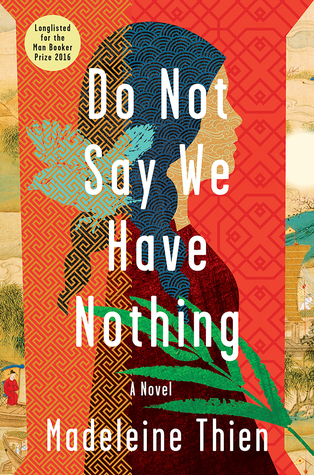
Robin Wasserman-- I've spent my summer lurking in Parisian cafes, drinking infuriatingly tiny cups of so-called coffee and trying not to feel like too much of a cliche when I pull out my journal and surreptitiously scrawl down some profound thought. (Said profundity slightly limited by the aforementioned caffeine shortage.) I'm a promiscuous but loyal customer: one cafe for writing, one cafe for critiquing student work, one cafe for hot chocolate, and one cafe, in the shadow of my favorite Parisian church (and, conveniently, favorite Parisian crepe stand), for reading. The last one is obviously the best one, but it's upped the stakes a bit: A book has to be pretty great to distract me from the wafting scent of nutella. Fortunately, I had Madeline Thien's Do Not Say We Have Nothing, one of the most absorbing and ambitious novels I've read this year. A story within a story within a story about the Cultural Revolution and the struggle of art and artists to survive in the face of oppression, Thien's book is brutally beautiful and a reminder that making art is both a privilege and a necessity.
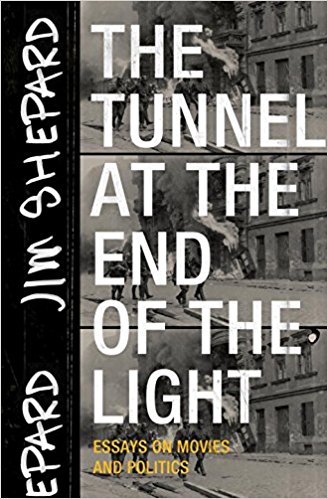
Justin Taylor-- This September Tin House will publish Jim Shepard’s first collection of nonfiction, The Tunnel at the End of the Light: Essays on Movies and Politics. Shepard’s cinephilia has been well-represented in his fiction (cf. his stories “Gojira, King of the Monsters”, “Boys Town”, “The Creature from the Black Lagoon”, his novel Nosferatu) so it’s a treat to read his wonkish and acerbic takes on the classics: “Badlands, and the ‘Innocence’ of American Innocence”, “Fool me Twice, Shame on Me: Saving Private Ryan and the Politics of Deception.” The essays first appeared in The Believer in the early and mid aughts, so the “politics” of the subhead largely concern the depravities of the second Bush administration, which periodizes the book but hardly dates it. Indeed, Shepard’s meditations on “the power and resilience of the lies we tell ourselves as a collective” have grown—if anything—even more dispiritingly prescient than they were a decade ago. I was going to say this is all less grim than it sounds, but it isn’t. What it is is smart, earnest, and unsparing.
For nonfiction students in particular, these essays are a solid model for a certain kind of personal-critical essay that puts engagement with a published work of art at its center but is not a "review" of the work in question. And for all Mountainview students, the essays have much to teach in terms of how to approach your close reading assignments and craft papers. Though the essays are polemical and make no pretense of "objectivity" (why would they? how could they? they're framed as persuasive arguments) Shepard is a rigorous of reader of texts--which in this case happen to be films and not books, but the point is the same. He is meticulous in his inspection of the material, noting craft elements like camera angles and minutes of screen time for a given character the way you might keep track of point of view shifts or the page-lengths of a given scene. Once he understands what something is, it's only natural to ask how it got that way, and to explore whether--and why--it succeeds or fails on the terms it has set for itself.

Benjamin Nugent-- For years I’ve considered myself a short-story writer, and I have just this month discovered Saul Bellow’s short stories. This is like considering yourself a drummer, and then, after years on the road, finally getting around to checking out Led Zeppelin. Track after track, you go, “Wait, what?” First you are filled with joy. Then you are filled with shame.
Here’s the businessman protagonist of Bellow’s “A Silver Dish,” published in The New Yorker in 1978:
"Woody, now sixty, fleshy and big, like a figure for the victory of American materialism, sunk in his lounge chair, the leather of its armrests softer to his fingertips than a woman’s skin, was puzzled and, in his depths, disturbed by certain blots within him, blots of light in his brain, a blot combining pain and amusement in his breast (how did that get there?) Intense thought puckered the skin between his eyes with a strain bordering on headache."
We’re outside the guy, looking at him, and we’re also inside him, feeling what it’s like to be him, at more or less the same time. As a bonus, we’re considering his symbolic significance. (Bellow is interested in the fact that Woody looks “like a figure for the victory of American materialism” but he’s also determined to make Woody more than a figure, to make him flesh.) When you’re writing short, it helps to be able to dig into a character quickly, the way Led Zeppelin digs into a rhythm. Bellow does it fast.
Boring Poetry: “Paterson” and the Observation of Repression
by Curtis Graham

The setting is a lustless marriage bed with gray sheets. Paterson lives an objectively boring life. The only thing more boring than his job as a bus driver, is his poetry. He is content. If he has aspirations, we don’t know what they are. We keep waiting to discover what he’s repressing.
Paterson’s poems appear handwritten across the screen, narrated earnestly in fits and starts by an endearing Adam Driver. The audience is part of the world with whom Paterson is afraid to share his work. We never hear a completed poem, and have to take his wife’s word that his poetry is spectacular. Driver’s voice expounds about the brand of matches he uses, and the burning sensation that love can give. He pairs physical descriptions with a writerly affect that even poetry students could snub.
But first person camera moves immerse us in Paterson’s existence, no matter how bland, and reveal that his sense of self is derived from observation of other people’s lives. Sitting at the front of his bus, he is a pair of eyes in a rearview mirror.
A middle school boy tells his friend he’ll dress as a shadow for Halloween and the camera shows us Paterson’s view: their feet nearly touching beneath the seat. This image is mirrored in the feet of two construction workers. They exchange stories of their weekend hook-ups. A woman offers them romance, and each turns her down for vague reasons. They bounce their heels on the floor, their feet as close as possible without touching. The camera rises, and we see the men sitting close together. One looks away before affirming that, definitely, he will call the girl back. A vertical pole divides them.
In the climax of the film, Paterson’s dog destroys his poetry notebook. His unphotocopied, unsaved, kept secret from the world, notebook, and in feeling Paterson’s loss, the poems gain significance. Each represents an unrealized life pulled through that rear-view mirror not from his own repression, but the repression of others. And we can finally feel his loneliness.
After the loss of his notebook, Paterson proclaims he is not a poet, but a sage Japanese tourist knows better and presents him with a new one, filled with blank pages. Where this convenient stereotype came from or went to subsequently, is uncommented on, but Paterson is redeemed and begins writing again.
Adam Driver’s voice returns to give us the line, but by the time the screen fades to black, we hardly remember it. The scrawled letters fade into the single word that is important to us: Paterson. We’re left with the hope that Paterson will continue seeing the people around him, even if they never see him.
Curtis Graham is a current degree candidate at Southern New Hampshire University's Low Residency MFA in Fiction and Nonfiction.
My New Barbershop
by Daniel Johnson

I got my hair cut by the same woman, a family friend—we’ll call her Allison—for twenty-one years, mostly at an in-home salon her husband built for her as a gift. Allison charged us cheap and came to understand the contours of my misshapen skull. She always led off a cut by spinning the chair around so my back was to the sink, gently tipping my head under the faucet’s stream of warm water, shampooing me, and using her wondrously long nails to scratch my head until the product was thoroughly distributed. From this—the scratching—she knew I got a boyish, puppy-dog pleasure. It was something, I know for a fact, she didn’t do for anyone else in my family.
I’ve asked every woman with whom I’ve been romantically involved to, at some point, scratch my head, scratch harder, use your nails. Reliably, most have fallen short of Allison. It is at my insistence that the specter of Allison’s hands stalk the landscapes of both simple haircare maintenance and—what?—foreplay, post-coital murmurings. I believe pleasure spectrums articulate themselves over time. Somewhere along that process of individual definition, the gestures involved in a routine, pre-cut wash warped into sensations I register as deeply ecstatic; for the vast majority of my hairdressed life, I must have looked forward to Allison’s cuts because I found them to be strangely and thrillingly intimate.
Now that I live in New York, I go to a barbershop packed away in a corner on the first floor of a high-rise near Battery Park. Its name: Barbershop. Intimacy-wise, it’s got the charm of a roadside motel truckers hit for some suspect crank and a quick midmorning fuck, cash up front. It’s the size of a rather large storage closet, with dirty white tile covered in unswept clippings, lit by overhead bulbs in frosted, flypaper-yellow plastic encasements. It’s manned always by the same four Israeli guys who talk less to and more over one another in their native language, and never to me. I find this both melodic and merciful; I’m terrible at any conversation when I’m in a leather chair being examined, reshaped.
I go there on my lunch breaks. I’ve been five times; they still don’t know my name. My first visit, I told the guy what Allison texted me to say when they ask what we’re doing: one on the sides, three on top, long enough so that I can style it, low fade in the back. At that, all four men switched their buzzers off and, almost in unison, told me with great urgency not to say this ever again. That, next time, if I said it, they’d actually do it, and I’d be a “crooked, unhandsome man.”
“Next time, you say, same style but shorter. That’s it.”
Once I had left and the lingering social terror had abated, something almost likeable revealed itself about the jaggedness to that experience. Living in New York City, there’s an inherent pressure to establish yourself as the prototypical Regular at the places you frequent: You walk into a café, you’re third in line, and by the time you get to the counter to order, the barista has already brewed your usual. I often feel myself crave for my transactions to be an acute combination of personal, neighborly, intimate. I’d very much like to experience the bodega equivalent of being the only one in my neighborhood to get a warm wash and a head scratch before I buy an egg and cheese on a roll. And so too often, I think, are strictly transactional experiences interpreted—distorted—as rude.
There’s a concrete ceiling on my relationship with Barbershop. It falls stories short of any familiarity appropriate to walk in and say, “Just the usual today.” I don’t find it cold. I find it absolute. Same style but shorter. It’s easy.
Admittedly, my hairstyle looks different each time I leave. The only consistency is in their method: the guys there tug my head around, press the corner of the buzzer blade behind my ear, come just short of drawing blood. They either forget about or ignore the bald spot where my crown meets the back of my skull, and fail to compensate for the receding hairline on the right side of my forehead. But I’m out of there in twenty minutes tops. They always ask me to come back—about as friendly as they get. They say it to everyone.
Daniel Johnson is a graduate of Southern New Hampshire University's MFA in Fiction and Nonfiction. He is currently an Editorial Assistant at Bedford/St. Martin's Press.
DFW on Lynchian violence in the new Twin Peaks
by Eddie Dzialo

I started watching David Lynch’s movies when I was too young. They didn’t ruin me, but I did see them before I was old enough to understand them—if they can be understood at all. When I was twelve, I saw Lost Highway for the first of many times and developed flu-like symptoms.
Now, at thirty-three, I am a father in the middle of remodeling my kitchen but still manage to make time to watch Twin Peaks: The Return. And I do so with the same level of enthusiasm that I had for Lynch when I was in middle school, minus the uneasy nausea. Part of that, is accepting that good art is the successful transfer of emotion from artist to subject. And those emotions don’t have to make you feel good. David Lynch’s work becomes particularly interesting when studying his portrayal of violent subject matter—the material that sent my stomach reeling at twelve.
In his essay “David Lynch Keeps His Head,” David Foster Wallace wrote: “an act of violence in American film has, through repetition and desensitization, lost the ability to refer to anything but itself.” Watching Lynch’s films are so surreal (and nauseating) because the visual and narrative devices Lynch uses to portray violence are outside the desensitizing vernacular of popular media. As Wallace notes in his essay: “Quentin Tarantino is interested in watching someone’s ear get cut off; David Lynch is interested in the ear.” In Blue Velvet, when Lynch zooms in on a severed human ear that is resting in a neatly manicured lawn, he is taking everything out of the shot but the thing itself. The viewer’s attention has nowhere else to go; it needs to lock onto the severed ear. As one of Wallace’s own characters was fond of saying, “Never underestimate the power of objects.”
In a scene from “Part 10” (Lynch referred to them as “parts” rather than “episodes”), Richard Horne attacks Miriam, but Lynch obscures the violence from the audience. The scene begins with Richard Horne arriving at Miriam’s trailer. While Richard is standing in her yard, Miriam shouts through her locked glass door that she has told the police that Richard ran over the young child. Richard cracks his neck by tilting his head toward each ear, then charges the trailer, breaks the glass door with his knee, and goes inside. For twenty-five seconds, the only thing the viewer sees is the outside of the trailer from a considerable distance away. What the viewer hears is Miriam screaming until she stops, presumably because Richard has killed her. Lynch never shows Richard hurting Miriam at all.
Wallace argues that Lynch’s violence finds a way to refer to something other than itself because “Lynch’s violence always tries to mean something.” Audiences ask for violence. They ask to see the act itself out of morbid curiosity, something the entertainment industry has exploited in numbing volumes. When Lynch gives his viewers nothing more than screams, he makes the scene visceral, taps into a universal expression of pain while escaping the visual clichés that make its consumption less painful.
Because of Lynch, I can feel for Miriam when she locks herself inside the trailer, and because of Wallace, I understand why. I can’t help but watch and wonder what Wallace would have thought of the newest season of Twin Peaks . As violent as Lynch’s movies are, Twin Peaks: The Return is like watching Lynch’s dissertation on the depiction of violence. And he transfers raw emotion better than he ever has.
Eddie Dzialo is a current degree candidate at Southern New Hampshire University's Low Residency MFA in Fiction and Nonfiction.
Re-beginning
by Ashley Bales

A funny thing about beginnings: they’re always false. They share this with endings, but while writers often talk about false endings, beginnings simply don’t start at the right time. ‘Begin as near to the end as possible’ is an idea about containment and a good lesson in why life and literature differ, or we can hope. A blog has a life and will begin as lives do at whatever moment an individual is born to it and will experience many more beginnings than the first. So, hello again. I give you the re-beginning of the Assignment blog.
I was once a paleontologist and finding beginnings was my job. Never the first beginning, only a committed search for prior beginnings. When a new species appears—something like this blog, reappearing, not reborn—it can always be traced earlier, though its life is no less significant for it. Needless to say, a blog for a literary magazine for an MFA program functions on hyperbolically compressed timescales relative to the life of a species. It adheres to the rhythms of application, acceptance, concentration, graduation, with new voices added and lost in 6 month cycles. It’s agglutinative, stratigraphic, an exercise in context.
Criticism is also an exercise in context: the successes of literary criticism (and the lit blogs that practice it) are not bound to facile judgement, but the ability to contextualize. This incarnation of the Assignment blog is re-begun within the context of me, my Mountainview cohort, the Fall 2017 entering to graduating classes, the year 2017, Trump’s America, all of our Americas, the blogosphere, a publishing landscape stuck continually re-beginning in a world where blogospheres exist (unless they don’t anymore), and a deep continuity of literary practice and practitioners reaching back without beginning to our earliest humanity.
My point being, an education in context aggrandizes the whole, as it humbles each individual start. Let's begin.
Last Week: Nabokov, Hardwick, and Emojis
For all the discussion of engagement flying around these days it’s hard not to want to ostrich-up once in a while. A new collection of interviews with Nabokov demonstrates his stubborn disengagement. He “… [didn’t] give a damn for the group, the community, the masses, and so forth…” limiting his political opinions to: "Portraits of the head of the government should not exceed a postage stamp in size." What would he have thought of this morsel?
In this inspiring profile of Elizabeth Hardwick, Sarah Nicole Prickett describes her as a "domestic writer," acknowledging the weight of applying that term to a woman. Prickett seems unsure how to discuss this unarguably feminist icon in the context of Hardwick's skepticism of feminism. Like Nabokov her concerns were literary and in so far as she did actively engage in and even help shape feminist literary criticism, she refused to be drawn beneath its homogenizing banner.
As citizens, that ideal unification we strive for turns us into the homogenized masses, which, as Auden so eloquently argues in his classic essay "The Poet and the City," has no place in literature. At least not as long as literature is still at its most powerful when presenting individual experience.
But a little engagement is unavoidable: Emoji poetry has made it into The Paris Review (blog), The New Yorker came out with it's first ever television issue mere days after Game of Thrones set it's narrative priorities airborne, but at least Curb Your Enthusiasm is coming back?
I'd rather go back to reading about Nabokov apologizing for cliched butterflies.
Ashley Bales is a current student of Southern New Hampshire University's MFA in Fiction and Nonfiction. She holds a Ph.D. in Biological Anthropology, teaches in the Math and Science Department at Pratt Institute and is web editor for Assignment Magazine.

Fangirling & Fanboying: Sweetbitter, Binary Star, Guster is for Lovers

Guster at the house of blues, courtesy of front row boston.

sweetbitter.
Lisa Janicki -- Not surprisingly, there’s a theme of consumption in Stephanie Danler’s Sweetbitter, which takes place largely in an upscale NYC restaurant near Union Square. There’s the eating, obviously, and the drinking and the snorting coke, maybe just as obviously. But there’s also being swallowed up by a new place, its inhabitants, and its rhythms. Some days, the city where you live is on your side: you go from A to B in one continuous movement: you breeze through turnstiles and catch every train; it’s all green lights and walk signals. There’s a welcome loss of self in times like these. Through Tess, Sweetbitter’s narrator, we experience this through the eyes of a server: “Specks of dust taking off from bottles, shadows darting onto the floor, glasses listing over the edges of counters and caught just in time…The reflex was to see beyond my line of vision, to see around and behind myself. The breath between consciousness and action collapsed. No hesitations, no projections, no order. I became a verb.” That passage is immediately followed by the best description I’ve ever read of what it means to be in the weeds during your restaurant shift. And how once you’re there, suddenly wrecked and paralyzed by your own surroundings, you can’t get back to the other side, you can hardly remember it. Danler presents to us these varieties of consciousness, and how slipping back and forth between the two can happen in an instant and is seldom in our control.

Lost Ground.
Eric Beebe -- About every Memorial Day I dig through my stacks of old CDs (yes, some of us still have such things) for Lost Ground, an EP by the band Defeater. The band made a name for itself with, aside from its myriad of talent, a distinct narrative style to its lyrics. Frontman Derek Archambault has so far written the lyrics to each new installment of the band’s music as different characters’ perspectives in a story linking all of them together. In Lost Ground, we are reintroduced to a homeless WWII veteran who plays the role of singing sage to the protagonist of the band’s album Travels. But the EP starts from this man’s adolescence, with a song titled “The Red, White, and Blues” kicking off his story as he drinks himself into oblivion before shipping off to war. Through six tracks, the EP takes us along the timeline of this man’s life. In the end track, “Beggin’ in the Slums,” our hero—returned home as a veteran and forsaken by his countrymen—spends his days playing guitar to passing crowds for change, and he sees the young man from Travels, on the run, and recognizes a look in his eyes he once knew as his own. With admittance of the time he’s lost, that he’s amounted to all he will, he finds hope that this young man will do better, somehow for the both of them. Because they both know the same thing: people deserve better.

Binary Star.
Nadia Owusu -- I should have found Sarah Gerard’s short but intense novel Binary Star to be disorienting. It is structured less like a novel than like a long prose poem. It’s about astrology and anorexia, capitalism and addiction, love and self-hate. It’s about all of these things at once, sometimes all at once in one sentence. Time is undefined. The past and the present collide without notice. Dialogue is unmarked and undifferentiated from thought. And yet, I was transfixed. The novel did not, despite its unconventional structure, feel confused. It was beautiful and raw and thoroughly original. Rather than being experimental for experimentation’s sake, one gets the sense that Gerard followed the architectural principal that form should follow function. Binary Star is about a woman and a world in chaos. The fact that the novel attempts to wrench the reader out of his or her literary comfort zone only serves to heighten the emotional power of the story.

The Laughing Monsters.
John Vercher -- There’s nothing funny about Denis Johnson’s The Laughing Monsters. It is described as “a high-suspense tale of kaleidoscoping loyalties in the post 9-11 world”, but the end result is, almost impossibly, something far more complex. Johnson’s slim novel is told from the first-person perspective of Roland Nair, a government operative (for which government, we’re never quite sure) on assignment in Africa to track down his former colleague, Michael Adriko, an African native with whom Nair has had some dirty dealings. During their reunion, Michael introduces Nair to his fiancée, Davidia, whose lineage involves Michael’s military past. What follows is a tumultuous journey that leads Adriko and Nair on a path to capitalize on the fears of post-9-11 terrorism with an ill-conceived plot designed to separate bad people from their money. While Johnson adroitly manages the tension of the plot, it’s the machinations of Nair’s mind that cause the greatest discomfort. He is a misogynist, a racist, and while he proclaims a love for Michael, he’s simultaneously looking for a way to steal his fiancée from under his nose. It is in this aspect where Nair’s characterization is most captivating, as his desires for Davidia spiral into obsessiveness in a manner that makes you question his sanity, and perhaps the reality of his perceptions. He is the most unreliable of narrators from which you can’t turn away. And while I found it somewhat difficult, at times, to separate the prejudicial ideations of Nair from the possible perspective of the author (Johnson did in fact spend time as a journalist in Africa prior to writing Monsters), the sentence structure is in fine form and the dialogue is masterful.

Guster is for lovers.
Daniel Johnson -- It's no well-kept secret that I am a tragic Guster superfan. In truth, I'm a little unsure whether recommending this band is a moment I was made for, or (much more likely) one I should have actively avoided, as there's just no chance I'll be able to articulate what makes theirs such timeless, quintessential, unbiasedly exceptional music. Regardless, here we are--you, me, and Front Row Boston's recording of Guster's January 15, 2016 homecoming concert at Boston's House of Blues, released in May of this year. The video is just over an hour long, comprised of 14 songs from their Night One set (I was at Night Two), spliced with commentary from vocalists/guitarists/bassists/everything-elseists Ryan Miller and Adam Gardner on their band's twenty-five year career. They formed in 1991, right down the road from the House of Blues, at Tufts University, where three of its remaining original members attended undergrad. So what's it like when they come back to Boston, when they come home? "It's always sort of emotional when we come back and play the place where we started--I mean, it's crazy," says Ryan. Adds Adam: "You can feel it, when we play, you can feel it in the crowd, you can see when you're looking out there ... Boston is the place that built our career." Such is the electricity with which they play during this show: beneath their characteristic lightheartedness, there's a palpable wattage of gratitude, sincerity, nostalgic revelry. It's no clearer on display than during their opus from Keep It Together, "Come Downstairs and Say Hello." These guys are object lessons in the rare sort of artistic brotherhood that endures and evolves (for a quarter of a century!), and as a fan, seeing that sort of synergy between them, strong as ever so late in the game, is intoxicating: to witness this concert for the first time or the hundredth is to understand a little better what lasting relationships at their strangest, funkiest, and most harmonious should look like. This is why--as we were reminded during the TNT broadcast of this year's NCAA Championship Game--Guster is for L<3vers.

100 Love Sonnets.
E.B. -- While City Lights’s translated collection of Pablo Neruda’s poems, The Essential Neruda, offers a grand overview of his work—his odes, his communist beliefs, his musings on Machu Picchu—it was his love poems that hooked me. Most notable to me was his poem “XII,” from his Cien sonetos de amor (100 Sonnets of Love). It’s impossible not to be enthralled by Neruda’s use of language, albeit translated, that touches upon senses that make reading his love poems feel nothing short of an aphrodisiac. Now, having tracked down and read Cien sonetos from cover to cover, I only find myself more impressed with it. Each poem is titled simply with the Roman numerals marking its place in a progression of Neruda’s musings. The emotions wax and wane, rise and fall, like the moon and waves he drew upon for symbolism. His use of natural imagery and picturesque landscapes blend with romantic sentimentality; whereas lesser writers would butcher such a mixture, this is Neruda’s chief triumph. He draws upon one image or another knowing full-well the associations they brought with them and carefully balanced these associations to create sex on paper. In a time when postmodern thought has cast more doubt than ever on what love is or even whether it exists, Neruda’s work calls out to demand its reality and prove that it’s something floating at will between our senses and psyche. It says we don’t need to know what love is or how it is, just to know it’s there and—most of all—feel it.

Fangirling & Fanboying: Jandy Nelson, Kurt Vonnegut, Arturo Pérez-Reverte

From the cover of I'll Give You the Sun.
Daniel Johnson -- Confession: Young Adult Literature, until recently, was oft absent from my shelves, and is admittedly under-represented (read: nonexistent) in these staff picks here at Assignment. It’s a sensibility thing, both as individuals and as a publication, and I get it. However, on recommendation, perhaps on challenge, and also because I’m in the process of renovating and expanding my tastes, I read Jandy Nelson’s 2015 Printz Award-winning novel I’ll Give You the Sun, and I fucking adored it. Seldom have I held characters as dear as I did Noah and Jude, the book’s twin teenage Californian protagonists, who we follow through art school rejections, the separation of their parents, and the eventual death of their mother, all of which leads to a monstrous rift in their relationship. From the very first page, I cared so deeply for their bond, was so invested in its loss and redemption, in each sibling's tumultuous road to individuality and healing; I longed so fiercely to wedge myself between their bodies during what Noah calls “the smush,” a sedentary position in which each twin abuts the other “until we’re not only one age, but one complete and whole person.” How many people, I wondered, read this book and realized that to be one half of a smush is all they’ve ever wanted? Nelson gives us a story that seems, on the surface, elemental because of its elasticity: twins start together, twins grow apart, two arcs that begin as parallels before they bend and meander away from one another, until they eventually snap into symmetry anew. What sets it apart as outstanding, for one, is Nelson's Lerner-esque ability to drive the story almost entirely through the interior registers of her protagonists. And then there's her language, which processes as flashes of color more often than it does as formations of words. Here’s Noah, speaking of his sister: “Jude looks at me. Her eyes are the lightest glacier blue; I use mostly white when I draw them. Normally they make you feel floaty and think of puffy clouds and hear harps, but right now they look just plain scared.” Both twins are artists, and their voices, as here, seem somehow liberated from the representational deficiencies of quotidian language; thus, Nelson’s prose scraped feeling from me with terrifying page-to-page ease, some of which was so complex and overwhelming and new that I struggle to name it here. What I can articulate, and what you need to know, is that I’ll Give You the Sun understands the rhythms of relationships, like Noah and Jude's, that are galactic in importance: it will leave you assured that it’s okay—beautiful, even—if one person is the central star to your cosmos, just as long as you’re unafraid to be ripped from orbit every once in a while, to be forced to go rogue and experience the universe as a sovereign world. Nelson is offering a comfort, here, that when it comes to her characters, or any set of twins, siblings, any and all family—plainly, when it comes to those we love—an inexplicable gravity will always ferry us back to them.
Slapstick.
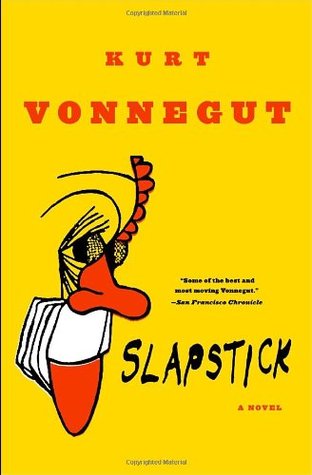
Eric Beebe -- To say I’m a fan of Kurt Vonnegut would understate the eye rolls and sighs of many friends of mine every time I mention his work yet again. I turn into a kind of missionary for his work—ironically, considering many of his themes—every time I meet someone who hasn’t read it, and I make a point of tracking down the gems he produced which didn’t receive the same fanfare as Cat’s Cradle or Slaughterhouse-Five or maybe just fell out of the public eye. This search brought me to Slapstick, which Vonnegut claims in its prologue to be the closest thing he wrote to an autobiography. “It is about what life feels like to me,” he wrote, which may sound strange regarding a story of a malformed, incestuous pair of twins narrated by one who becomes the last president of the United States, but therein lies the joy of the book. The story is so blatantly absurd, with things like telepathic orgies and a campaign platform of grouping the nation into artificial families, that it stands as one of Vonnegut’s best efforts he makes across many of his books with regard to showing us just how ridiculous humans really are. This book is a must while seeking distraction from real-life absurdities like the rise of Trump and other pains of the impending election, but it also satirizes such events like only Vonnegut could. It’s a story of triumph and failure in simultaneity, as is often the only true case, told through a hyperbolic comedy of the journey there which makes us question, in the protagonist’s words, “And how did we then face the odds, / Of man’s rude slapstick, yes, and God’s?” If you want the answer, go read Slapstick.
the painter of battles.
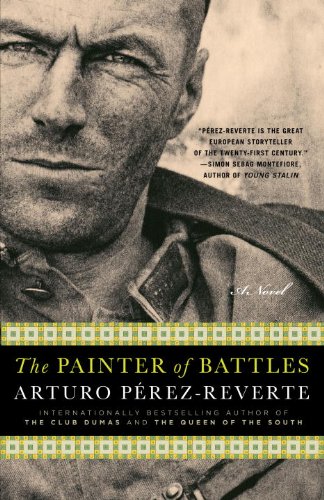
Ted Flanagan -- If you make it to the surprising, soul-crushing denouement of The Painter of Battles, it will be as if Arturo Perez-Reverte has combined the blizzard-cold human condition of, say, Crime and Punishment, the tragedy of Anna Karenina, and the construction of the mirrored city of Macondo in One Hundred Years of Solitude, and condensed it into 211 pages without missing a chord of the originals’ beauty and cruelty. The protagonist, Andres Faulques, is a retired war photographer living in abandoned lighthouse on an unnamed stretch of Spanish coastline, and spends his days painting an epic mural along tower’s inner wall, bearing witness to the horrors his camera recorded. Into this solitude arrives a former Croatian soldier, Markovic, whose life was inadvertently ruined as the result of an otherwise inconsequential photo Faulques took of him while covering the brutal war arising from Yugoslavia’s death throes. The photo becomes a worldwide sensation, brings Faulques great fame and money, but also costs him the love of his life, who stepped on a mine near a muddy Balkan road two days later. The picture costs Markovic dearly, too, and he arrives at the tower to engage Faulques in a conversation, ask the photographer some questions, and then: “I’m going to kill you.” Throughout the characters’ extended daily conversations about art, love, death and war, Reverte’s writing is lyrical, philosophical, building to its surprisingly emotional climax slowly, one beautiful word upon another, in the way of all great literature.

From the cover of Half an Inch of water.
David Moloney -- The birth of twin Appaloosa foals on a Western Indian Reservation could be an intense enough event to carry a story. But in his collection, Half an Inch of Water, Percival Everett isn’t content with easy narratives. Here, in “Finding Billy White Feather,” the elusive title character tacks a note on a rancher’s door, offering to sell both horses. Billy claims to be a Sioux, but is described by many in many different ways to Oliver (the rancher): “a tall, skinny white boy,” and, later, “Could be he’s fat,” by another. The note sends Oliver in search of White Feather, but each time he is thwarted. Like many of Everett’s stories, this one is shot out of a cannon, propelled forward without any backtracking or history, all the way to its bleak end—Oliver never does find White Feather, and the twin foals die. So it goes for the rest of the collection: Everett rarely leaves you fulfilled. But in each story, as with White Feather, there’s an intentional mysticism that surrounds the characters. In “A High Lake,” Norma Snow, an elderly horse owner who still rides every day, gets lost with her horse one morning. As she tries to find her way back, she enters a spirit-realm where her dead dog runs alongside her. Everett writes it as if this is a sure sign of Norma having perished on horseback in a meadow—a fitting end to a character who died doing what she loved—but somehow she finds her way home, to her fireplace, where she remains as the story ends. We’re left with the feeling that we were tricked: Did Norma go on that ride? Did she dream it? Again, unfulfilling. You’ll never know the answer, but you’ll be glad Everett showed you what that last journey would have been like.

Between the world and me.
John Vercher -- My father and I have never been close. There was a time though, however brief, during the mid-to-late eighties, when we connected for a few hours a week. Several days per week, we’d drive to the neighborhood gym. On those car rides, he’d tell me why my hair was different from other mixed kids and how I should assume all white people were racist until they proved themselves otherwise. Then we’d get to work on building our bodies. It wasn’t until I read Ta-Nehisi Coates’s Between The World And Me that I began to gain some perspective as to what was really going on in those car rides, in those subsequent gym sessions. Written as a letter to his fifteen-year-old son, Between is Coates’s declaration of the imperative need to preserve “the sanctity of the black body”, to protect it from the threat of systematic racism “that makes your body breakable.” Through Coates’s eloquent narrative and frank confrontation of an eminently necessary conversation, I gained some modicum of clarity about what was really happening in those car rides, in that gym. While my adolescent arms quaked under a weight I could barely lift, my father’s shoulders bowed, not from helping me lift the bar, but under a love he almost could not bear, trying to protect me from the world I’d inevitably come to know.

DJ -- This week, I'll be recording an episode with our friends over at The Critical Breakdown, which, for those of you who are unfamiliar, is a little movie-review podcast with a single hilarious (and existentially lofty) objective: "We review movies based on their Rotten Tomatoes score, starting at the very bottom with 0% and working our way towards 100%. We'll learn what makes a bad movie bad, if ratings are fair, and maybe even something about ourselves." Right now, they're at 8%, and after reading my piece on horror films here, they asked me to help review The Number 23, a pseudo-horror/conspiracy thriller/pulpy, oversexed detective noir flick in which Jim Carrey, as an animal control officer, tries (and so catastrophically fails) to defeat the 23 Enigma. Now see, I'm typically a JC-in-non-comedic-roles apologist, and I remember watching this film in 2007, when I was sixteen, alone in my basement with a take-out order of onion rings, and loving it. You'll have to listen in to hear what my opinion is nine years later (spoiler: the movie is egregious, really, just downright insulting). Scott & Max, TCB's hosts, are erudite and funny, and their rapport with one other is seamless. Perhaps most impressive about their approach is the tender seriousness with which they consider each movie; this is almost impossible not to appreciate, given the broken body of cinema they've handled thus far (Good Luck Chuck and Battlefield Earth, to name two). They've even got an official podcast poodle, Walter, who occasionally drops into the studio for some canine analysis. In other words, they quite organically inhabit the airwave space between smart and absurd; this is why I consider them legitimate and sincere critics, and why they're such good radio.
Fangirling & Fanboying: Ottessa Moshfegh, Luke Mogelson, Nuruddin Farah

from the cover of homesick for another world: stories
Benjamin Nugent -- In his essay "Michael", John Jeremiah Sullivan points out that Michael Jackson’s best songs have the peculiar catchiness of schoolyard chants. You’ve got to be starting something, Hey girl with the high heels on, Billie Jean is not my lover, I’m bad, I’m bad, you know it, etc. One of the reasons I love Ottessa Moshfegh’s forthcoming collection, Homesick for Another World: Stories, out next January, is that she too is a master of the taunting cadence, only Moshfegh’s schoolyard abuts a high school or a liberal arts school: “The deluxe shopping center on Route 4, where the fattest people on earth could be found…”; “But having held my dick in her hand, she seemed to feel she’d earned the right to belittle me as much as possible”; “The shoulder pads nearly hit his ears, as he had basically no neck.” Lesser writers don’t trust the reader to engage with narrators who express contempt, so their narrators are artificially aw-shucks and nonjudgmental. But Moshfegh knows that people make fun of other people to shield themselves from their own self-loathing, fear and loneliness, and she knows how to twist a story at the end so that the mask of disgust falls away and we see the desolation that was always lurking behind.
New American Stories
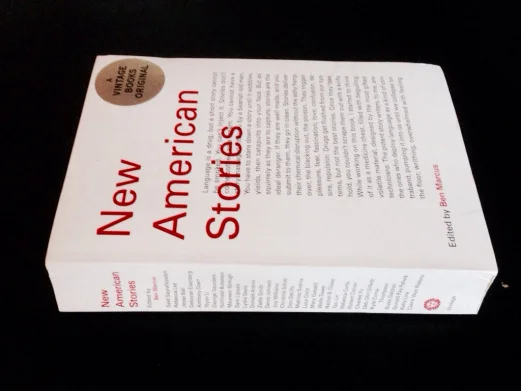
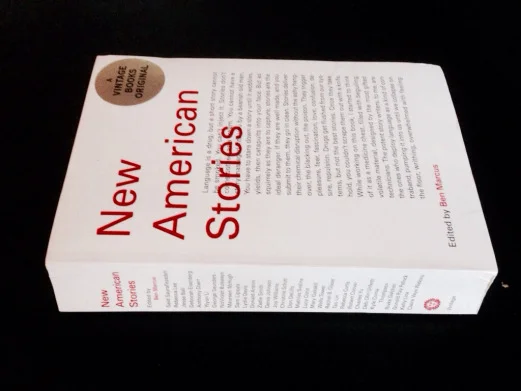
Daniel Johnson -- Why is it that all the world has yet to acquire a copy of New American Stories (2015), the 750 page anthology edited by Ben Marcus, and gorge themselves on it? Contained therein are over twenty-five pieces of short fiction--including installments by Don DeLillo, Mary Gaitskill, Wells Tower, and Kelly Link--that matter now, not only because they're individually outstanding with regard to their contributions to the endurance of the short story form, but also because, collectively, they're a clip of what the American voice sounds like now. It's The Unprofessionals, but more sweeping in scope. And sure, I'm quite aware this is a terrifically cliché way to talk about any book. But what else is there to say about the most quintessential curation of contemporary stories available? Perhaps that Marcus's intro is knockout: "The potent story writers, to me, are the ones who deploy language as a kind of contraband, pumping it into us until we collapse on the floor, writhing, overwhelmed with feeling." Perhaps, too, that the book as a physical object is gorgeous (see left), and simply feels like something substantial when you hold it. It's got the weight and paper gradation of a Bible. Just saying.
John Vercher -- As a new(ish) father, I find that certain books, movies and the like affect me on an emotional level they wouldn’t have pre-rugrats. Marlin finally reunites with Nemo? My chin crinkles. “Cat’s in The Cradle” plays on the radio? The eyes start to burn a bit. And don’t even get me started on that scene from Interstellar when McConaughey watches the video messages from his children back on Earth. So it went for me with Celeste Ng’s 2014 debut novel Everything I Never Told You. Lydia Lee, the teenage daughter of James and Marilyn, is missing. Her fate is revealed to readers by the end of the first chapter: “Lydia is dead. But they don’t know it yet.” Despite the innards-twisting tension that Ng so deftly ratchets before divulging Lydia’s fate, it’s her family’s reactions to their loss and the memories conjured by it that deliver much of the novel’s emotional resonance. Ng writes with the painful beauty of a parent’s perspective as they bear witness to the cruelty of which children are capable. It’s stories like these that stop me cold, make me set the book down long enough to find my sons and hold them, with the hopes of protecting them from the world.
Sarah Eisner -- My mother often writes me lengthy emails about her childhood in Savannah, Georgia, and sometimes asks me questions about the way I remember mine in suburban California. I tend to respond like I’m less interested than I am, like I don’t know that I’m privileged to have a mom who wants to relive my life and share her own, like I don’t realize that someday I’ll wish I asked her everything I could. So when she mentioned that I should read The Rainbow Comes and Goes—a back and forth correspondence between Anderson Cooper and his mother, Gloria Vanderbilt—I told her it wasn’t my thing, thinking it was another lame celebrity memoir. It arrived on my doorstep on Mother’s Day anyway. I was surprised to find how deeply satisfied I was with the way Rainbow explores motherhood, ambition, identity, aging and grief, framed within a unique narrative of a very particular kind of American privilege and pain. The relationship between Anderson and Gloria illustrates the way families remember through parent and child, and inspired me to ask my mom a few more questions.

from the cover of bright lights, big city
Eric Beebe -- After far too long, I finally picked up Jay McInerney’s Bright Lights, Big City and got to making up for the lost time it spent buried in my reading list. It quickly shot into place among my favorite books. The novel gave me the feel of following thoughts rather than plot, but with no lack of an arc to show for it—just gems of true consciousness that seem universal to human experience: “No. Stop this. This is not your better self speaking. This is not how you feel.” The universality of the protagonist’s thoughts is one of the novel’s greatest triumphs; it’s only aided by the way McInerney's style allows us to feel we know the character so well. In a world where we’re constantly pummeled with the differences, assumptions, and enigma surrounding baby boomers, millennials, or whichever generation, it’s an extreme relief to read work which—touted as definitive of one age and place—feels purely, innately relatable in its humanity. Bright Lights, Big City isn’t just a coming-of-age novel, or a New York novel, or an eighties novel. It’s a story about the disillusionment and disappointments that can strike anyone, anywhere, at any time, and the fleeting efforts we make to cope. Rumor has it that The Paris Review’s sitting on a forthcoming interview with McInerney, and after this, I’ll be counting down days.
David Moloney -- Luke Mogelson’s first collection of stories, These Heroic, Happy Dead—a title borrowed from the E.E. Cummings poem, “next to of course god america I”—would have you know that when veterans return from war, there’s no glory awaiting them. Rather, what happens is a continuance of trouble and violence. What is especially empathetic about these stories is how Mogelson not only focuses on the veterans, but also the people close to them: mothers, neighbors, and co-workers. In “Visitors,” a mother, Jeanne, loses her son a second time when he returns from war and kills a man in a bar fight. Jeanne is in denial, as she believes her son merely “had to go away again.” But Mogelson doesn’t condemn his characters for feeling wronged. Instead, he allows them to act out their anger and anxiety---as in “Human Cry”---only to find them in a worse way. The protagonist in “Human Cry” explores his own involvement in a man’s death and how he subsequently dealt with it with a self-imposed isolation from the world. But the full extent of the isolation isn’t understood until Mogelson switches point of view in the final page, revealing the protagonist’s bizarre and embarrassing actions to the reader---he’s been living in the man’s home, the man he is responsible for killing. These Heroic, Happy Dead is a book of war stories---perpetual war---and the consequences of sending men to kill and then asking them to return to family, work and normalcy no different.
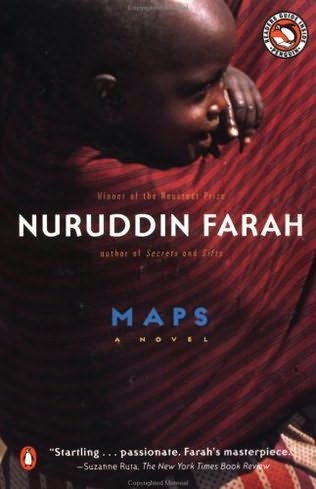
from the cover of maps
Nadia Owusu -- In Nuruddin Farah’s rich and lyrical novel Maps, a young boy by the name of Askar bears witness to the violent redrawing of Farah’s native Somalia and neighboring Ethiopia post-colonialism. At the same time, he must make decisions about who he wants to be and what he is willing to fight for. Although the political and geographical context of this novel is specific, there are many parallels between Askar’s wars (internal and external) and the wars that are currently being waged, from the Sudans to Syria. Examining themes like religion, class, and community, Maps reminds us that identities and borders (particularly, perhaps, in Africa) are fluid and rarely easily defined.
Ted Flanagan -- The recent paperback reissue of Richard Price’s The Whites drops the hardcover’s unfortunate author attribution of “Richard Price writing as Harry Brandt” in favor of simply his name, which any devotee of Price would have known by the end of paragraph one. Consider the opening lines: “ ... a quarter past one in the morning and there were still far more people piling into the bars than leaving them, everyone coming and going having to muscle their way through swaying clumps of half-hammered smokers standing directly outside the entrances. He hated the no smoking laws.” The book has all the Price-ian staples. Its protagonist, Billy Graves, is a conflicted veteran police detective, now working a kind of overnight bunco-cum-broken-windows squad in NYC, all the while stewing about a case from his past involving a triple-murder suspect Graves could never pin with the crime. And then there’s the mysterious stalker, intent on destroying the Graves family. The change on the paperback cover just goes to show that a Price novel, even one intentioned to be a simple whodunit penned under a pseudonym, will always be a Price novel. If there’s a writer living today with a better ear for honest, human dialogue, or a more pathological inability to see every character in anything but full 360-degree, four dimensional view, who illuminates the wider world around us by focusing on the narrow world within his characters, and turns up the heat slowly, so you don’t realize you’re in hot water until it’s too late, I don’t know who they are.
Fangirling & Fanboying: This Week's Recs from Assignment

Enclosed: Facebook activists, but opposite
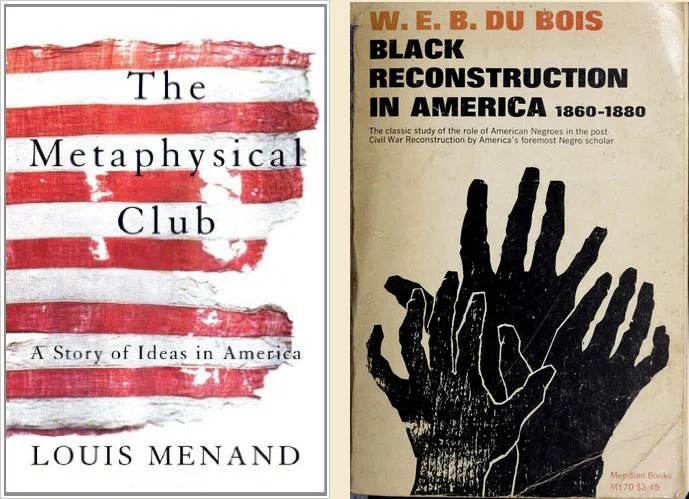
Benjamin Nugent -- I’ve used a metal detector to extract a lead .59 miniball from the dirt near Manassas. I’ve sipped whiskey from a party cup at the site of one of the last charges of the Army of the Potomac. I’ve been to the Chancellorsville gift shop and seen the bookshelf that’s divided into three sections: Northern, Southern and neutral. But until recently I was fairly ignorant about what came after the Civil War. So I picked up Black Reconstruction in America, by W.E.B. Du Bois, and The Metaphysical Club, by Louis Menand. Du Bois is interested in the masses: why, he asks, did five million poor whites support a war on behalf of eight thousand rich whites to keep four million blacks enslaved? It’s required reading for the Summer of Trump. Menand is interested is the intellectual foment that attended and followed the war. His book is set in the salons of Cambridge, Baltimore and Chicago. There are characters like Zina Peirce, who believed that adultery should be punished by execution or life imprisonment, and her philosopher husband, Charles, who cheated on her a lot. It serves as a reminder of how hard it is to find role models in the nineteenth century; even the most ardent abolitionists espoused some pretty appalling views. Their heroism resides in what they did, not in what they said. Sort of like Facebook activists, but the opposite.
Eric Beebe -- Ever since reading “The Weirdos,” I’ve grabbed any piece of Ottessa Moshfegh’s work I can. Her short stories fit my tendency to read in twentyish-minute bursts, but when I heard about her novel, McGlue, I had to see what she did with the extra length. The book follows the title character’s inner monologue, picking up where he’s accused of murdering his shipmate and best friend, Johnson. McGlue’s constant state of impairment by both alcohol and head injury keeps clarity to a foggy minimum, and that was perhaps my favorite aspect of the whole story. Being tied to his altered reality, I learned to stop trying to distinguish the corporeal from hallucination and simply accept what he saw in front of him. The dichotomy between these two forces becomes integral to the plot as the weight of events leads McGlue to seek escape by any means necessary, even if it kills him. The resulting feel falls somewhere between reading The Things They Carried and watching Reservoir Dogs while our narrator teeters back and forth between blacking out and drying out. Moshfegh doesn’t hand us just any drunken sailor; she gives us a man floating between two worlds, battling with himself over which to choose, if he can at all.
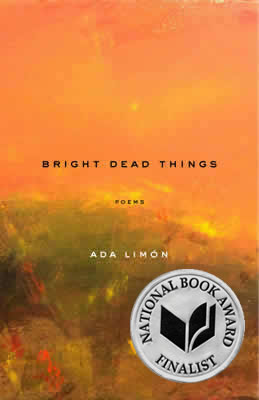
From the cover of Bright, Dead Things
Lisa Janicki -- My favorite poem in Ada Limón’s collection, Bright Dead Things, is “Downhearted,” which begins, “Six horses died in a trailer fire. / There. That’s the hard part. I wanted / to tell you straight away so that we could / grieve together.” She’s a city girl who moved for love to the south, where even the tragedies are foreign. She bumps up against new idioms and “tornado talk”— the subtle stuff that’s peculiar to regions and can be so disorienting to transplants (“All the new bugs.”). And from these small moments, she elaborates larger impressions of her existence. She had imagined herself differently in this new life—more agreeable, more open to its magic, more like a child. But when our grown-up selves allow us to become children again, it’s often in a way that’s less magical and more sullen: in “The Last Move,” she writes, “This is Kentucky, not New York, and I am not important.” I root for Limón as she cleans her big new house and tries to like gardening, though it seems clear she’d rather be in her Brooklyn apartment. I root for her because she threw it all in for love, because she moved to Kentucky for it, because she had no Plan B. And mostly I root for her because I get the sense that she’s resurrected herself before, and she’s about to do it again: “What the heart wants? The heart wants / her horses back.”
David Moloney -- You’d think Olive Kitteridge would be the focus of Elizabeth Strout’s novel in stories titled in her name. But we’re instead given thirteen stories that concern themselves more with the residents of the small, coastal New England town of Crosby, Maine. Olive is a math teacher there, and she seems to have had all the book’s characters in class at one point; she always finds herself crossing paths with them when they’re stalled in a threshold of self-destruction. It’s these characters that are most central to the novel. Whether it’s a former student who contemplates suicide on a beach, an anorexic teen, or even her own husband falling in love with a much younger employee, Olive---through her staunch and sometimes misplaced contemptibility for weak people---says what we’d only wished to have the courage to say. She tells the anorexic girl in “Starving,” after giving sound advice about never giving up, “I know you’ve heard all this before, so you just lie there and don’t answer. Well, answer this: Do you hate your mother?” Olive isn’t always right (sometimes far from it); that’s when the book is at its best. The stories are so human, so New England, and in the closing moments, we know Olive did her best, and we know she never gave up—and isn’t that all we can do?
Nadia Owusu -- I first encountered Lydia Davis two years ago. I was thoroughly confused. What was I reading? Were these monologues? Prose poems? Scenes? “She is the master of the short story,” declared the instructor of my workshop as she assigned three of Davis’s stories to me. “But, where are the stories?” I fretted to myself as I diligently did my assigned reading, certain that I had made some sort of mistake. Don’t get me wrong: I liked what I was reading. I just couldn’t easily categorize it. Later, once my obsessive, ‘I need to make sure I’m doing the assignment right’ voice was quieted by a glass of red wine, I was able to admire the way that Davis was able to imbue such brief moments, untethered by much context or character development or setting or structure, with such feeling and meaning. This month, I worked on my upper body strength by carrying around her Collected Stories. In making my way through it, I tried to give some thought as to how she does what she does and why it works. I found myself particularly admiring how she takes her characters’ specific circumstances and in a matter of a few pages, or in some cases even just a few sentences (Davis’s stories are known for being minimalistic and very brief), makes them universal, raising and exploring difficult questions about the things in people’s hearts and heads that are often heartbreakingly left unsaid.

From the cover of Crimes in Southern Indiana
Ted Flanagan -- Reading Frank Bill’s gut-punch collection of loosely-linked stories, Crimes in Southern Indiana, is to bear witness to a nihilistic muscularity of prose one might expect of the love child of Jim Thompson and Donald Ray Pollock, if such a thing were possible. Bill’s slim collection packs a weight far beyond its pages, delivered at a high-velocity. His characters hint that their squalid, violent lives are the result of choices, often (as in drugs or alcohol or regret) the righteous reward for their own. But also, as in poor teenaged Josephine, who’s own grandfather, Able Kirby, sold her into sex slavery to a local gang—some pay debts incurred by someone else. The opening story, Hill Clan Cross, follows two drug dealers avenging their losses against two associates who got all entrepreneurial with the gang’s drugs, a big no-no in a desolate landscape where the only thing thicker than blood are dollar bills. From there, the book accelerates through the bleakness and darkness until the titular story, the collection’s last, in which Mitchell, a local police detective, attempts to help Crazy, a member of the notorious gang MS-13, which has populated the ranks of workers in a chicken processing factory. For me, that’s the brilliance of the collection. Crimes in Southern Indiana, as it insinuates itself, whispers amongst the brawling, crashing, and exploding backdrop that this isn’t just Indiana. It’s the 21st century Animal Farm, decrying not Fascism, but a distant offspring of it.
John Vercher -- Addiction has a name, and that name is “Scotty.” He’s an incubus and succubus for men and women alike, dangerous in his charm and seduction, fulfilling all cravings while reaping wanton destruction. Scotty is, literally, crack cocaine. He is funny, repulsive and impossible to ignore. In his PEN/Faulkner award-winning novel Delicious Foods, James Hannaham tells the story of Eddie, his mother Darlene, and her relationship with Scotty. It is a story of tragic loss and horrific violence infused with irreverent humor. The novel explores the depths of maternal love pitted against chemical dependence in the shadow of the titular farm where both Eddie and Darlene find themselves held captive. Hannaham’s stark and concise prose is instantly engaging, and doesn’t shy away from the horror of the subject matter while avoiding the melodrama that could easily overcome it. In between the braided flashbacks of Darlene’s youth and the tragic events that lead to her eventual addiction, we’re treated to Scotty’s dark humor and cruel charisma. He’s a twisted conscience in a novel of painful truths about desperate acts and the systematic racism that lead to them. Delicious Foods is at once heartbreaking and breathtaking with richly textured characters that has stayed with me long after the final page.

From the cover of Vitals.
Daniel Johnson -- You've got enough to read (and if you're really interested in what I'd recommend, check out my weekly selections at The Paris Review Daily's "Staff Picks"). Meanwhile, let's talk obscure music. Like many of their fans, I discovered MuteMath when they debuted their first single, “Typical,” on Letterman’s Late Show in the summer of 2007. The band’s performance—and particularly that of drummer Darren King—stunned Ed Sullivan theater such that once the music stopped, all Dave could say was, “How bout that drummer!” Eight years later, in the Fall of 2015—one guitarist, a Transformer’s theme and two underappreciated records since Letterman—MuteMath started its own label, Wojtek Records, and released their first self-produced studio album: Vitals. King’s percussive energy and Roy Mitchell-Cardeńas’ critically acclaimed bass-playing have been at the forefront of most of their music; Vitals, however, is unquestionably frontman Paul Meany’s opus. It’s all vocals, all keys. The result is something like a contemporary eighties record, if only, say, Earth, Wind and Fire had grown up in bluesy New Orleans, where Meany and the rest hail from. Both the album’s single, “Monument,” and “Light Up” share the insane vocal range of “September”; both have that same wedding-reception-banger vibe. And though the album feels at times like a throwback or an homage to Meany's influences (The Police being a big one), it's actually a welcome step into the future for the band: Vitals is heady and joyous and wonderfully hypnotic in a way that most MuteMath is not. Meany has said himself that, when composing a work, he wants the end product to be “a picture of something dark, but it should be framed in light.” This is their first album that’s more frame than picture--just listen to "Stratosphere," my favorite of all eleven tracks: "The sun has lost its gravity / and severed my connection to the starlight. / I never meant to have to start all over / without you."
A Digital Ghost Story
by Nadia Owusu

I have been haunted for five years and six months. The voice first came to me through my Blackberry and then through my iPhone. Mostly there is just raspy breathing and incoherent whispering. Sometimes the voice hums my name and laughs. Sometimes there is nothing but background noise—horns honking, a fork clanking against a plate. Once I heard a baby cry and then the call was ended.
Occasionally, I am haunted through my Gmail. The sending address is always different. It is always a man’s name like Fred or Robert or Carl followed by seven or eight numbers. The messages are not especially interesting. Often there is just a question. What did I have for lunch? Was I enjoying the beach weather? Recently, Larry7678919 wanted to know what I thought about the Republican presidential debate. In 2013, the emails were mostly one-sentence directives. Let love in. Don’t be afraid of what you really feel. Open up to new possibilities.
I assume that the voice on the phone and the words in my Gmail are from the same person. It might be the guy I went on one date with in the summer of the year that I got the first phone call at 1:30 in the morning. The guy’s name is Rob. It’s not really Rob, but I don’t want to use his real name because he has a wife and two children now. I know this because I looked him up on Facebook. I was looking for evidence. I don’t know what kind of evidence I expected to find on Facebook, but you have to start somewhere.
On our date, Rob told me that, years earlier, he had stalked a woman who he was too afraid to ask out. He didn’t do anything to her, just followed her around as she ran errands and met friends for brunch. When he told me this, his voice was gurgling in the way that comedians’ voices gurgle when they are telling a joke that they think is really clever. We were eating lasagna and drinking white wine on the patio of a restaurant in the West Village. It had been one of those sticky New York days when you feel like you are breathing in dirty steam instead of normal air. But, now that the sun had set, there was a breeze that tickled the romantic candlelight at our table. The breeze and the perfect crescent moon made everyone happy and beautiful with rustling hair and luminous skin. But, Rob looked like he had smoked a lot of pot. His eyes were red and half-closed.
The stalking happened before he knew how to talk to women, he said. He didn’t have trouble with that anymore because he had taken a weekend-long seminar with a man who wrote a book about picking up women at parks and bookstores. I met Rob at the Guggenheim. I was annoyed that he approached me to let me know that I furrowed my brow when I looked at paintings and that might give me permanent wrinkles in the future. But, after that, he started talking about Analytic Cubism in a way that was endearingly nerdy. Later, I learned that the book about picking up women written by his seminar instructor encourages readers to say something mean instead of something nice as an opening line. This is supposed to change the power dynamic and make the woman feel as though she needs to impress the man. I think that is stupid advice. I agreed to go out with Rob because of the endearing nerdiness and because I liked the idea of telling people that I met a man at the Guggenheim. It had nothing to do with him informing me that I was going to be wrinkly.
I did not go on a second date with Rob. He said “Stop being so uptight” when I told him that all the talk of stalking was making me uncomfortable. Then, he said, “Why do women have to make everything such a big deal?” I got up from the table without saying another word to him. I walked home, looking over my shoulder whenever I heard footsteps close behind me. The breeze no longer felt enchanting. Now, it felt ominous. A shiver worked its way up my spine despite the heat. At home, I told my roommate the story, laughing. I left out the part about being scared.
Rob is at the top of my list of potential haunters. Also on the list are:
1. The guy I worked with at the Pizzeria Uno at South Street Seaport during my freshman year of college. He got my phone number off the schedule that was posted on the staff changing room door and called me to tell me he loved me. I told him that I was flattered but I did not love him. He told me that he would wait until I did. Two weeks later, he started dating the pretty hostess with very large breasts, but sometimes he looked at me when he kissed her hello or goodbye.
2. The ex-boyfriend who showed up in front of my job to say that he was getting married to the woman he cheated on me with unless I told him not to. I did not tell him not to. I had let him break my heart for long enough. He got married at City Hall and texted me a photo of his smiling wife. I texted him ‘congratulations.’ I really wanted to text him ‘you’re an asshole.’
3. The creepy yoga teacher from the studio I used to go to on the Lower East Side who asked a lot of students out, including me. He could easily have gotten my information from the registration system. He got fired for masturbating in the acupuncture room.
4. A robot.
The calls generally come between 1:30 and 3:30 in the morning. They come from a blocked number. I answer because what if it is my brother calling me from Ghana or my friend Pascal calling me from jail? My brother sometimes forgets about the time difference between Accra, where he lives, and New York. Pascal is one of the kindest souls I have ever known when he is sober, but he gets too drunk and fights people in front of bars.
The only thing I ever say to the voice on the phone is ‘hello’ and ‘who is this?’ and ‘stop this.’ I say these things several times, then I listen for a few seconds before hanging up. I never respond to the emails.
I do not believe in ghosts, but sometimes I wake up in the middle of the night with a feeling that something is in my room, floating above me or standing silently in a corner. I have had this feeling since I was a little girl who was afraid of the dark and had to sleep with a nightlight. It is a thumping of heart, a tightness of throat. Recently, I jolted awake and saw a man-like thing sitting in the armchair by my bed. When I turned on my lamp, the shape of the man became a pile of unfolded laundry. Fear is an unpredictable and, at times, irrational emotion. It can be caused by dangers both real and imagined.
The number one lesson in the book about how to pick up a woman is to keep her wanting. Smile at her but then talk to her friend instead. Pretend that you have somewhere important to be so that she thinks that she has to sparkle to convince you to stay. Very slowly increase physical affection. Wanting is perhaps the opposite of fear, but they are both urgent forms of anticipation. The book aims to teach men to create in women the kind of wanting that works like a phobia—a type of persistent fear (want) of a being, object, or situation that the affected person will avoid (pursue) in a way that is disproportional to the actual danger (appeal) posed.
My ghost is a seemingly benign presence. It never threatens or rages. Sometimes, months will go by in which I won’t get a call or an email. Then, the familiar ringing in the dead of night, the realization that I have been waiting for it. The goal of a haunting is the same as the goal of a seduction: to become embedded in the consciousness, to not be forgotten.
Perhaps this is why I am convinced that my ghost is the voice and words of a man who failed to seduce me. Perhaps this is why, once in a while, a summer breeze against my back as I walk home at night makes me pick up the pace, makes me turn to see who is at my heels, makes me, still, just a little afraid of the dark.
Nadia Owusu is a current degree candidate at Southern New Hampshire University's Low Residency MFA in Fiction and Nonfiction.