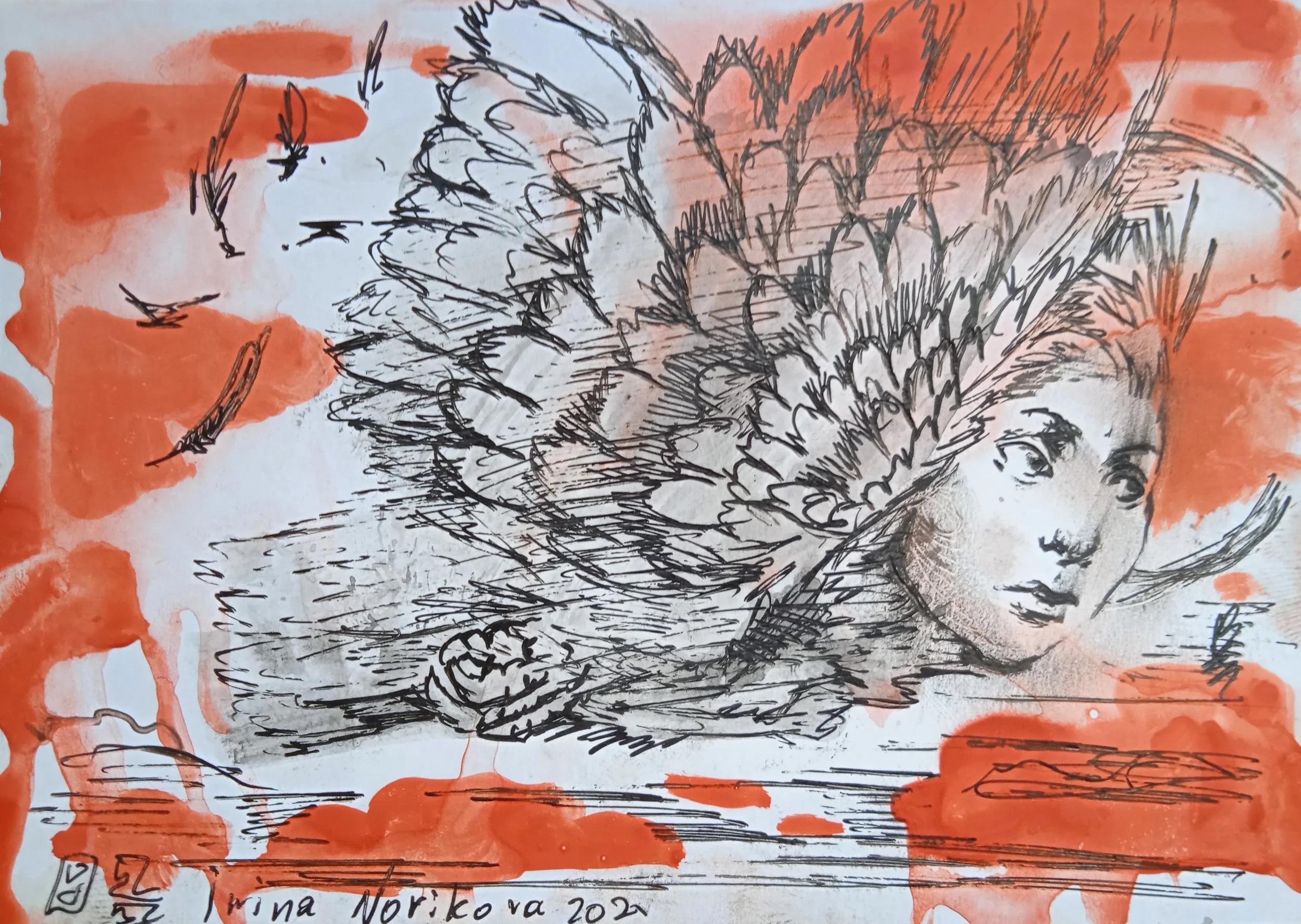
Two and One More
A falcon flew by, caught a dove in its claws, and tears it apart dead, and blood flows, and he himself sits on a dark column, at the very top and blood flows onto the altar, the bird made a sacrifice to someone ... To whom?
A falcon flew by, caught a dove in its claws, and tears it apart dead, and blood flows, and he himself sits on a dark column, at the very top and blood flows onto the altar, the bird made a sacrifice to someone ... To whom?
The wanderer galloped past, cried, saw him off, and the robbers chased after him, caught up, tore him up, killed him and took the gold from the bag, divided it equally, between three and three roads diverged, and no one saw them together again.
And he remained on the ground lying lifeless, a dove flew in and brought water to him and he came to life, the wounds healed, he woke up, looked around and did not see those who were chasing him and did not see a bag of gold. And the dove brought him a blue bag, he opened it, and there were diamonds.


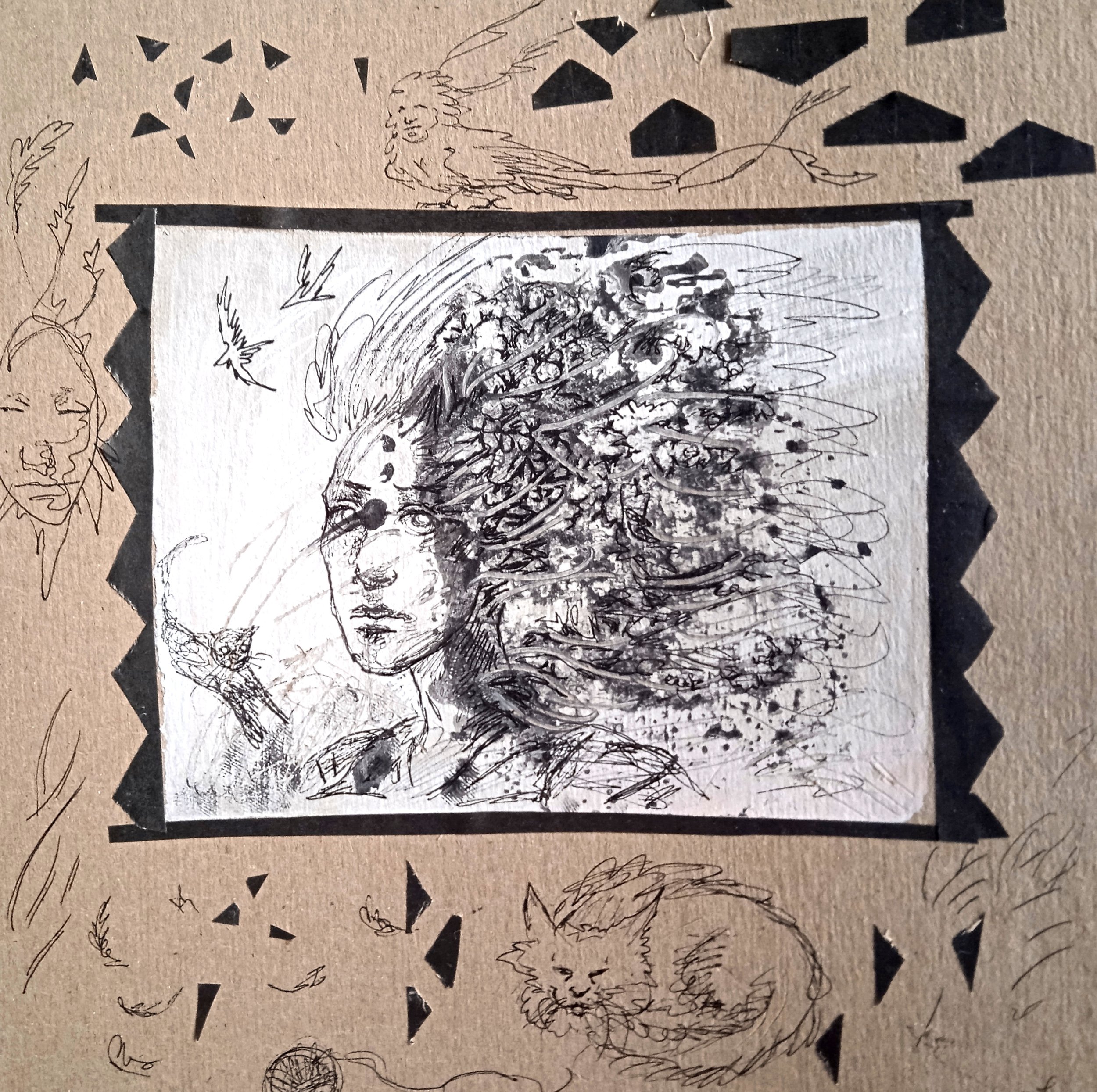


He went to the city and decided to sell precious stones, but not a single shop worked in the city, everything was closed, only the local tavern opened and he went there, and behind the counter, black as a raven, a stranger poured him green and steaming wine, the wanderer did not drink , pushed back the hour and looked askance at the raven.
And he told him: -Kar!
I wanted to run away, but the body grew to the floor and did not.
Then the raven: - Kar... You know what? Do you want money? Do you want to rule the world? Do you want a girl? Do you want a palace? I have everything ! I will give you everything!
And the man turned into a bird, and the bird became a man ...
scene two
Double walled room.
Inside, in the very depths, there are two, one is a wanderer, the other is someone else...
He whispers something in the ear of the wanderer, he wants something and almost demands something, but he can’t do anything, in fact, time has shrunk like a snail and only a lie crawls like a worm over an apple, something eats an apple and it dies.
- I don't want to! - the wanderer answers, - I won't! I don't need
Need! You need everything - croaked a raven, he slammed the book, with a bang and the spine flew off, hit the wall and, as if alive, flew over the floor, landed in a porcelain bowl and burned down, there was no ash.
And the raven whispers everything, whispers ...
- Put on a mask and become like a leader, you will rule the nations! You will be great and powerful! You'll get everything!... But you'll give me your soul, and then I'll take you into the darkness so that you don't see the light. I will take them to the darkness earlier, so that sadness and anger and hatred will devour your soul.
-What about the contract?
- You sign it with blood ... Take that knife, cut your finger, and squeeze a couple of drops of blood into ...
- And it's all?
- Yes, everything and nothing more (and to myself), but you will not get anything, and I will take my soul into darkness.
Irina Tall (Novikova) is an artist, graphic artist, illustrator, writer. She graduated from the State Academy of Slavic Cultures with a degree in art, and also has a bachelor's degree in design.
The first personal exhibition "My soul is like a wild hawk" (2002) was held in the museum of Maxim Bagdanovich. In her works, she raises themes of ecology, in 2005 she devoted a series of works to the Chernobyl disaster, draws on anti-war topics. The first big series she drew was The Red Book, dedicated to rare and endangered species of animals and birds. Writes fairy tales and poems, illustrates short stories. Her work was published in the journals "Gypsophila", "Harpy Hybrid review" and others.

DOT
in the Blue Ridge mountains morning
brief interruption of the unusual month-long train
of thunderstorms flooding hollows and highways…
DOT
in the Blue Ridge mountains morning
brief interruption of the unusual month-long train
of thunderstorms flooding hollows and highways
white gray black clouds pile on top of each other
as though the narrow slough of sky is too small for their fury
IHOP truck stop outside Lexington Virginia
20 acres of parking
11:00 AM
50 maybe more tractor-trailer trucks with sleeper cabs
eighteen wheelers
a few double trailers
some with double wide wheels and tires
arrivals and departures in continual motion
a railroad switching yard
with silent rules
park side-by-side 3 feet apart in neat rows
Detroit Diesel engines 100% guaranteed first million miles
Mitsubishi made in France
Cummins a Hollywood star
12 cylinders run idle
no exhaust smoke just low rumbling background noise
green red orange white blue yellow
clean or new cab paint jobs
corporate logos in durable black and brands bold
independent truckers rigs ablaze with lights outlining freight boxes
pride of ownership
kids in dining rooms pause eating stacks of pancakes
aromas of spilled fruit esters on Formica tabletops
point and laugh with delight
decorated Christmas trees
heavy weary men solo drivers
wait for their call to showers
no corporate uniforms except the FedEx guy
in oil stained old clothes and canvas shoes
in the men’s bathroom brush teeth
foaming paste runs down hands
splash cold water on their unshaven faces
watch noon news in the truckers lounge
how many are military veterans professional at maximizing bivouac
won’t waste reprieve from battle with trivial chitchat
confirm weather
accuracy of Google and Apple GPO maps
what Kentucky routes require caution
walk through the dining rooms
smile at the FedEx driver who argues a discount
for his chicken omelet with the waitress
ignore tourists and children
theirs are back in Oklahoma or Arkansas or Stockton
far from the long haul out of LA and Long Beach ports
hope they don’t get pulled over
by Federal Highway inspectors to check logs
order them to stop driving
right then and there
sleep for two hours on shoulders of interchange ramps
before returning to interstate highway truck lanes
to drum multi-ply rubber tires
on 11.5 inches of unforgiving poured concrete
reinforced with steel rebar

Ron Tobey grew up in north New Hampshire, USA, and attended the University of New Hampshire, Durham. He and his wife live and farm in West Virginia. He is an imagist poet, expressing experiences and moods in concrete descriptions in haiku, lyrical poetry storytelling, recorded poetry, and in filmic interpretation.
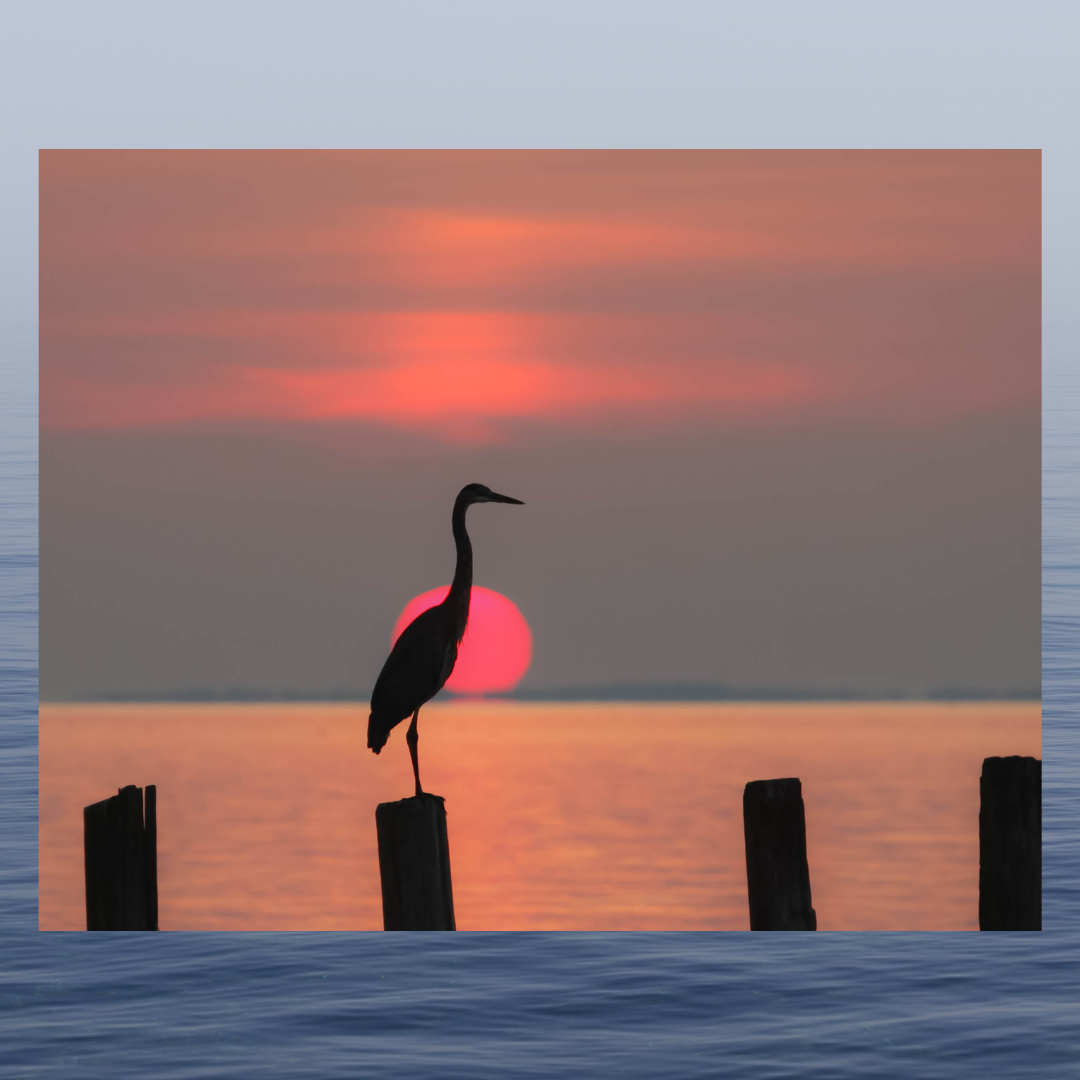
Sunrise over Orange Bay
It should have been a normal day at the Orange Bay observatory, situated in sleepy Orange Bay, Florida. That day should have been a lot of things.
It should have been a normal day at the Orange Bay observatory, situated in sleepy Orange Bay, Florida.
That day should have been a lot of things.
It started easily enough, you roll out of bed, see your bleary-eyed reflection in the mirror, gulp down reheated coffee because the Starbucks down the block’s still closed. You throw on your normal clothes, a pair of jeans, a light jacket and your “I want to believe” T-shirt. You think it’s funny to work in an observatory and wear those clothes. Your co-workers are either too dead inside to appreciate the joke or you aren’t as funny as you think.
Regardless, you’re on your way to work on time, watching dawn break across purple and orange clouds over the bay.
It’s quite beautiful where you live, but being here for years has sapped some of the wonder. Like an old photograph left in the sun, the sunrise’s color is leached from your view by mind numbing routine.
Even though the sunrise doesn’t elicit the same burst of endorphins it once did, you still take a route that allows you to gaze at it nearly the entire ride. You tell yourself it's a habit. You notice a couple of dark sedans, four door types with tinted windows. They’re convoying past you, the black paint contrasting with the ocean and the sand and the sunrise. Your car, made in the 90’s and utterly unremarkable, rolls over the iron bridge connecting Orange Landing from the rest of the town, the small island replete with boardwalks, sand, boat rentals, trendy bars and restaurants and the Orange Bay Observatory.
Nothing special about your place of work. You roll off the line at a reasonably priced but mediocre midwestern college, earning your Ph.D. in Astronomy, Then eagerly applying yourself to the first place that took you. Orange Bay! Floridian coast paradise and purgatory.
It’s quite boring, actually. You used to laugh at yourself as a kid, foolishly wondering what’s out there in the sky. You know what’s out there. And it’s really nothing special. It’s nothing at all, really. Just like the dawn here in Orange Bay, space is nothing but a multicolored light show to captivate casual onlookers. And the fool that you were, you made it into a career.
It’s not all bad, honestly. You get an office party four times a year, five if you're slated to work at Christmas. (Not that you have any family of your own. The rest are still back home, out of the reach of everything but skype).
Every year there’s an astronomy conference in Hawaii, which is nice. You usually go, unless you don’t have to work on Christmas, in which case Dana from the night shift attends.
The scenery is nice enough there but you live in Orange Bay long enough and all picture-perfect coastline looks the same.
Besides, you hate the conference itself. Tourists think Orange Bay having an observatory makes it important. Your colleagues across the U.S. know differently. Half of the conference itself is in the biggest observatory in America, named Mauna Kea. It’s like yours but with more expensive equipment.
And probably not as soul-sappingly boring.
You roll past the gates, a security booth checking you in. The fence wouldn’t even be necessary if the teenage hooligans of Orange Bay didn’t think it was funny to damage million-dollar stargazing equipment or have bad beer and sex in the parking lot.
You don’t bother to look at the massively overweight security guard, Keith, who probably hates his job more than you do. The funds at the observatory were recently cut, again, so half of the janitorial staff was let go, leaving only one. That means, whenever the teens inevitably break in, he’s normally the one to mop up whatever refuse they leave behind.
You hand him your I.D. without looking, knowing it’s a formality at this point anyway. You’ve worked here for fifteen years and not once was there a problem with your identification. Until today, apparently. Because the hand that grabs the card from you isn't Keith’s pudgy, soft fingers, it’s a pair of well worn, well dressed, and well manicured hands. You do a quick double take, as the man in the booth is most decidedly not Keith. He’s dressed in a sharp, well fitting, tailored and mysterious black suit, with a white tie cutting the middle. Sunglasses cover his face and an earpiece fits snugly in his left ear. He’s got a name tag too. His name’s Henry.
You want to ask where Keith went, suddenly missing the former guard’s familiarity, if nothing else. Before you can open your mouth, he hands your card back, with a smile that doesn’t quite reach his eyes. Something about those dark shades dissuade conversation, and you hurriedly edge your car from the 90’s through the gate.
You’ve never once had a problem finding a space to park here at the observatory, unless you count that one time Keith had to clean the carcass of a seagull from your favorite spot. Regardless, barely a dozen staff work here, all shifts included, and twenty parking spots were made. You never understood why, as no tourists ever got past the gate, so why did the government spend on twenty parking spots while only hiring a dozen staff?
All twenty are filled, and the curbs too, so you coax your car up the hill, staring at the identical fleet of four door jet black sedans, all of the same make and model, all with tinted windows, and all with the license plate removed.
A chill runs down your spine. Is this legal? Suddenly all you want to do is finish your shift and go home, or better yet, find your boss and pretend to be sick..
Two men stand at either side of the double doors to the observatory, all in immaculate black suits. They all have the same body type - not one man below six feet tall, nobody with a spot on their black suit or white tie, and not one without earpieces feeding past their collars.
You want to make a joke about their sunglasses. It’s cliche, painfully so. But as you approach the door and realize the man on the right’s hand is bigger than your face, you bite it back.
Besides, you aren’t that funny anyway, apparently.
You want to scan your I.D. on the doors, unlocking them automatically, but the scanner’s directly behind the man on the right. You think it’d be a very bad idea to ask him to move. The situation takes care of itself, luckily. They saw you coming a mile away, in your car that barely makes 70 on the highway and in your T-shirt with a bad science fiction pun. If they think it’s funny, they show no sign of it. In fact, they don’t seem to have emotions at all. They remind you of the Terminator. The impulsive side of your brain tells you to wave your hand in front of their face to see if they can see you but you value having an arm still connected to you too much for such tomfoolery.
The doors swing open, either they gave some unseen signal or, more likely, another of their identical troupe saw you on the security cameras, which were until today completely useless.
As you pass you notice they have name plates too. The man on the right, the one until now you referred to in your brain as giant-hands is called Thomas. The one on the left, Paul. No last names or titles here, either.
The bad feeling intensifies. The names are too generic, if you’d watch more sci-fi thrillers you’d probably think they're fake. Either that or they come off an assembly line or cloning vats somewhere.
Maybe they’re grown beneath Mauna Kea. The absurdity of it makes you want to chuckle.
There are more of the suited men inside.
You don’t chuckle.
The receptionist desk is empty. A phone’s ringing but nobody stops to answer. You don’t think the receptionist, Darla’s, in the bathroom.
You wander up into the main telescope area, the usual title eluding you. Normally there’s a big screen set up, showing whatever interstellar fireworks display that’s going on this week’s internet backgrounds.
This time it’s a comet.
You frown.
You don’t monitor comets here. The telescope’s too slow for that.
Men and women you don’t recognize, looking for all the world like extras in a 70’s sci fi flick rush around, shouting things to each other. They look perfectly ridiculous, so in place they’re out of place. Except the sunglasses. Why do they wear sunglasses inside? You try in vain to see what’s going on. You also try to locate someone in charge, so you can ask to go home.
No luck.
Wandering up to the screen, you get a better look at the comet. You rub your eyes again, just to make sure it’s as… geometrical as it appears to be.
You recognize the constellation behind it.
That’s above you right now!
Your search for someone in charge redoubles, no longer wanting time off, you need to see if your life’s in danger.
Someone clears their throat behind you.
You whip around, starting a little. A woman stands before you, same trademark sunglasses covering her eyes. No nametag. She’s in a suit too, this time with a red tie cutting down her chest.
It looks ridiculously like a wound.
She smiles, a little too widely.
“You work here, don’t you?”
You nod your assent, suddenly speechless. Backing up, you thump right into another cookie cutter thug. His name’s probably not Logan.
Some techs in white coats are modifying your telescope. It costs multiple millions of dollars, is the most expensive thing here, and the most delicate one too.
You don’t get paid enough to intervene.
“What’s your name?”
You don’t tell her, not because of resistance. “Logan” could probably crush your skull like a watermelon if he wanted too. You don’t tell her because your voice has deserted you. The Techs start wiring up a computer. Flashes of code spit across the screen. Not code.
Coordinates
Coordinates that are directly in the middle of Orange Bay.
You work up enough strength to ask something along the lines of “Can I go home?”. It sounds ridiculously childlike, more akin to an elementary school kid trying to appeal to his teacher than a grown adult negotiating.
Her smile grows wider, which you previously believed to be impossible.
“Tell me. Do you like the sunrise?”
You nod, wondering what this has to do with anything. You don’t like that she dismissed your question. You don’t think you'll go home today.
“Tell the truth” The words have an unnatural malice to them. It’s too late to run. The doors are guarded. You’ve checked.
So you do. You do tell her the truth, The truth of how it meant so much to you, but year after year you took it for granted. And how now it’s nothing more than a view. A tech sits in a chair to the left of you, adorning a comm headset. You don’t even have those normally here. You can’t hear him well but you’re sure he’s communicating with the comet.
You’d be much more attentive if you weren't so afraid of the woman.
She leads you outside, the dawn hitting its full stride now. There’s a balcony area with a beautiful view of the sea, past the banister nothing but a terrifying drop, jagged rocks ending with breaking waves
It’s also very high up. You realize this now.
The wind buffets you and you resist the temptation to look down.
You ask the woman what she is. Who is no longer applicable, you think.
In response, she flicks the sunglasses from her face. They plummet down, past the rocks. Your eyes follow them for a second, before recoiling in horror at the sight of her. It wouldn’t be correct to call her eyes blind. She can obviously see. But they look like cataracts, too much.
Peering into her milky depths, you’re sure you see something move behind her eye. You fight the urge to vomit.
She gives you time to recover. Gazing over the sunrise she shouldn’t be able to see. Once you’re ok you ask her what she wants. She answers honestly. Her candidness no longer surprises you.
“The World. All of it.”
You nod. You don’t think there’s anything you could do to stop her.
“This isn’t the invasion, you know. Just the beginning.”
You nod. An invasion would be more… flashy, you suppose.
“I can’t let you leave.”
You nod again. You’ve known that for some time.
In a voice that’s incredibly calm given the circumstances, you ask her why you’re still living.
She smiles.
“A choice.”
Her hand goes into the pocket of her suit and withdraws what looks like a worm, if worms had barbed spines and were a pasty white.
You gulp, remembering the thing wriggling behind her eye. You ask your alternative. She nods towards the rocks, down below. You peer at them, and you can see what you think is the broken body of the receptionist, Darla.
A rustle of movement behind you makes you turn. Logan’s removed a Colt 45. with a silencer attached from the inside of his coat. Behind him you think you can see Keith, if he fit into a pressed suit and wore a white tie instead of a black one.
He looks surprisingly good in sunglasses.
You ask if you can have a moment to think. The woman nods a little.
You walk to the balustrade, overlooking the ocean
She promises, whatever your choice, it won’t hurt.
The railings are made of wrought iron, with three horizontal bars curving around the building with vertical ones dug into the concrete every three feet.
Your feet climb the first rung.
She tells you that if you wish to die you don’t have to be shot if you don’t want to, that Logan’s gun’s only meant for you if you resist. She tells you Darla jumped. The wind buffets around the Orange Bay Observatory. You gaze out over the ocean again. It really is quite beautiful.
You make your choice.
And the sunrise over Orange Bay’s the most beautiful one you’ve ever seen.
Grant Gargaliano
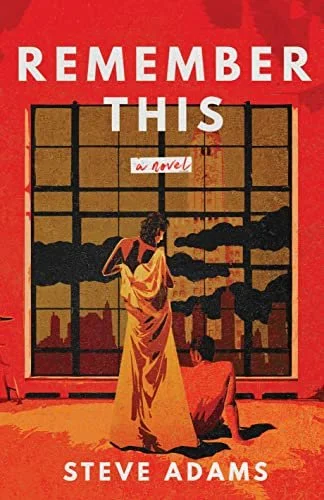
Interview with Steve Adams
Steve Adams is a writing coach, and his debut novel Remember This has received high praise and was selected for the Southern Festival of Books.
Steve Adams’ writing has won multiple awards. He’s been published in prestigious journals like Glimmer Train and The Missouri Review. He’s been nominated for Pushcart Prizes, and his memoir “Touch” was selected to be part of the 2014 Pushcart Prize Anthology. Steve is a writing coach and his debut novel Remember This has received high praise and was selected for the Southern Festival of Books. I talked with Steve about his debut novel Remember This.
— Paola Lastick

Paola Lastick is the co-editor for Assignment. She is a student at the Mountainview MFA program. Her writing has appeared on blogs, The Real Chicago, and other places. She is a mom girl, lives in a suburb of Dallas with her husband, three small yappy dogs, and four hermit crabs.
PL: Your book, Remember This, made its debut on 10/11/22 with amazing reviews and blurbs, such as “Exquisitely written and full of longing” and “Read this book, take a breadth, and read it again.” As a debut author putting your book out into the world what are your initial thoughts on the responses you’ve received so far?
SA: It’s really strange in a way. I mean I’m so grateful for these very generous early reactions. It’s gratifying and helps stabilize me. I do love this book a lot so I do feel some vulnerability as far as how people might respond. On top of that, the book itself is a very vulnerable and raw piece in both the way it’s written as well the subject matter. I chose that. I knew that was what the story would need, so I went right at it. I’ve had a lot of short work published and I always feel a bit raw when it goes out there. But with a full-length story it was even more intense, like oh my god people are reading this now! I’m a brave writer when I’m at the coffee shop or my apartment or quiet bar. But when it’s suddenly out there and you know people are reading it, there’s a real sense of exposure. But I think that’s true for any art. If you put your heart into anything you’re going to feel vulnerable. My book’s about New York City, which is a really important place for me. I wanted to capture it as well as I could, and the reactions have made me feel much more confident about that. We are still early, and so far we have gotten one really good official review in a trade journal. There are fewer review outlets out there now and a lot more books. Also I hear publishers were holding back because of Covid until this fall so it was an especially big season as far as releases. I’m lucky to have that one trade review, and thank God it was good. One thing I’ve learned is that you really have little control over much of what happens. I mean, you do whatever you can, but unless you’ve got a huge publisher and a big advance behind you, you have to let the cards fall how they fall and make peace with that. And even as far as big publishers with major influence, a friend was just telling me about a recent book from one of the Big 5 [publishers] that sold for a lot and got raves, but only sold a couple thousand copies to readers. Meanwhile other books with much less support are selling. But as far as my book and the people who’ve read it and gave me blurbs, they were really generous and amazing. They helped me to have some faith and belief, because it was about to go out there and there was no way of knowing what the reaction might be. It was really gratifying to know I was reaching some people. Super gratifying. We’ll see what happens next.
PL: Once you got your book deal and began the process of getting Remember This out into the world, what were some things you were surprised by that you did not expect?
SA: Well, I’m still in the middle of it, but there was something that surprised me personally. I make a living out of calming writers down, editing, and helping them create. I’m really a natural at that. It’s what I love, it’s what I’m comfortable doing. I also have confidence speaking in front of people. I’m an introvert, but I can do that on a stage even if I’m a little nervous. I studied acting and that helps. What I wasn’t prepared for was the marketing and publicity aspects of it, that in-between area between the writing and performing at events. You know, trying to figure out who you know and who to ask to help, who you can invite to a reading in a town, if anyone you know does reviews, asking for favors (I’m not good at this), thinking outside the box, thinking inside the box, setting up dates and logistics for events. It’s a lot, and I have a publicist. As far as the process itself with my press, the University of Wisconsin Press, it was great. They were very respectful and careful and thorough with the book. They challenged me in areas and I did my best to address their concerns. But I also pushed back when I needed to, and in the end they supported my vision. An experience this positive doesn’t always happen. University presses can’t pay you a lot of money, but a good one will often be a good collaborator and partner in getting your book out into the world in a way that’s true to your vision. Writers, more and more—this is what they say, and I feel it is true—have to do a lot of their own publicity. They have to reach out and do a lot of that stuff themselves. I had to go back and think who I met five years ago, 10 years ago, who could help me and hopefully wouldn’t hate me for contacting them. Some people are good at that hustle, but it wears me out. It exhausts me. That was my surprise, that I kind of stink at this stuff. I’m not a natural and I have to do my best just to get through it. My advice is, as you go along and you’re getting your short work seen and connecting with other writers, to be a good literary citizen and build connections, make friends. You know, just be nice, and help your writer friends when you can. They will come back to help you. I’ve had friends give me advice with promotion and help me with events. And I’m getting better at this stuff, but it’s not easy. If you think about it like surfing, I’m the surfer flailing in the water with my board bouncing all around as I try to clamber back on. That’s what it feels like anyway. My hope is that the next time I’ll have a better sense of what’s involved, and I’ll be able to stay on the board and maybe ride the waves a little better. Like I said, I do have a publicist so it’s okay for me to fall off the board some.
PL: How did you come up with the idea for Remember This?
SA: The time I spent working on it, and the time it sat in my computer hard drive (otherwise known as “the drawer”), is a big part of the story of this book. I don’t want to discourage anyone, but the length of time it took to get this in the world can hopefully be a story of hope too. You can have something that doesn’t hit and then years later it can come out, and that’s what happened. In 2008 when the economy collapsed I was living in New York City. As I said, that place is a really important place for me and I lost my job in that collapse. I knew I was going to have to leave my city, and I started wandering around to all the places there I loved while taking notes. Since I’m a writer, I started writing a story where I could put my sense of love and loss about my city into a narrative form. Out of that I came up with the story line. I mean, just having some sad guy wandering New York is hardly going to work as a novel, so I created this affair my protagonist has with a woman he’s pretty desperately in love with, and they can only be together a short time—two months, until her husband comes back from an overseas trip. So that adds a ticking clock to the story, and stakes, and tension. The second storyline, what I call the understory, with his childhood, that came in later.
Thanks for your questions and this interview, Paola. I really appreciate it.

About Steve Adams, in his own words: I graduated from The University of Texas at Austin with a BA in Theater and received my MFA in Creative Writing from The New School in New York City. I’ve studied creative nonfiction as a scholar at the Norman Mailer Writer’s Colony and creative coaching with Dr. Eric Maisel. My work has been used as a teaching text at major universities, as well as in the public high schools, and cited in the book, Beyond the Writers’ Workshop: New Ways to Write Creative Nonfiction, by Carol Bly. My plays have been produced in New York City.

Interview with Keith Gave ’18, author of The Russian Five, Vlad the Impaler and A Miracle of Their Own
Keith Gave is the author of three books: The Russian Five (March 2018), Vlad The Impaler (April 2022) and A Miracle of Their Own (October 2022). The works cap an eclectic work career that included lengthy stints as solder, spy, newspaperman, radio host, TV analyst, publicist, teacher and college newspaper adviser and filmmaker – all before he set out to write book.
One sultry summer night in Helsinki, Finland, Detroit sports journalist Keith Gave approached a pair of Soviet hockey players after an exhibition game. In the eyes of the KGB minders circling their charges, media guides were exchanged and nothing more. What no one knew at the time—and in fact, what no one would know for years—was that life-changing letters were tucked between the unassuming pages. A former Russian linguist for the National Security Agency, Gave spent several years eavesdropping on the Soviets at the height of the Cold War—apt training for a future journalist. Tasked with spilling secrets in both of his professions, Gave now had to prove that he could keep one.
In 1989, the Detroit Red Wings drafted two sparkling prospects out of Moscow, Sergei Fedorov and Vladimir Konstantinov, despite the near impossibility of negotiating their releases. Team leadership concocted an audacious plan to stage their defections, but the Red Wings required a Russian speaker to make contact with the players. Enter stage left: Keith Gave, a reporter for the Detroit Free Press with intensive Russian training from the Defense Language Institute in Monterey. Despite his misgivings around the ethicality, Gave flew to Helsinki and talked his way into the Soviet locker room, successfully relaying the message that Detroit would breach the Iron Curtain for their draft picks. Within two years, the pair of budding superstars had escaped conscription for the spoils of the NHL—but Gave’s role as reluctant envoy was cloaked for decades.
Like most epic romances—from William Shakespeare’s Much Ado About Nothing to Jane Austen’s Pride and Prejudice —my relationship with Soviet hockey followed the enemies-to-lovers trope. When the Detroit Red Wings swept my Philadelphia Flyers in the 1997 Stanley Cup Finals, I cried myself into a nosebleed. Nearly eight and new to the Philadelphia birthright of sporting disaster, I crumpled as Detroit fans lined the streets with brooms to celebrate their sweep. Yes, the so-called Russian Five—a line of Soviet-born players acquired in a string of wild defections and clever trades—had vanquished my team, but why were they so hard to hate? What was it about their inch-perfect shots, their clairvoyant passes, those eyes that seemed exuberant and melancholy all at once, that etched themselves into my heart? It was kismet that Keith Gave set into motion. A childhood dream manifested in Moscow decades later when I dove head-first into the soul of Russian hockey, and it was Gave’s gentle guidance that led me to Mountainview–the program in which he authored The Russian Five.
I suppose you could say I have walked a path that Gave laid—wittingly or unwittingly—all my life, but now I have the privilege of walking it with him. “I saw that miracles were shocking, as overwhelming as disasters,” wrote Janet Fitch in The Revolution of Marina M, one of Gave’s favorite books. I consider his cherished mentorship to be a miracle of fate, one that continues to astonish me.
Keith Gave is a Pulitzer Prize nominee and 2018 Mountainview graduate whose bestselling debut, The Russian Five, was turned into an award-winning documentary that he co-wrote and produced. A Miracle of Their Own: A Team, A Stunning Gold Medal and Newfound Dreams for American Girls, co-authored with Tim Rappleye, hits shelves in late October. Gave is also the author of Vlad the Impaler: More Epic Tales from Detroit’s ’97 Stanley Cup Conquest. I caught up with hockey’s Ethan Hunt ahead of the Miracle launch to discuss his trifecta, measured use of memoir, and the adjective that almost blew his cover.
—Gillian Kemmerer ‘24
GK: You spent three years in a West Berlin spy station eavesdropping on the Soviets for the National Security Agency. Who was harder to get information from—the operatives you spied on, or professional hockey players?
Keith Gave (KG): Well, I'll tell you that when the Russians were drunk and playing with their radios, they were a lot of fun to listen to—especially on New Year’s Eve. You could hear them singing songs, telling stories and crying that they were homesick. They wanted to get home to Irkutsk and back to their wives. But for the most part, we were hearing ciphered speech. We could tell they were speaking, but we could not understand what they were saying. We taped all of that stuff and sent it back to NSA Headquarters in Fort Meade, where the code breakers were able to get to it. They never really said much in terms of when the war was going to start or stop, or whatever. The Russians were difficult to get information from, hence the thousands of spies at the NSA.
As for hockey players, when I covered them in the mid-80s, they were great to talk with. It was pretty easy to establish relationships with them. I did not go out drinking or partying with them, that was one of those lines we did not cross—but after they had a few pops, sometimes they were more forthcoming as well. A guy like Steve Yzerman loved challenging and curveball questions. If you asked him cliché questions, you got cliché answers. Brendan Shanahan had the gift of Irish gab; all you had to do was ask him any dumb question and he would fill your notebook. Toward the turn of the century, teams began to control the message and limit access to players. COVID played right into [teams’] hands, closing the dressing room and doing everything by Zoom. I would not want the job I had at the Free Press now, not for anything in the world. It’s a horrible job now.
GK: Speaking of shifts in the profession, the rise of New Journalism has permitted reporters to occupy more profound spaces in their own stories. This was not en vogue when you began, and I know you concealed the role you played in Fedorov and Konstantinov’s defections from the Free Press for years. Did you ever have a moment where the truth nearly slipped out?
KG: I wrote the very first story after [former Red Wings executive] Jim Lites called me from the plane. “Guess who’s sitting next to me, Keith?” He asked. It was Sergei Fedorov. I pushed my plate away, grabbed my notebook and started interviewing him. The desk gave me thirty-five minutes to write the story, and I got a call about ten minutes after filing. The copy editor asked, “How did you know that it was a sultry summer night in Helsinki?” I had to do some really fast talking. I said that I talked with the guy who was over there, and he told me that it was an unusually hot, humid evening in Northern Europe—even for August. I was sweating bullets, but that was the closest.
I had to be really careful because I knew that if they found out, I'd lose my job. I had been skating on some ethical thin ice. I taught journalism for twenty years and always told my students, "Never, ever do anything like that. You don't do favors for the team you cover." And I did a big one. I made a deal to do it on my own dime on the condition that, if and when these guys started coming over, I wanted the story first for my readers at the Free Press. Luckily, it turned out that way—and the newspaper was really gracious to me when the book came out. They helped me to sell a lot of books.
GK: Of all the words to have torpedoed a hockey career—sultry. Can you imagine.
KG: I know, exactly. And it’s one of my favorite words.
GK: It really captures the humidity clinging to you. The seductive breeze. I get it.
KG: I try not to use it too much, but it's a good word.
GK: Your use of first-person narrative in The Russian Five is restrained, which makes it really impactful. There is this one moment in Voskresensk where you re-enter the story somewhat unexpectedly and drop a haunting exchange between yourself and Slava Kozlov's father. Why did you choose that moment to hold the reader’s hand?
KG: As that moment was happening, I was getting chills down my back. [Kozlov]’s father dragged me out of the house by my arm and said, "I need to show you this." It was a little spot in a dumpy yard with a wretched-looking apple tree. You could tell that it was a low-lying area where water would gather if it rained or snowed enough. He told me that this was where his son took his first strides on skates. He told me how proud he was. Nobody knew how good Slava Kozlov was going to be in the NHL. As a matter of fact, his statistics over his entire career are worth a discussion about whether or not he deserves to be in the Hall of Fame. But that moment was so inspiring to me because his father was almost tearful. He was a really kind and emotional man, very thoughtful. The only way I could resurrect that moment for the reader was to put myself there.
GK: If you were writing The Russian Five in this moment in time, would the political environment change how you framed it? Do you think current circumstances underscore the importance of such a story?
KG: Both. I think what is happening there underscores it. When I was writing that story, even though things were changing, I was still committed to the whole business of sports connecting cultures. I was still holding on to my vision of a world where the former Soviet Union and the United States of America could keep building those bridges. As a kid growing up in the fifties, everybody was talking about air-raids and bomb shelters. We had to do drills at school for when the Russians started dropping bombs on us. You grew up hating them. You were indoctrinated. Then I was in Russian language school in Monterey, California, learning from older Russians who lived through horrible times and had found their way to the United States. It was so important to them to teach us the language so we could fight the Cold War. You could not help but take it seriously. When I was writing the book, all of those things were in my mind—and I have a deep affinity for the Russian people to this day.
Honestly, Gillian, I don’t know how I would approach it now. I think I would want to maintain my hope and vision for what could have been, what could be. I was there in 1997 when the Red Wings won the Stanley Cup and they took it to Red Square. I saw how the Russians reacted—not so much to the Stanley Cup, but to their players. They were their heroes over in the U.S., doing great things and making them proud. You could see these two worlds coming together and making it work—and suddenly, it's not. And it's heartbreaking.
GK: You know the role that The Russian Five played in my life, but as I reflect on those origins as a fan, women’s hockey was unfathomable to me until Nagano 1998. Your latest book centers on the U.S. team that won the first-ever gold medal in women’s hockey. What ignited your interest?
KG: It was almost love at first sight between myself and women's hockey. I just loved the whole idea of it. I was in Nagano for the Dallas Morning News at the time. They gave me carte blanche to find the stories and to write about them. I made a point to cover the very first game of the women's tournament between Sweden and Finland. There might have been ten reporters in the press box, a few hundred fans maybe, family members of the players. At the end of the tournament, the Americans upset Canada in a very, very good hockey game. Two women approached the podium with a tray of gleaming gold medals. [U.S. Captain] Cammi Granato bent from the waist in a perfect Japanese bow. The first women’s hockey gold medal at an Olympics was placed around her neck. I was watching the reactions of her teammates, most of whom were doubled-over in emotion. I had been covering sports for well over twenty years, and that was the single most emotional moment I had ever experienced. It did something to me. I was not thinking in any way, shape or form that it was going to be a great book one day.
GK: So when did you realize it could be a book? Was it different from your process with The Russian Five?
KG: On June 7, 1997, when the Red Wings won the Stanley Cup and I was in the locker room, I ran into Sergei [Fedorov]. He was in the corner with Anna Kournikova and a whole bunch of other pretty girls. Sergei leaned over and said, “Keith, you remember that night in Helsinki a long time ago?” I said, “Yes, Sergei. I remember.” He replied, “I remember too. I never tell anybody.” I was thrilled that he chose to tell me in that moment that he remembered. I was driving home at three or four in the morning thinking that I needed to sit down and start writing that stuff because it could be a book one day. I wrote four or five thousand words, tucked them away. That was until I got into the Mountainview MFA and started to write my ass off. I would never, ever have been able to get The Russian Five published without that program.
With regard to the Miracle book, I was at the Traverse City prospects tournament in 2019 pushing The Russian Five. John Vanbiesbrouck came by and gave me a thumbs up. He said, “I’ve got an idea for your next book — Nagano ’98.” The lightbulb went on. We both witnessed that emotional, golden moment by Team USA. And I’m thinking, “You know what? That’s a damn good book.” I started digging away and realized pretty quickly, to be perfectly honest, that I was in way over my head. I wouldn’t have been able to do it myself, and I wound up writing with Tim Rappleye, who I met at the National Writers Series in Traverse City.
GK: What was the experience of co-authorship like for you?
KG: When it comes to covering a story, a big story, I sometimes don't play well with others. However, I worked for a newspaper—and putting out a newspaper is the best team sport I know. Writing a book is a team sport, too. Nobody does it alone. I got a lot of help from my three mentors in the MFA program and my peer group sessions. When Tim and I started working together, things flowed really nicely. He would write some things and I would come back and say, “I see some problems here—let’s work on the lede. I think your lede is down here; let’s move it up.” And so on. He did the same with mine.
GK: Did anything about this third book experience differ from the first two?
KG: There were some really hard stories to get to. Shannon Miller, the head coach of Canada, was a hard nut to crack—but I wound up doing five or six interviews with her. She was in tears half of the time. I discovered that she was a completely different character than people had imagined. We have another chapter called Sleeping with the Enemy, where you had women from both teams hopping into bed with one another. You had people on both sides—but especially the American side—saying, “This is bullshit. We don’t want anyone to be that close to any of our players. We’re trying to win a gold medal.” But there have been three marriages, really great, model marriages, between women of Team USA and Canada. They have the kind of relationships that many of us should aspire to. There are some great interviews in this book that Hollywood would love.
GK: I previewed one chapter from the Miracle book—Of Pucks and Ponytails. You write: “Little girls fall in love with hockey for the same reason little boys do.” It made me wonder if women’s hockey players express that love or frame their stories in ways that differ from the men you spent a career covering.
KG: That's a great question, and I don't think so. Sarah Tueting is the prime example of a kid just absolutely falling head-over-heels in love with her goalie pads. “I laid down on my stomach and my dad strapped them up. When I stood up, I was a goaltender." I mean, that line gives me chills, but that is how she identified with herself until she was twenty-one years old sporting a gold medal. When I talk to boys, I always ask, "How'd you become a goaltender?" There are always two reasons why. One of them is that they had older brothers who needed somebody to shoot at.
GK: Every single time.
KG: Or if it's not that, they say, "Oh, the equipment. I just love the equipment." Little girls are no different.
GK: You have written three books, completed an MFA, received a Pulitzer nomination, spied on the Soviets. I imagine that the standards for what you read are sky-high. What qualities do you admire most in a writer?
KG: I am inspired by the kind of writing that I know I could never do myself. When I read some passages from Pat Conroy in The Prince of Tides and Beach Music, I want to throw the book against the wall. That kind of work inspires me. Janet Fitch, The Revolution of Marina M and Chimes of a Lost Cathedral. Fredrik Backman can make you laugh and cry, sometimes in the same sentence. Writing like that gives me chills down my back and makes me feel small, because I know I'd never, ever be able to write like that. You know who else writes like that? When I read her work in my first semester of the MFA program—Nadia Owusu. Nadia's work does that to me. Writers who make you feel, I guess that's what I look for.
Keith Gave - www.keithgave.com
New Book: A Miracle of Their Own: A Team, A Stunning Gold Medal and Newfound Dreams for American Girls

Gillian Kemmerer is a multi-platform storyteller whose career has spanned two of the world’s toughest sports: ice hockey and Wall Street. She is using her time at Mountainview to write about the breathtaking love and connection that hockey has inspired across the deepest political chasms.
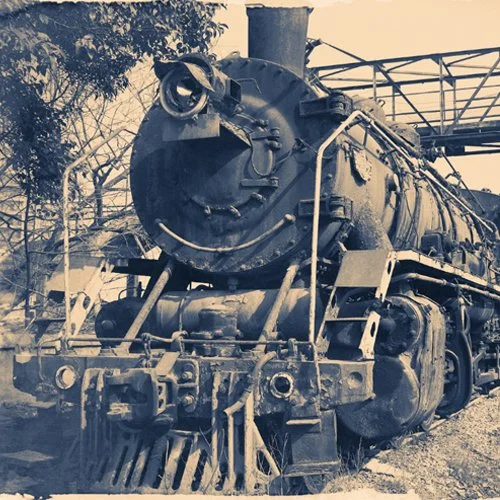
First Date by Phil Scearce
He kept a diary of the rails he’d ridden, the crossings he’d recorded. He saw life through rail metaphors, strong couplings, keeping switches closed that might lead off the main line. And signal blocks along the way, showing green for the distance of a good run of life. Delores listened, fascinated, and promised him he wasn’t boring her. This isn’t a date, she heard herself saying, and for a moment she feared she’d said it out loud.
Six months had passed, but Delores wondered if it was too soon. She knew Wallace would laugh at her as she fretted about things that didn’t matter. She didn’t need to rearrange the plastic fruit in the bowl on the dining room table, didn’t have to change the towels in the guest bathroom. Mainly, she didn’t need to worry whether it had been long enough. Wallace convinced Delores, in the months before he died, we have an unlimited capacity to love. If she found someone, someday, it wouldn’t mean she loved Wallace any less.
Delores believed it. But if she let go of Wallace enough to embrace someone else, wouldn’t she go through the same pain again, eventually? Delores created men and scenarios with men in her mind, and she imagined how she would react, how she would behave if one of them showed real interest in her. She embarrassed herself, getting carried away in her fantasies and the choices and crossroads she created for herself with someone new. She’d always bring herself back with thoughts of Wallace laughing at her in a way that said he would always tolerate her fretful nature.
It was only a first date, but Delores daydreamed way beyond the next Saturday afternoon. She thought of all the things he might say and do, how she would respond, how he would interpret her responses, and where it might go next. What did she really want? Was it worth all this worry? “Damn it Delores, it’s just a first date,” she said aloud to herself. That’s what Wallace would have said.
“It’s not even a date, really,” Delores replied, now beyond talking to herself, Delores had conversations with herself, arguments sometimes. She wondered if she was crazy, but she told herself crazy people don’t ask themselves whether they’re crazy. “It’s not really a date when you plan to meet somebody someplace. It’s not really a date when you drive separately and it’s at 2:00 in the afternoon.” “It’s a date when you agree to meet a man and go somewhere with him, Delores,” she said aloud. “Kiss my ass,” she responded. Then a moment later, she said, “I think you might be insane after all.”
Delores tossed and turned Friday night. She stared at the black ceiling. What’s the train like, she wondered. Will there be lots of other people around? “I hope there’s lots of other people.” Will he want to hold hands? Will the old rail car be air conditioned? “I hate to sweat,” she said. “Especially on a date.” “I told you it’s not a date.”
By Saturday afternoon Delores was too tired to worry anymore. She was past caring and looked forward to having it over and done. She wondered if he was thinking the same way, looking forward to the drive home, alone, more than anything else. She caught herself hoping he genuinely wanted to spend the afternoon with her. She felt guilty about wishing it to be over. “Just have fun, you stupid old hen,” she said.
The train was at the depot when Delores arrived, and he was there waiting for her. He smiled and approached the car, held the door for her as she got out. After hellos he showed her a commemorative book he’d bought in the depot, then asked her to forgive him for being so effusive about it. Inside the depot, he admitted he was a rail nut, had been all his life. He built a scale railroad in his garage and lost himself in it, obsessing with it after his wife died. He dreamed about railroads and fantasized about working on the railroad. He laughed at the idea, confessing it was a childhood dream he’d never outgrown.
He kept a diary of the rails he’d ridden, the crossings he’d recorded. He saw life through rail metaphors, strong couplings, keeping switches closed that might lead off the main line. And signal blocks along the way, showing green for the distance of a good run of life. Delores listened, fascinated, and promised him he wasn’t boring her. This isn’t a date, she heard herself saying, and for a moment she feared she’d said it out loud.
He opened the book and told her all about the road they were about to travel. It was originally a canal route, he said. The canals were used to transport building materials into the interior and returned with harvested crops. She listened to this man and his passion for the history of this place and wondered if he had loved his wife for listening to him the same way, tolerating this little boy still in love with railroads. He told her how the horses walked alongside, pulling the canal boat, and how the men walking the horses would release the harness from the tow line to pass the bridge, then reconnect it on the other side after the boat’s momentum carried it through.
But the rails bought up the canal lines and the horse paths became rail beds for trains, and Delores wondered what became of the horses. Were they allowed to retire, grow old with dignity and die in peace? She thought they’d earned the right but she doubted that’s how it happened. Sold out to a farmer for plow horses, had to keep plugging away, no doubt. “Probably slaughtered when they got too old,” she said to herself, and she laughed, glad she wasn’t an old plow horse.
He said they’d sit on the right. They’d be able to see some of the old stone locks still in place along the canal route, next to the rail line. He explained how the locks raised or lowered the boat for the next part of the trip, and how fascinating he believed it was, that these locks still existed at all, and how tight the stones used to build them still fit together. Delores lost herself in thought about how the stones must have been hammered and chipped and refined before they would go together so well, and seeing a couple fitting as one, it was easy to forget how much effort went in to making the fit just right. It didn’t just happen. Once they were together, she was sure it took a lot of work to keep the seams tight.
He was pointing out the first lock but it passed before Delores focused on the right place, and she felt bad, like she had disappointed him. “You silly old bird, Delores,” worrying about what he thought. She leaned into him, watched his mouth form words, and shut out the clank, roar and screech of the old train. She hoped he sensed how much she appreciated his effort, trying to give her a good time. But she lost herself again in the plight of the horses and the backbreaking work, getting those stones to nest up to each other so well, just to have the next generation’s train come along and zip by so fast they didn’t even notice.
He explained the second half of the rail loop, how it was built so they could bring trains in, load them with lumber, and run them back east to the mills and factories depending on them for raw materials. He talked about how many trains they kept on the loop, and how men came from all over to work the forest or the mills, the factories or, if they were lucky, a job on the rail line itself. It was a boom time for the area. But now it was faded to an excursion train with a handful of people hardly able to imagine its rich history. The boom time had been the area’s youth, Delores thought. Now it was holding on to an aging piece and hoping the school field trips passing through would inspire some young person, or plant inside them some bit of appreciation for what had been, and who. But it’s hard for a young person to understand that old things and old people were once young and strong, too.
“Your mind is wandering, you old biddy,” Delores said. “Pay attention.” She hoped her whispered uh-huhs and innocent questions convinced him she cared about what he was saying. She tried to appear interested when he pointed to something along the line, or to a picture in the book. He touched an old black and white photo and then pointed to the site, where whatever it was in the picture had once been, and if you look there you can see the supports for… something, he said, but it was a railroad term or a lumber industry term. She didn’t hear it over the whine of steel wheels. “Just nod, Delores.”
The railroad conductor approached in his period costume, and smiling passengers handed their tickets to him. He punched each ticket and returned it to them, a souvenir of their ride. The conductor reached Delores where she sat, and she passed her ticket to him. He punched it for her and asked whether she was enjoying the trip. “I was,” she said, and in the fog of her daydream, the conductor’s smile became the smile of the nurse, the nurse who cared so well for Delores, but Delores resented for interrupting her dates throughout the day.
“Miss Delores, you need to be with me long enough to eat something, okay? You can’t take your medicine without some food first, right?”
“I was enjoying myself so much.”
“Were you riding your cruise boat again, Miss Delores?”
“No, I was…I was on a train, riding through a pretty little valley with lots of trees. And I was with a very nice man.”
“I am sure you were, Miss Delores. Were you riding the train with your Wallace?”
“No, Wallace is gone.”
“And you know why he’s gone, right Miss Delores? You know why you’re here?”
“Wallace died and the judge said I had to come here and stay with you.”
“Now why do you suppose the judge would say a thing like that?”
“Cause Wallace was sleeping and I soaked the bedroom carpet with kerosene, and I lit it under the door with a fireplace match.”
“That’s good, Miss Delores.”
“And they said the smoke’s what got him.”
Delores paused, turned her head and looked again out the window, and she saw birch trees and falling leaves, and for a moment, she thought she saw snowflakes floating past as the train rocked along. He slid his hand under hers on the seat and smiled at her.
“But I made sure the cat was out first, before I closed the bedroom door. And that’s good, right?”
The nurse watched Delores swallow the last of her medicine, and said again, “That’s good, Miss Delores, that’s good.”

Middle Age by Trina Peterson
“..he forgets the technology he enjoys — like the internet and touch screens — hasn’t been around forever, and he is astonished to learn I didn’t have these phenomena as a kid. I wonder if he’d recognize my old Nokia brick from college as a cell phone.” — From “Middle Age” by Trina Peterson
"Was electricity invented yet when you were born?"
I get questions like this from my seven-year-old on a daily basis. He's into the origin of things. He wants to know how they work and when they were contrived. Most of the time, though, he forgets the technology he enjoys—like the internet and touch screens—hasn’t been around forever, and he is astonished to learn I didn't have these phenomena as a kid. I wonder if he’d recognize my old Nokia brick from college as a cell phone.
When he asks me a question to which I don't know the answer, he says, "Well, can you ask Google?" I roll my eyes at him, hands dripping in dishwater, and ponder what it must be like to be seven with a world of information at your fingertips. When I was seven, my random queries mostly went unanswered. They’re still unanswered because I forget about Google, not having grown up with it.
The things that drive him crazy are the great engineering mysteries to which nobody—not even Siri—has the answer."How did the ancient Egyptians build those pyramids?" and "How was bread invented?"
"Nobody knows."
"Well, can you look on your phone?"
"No, I mean literally nobody knows."
Then he pouts and stares at something without seeing it, thinking, I imagine, about the possible scenarios that could result in such a perfect vehicle for salami and mayo. Eventually,he comes up with an elaborate theory that involves an advanced kitchen implement, which must have existed during the dark ages.
The cultural and technological divide between his generation and mine is perhaps one of the widest chasms to ever separate parent and child. I am not a young mother, to be sure, but I'm no ancient Egyptian either. The thirty years between my birth and his comprises the advent of personal computers, the internet, and cell phones as we know them. My parents and grandparents marvel at his intellectual development, but it’sobvious to me that my kid isn’t going to replace Newton orEinstein in the annals of ingenuity. Modern kids are smarter because the world is smarter. Education is disguised as boisterous television shows for toddlers. Reading and math are presented as games on a touch screen. I am confident that at the same age my kids read their first books, I was busy liberating a box of Crayolas from their constrictive wrappers.
Does this nerdy shift make xennial parents feel older than we should? Is it harder to relate to our kids? How do we make decisions that govern their social lives when these techno scenarios were alien to our own childhood adventures? Is this what middle age is? These are the questions that keep me awake at night and into the small hours of the morning. I check my phone to see how many hours it might still be possible to sleep before the tiny humans wake me up demanding sustenance. The stars fade as I turn over and stare out the window. The sky is the color of that crayon I love, and it cuts to coral like a single brush stroke above the happy little trees. Barn swallows swoop across the canvas, but I am surrounded by sleep.
The seven-year-old occupies a camping mat on the floor because I was too sentimental to argue him back to his room last night. The smaller one is spread wide, forcing us to our respective edges of the king-size bed with barely enough blanket for our medial halves. We are an inverted Oreo cookie—black union suit smooshing down white comforter. We are the double, stuffed. He always sneaks in under cover of darkness, mounting the top of the duvet while we dream over damp, positive pressure from the CPAP—a comforting shush, evenly paced. More comforting than rousing a spouse with silent blue lips or smothering the snores.
It's not just the unanswerable questions that keep me awake; it's heartburn, too, I guess. I stopped dying my hair and my digestive system copped an attitude. Suddenly, I was searching the grocery store for antacids because until that moment I was young and their location irrelevant. I asked a tall kid with pimples in an employee shirt for directions to the elusive remedy. He had no idea, ma'am. Naturally.
Welcome to middle age. It's chalky.
Trina Peterson is a Maine native transplanted to Wisconsin where she lives with her husband and two sons. She's a Navy veteran, small business owner, and full-time grad student.

Interview with Peter Rock, author of The Night Swimmers
It’s been lovely following Peter Rock’s work, from his atmospheric and suspenseful debut novel This Is The Place (based in Utah, where he was born), to his more recent My Abandonment, a novel about survivalists and a unique father-daughter relationship that was made into the award-winning movie Leave No Trace (2018). Now his new novel, The Night Swimmers, is out and is about the relationship between a young college graduate and his swimming partner, Mrs. Abel. It traces their relationship through time, and explores the mystery of her disappearance as well as the more abiding mystery of how our older selves connect back to who we were decades before.
Chaya Bhuvaneswar
Your earlier work was eerier and spoke to human disconnection as well as to a machine-like quality of human life. How did your work evolve into the richly nuanced, relationship-focused writing that we see in your most recent novel?
Peter Rock
I’m not sure I’m the best person to answer regarding how my writing has progressed, as it’s a pretty unconscious process. But there are at least two thoughts that come immediately to mind:
First, I realized after publishing a couple of books that my characters seemed unable to deal with interpersonal conflict or complication. Tension and drama built up to a certain point, and then there were a lot of slamming doors, people leaping into pickup trucks and driving to other states; once they settled in a new situation, new drama would ensue, and a similar flight would result. It was pretty unsatisfying and, unsurprisingly, my personal life was eerily similar; I had a talent for beginning things, and a talent for bailing at the earliest sign of trouble. I just didn’t know, in my fiction or in my life, what people said to each other, past a certain point. I also had no handle on subtlety, no perspective whatsoever. Probably the biggest thing that allowed this change in my writing was being married.
Second, I’ve never been a very autobiographical writer, or I’ve always failed when trying to write a character or narrator who is close to me in terms of identity and life experience. The work of building up a character and convincing myself of that person works to convince the reader, but that also comes with built-in limitations. I know more than what I’m showing about these people, but compared to the incredible amount of detritus I know about my own life, it’s relatively easy to manage. When writing closer to my life, I have a harder time deciding what is important, and I also don’t have to do that work to convince myself, so the writing can fail to communicate. With The Night Swimmers I was happier with writing closer to my life, and I think this was because I’ve gotten so old that the person I’m describing and trying to inhabit is a mysterious other to me, and also, I’ve, through mistakes and practice, become a much more dexterous and intuitive editor. (Which sounds less than humble, but we need to take into account the shambles where I started!) Last thought: of course, all of my books come out of me, and in retrospect I can see what I was working through, personally, but the material of the narratives is further from my actual life. It’s probable, I suspect, that these unconscious revelations are more revelatory.
Chaya Bhuvaneswar
How do you construe writing about intimate relationships in relation to writing about darkness and uncanny themes? There is something very original about the juxtaposition.
Peter Rock
It is difficult for me to convey how I feel about living in this world by writing in a purely realistic way, and this is perhaps especially so with regard to intimate relationships. I do believe there are invisible forces around us, and the private languages and unspoken understandings we possess in intimacy bring this out, make a secret shared, make everything vibrate more specifically.
Perhaps a larger backdrop for this question is simply the relationship between the visible and the invisible, or what we understand as realistic fiction and that storytelling that bends or questions this familiar, agreed-upon world.
My interest in storytelling, I believe, rose out of my father reading to me before I fell asleep. And that reading was The Chronicles of Narnia and Tolkien, and most central was Ursula K. Le Guin’s Earthsea Trilogy. So that’s where and how I started, and what set my sensibility and momentum. I continue to love those books, and devour folktales, and fairy tales; one of my favorite writers is Angela Carter, whose prose itself ripples and bends our world. Writers like Aimee Bender and Karen Russell work a great vein that exists between these worlds and a more quotidian one, and that interests me. If there’s a kind of spectrum, perhaps I come in somewhere on this other side, where in my work I’m often trying to start with a more familiar, realistic world and then reveal it as otherwise, slowly, without departing entirely from that realistic world.
Again, I may not be the best one to ask. Yet this digression does make me recall first encountering what we termed “magical realism” back in college, and being completely undone. I still really love Garcia-Marquez and especially [Julio] Cortázar ; for me, there are stretches of Garcia-Marquez, though, where I lose track of a concrete world, where the tension flags into “can he outdo that last fantastic occurrence?” rather than “what’s at stake for these people?” Again, I may not be the best one to ask. Yet this digression does make me recall first encountering what we termed “magical realism” back in college, and being completely undone. I still really love Garcia-Marquez and especially Cortázar; for me, there are stretches of Garcia-Marquez, though, where I lose track of a concrete world, where the tension flags into “can he outdo that last fantastic occurrence?” rather than “what’s at stake for these people?”
Cortázar, on the other hand, fits closer to my sensibility—here the maintenance of that original world was always a priority. This is also part of [Haruki] Murakami’s appeal for me, in that however much underground voyaging is happening and how many tiny people are appearing, there’s still all that spaghetti cooking and beer drinking, ironing and lawn mowing. One dimension doesn’t supplant the other.
I’m drifting away from your question, I fear. But I want to also say that I have rarely been drawn to work where the fantastic can be understood purely psychologically, or as the delusion of one character, or as some kind of metaphor or thematic amplification. Stubbornly, I don’t really get metaphors or themes, and find such thinking when writing would only take me out of the story; I just want these seemingly fantastic events to actually happen, to be as real as the real and get all mixed up. Again, this is not so much a literary question, or one of technique, it’s one of personal sensibility, an attempt to capture how I feel as myself living in this world.
Another attempt to answer: when I teach the undergraduates, I have many students who are primarily interested in genre—science-fiction or horror or different kinds of speculation—and are quite anxious that this won’t “count,” or that it is not sufficiently “literary” and that I’ll punish them. What I tell them (simplifying and generalizing, as teachers do) is that literary fiction is celebrated for its characterization, the dimensions of the human it can conjure, but (to me) the plots and storytelling can be pretty boring and predictable; much genre fiction is noted for the ingenuity and unpredictability of its plots and storytelling, but the characters are often two-dimensional and clearly at the service of these plots or, ultimately, the author. So why, I ask them and myself, can’t we have richly complicated characters in narratives we haven’t yet seen, that startle and delight us?
Chaya Bhuvaneswar
How do you see your teaching fitting into your life as a novelist and story writer?
Peter Rock
Teaching is how I make a living, and how I share my mistakes. Now that I’ve been doing it for over twenty years, I spend a lot of time wondering whether I am helping anyone at all, or what exactly can be taught, and for what purpose. I also know it’s hard on my own writing practice in many ways, but the benefits of teaching really should be thought of in terms of the benefit to the student. And about that I can surmise, but it would be a little ridiculous to make declarations.
You’re catching me at an interesting moment in terms of teaching, as I’m taking two years away from it and reconsidering what I’ve been doing, and why I do it. I’ve also been thinking of my former teachers; I never liked the idea of “mentors,” as that seemed a little Svengali-like, and I always considered myself as too much of a desperado to have a mentor. And I’ve never really wanted students who desired a mentor, either. A few years back the poet Carl Phillips came to give a reading at Reed, where I teach, and he said, “I never want to put my fingerprints on a student, I never want anyone to say, about someone who’s been in my class, ‘oh, of course, well, she studied with Carl Phillips.’” I feel that way. I think the best I can do is give my undivided attention and respect to what someone is doing, to sit with it, to give them new things to read, and to challenge them to take responsibility for what their work will become.
I find great pleasure in encouraging people.
But your question is more about how teaching fits into my life as someone who’s trying to write. It’s kind of crippling, I think. On the one hand, and it’s a gigantic thing, having a tenured teaching job allows me the latitude to write what I want to write, regardless of commercial outcome or outright failure. But it’s also made me self-conscious and pretty much taken away the pleasure in writing short stories from me; I talk about them too much, I even read them wondering what I’ll say about them, whether I’ll teach them. For me to write well, I have to have that critical, authoritative, reflective intelligence as absent as possible. I need to be confused. To believe that I know what I’m doing, that I’m in control, that I’m some kind of authority—that is poison. And yet to teach, one is continually in the position of providing answers and generalizations, of being that authority It’s dangerous. When I started out teaching I think I was clearer and had more answers; now I’ve tried hard to be honest about how bewildering I find it. That vulnerability is probably just confounding to the students, but it’s honest.
Back when I was a ranch hand or security guard or medical trials subject or temp, my relationship to writing was clearer, but I also hurt my body, often, had no health insurance, etc. A part of teaching, I think, is also to be honest about how writing is not a wise professional choice; this is one reason I feel more comfortable teaching undergraduates, to be honest. I admire people like yourself who’ve been able to write while having a job that is far from the snake oil of talking about writing. Perhaps it’s simply the idea of being a “writer” that feels problematic to me. It’s not a destiny or identity or occupation. And the work we’re asked to do here on the web is often about presuming that.
I’m a person who sometimes likes to write; I wish my writing could and would speak for itself! Maybe “author” is better? It feels more past tense, like, “this person once wrote something.” But this pretentious idea of being a writer, I wish I never possessed it, wish I could totally shake it.
To reflect on one’s practice probably only reifies this problem. That said, a few thoughts: I write by hand, and I try to write all morning (but I have children, and a dog, and often a job), and then there’s often a lot of typing to do, later in the day. I don’t let machines into my workspace. With The Night Swimmers I took it a little further and spent a few years gathering notes (this is typical) and typing them in and rearranging them, but once I started writing I decided not to type it until I got to the end. This made me kind of paranoid about house fires. I started photographing the pages, at the end of the day, just in case; and then once I did get to the end I did nothing but float in the isolation tank and type for several weeks, hoping this would cause the whole thing to settle and transmute in me somehow.

Peter Rock is the author of the novels The Night Swimmers, SPELLS, Klickitat, The Shelter Cycle, My Abandonment, The Bewildered, The Ambidextrist, Carnival Wolves and This Is the Place, as well as a story collection, The Unsettling. The recipient of a Guggenheim Fellowship, a National Endowment for the Arts Fellowship, an Alex Award and others, he is a Professor in the English Department of Reed College.

Mount of the Dead Men, by Chaya Bhuvaneswar

Mount of the Dead Men
Sculptor left your stone eyes blank. But you were busy looking someplace else.
No dancing girl, Mohenjo Daro, terra cotta, Indian Jazz Baby, Twenties flapper contraband for bobbed hair alone.
You’re one of us, all the real girls.
Three steps you were supposed to stay behind but you two-stepped, grape-vined, twined closer with a lover’s hand. Moved him out of the way, so you could see words he was reading.
Half out of his mind with grief once you were gone, out of sight, out of mind, he listened to you then, instead of expecting you to look at him.
In fact, it was his eyes that went blank then, listening for words you had to say that were his words, not finding them,
not finding you. No Eurydice, no Beatrice, no Muse, no Magic Bus.
You only came up to here, on him, but had it up to here with him.
And had your way. And didn’t get your way.
As one of us, all the real girls. An Amrita, Arundhati, Mira, Deepa, Mahesweta Devi.
You were a gritty brown bottom exhibiting yourself, telling stories of what the sculptor did. Leaving your eyes that way, so you couldn’t see.
Interview with Danielle Trussoni, author of ANGELOLOGY and THE ANCESTOR
Note: this interview first appeared in Michigan Quarterly Review.
Interview with Danielle Trussoni on The Ancestor: A Novel
Danielle Trussoni is a New York Times bestselling author of the Angelology series, as well as of two acclaimed memoirs, Falling Through the Earth, about her relationship with her Vietnam War veteran father, and The Fortress, about her first marriage and time in Bulgaria. Her most recent book, The Ancestor, is both a delightful, gripping gothic horror read, as well as a thoughtful and provocative examination of women, families, evolution, power, genetics, inheritance. Danielle also writes screenplay adaptations and runs a Writer’s Podcast. She has taught at the Hudson Valley Writers Workshop and is a member of the Salve Regina MFA Program faculty in Newport.
I spoke with her before the release of The Ancestor, which received a glowing review in the New York Times, which called it “chilling and inventive.”
Chaya Bhuvaneswar (CB): I’ve noticed that your new novel The Ancestor, which I thoroughly enjoyed and would take on any train or plane ride along with a blanket and a cup of hot chocolate, is receiving praise as a “gothic” and “horror” novel, including in Publishers Weekly and on many “horror novel” lists. In thinking about how other literary fiction writers have played with and refashioned “genre” (I’m thinking of Victor LaValle and Justin Cronin, for example), I wonder: what does ‘genre’ mean for you and has it been a useful way to categorize your work?
Danielle Trussoni (DT): I can say that I have never written a genre book in my life and that I would not categorize my work here as pop fiction/commercial fiction either. My first book, Falling Through the Earth, a memoir that has been called literary and was chosen by The New York Times Book Review as one of their Best Ten Books of the year, is an important story that is also a portrait of real people. Call it literary memoir if you like, but for me, it is the story I needed to tell in the form that could hold such a story. Angelology, my first novel, was written with the same attention to language as my first book but was put into a genre category— supernatural thriller. Because it was a bestseller, it was called commercial. Since then, I have written another literary memoir and another novel that involves elements of suspense and mystery.
So, to answer your question, my training at Iowa was in the training of writing great fiction, which applies to everything I do. I am always striving to push the limits of categories, and if people have a hard time classifying me, I see that as a very good thing! As far as I’m concerned: good writing is good writing, wherever you shelve it.
CB: About the book itself— there are interesting feminist and woman as monster themes, My Favorite Monster, the graphic novel being another favorite example— and I wondered if you had intentionally set out to explore these as well as reference the history of gothic and horror novels by women.
DT: The Ancestor is firmly in the tradition of Mary Shelley and the Brontes (and contemporary writers like Sarah Perry or Jess Kidd), all of whom use the gothic elements of the supernatural or historical hauntings to create stories. I think of Frankenstein as the ultimate feminist novel, the horror of what happens when a man removes a woman from the creation of human life. I see this as a metaphor about the world we live in, in which women are kept from power, sidelined from authority, and marginalized in a thousand small ways. It creates a monstrous society.
CB: I’ve listened to and been thrilled by your writing advice for literary fiction and nonfiction writers on the podcast you run that readers and emerging writers can access here: writerlypodcast.com. Do you have advice you might condense here for writers who, reading The Ancestor, get inspired?
DT: My advice to all writers is to spend the time you need learning to write a great story. Read widely and write every day. Don’t limit yourself to a certain kind of writing, and write what inspires you. Understand craft, and think deeply about what it means to be a storyteller. One of my favorite endeavors as a writer is exploring new ways to tell a story. Experimenting with different traditions of storytelling is deeply rewarding, and I find that readers respond to innovative and fresh takes on literary forms that have moved them in the past.
The technology we have at our disposal now allows us to experiment even further with new forms. For example, in editing The Ancestor with my editor at Morrow, I lost about 100 pages of material, much of it pertaining to the scientific research. I loved that part of the story and felt that it would be a great story in its own right. And so I wrote a 10-part audio drama podcast, partnered with a great director, cast actors, and hired a sound designer. The result is an incredible audio experience of narrative, Crypto-Z, which you can sample here:
https://www.danielletrussoni.com/crypto-z/
CB: What’s next for you?
DT: I have been working on a new series and on adapting my work as a television series. I’m also going to be publishing another piece of the Angelology series, as I have readers who are waiting for more. I have a weekly newsletter that gives writing advice and personal stories from my life to inspire writers and readers, so if you’d like to know more about what I’m doing, please join it by sending me a note at danielle@danielletrussoni.com
Interview with Rowan Hisayo Buchanan, author of STARLING DAYS
Ed. note: This interview appeared originally in BOMB magazine.
Rowan Hisayo Buchanan is the author of Harmless Like You (2017)—winner of The Authors’ Club First Novel Award, a Betty Trask Award, a New York Times Editors’ Choice and an NPR 2017 Great Read. Critics have praised “Buchanan’s versatility as a writer in her ability to both maintain distance from and be intimate with her characters” (LARB, Ilana Masad) along with the elegance and visceral power of her writing. In her new novel, Starling Days (Abrams), she takes on the story of a young couple, Mina and Oscar, as they cope with the aftermath of Mina’s suicide attempt.
I was drawn to the book not only because, as a psychiatrist as well as a writer, I celebrate rich and questing depictions of depression and other conditions, but because this deft story engages queer desire and identity, family obligation, and idealization versus acceptance in a marriage. I also loved the moral ambiguity and compassion of this book, that deepens the characters and makes the story so engrossing and credible. Finally, the book presents such a fresh take on the “Americans abroad” and “expatriate” narrative, in terms of the sense of dislocation and vulnerability, familiar themes, but in the tech age. In an interview conducted in April 2020 via email, Buchanan talked generously and insightfully about craft, the role of classical myth and tragedy in her work, the influence of nonfiction, and what she has planned next.
--Chaya Bhuvaneswar
Chaya BhuvaneswarHow did you balance honesty and immediacy with an awareness that whatever you wrote was going to "represent" suicidality in some way, especially against the backdrop of the stigma that exists?
Rowan Hisayo BuchananOne of the things that was important to me is that Mina is a specific person—with her own flaws and strengths. I'm not interested in everywoman. None of us are everywoman or can represent an entire group of people. In particular, I didn't want to write a poster-girl for mental illness for two reasons.
A. It's not artistically that interesting to me.
B. I don't think mentally ill people can be reduced to a dichotomy between the hopeless and some Starbucks-perfect corporatized version who perform perfectly despite the sickness. I wanted to write a person who was sick but was also human and as such was sometimes brave and selfless and other times consumed by their own brain.
I tried to write her as a woman responding to her own particular circumstances. As a classicist, she tries to map her feelings onto nymphs, dead princesses, and the women of myth. As a modern woman, she falls down holes of Internet research and Googles her symptoms on WebMD. The journey she takes with her husband Oscar leads her to meet a woman for whom she develops feelings. I hoped that perhaps some readers might be able to relate to Mina's experience but I never tried to portray the Platonic version of depression.
However, I was aware that some people reading this might be in a vulnerable position. So I wrote an author's note addressing those readers who might be considering their own journeys through sickness. I didn't want someone in a fragile state of mind to take some of the cruelest judgments Mina makes about herself to be indictments of their own struggles. I believe fiction should be able to stand for itself without explanation—but I felt too responsible to take that risk here.
Photo of Rowan Hisayo Buchanan by Heike Steinweg.
CBI am struck by the way you found a clear, lovely, dynamic language to represent what can by its nature be a static experience—that of clinical depression. Can you talk about the writing on mental health that has been important or influential for you?
RHBIt is strange to me that depression is so often perceived as being static. In some ways, it might be easier if it were. If the depressed person could just put the whole world on pause while they healed. In some ways, this is the experience that Oscar tries to create for Mina by bringing her on his work trip to London. But unfortunately, this is never the case. Life bites the heels of the depressed person. Mina can feel Oscar becoming fed up. She senses that she is letting her career drift further and further out of her reach. And I hoped to capture that tension.
I think the works of fiction that were most influential to me were simply those that viewed the interior of the mind not as something ghoulish but instead something worth paying careful attention to. To name a few Kokoro by Natsume Soseki which is about love, friendship, and ultimately suicide. Virginia Woolf's Mrs. Dalloway is, I think, unavoidable when writing about intersecting lives, love, attraction to women, and depression. The work of Anita Brookner is not specifically about mental illness but it finds its great drama in the longings and dissatisfaction that occur in the private chambers of her protagonists' minds.
Although for the novel, I read the articles about suicide that Mina does (and more), the nonfiction that most influenced me was about attitude. When I was young, I stumbled upon the work of the poet and psychiatrist RD Laing. I came on his poetry first and then began to pick my way through The Divided Self. The book focuses on schizophrenia. What struck me immediately, was the way in which he did not present himself as being above his patients. He emphasizes that many people "regarded as sane" are equally or more capable of being irrational or dangerous. And while he views his patients as sick he also sees their potential for insight and wisdom.
This is from the 1964 introduction to the Pelican edition of The Divided Self:
A man who prefers to be dead rather than Red is normal. A man who says he has lost his soul is mad. A man who says that men are machines may be a great scientist. A man who says he is a machine is 'depersonalized' in psychiatric jargon. A man who says that Negroes are an inferior race may be widely respected. A man who says his whiteness is a form of cancer is certifiable.
Although there have been many advances in pharmacology since Laing's time, our willingness to ignore the sick or treat their thoughts as being without value seems to remain equally true. Perhaps my greatest desire in this book was to treat the story of the internal fight as worthy as a battle epic.
CBOften as a psychiatrist, I not only treat patients who have suffered from the actions of others--I also treat what legal language calls "perpetrators," people who have raped others, harmed others, terrorized others. Do you feel that duality is relevant to your book?
RHBThank you so much for talking about seeing both sides, because that is especially important to me. As a writer, I’m not very interested in good and evil. They’ve never felt particularly representative of the world. If my characters do something cruel or frightening I want the reader to understand where it is coming from. Most people want to be kind, loyal, responsible and so on. And yet, lovers and family members hurt and abandon each other. For me, writing about trauma and pain is a way of making sense of that.
People talk about emotional baggage, as if it’s something static that we just lug around. I think of our histories as closer to laboratory chemicals. They may be still and silent for years but the addition of a new chemical can neutralize them or make them explode. Mina is born in New York to a Chinese American family who do not have much money at the time. Her mother dies, possibly by accident, possibly on purpose. She is raised by her grandmother who then dies when she is a teenager. She’s put on medication and grows up to be a classicist fascinated by these ancient myths and legends that were supposed to explain the world.
Meanwhile, Oscar is the mixed-race child of an affair. He grows up trying to impress his British friends and his Japanese American father. He’s trying to be successful and normal. And then he falls in love with this woman who tells him she’s mentally ill but has it under control. All of this has already happened by the time Mina’s mental health medication stops working. And the weight of Mina’s loss smashes against Oscar’s need for everything to be okay. It is the collision of these histories that shapes Starling Days.
CBI will be honest and say that I had very mixed feelings about Phoebe, the hot blogger that Mina ends up falling for, and "escaping" with. I actually liked Oscar so much I felt it was disloyal to him to read those sections too closely! Can you talk about Phoebe?
RHBPhoebe was a particularly challenging character to write because she is seen only via Oscar and Mina. Oscar finds her not particularly interesting or noticeable—if anything he is grateful that she is keeping his wife occupied. Meanwhile, Mina is fascinated. She idealizes this beautiful English woman as somehow being perfectly elegant and put together. (Although I think the reader begins to see cracks in this vision. Phoebe is both less perfect than Mina envisions and more vulnerable.) But even Mina wonders if it’s sickness, obsession, a fascination with Englishness or perhaps love.
As the child of an interracial marriage and as a bisexual woman, I am interested in the way our identities shape the power relationships of even the most intimate interactions. There is a section of the book in which Mina follows Phoebe to her workplace. If Mina were a large man this might seem threatening. In Mina’s case it seems tragic or possibly embarrassing. However, there is another layer. As a person who has experienced queer desire but never been able to act on it, she associates a desire for women with unreciprocated pining. I doubt she would follow a man in the same way.
CBTell me about your writing process.
RHBMy own process is a slow one. I write the first draft as a way of learning who the characters are and what their story is. I am not an outliner so this time is exciting. I feel as if I am uncovering something new. Then I edit and edit and edit. This can take two or three times as long as that first draft. In this time, everything is up for grabs. For example, the very first draft of this book included sections written from Phoebe’s perspective. I later cut these because I realized that this narrative worked best when seen from the two sides of the marriage. Then, when I have a second draft that I’m happy with, I print it all out and read it through, marking it up as I go. At times, I’ll read sections out loud to myself or to my partner. Then I send it to my first readers, get their thoughts and begin the editing process all over again.
In terms of advice, I cannot tell anyone how they should write. There is no single correct way. I can say that you should read widely and with an active mind. The width allows you to see what is possible. When you find something you love, it is worth asking yourself why you love it. Is it the structure, the subject matter, the word choices? These become resource banks when you are stuck. Although the majority of what I read falls under that loose title of “literary fiction,” I read poems for language, murder mysteries for structure, and personal nonfiction for the mapping of mental landscapes.
CBHow are you spending quarantine? What are your days like and what are you reading?
RHBI’m mostly trying to keep going with work. I have a little online teaching to do and some longer-term projects that I’m thinking about. I’m reading in bits and pieces—at the moment Tiny Moons by Nina Mingya Powles. It’s about food and identity and language. It also contains some excellent writing about what it is to be mixed race.
I’m also reading Deborah Levy’s The Man Who Saw Everything. I’ve only just begun though so I can’t say if this is a recommendation or not. But I am very intrigued by the choice she has made never to physically describe her main female character but to describe almost lasciviously her male protagonist’s appearance.
CBWhat's next for you?
RHBI hope very much to write another novel. It is in those early tender stages so I’m not sure what it might become. I’ve also been working on some short stories (mostly about ghosts!) that should be coming out soon.
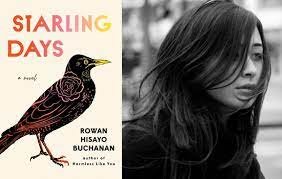

Swallow, a short story by Lindz McLeod

by Lindz McLeod
The first time our son nearly choked to death, we were at a nice—not so nice that it made
me anxious I wasn’t dressed appropriately, but nice enough—restaurant on the Upper East Side. My
husband had ordered a pesto pasta dish and was tucking in with gusto, while Benji picked at his
chicken. Afterwards, I could never remember what I’d ordered, although I must have ordered
something. There was a bottle of house red on the table; our glasses were half-empty, and when
Benji lurched forward, his face shading from crimson into purple, eyes bulging out in a way they
hadn’t since he’d been born and the cord had been wrapped tightly around his little neck, my
husband and I had both leapt to our feet.
The table jolted and the glasses all tipped sideways. One broke—I heard the crack, sharp and
high—while the others fell harmlessly against cutlery. I put both arms around my son’s waist, made
a fist, and heaved upwards. He smelled of fear and shampoo and earwax. The label on the inside of
his shirt collar had come loose, the fabric hanging by a couple of threads. I wanted to bury my face
in his hair and never let go. Instead, I stared into the spreading red stain and heaved again and again
until the offending chunk was finally expelled.
We’d assumed it was a one-off—that everyone, from time to time, bites off a little more than
they can chew—but Benji developed a habit. We’d taken him to doctors, specialists, even a
therapist, but he was still struggling. They said it could be something to do with how he was eating,
or what he was eating, or stress, or hormones, or depression, or any number of fixable or unfixable
things. I’d enforced a soft foods policy for two of the three meals, and had banned him eating
outside with his friends, even in public places, even in his own bedroom. I couldn’t take the risk.
On a Friday night in late June, Benji sat at the kitchen table, head cupped in one hand, sheets of
paper spread everywhere, while my husband stood in front of the open fridge in my line of sight
and, unblinking, drank straight from the carton. Marriage makes monsters of us all.
“What’s the report about, bud?” My son pushed a dog-eared textbook towards me. He’d
circled several pictures. I read the footnotes, squinting, because my glasses were upstairs in the
bedroom. “Gargoyles?”
“Your mother’s a gargoyle.” Henry grinned, a thin milk moustache on his upper lip. Once
upon a time, he’d have been teasing; the sting would have been light. No more than a needle prick.
One and done. These days his words stung like paper cuts. Lingered, salty and ragged.
Benji’s eyes flicked sideways to catch mine. “We had to pick something interesting from our
last field trip. They’re usually monsters with funny faces. People used to think that scary statues
would frighten away any demons or ghosts or whatever.”
“Okay.” The fridge door was still open. My husband was just standing there, listening,
letting all the cold air out. The AC was turned up high but even so, I could feel sweat break out on
my lower back. Outside, on the trees which adorned the property line, the leaves trembled in a faint
breeze which, if I opened the door, would feel exactly like someone holding a hairdryer three feet
from my face. The sun was still an hour away from setting, the light dipping gentle golden fingers
against the windowpanes. Whispering a farewell, not shouting. “Did they?”
“Probably not. But look, this is cool. If they have a spout where the rain can come out,
they’re called gargoyles.” He flipped back through a page and pointed at a picture. “See this? The
rain goes through somewhere at the back and comes out of the mouth here.”
“Wow.”
“But guess what they’re called when they don’t pour rain—when they’re just solid stone.”
I thought for a moment. “Statues?”
“Nope. Grotesques.”
Henry lifted the carton to his lips again, badly hiding a grin. I pictured the milk spilling
down his chest, soaking his t-shirt, filling up his lungs. Coming out of his nose like a cartoon.
“Don’t finish that. We’ll need it for cereal tomorrow.”
“I’ll get more.”
I bit back a retort and turned to Benji. “Okay, bud, time for dinner. Can you take all this stuff
upstairs?”
He nodded and started to gather up his things. When he’d left the room and the creak of his
footsteps echoed across the ceiling, Henry finally closed the fridge door. “What are we having for
dinner?”
I didn’t point out that he’d been in there long enough to set up camp, never mind memorize
the contents of the fridge. “Takeout?”
He picked up his phone, selected an app, slid it across the table.
“We need to get him something soft,” I said, scrolling through the options.
“He just needs to chew. He’s not a baby.”
I paused at Greek, scrolled on past Chinese and Indian, then went back to Greek. “The
therapist doesn’t think the problem is entirely psychosomatic.”
He scoffed. “Yeah, okay. You think doing a project about swallowing is going to help keep
his mind off choking on every meal?”
I picked out a sweet chili pita wrap, aware that my blood pressure was rising again. “No,” I
kept my voice measured, “but maybe there’s a reason he chose gargoyles.”
“Whatever, Becca. He just needs to chew,” my husband repeated, and stomped into the
living room.
A second later, the TV blared loud enough to shake the glass in the kitchen cabinets.
On Saturday night, I slipped into a gorgeous emerald cocktail dress and raked through my
jewelry box to find matching earrings. Henry walked through the bedroom wearing only boxers and
socks, carrying a freshly ironed pink shirt in one hand and a beer in the other. He put the can down
on the bedside table and opened the closet.
“So I’m a gargoyle, huh?” I put an earring in.
“What?” He was staring at his tie rack. I didn’t know why he bothered, since he only wore
about four of them.
“Yesterday. You called me a gargoyle.” His words had been bothering me; I’d laid awake for
over an hour last night, listening to his heavy breathing, picturing myself haggard and hunched on
top of a building.
He picked up the beer again, took a long swig. “Oh my god, lighten up.”
I put the other earring in and wiped a mascara smudge from my eyelid.
“Jesus. You used to know how to take a joke.” He replaced the beer, bent, produced a
crumpled green t-shirt from under the bed. I was forever finding his clothes scattered around. There
were hampers in damn near every room but that didn’t seem to matter to him. “Where did this come
from?”
I wasn’t sure that was true. I’d rarely been the butt of his jokes and when I had they’d been
easier, more tender. A casket, lined with sweetness. “It wasn’t a joke, it was a barb.”
“A what?” He dabbed cologne onto his wrists and neck. The scent wafted over, dominating
my subtler sandalwood with brash pine notes.
“A barb.”
“Who died and made you Alex Trebek? What’s the fucking difference?” He balled up the
green t-shirt and threw it near the laundry basket where it lay, crumpled, on the floor. I pictured the
warmth of his body slowly receding from the material, leeching out in the air. Dissolving like salt in
water. I wondered how long it had been lying there, and when he’d last worn it.
“There’s a difference,” I insisted. “Besides, Alex Trebek is dead.”
“Okay, whatever.”
He disappeared into the bathroom. The sounds of vigorous toothbrushing drifted out,
followed by a loud gargle. He spat, ran the tap. Appeared in the doorway again. “Is he really dead?”
“Yeah.”
His dark eyebrows kissed. “I didn’t know that. I used to love watching him.”
After Benji had been born, we’d watched a lot of Jeopardy together. My son preferred to fall
asleep in his father’s arms; neither contestants answering questions or the familiar theme music
would rouse him, but the slightest indication that he was about to be put into a crib was enough to
prompt full-throated wails. Jeopardy got us through hundreds of quiet nights.
“Me too.”
He smiled, shrugging into his shirt. “You look beautiful. Did I tell you that already?”
He hadn’t but I wasn’t going to ruin the moment. “I wouldn’t mind hearing it again.”
He crossed the room, still buttoning the shirt, and dipped to press a peck against my cheek.
“Beautiful,” he repeated, and turned my head to kiss my lips.
On Monday morning, I drove Benji to another specialist appointment. We hadn’t told our
son we’d discussed divorce. He probably knew, or at least suspected, because he was a smart kid.
I’d asked the therapist in private whether she thought he might be anxious about things at home, and
she’d hedged the answer. Guilt gnawed at me as I stopped at red lights, navigated the city’s
honking, chaotic traffic. Benji sat quietly, legs splayed, fingers drumming on his thighs.
I pulled into a spot recently vacated by a blue Volvo and turned the engine off. Benji didn’t
unbuckle his seatbelt. He was at the age where he didn’t want me to come inside because it made
him feel like a little kid; at the same time, he was frightened—not childishly, but in a deep, visceral
way. Anyone at any age would be—should be—terrified by their body turning traitor, rejecting the
most basic method of survival.
“I’ll come in with you, if that’s okay,” I said, solving the issue.
His shoulders relaxed. “If you want.”
God, he was just like his father.
The specialist went over the details with us for what seemed like the thousandth time. He
suggested a variety of treatments, most of which we’d already tried.
“Your file is very thorough.” She put down her pen. “There’s always the chance that one of
the treatments could work, but we simply haven’t given it a proper chance to settle in yet.”
I looked at Benji, who was staring at his feet. Unlaced Jordans; an expensive birthday
present from my brother-in-law. “What do you think?”
“I don’t know.”
The specialist bit her lip, skimming the file again. “We might consider an anti-anxiety
medication.”
“Anti-depressants? I’m not sure that—”
“Yeah, maybe,” Benji interrupted.
I stared at him. “Are you depressed?”
The specialist picked up her pen again. “That’s not all they’re used for, Mrs Parks.”
“It’s no big deal, Mom. Loads of people at school are on them.”
Other parents complained about their kid’s grades or extra-curricular activities—or lack
thereof—but I had no idea so many of his peers experienced mental health issues. Despite probing,
he refused to elaborate; unsatisfied, I dropped him off at school and drove on to work. My boss was
waiting for me as I walked in the door, hauling me into a client meeting I’d hoped someone else
would lead in my absence. The day passed in a blur of emails and catch-ups, and I was thankful
when I finally slid into my car and out of my heels. My driving moccasins soothed my aching
arches, and the traffic wasn’t terrible. I turned the radio on and up, windows down, letting the tepid
wind whip my hair against my cheeks.
After dinner that evening, my husband asked Benji what the doctor had said, which my son
relayed in almost correct terms before trudging upstairs, face already glued to his phone. When he
was out of earshot, I clarified further. My husband frowned. “Anxiety meds? So it is all in his head?
That’s what they’re saying?”
“Yes and no.” I picked an apple out of the bowl, rolled it between the palms of my hands.
Pictured pushing, hard enough to crush the flesh into pulp. Once, Benji had showed me a video of a
man demonstrating how to pull an apple apart into two halves. My son spent almost a month trying
to replicate the trick before giving up, leaving a bowl full of bruised fruit in his wake.
“Which is it?”
“Neither, really.” I put the apple back in the bowl.
Henry blew out an impatient huff. “I’m going to the gym. Back in a while.”
I pushed in the chair and turned towards the sink, where hours-old dishes were calling my
name in discordant voices.
“Hey, uh, did you book the room for tomorrow night?” His hands slid around my waist,
stopping just short of meeting on my stomach.
“Yeah.”
“Okay.” He mouthed the back of my neck, teeth scraping in a move that had stopped driving
me wild years ago, and which he’d never noticed or cared to amend. He pulled away with a pop,
leaving the wet flesh chilled. “Looking forward to it.”
On the bed in the hotel room, I googled proactive positions to receive your lover and how to spice
up your marriage. Everything was about spicing something, heating up. Mating in captivity. I
pictured us fucking in a zoo, cameras flashing, newspapers spinning like in the movies. LIBIDO
ON LIFE SUPPORT.
He knocked on the door. I told him to come in. He jiggled the handle.
“Didn’t you get a card? I left one at reception.”
“I didn’t ask.”
“Why not?”
“What’s the point in pretending if I’m going to get a card and walk straight in?”
“That isn’t part of the pretending. Its just practical.”
“It’s not sexy if you don’t commit.” Knuckles rapping against wood. “Come on. I’m not
having this conversation through a door.”
I got up and let him in. He pushed past me, cheeks already flushed, and made a visible effort
to relax.
“You look great.”
“Thank you,” I said, although I wanted to scream.
“Do you want to—” he gestured towards the bed.
I unbuttoned the second button on my shirt. “Aren’t we pretending?”
He was already unbuckling his belt. “Aren’t we always?”
I assumed a docile expression while he flung his belt at the chair, missing it, and walked
back to the door. With his fingers loosely resting on the handle, he began to apologize for walking
into the wrong room. I assured him it was no trouble. His gaze travelled from my chin to my
sternum as he hesitated, explaining it wasn’t safe for a pretty girl like me to travel alone. I wanted to
ask what kind of world he was building here; which genre he was fantasizing in. I wanted to know
whether he truly enjoyed the idea of a world where a woman couldn’t safely travel alone, and
whether he realized that was the world we already lived in. A fun pretense for him; a jarring
reminder for me.
I wondered what would happen if my new persona told him to leave—if she turned out to be
a witch, a shape-shifter, a demon. If she informed him that she was more than capable of managing
her own adventures. I wondered what his expression would be at first, what it might evolve into
afterwards; the many-legged stages of homo rejectus. I wondered what my future would be like
with neither an occupied space nor a man-shaped void next to me. The words didn’t choke me,
because they never made it as far as my throat, far less my tongue.
As my husband kissed his way down my chest, I wondered why we bothered pretending to
be strangers to each other when we so evidently already were. When he slid into me after only a few
minutes of lip service, I pitched my response. Low, encouraging, but not condescending. He stared
straight ahead, thrusting steadily, while I was treated to a close-up of the underside of his jaw. He’d
shaved that morning but there were several ingrown hairs, the skin around them swollen in small,
pink mounds. Oysters formed pearls around pieces of dirt. Lucky me.
Squeezing my eyes shut, I pictured a clamshell, razor-edged rims slicing through the water.
The back of my husband’s head and shoulders flexing as the door closed behind him. The thought
spurred me on abruptly; my climax rose steeply, banked, thundered to a crescendo. I came,
shuddering, an empty doorway outlined against my closed eyelids.
He followed suit shortly, looking smug and satisfied, but the smile of contentment faded
within seconds. “Did you have a good time?” He rolled off, clutching the sheet to his chest.
“Yes.”
“Who were you thinking about?”
“No one.”
“Yeah, right.” He bent over over, the jutting sail of his back reminding me of a replica of a
Spinosaur skeleton Benji had once been so fond of, and clawed around on the floor for his shirt.
“If I’m a gargoyle—”
He blew out a sigh, hard enough to ripple the curtains. “Jesus fuck, not this again.”
“If I’m a gargoyle,” I persisted, propping myself up on my elbow, “does that mean you’re
the building I’m there to protect?”
Henry rose, bare-buttocked, and didn’t turn around. “Uh. I guess so. That sounds kind of
romantic. Where’s my belt?”
“Where you threw it.” I flopped back on the bed.
After he hopped into his pants and threw his jacket over his arm, he glanced over. I hadn’t
moved. “Aren’t you coming?”
“I thought I might stay here for a while. Get a little work done.”
The vein in his forehead swelled, but all he said was, “Okay, babe. See you at home.”
When the door clicked behind him, I waited until I heard the elevator ding open and whoosh
shut before I pulled my laptop out and googled gargoyles. I studied their faces; some horned,
snarling, some roaring with silent rage. Some looked tragic, mouths curved in theatrical frowns. The
urge to pick apart the word—to ascertain exactly which of us was the monstrous being and who was
a mere conduit for the onslaught of rain—seemed more important than ever. I didn’t dare tell Henry
I could only climax now while picturing his absence. It was nothing to do with other people filling
that gap, although he would undoubtedly jump to that conclusion. The idea of the gap being filled at
all, by anyone, was abhorrent. These days, emotions ran through me and poured out onto the
pavement far below. I figured I had my answer.
I drove Benji to his next appointment, late on Wednesday afternoon.
“I’m gonna go in alone, okay?” He slouched off without waiting for a response.
The waiting room was empty, the TV in the corner mouthing silent news between
advertisements for back pain medication. I picked up an issue of Teen Vogue and flipped through
the glossy pages. They’d been doing some steady journalism over the last few years; teenagers these
days had access to instant news and an incredible nose for even the slightest hint of bullshit. I
stopped at an interesting headline and smoothed the page out.
The article purported to expose yet another senator in the latest string of sexual harassment
claims. Opening with a description of the execution of a man called Giles Corey for the crime of
witchcraft was a strange choice, but it caught my interest. Apparently, the executioners had pressed
his body between heavy stones, and when they’d demanded that he confess to his crimes under such
a punishment, Corey had simply requested more weight. More weight, more weight, until his last
labored wheeze. The author of the article asserted that the truth could be crushed, but never quelled.
I wasn’t sure I agreed, but Benji emerged from the doctor’s office before I had a chance to find out
whether the rest of the article supported the idea.
“That was fast.”
He shrugged.
I waited until we were in the car, buckled in and reversing, before I pressed the issue. “So?”
He was already fiddling with the radio. “He thinks I’m doing better.”
I waited at the intersection while a red car barreled past, way over the speed limit. “Do you
feel like you’re doing better?”
The radio settled on screeching dubstep. “Yeah.” He crossed his arms and didn’t pull out his
phone. “My report was good, by the way. Mr Adamson said he liked it.”
“The gargoyle one? That’s great, bud. Do you want to celebrate?”
He pulled out an apple and took a careful bite. My fingers tightened on the steering wheel,
but I said nothing. He swallowed. Chewed again, swallowed. “Maybe we could get Chinese?”
“Sure. Whatever you want.” I held a smile in, all the way home.
When I passed on the good news, Henry didn’t seem as relieved as I felt. He opened the
fridge, stared inside. “Okay. Good.”
“Good? Just good?”
He picked up the milk, shook it, and drank. “Yeah. Good.” He caught my eye, sighed, and
closed the fridge door. The carton bent under the pressure of his fingers. “What?”
“Nothing.” I put my keys down on the counter. I’d been wrong; neither of us were
gargoyles. We were simply two halves of a building under permanent construction, waiting out the
latest storm. Maybe that’s all marriage ever was.
“What do you want, Becca? Do you even know? Is there someone else?” Bit out each word
like a bark, the sound of a dog half-strangled by an urge to stretch a chain as far as it would go.
“Yes. Myself. I’m the other person.”
He scoffed, disbelieving. “Don’t get cute.”
I splayed my keys out, one by one, making sure each had individual space. The words
bubbled in my throat, pricked my sinuses. I want to recreate myself in stone. I want to carve out my
own void and leave the space empty. I want to choose weight, not water.
More weight.
More.
Bio: Lindz McLeod is a queer, working-class, Scottish writer who dabbles in the surreal. Her prose has been published by Catapult, Flash Fiction Online, Pseudopod, and many more. She is a full member of the SFWA and is represented by Headwater Literary Management.

Novel Excerpt by Danielle Lazarin
Editorial note: We are thrilled to publish a novel excerpt on the timely and pressing topic of reproductive rights. For more of Danielle’s work, please visit her website at https://www.daniellelazarin.com/.


JULIA, APPROACHED AT PLAYGROUND
It was a weekday morning when Julia was approached at the playground. She’d just put the baby in the swing, facing him away from the sun. Ben was eight months old. The woman who came up beside her on that day wore a baby on her chest who was younger than Ben by a good number of months, “a fresh one” they’d have called it at work. This time yesterday, Julia had been in the middle of a delivery, a healthy baby girl.
The baby in the carrier fussed, and Julia instinctively turned towards its mewl. The woman bounced on her toes to calm it. Though Julia usually kept to herself at the playground, she smiled.
“Julia,” the woman said.
Julia squinted. She didn’t recognize this person. Had she delivered this baby? No, her memory was strong, especially for patients. The woman continued, in a voice low enough that Julia had to lean in just a bit. “I’m here to talk to you about a job, about changing your life.”
Two thoughts shot through Julia’s mind: that, even though there hadn’t been more death threats since the two while she was pregnant, this was a trap, or that this was a rep from a private healthcare firm. These firms catered to women who could afford non-insured procedures—not abortions or any of the reproductive services that had drawn Julia into the field to begin with, but otherwise the best care money could buy. Julia felt these organizations had turned their backs on women just as strongly as the government had. She’d gotten calls before at the hospital, but never an in-person solicitation. The salary was five times what she made now.
“Are you with Women First?” She could barely get the name of the private network out of her mouth without snorting. She and Lily called it Rich White Women First.
“No, no. Nothing like that. We’re part of a coalition that serves all women, forgotten women, all over the country. We’re looking for someone with your training and discretion.”
The woman handed Julia a piece of paper, a three-inch white square, one which she didn’t have to turn over to know was blank. She’d heard about this, activists signaling one another with a blank piece of paper, a reference to the laws they’d wanted: unrestricted. Some women carried empty signs to the protests. Of course she’d heard her share of rumors since undergraduate anatomy: that there were groups begun by med school dropouts disgusted by the lack of support for the true spectrum of care, groups secretly funded by the governments of certain states. Julia had thought it rather silly then; she didn’t know what to think now.
The only other people at the playground were a small girl, about two years old, building in the sand pit three yards away, and the girl’s mother on a bench, eyes trained on her phone. Julia slipped the piece of paper into her jacket pocket quickly.
“I’ve never done one.”
“We know you’ve been trained.”
The woman’s baby—and later, Julia would learn it was not hers after all, but a loan, so she could be in the playground with Julia without suspicion—was quiet now, but the woman was still swaying from side to side. Julia kept up her rhythm with pushing the swing, watched the way Ben’s single lock of hair, dark like Marcus’s, was lifted by the motion of it. His eyes fluttered closed. She needed to get him home before he fell asleep, or the afternoon nap would be impossible.

Interview with Danielle Lazarin, author of BACK TALK: STORIES
Interview with Danielle Lazarin, author of “Back Talk,” a short story collection on what it’s like to wait.
We all know it can take months to hear back from publications after we submit a short story, poem, or creative non-fiction piece, but a full manuscript on submission can take longer. I recently had the opportunity to discuss what goes through the mind of an author when their manuscript is on submission, and they haven’t heard back. Especially when the manuscript is so timely. Here is the candid interview with Danielle Lazarin, author of a short story collection titled “Back Talk” on what went through her mind as she waited to hear back.
PL: In your essay The Ambiguous Loss of (Probably) Not Selling My Novel, you write that “when your book is on submission, there’s a pressure of silence till you know the end.” Why did you feel compelled to write about the ambiguity of your novel selling or not, since I assume you are still in submission?
DL: I was on submission when I wrote the essay, but I’m not any longer. It was important to me to talk about it in the middle of it, knowing that any ending, whether it was a sale or not, would color the whole of the experience. We put too much weight on the end or results of things and most of the experience of something is going through it, not the processing of it, which tends to flatten it some. To put it in fiction terms, it’s the way that retrospective narration can sometimes add a false layer to a story, one that wants the story to mean a certain thing, so it’s told through a lens of (sometimes too absolute) knowing and leaves out the complicating parts because they don’t fit the story; I suppose that’s true of any sort of narration, isn’t it? It feels most honest to me to write about the spaces where we don’t yet know, and it adds an interesting craft challenge, too, to tell a story without knowing the ending.
PL: In your essay you mention Pauline Boss’s work “…ambiguous loss, the fraught space of what no longer exist but isn’t concretely gone.” You wrote that essay nine months ago. Are you still in that space of not knowing how to “mark or mourn” your novel not selling yet?
DL: Overall, with time it has mostly become less powerful, but like any grief, it depends on the day. Being in the headspace of a new project I’m excited about helps tremendously. What’s been most difficult, given that my unsold novel is about the obliteration of abortion rights, is to be living through what is now undoubtedly the collapse of Roe and I’m certain a future onslaught of privacy rights. As a citizen, I feel constant waves of anger and grief both for the despicable way this country destroys its own people. As a writer, there’s still a lot of loss knowing that my book could have been part of a larger conversation, an access point, perhaps, for understanding or thinking about what we owe one another. It’s frustrating and weird to be sitting on something that is relevant to right now and will not be read right now or maybe ever. In some ways it can feel like I never wrote the book, and writing the essay was a way to remind myself I did; it’s the marker and the mourning itself.
PL: You’re a teacher as well as a coach for aspiring writers. How do you motivate your students to continue moving forward with their work and not be discouraged if they enter long periods when they don’t know if something they’ve written will ever be published?
DL: I ask them to consider what it is they want from publishing: money, admiration, validation, other opportunities? Asking what the end game is is itself enough for most of them to realize that the aforementioned is either not coming from a single publication or won’t be enough to sustain them through the long haul resilience of being a writer when it does. That even the most “successful” writers still want all for those things; the pursuit is perpetual. To keep writing you must learn how to sustain yourself outside of these short-term rewards. We talk about how linearity is a ruse, in both the arc of a writing life and within the process itself; it can be helpful to recognize that a writing career starts at some A and ends at some Z (Z being…a Nobel Prize? Posthumous fame?). Working on novels or other large-scale projects is particularly hard because there aren’t nibbles of validation or success along the way as there might be with shorter pieces. Practically, I tell them to take breaks and work on shorter things so they can feel the satisfaction of finishing or having a breakthrough on something---a short story or poem or essay or even a visual piece---to simply get out of a mode of voice or whatnot they’re in a long-term relationship with. That, too reminds you that your writing is not your current single piece of writing. If you have only one story to tell in one way then---I hesitate to say this as declaratively, but I think it’s true--- you’re not a writer. Writers have lots of stories and a multitude of ways of telling them, many of which they don’t yet have access to, but will come if they keep working, if they let themselves see what they want to try and can try it for the sake of—the thrill, the joy, the intellectual exercise of--trying. With time this becomes the thing you seek, that satisfaction of an idea or an experiment gone well or the learning when it doesn’t so you can carry that forward to what’s next.
PL: When you wrote this essay you said there are times when you try to work on your new novel, but “can’t get a grip on it.” We are now in June of 2022, nine months since you wrote your essay, over two years since your book “The Pathways” went into submission. Are you able to get into your new novel now? How has your work been affected by this experience?
DL: Things are moving along with the new novel! I’m rolling towards a first draft. Crawling? I’ve started tracking my time and process over the past year and have come to terms with the reality of my pace. If anything, overall this experience has reinforced my drive to write what I write. Knowing how unpredictable and wholly uncontrollable the publishing end is, what else is there to do? It’s been said many times over that the only thing you can control is your work. In my class on claiming your own process and practice I quote a line from the book Art & Fear which takes it a bit further into process: “Your job is to learn to work on your work.” I try to do my job the best I can, to dig into the regular practice, which is all I can control.
PL: In your essay you also mention that in the past when self-doubts emerge “…I’ve always managed to find the smallest shred of faith and let it carry me through,” but now you are considering “giving up all together.” What makes this particular time of self-doubt want to make you give up writing? What changed from before when you could pull yourself through the self-doubt?
DL: Thankfully I don’t feel like giving up anymore, though it was very strong feeling during the earlier periods of the novel passes. So much was going on then: living in New York City at peak pandemic, adjusting to working with three other people in an apartment with barely any doors, general disconnection from a lot of people and things that kept me grounded and motivated. I’m in my mid-40s now, and like many writers at this age, there’s a sense of in betweenness I have about being neither a young writer nor an established one in a culture that fetishizes youth. This is compounded by being a parent, which makes getting work done as I’d like to very difficult, just much slower than is ideal or that I know I’m capable of. So there became a sense, especially with my kids suddenly literally in my working space again indefinitely, of the futility of the work I was doing. I think I wrote a good book, one that is relevant and compelling; as I said above, I did my job the best I could, just as I feel I did with my first book. But this time the job I did didn’t cut it, and there was no singular reason why, nothing I could point to to understand how I might have more success. It was painful to have spent a near decade struggling to accept that as a parenting writer I’d eek out the book the best and fastest I could given my circumstances and then still be in this in between space career-wise. Was I willing to spend another 5-10 years doing the same, knowing it would likely feel even worse to repeat that failure? Apparently, yes, I am. I can’t say this makes any sense; it is not a logical profession.
Danielle Lazarin is the author of the short story collection Back Talk. Her fiction can be found in The Southern Review, Buzzfeed, Colorado Review, Indiana Review, Glimmer Train, Five Chapters, Boston Review, and elsewhere. Her non-fiction has been published by The New York Times, The Cut, and Lenny Letter. A graduate of Oberlin College’s creative writing program, she received her MFA from the University of Michigan. Her work has been honored by the New York Foundation for the Arts, the Northern Manhattan Arts Alliance, the Glimmer Train Family Matters Award, Hopwood Awards, the Millay Colony for the Arts, and The Freya Project. She teaches fiction for Catapult and the 92Y. She lives in her native New York, where she is at work on a novel.

Paola Lastick is currently a student at the Mountainview MFA program at Southern New Hampshire University. Her writing has appeared on blogs as well as the newspaper, The Real Chicago. She lives in a suburb of Dallas with her husband, daughter, and three small yappy dogs.
Ask Me How I Know, Youngblood: a short story by W.T. Paterson
The reason love is so hard, youngblood, is that we don’t fall in love with someone else. We fall for a person with the qualities we want to see in ourselves. Love is a mirror.
Imagine there’s this guy, and he’s lonely, and he wants to find love. It doesn’t have to be a guy, youngblood, it can be a girl, too, or however a person identifies. This is just how it goes. Imagine, for the sake story, that this guy is looking for a girl. It can be a girl looking for a girl, or any combination really, but for now, it’s a guy looking for a girl. Ask me how I know, youngblood, and I’ll tell you a different story.
The guy has been burned before. In past relationships, he learned what it meant to be cruel, what it meant to be heartbroken, what it meant to make mistakes, and what it meant to see the future reflected in a young lover’s eyes. All of that is in the past, and he works a job that leaves him wanting something deeper. At his job, he’s underappreciated. You understand?
Then one day, he meets a girl. She’s younger, but not by much, and possesses has the type of vibrancy that he’s desperately craving. On the train home from work, the girl dances a small dance in as music tickles through headphones. She smiles. She looks happy, but she, too, is wanting, is tired of drifting. She wants stability. She craves partnership after a series of failed romances. Ask me how I know, youngblood, and I’ll tell you a different story.
On the train, the two see each other. It doesn’t have to be a train, it can be anywhere. A park, a store, a gathering. But for this story, it’s on a train home from work. Trains move like life. They barrel forward making quick stops for people to enter and exit.
The guy and girl recognize in the other the things they want for themselves. It’s the magic of attraction. You understand? This person is everything we’re not.
The guy and girl speak. Since the other party reflects us, we’re telling ourselves what we’ve been waiting to hear. That, youngblood, is why the language of love feels like a song. We give ourselves permission to be free.
They kiss, and that first kiss, becomes a benchmark. So, they kiss more. They kiss so much that they forget to breathe. And it’s not that they are secretly kissing themselves, it’s that they’re kissing someone in the way that they’ve always needed to be kissed and that kiss is returned to them, and the pieces fit.
Kissing turns into more intimate affairs, and so the guy and the girl strip away their clothes to become closer, to understand who each other truly are, and in doing so, it gets complicated. By being more honest, they start to see the cracks in their own foundations.
You see, youngblood, we are not always who we think we are, and this is a scary moment of truth. Am I the person I want to be? Or have I been fooling myself, which means I’ve been fooling them, which means am I deceitful? The guy and girl have long conversations and some of the pieces they thought fit together so perfectly suddenly don’t fit together as well. They bottle it down because why tamper with something that, up until then, has been working so well?
But what’s really happening is that they’re seeing themselves reflected back as imperfect and it scares the, it makes them vulnerable. The guy and girl silently promise to get better, to grow and evolve, to change.
And therein lies the rub. Ask me how I know, youngblood, and I’ll tell you a different story.
Over time, an argument erupts, and things get said, and blame gets thrown, and feelings get hurt because this person, this reflection of us, now mirros all of the things about ourselves that we don’t like. They are us, and by arguing and yelling and fighting, we’re actually fighting ourselves. Every mean thing we say is actually aimed at us, every criticism and jab is pointed inward. It’s hard to accept that the person we want to love is imperfect, even though that person is us. Then the guy says I love you, and the girl says, I love you, too.
This guy and girl push through. Neither wants to go back to being alone and so they make adjustments to find common ground. The guy still goes to work, the girl still dances to the music in her headphones. But then the guy, knowing how much he loves the girl, decides to adopt her traits. On the way home, he dances to music in his headphones. The girl gets a job that pays well, but she doesn’t enjoy it. We take on the traits of our partners thinking that to be more like them, we must become them.
But that doesn’t work the way we believe it to. We swap roles and our partner becomes more like us than we are like us. The things we fell in love with no longer exist in them, because we are them, and they are us, and the whole thing is complicated, you understand? No longer is the guy reflected back in the girl, and the girl is no longer reflected back in the guy. They are trying to be the other. After some time, neither knows who they are anymore. The person reflected back is us, but the old us, the us full of flaws, and secretly we fear them.
Tension builds. One night there’s another argument and someone says you’ve changed, but it goes both ways because how can one person stay the same forever? The thing we wanted to see ourselves as no longer exists because we’ve become someone else without knowing we’ve become someone else, and in the process, we don’t like who we’ve become. The traits the other person possessed that we admired so much, are us, and we are no longer us. And how did it get this way?
We get mad at ourselves. It’s complicated, but we have adopted the traits of our partner, which means we have become the person we’ve always wanted to be, and even though it was how we always saw ourselves; it doesn’t feel right. Because there’s power in wanting and magic in not-being. Ask me how I know, youngblood, and I’ll tell you a different story.
The guy and the girl are so far away from the selves they were that day on the train, and now the train is running express. The guy, in his new skin, wonders if the girl is worth it, but because she has become him, he’s asking this of himself. It’s confusing, you see, but it’s always pointed inward. She is him and he is her and that’s always the way it will be. We are each other, always. And now seeing himself through her eyes, the guy finds boredom and stability when he craves music and dancing. The girl looks at the guy and sees someone more free, now that she is bound to her stable job. You understand?
But they stay together, you see, because they’ve been burned in the past, and they’ve changed together, and going back to the way things were feels foreign and terrifying and the game of a younger blood.
Eventually, they have a child, and that child is an even mix of the guy and the girl. Or they adopt, or they find a child to dote their values upon. The girl has become the guy and the guy has become the girl and the child has become both of them, but what happens is that the child becomes only their best and worst parts.
The child grows and exhibits loneliness while dancing to music, finds joy in the menial, treads the waters between cruelty and empathy. The child seeks magic and watching them seek magic becomes magic for the guy and the girl.
And then one day, the child asks them about love, and how it works, and where to find it, and there are no definitive answers. The girl tells one thing, the guy tells another, and though neither are wrong, they both believe they are right. They say it’s compromise, but without sacrifice. They say
it’s never settling, but also settling down. They say it’s being selfless, even though selflessness is selfishness because to love someone means to love yourself, you understand?
And that’s the way life goes, and how love only ever exists in the small pocket of time when a guy and a girl meet on a train. That’s it. Small pockets when the world feels full of possibilities because the person across from us is everything we want to see in ourselves, and the train barrels forward, and we lose ourselves to an idea until nothing else remains.
Ask me how I know, youngblood, and I’ll tell you a different story.

W. T. Paterson is a four-time Pushcart Prize nominee, holds an MFA in Fiction Writing from the University of New Hampshire, and is a graduate of Second City Chicago. His work has appeared in over 90 publications worldwide including The Saturday Evening Post, The Forge Literary Magazine, The Dalhousie Review, Brilliant Flash Fiction, and Fresh Ink. A semi-finalist in the Aura Estra short story contest, his work has also received notable accolades from Lycan Valley, North 2 South Press, and Lumberloft. He spends most nights yelling for his cat to "Get down from there!" Visit his website at www.wtpaterson.com.