
Brief Notes on Failure and Narrative
By Aaron Calvin

The most enduring image from the 2020 NBA Finals is not one of LeBron James or his younger co-star Anthony Davis as they dominated their way to the victory and basketball supremacy alongside the rest of the Los Angeles Lakers.
It is, instead, a picture of Jimmy Butler, with 16.8 seconds to play in Game 5, a game that he and his Miami Heat team would win. In the indelible image, Butler’s body is bent in exhaustion. He is still standing, but half bowed behind the goalpost where he has just caught himself after being fouled on his way to the basket. He is in this moment grasping at a moment of stillness before moving to shoot two free throws. These free throws will help ensure his team ekes out a win over the dominant Lakers in a series that the Heat will ultimately lose in the next game.
In this image, Butler’s hands droop over the barrier like flowering clematis; his face lies hidden between them. It is an emblem of exhaustion. His posture is reminiscent of so many depictions of Jesus falling beneath the weight of the cross on the road to Golgotha. In the parlance of the sports cliche, Butler “left it all on the floor.” Though he ultimately suffered defeat, his exhaustive and admirable attempt at victory earned him a defeat that was widely lauded as a noble and admirable one.
This was the narrative that formed around Butler’s defeat. Within the context of his personal career and the over-performance of his underdog team in the vacuum-sealed playoff event amidst the coronavirus pandemic, it was an undeniable triumph. But, as is often the case when it comes to the harsh dichotomy of winning and losing in an athletic setting, Butler may end up among the many world-class athletes to never achieve victory at the highest level. Even if this is the case, he will not be thought of as a “loser” in the traditional sense, but someone who never achieved the pinnacle of success in a team sport that demands more than individual excellence.
Failure is inextricable from the human experience, but is only made legible by narrative. Placing failure within a context of wider events makes the event of failure, for many, bearable. The easily parsed, distinct relationship between failure and success is part of why sports are conceptually appealing. A wide spectrum of failure is allowed; there are valiant fighters defeated in a team sport despite spectacular individual performances like Butler in the 2020 playoffs or LeBron James through most of the Golden State Warriors dynasty in the mid-twenty teens or any of the all-stars who had the misfortune of playing against Michael Jordan in the nineties; then there are those who just plain blow it, collapse, or even downright choke, ala the New York Knicks’ John Starks in Game 7 of the 1994 NBA Finals or the Houston Rockets’ 27 consecutively missed three-point shots in Game 7 of the 2018 Western Conference Finals.
But there is only one variety of winner: the person who dominates, who performs at a higher level both personally or, in a team sport like basketball, is joined and complemented by other exceptional athletes. They are declared the best, unequivocally. It is the reason why the debate over who claims the title of the Greatest of All Time basketball player endures. There can be no popular acceptance that Wilt Chamberlain or Kareem Abdul-Jabbar or Michael Jordan or LeBron James played and succeeded in different eras or exhibited different strengths or bested incomparable foes.
In life, of course, failure contains an interminable level of gradation. Even worse, the failure suffered is often contingent upon uncontrollable forces. It is mostly random and indifferent to one’s desires. Success—conceptually, morally, fiscally—is fragile, amorphous, and untenable. Most of lived life exists within the clearing created in the wake of the dueling forces of desire and responsibility, neither of which are generally satisfied by the individual alone.
Literature, on the other hand, helps to address the incoherent failure of life by giving it a clear narrative framework to exist within. Failure, loss, defeat—this has long been considered necessary for the successful execution of plot. It generally arrives in the second of three acts and often serves to set the table for a satisfying denouement. Particularly in popular media like melodrama or anything involving superheroes, the failure event is often exaggerated so that the victory, in the end, feels all the more triumphant. Failure is made palatable, even acceptable and exciting, by narrative that assures conquest and success.
This makes a narrative that doesn’t assure or satisfactorily deliver victory and success still remarkable and, in turn, likely less popular. Audiences—consumers of narrative—prefer an uplifting story or, at the very least, a narrative that concludes with some level of satisfaction. Characters may be permanently altered by the events that transpired through their journey from the beginning to the end of the narrative, but not a little broken or unalterably worse or even totally ruined.
So it still offers a certain kind of thrill when failure is eschewed simply as a device to be used to create tension or further the conflict and made into something more central, when it is made not just as an inconvenience or a hitch, but an integral, unavoidable, and irreversible part of life. There are many works that do this and do this in an array of impressive, engaging styles, but I’ll take a moment here to examine just three of them.
Herman Melville’s Moby Dick is one novel consumed with failing. Its protagonist, Ishmael, fails to find satisfaction in normal life on land; he fails to keep the “damp, drizzly November” from his soul. A great deal of the book is spent in the cetology chapters, an initially puzzling through-line of the book in which Ishmael expounds at great length on the anatomy, behavior, and general substance of whales. Most of this information is scientifically inaccurate. Ishmael’s famous line in the chapter “The Prairie”—“I try all things; I achieve what I can” —should be understood in the context that Ismael’s achievements are few and far between. The entire mission that propels Ahab and The Pequod throughout the book is a doomed one. It ends in oblivion, as it was destined to, and as Ahab knew full well it would. Only Ishmael and his imperfect science is left to tell the tale.
The meta-narrative surrounding Melville’s novel only bolsters its claim to one of history’s great failure narratives. Its current stature in the pantheon of American literature stands in contrast with how poorly the novel was reviewed initially and even mostly ignored. Melville died in such obscurity that the New York Times barely noted his death while misspelling the name of his definitive work. There’s an alluring appeal to this kind of tale, a sort of Van Gogh Effect, where an artist’s genius is so undeniable that—though it was denied them in life—the proper renown, respect, and recognition is eventually bestowed upon the artist and their art in the grander historical narrative.
Of course, Melville—author of Bartleby, the Scrivener, a novella dedicated completely to the high art of refusal—understood well the usefulness of failure. Typee and Omoo—his early oceanic travelogue novels that were not nearly as allegorical and complex as Moby Dick and a great deal more rollicking and bawdy—were commercial successes. He progressively turned away from the accessible through his career and purposefully produced more challenging works even as he descended into obscurity and poverty. In the final phase of his working life, in the midst of the Civil War, he even got really into writing poetry.
The idea that Melville was a commercial failure in lifetime but received justice after his death is a simple and compelling one. The truth, that he was a commercial success but produced increasingly challenging work and became unfashionable later in his career before this work was championed by writers and artists after his death, is a bit more complex. It all depends on the narrative framework that gets applied.
John Williams’ Stoner, another novel somewhat neglected in its time and revived in a Renaissance of sorts (it has become very popular in Europe) a half-century later, dwells in failure. Tim Kreider described the book in a 2013 New Yorker article as the antithesis of Fitzgerald’s The Great Gatsby. Not a romantic tale of wealth and beauty built on a deceitful façade that all falls apart in the end, but instead an elegiac mining of a somewhat unremarkable middle-American life. “Stoner ’s protagonist is an unglamorous, hardworking academic who marries badly, is estranged from his child, drudges away in a dead-end career, dies, and is forgotten: a failure,”
Even Cormac McCarthy’s infamously bleak post-apocalyptic father-son novel, The Road, ends on a hopeful note, offering the reader a crumb of solace amidst the dreariness of humanity’s near-end. Stoner is truly an unrelenting bummer. There is, however, such beauty in William Stoner’s struggle, in his pain and suffering, his devotion to language and literature that gives shape to it all. The novel ultimately presents Stoner’s life of quiet desperation with measured acceptance, a life without despair but also absent of any kind of self-justification.
Failure is transformed in narrative when it is examined with openness and clear-sightedness, often the result of writing that challenges how people are encouraged to think of failure in the broader culture. The systems of capitalism that frame the living, modern world often allow for only certain narratives about failure. Above all things, failure must be useful, these systems demand. Failure is allowed, but only if it’s learned from and pushes you further in pursuit of success (this is also a common cliché found in sports). There’s a pervasive inability to accept the things that failure often is: random, indifferent, constant, meaningless, predictable, and often highly recurrent.
So when a novel comes along that challenges the popular modes towards failure, it feels unique and even revelatory. The late, great Jade Sharma’s excellent Problems is one such novel. The novel’s narrator, Maya, fails at being all the things you are taught you should want to be. She’s a narcotics addict. She’s cheating on her husband but not for any very good reason. She’s lazy, and often willfully cruel. Her voice electrifies the narrative, her brazen willingness to be all these things unapologetically feels almost decadent, an illicit treat compels the reader to consume more.
As Lauren Holmes puts it at the beginning of her New York Times review of the book, “a novel about a heroin addict shouldn’t be this much fun to read.” But Problems is even more than that. It epitomizes a certain kind of failure narrative; it is a total, gleeful refusal to value what people are told they should value or feel bad in the ways people are told they should feel bad.
These three novels, though different in a number of ways, have in common a refusal to narrativize failure in traditionally acceptable frameworks. There’s a shared inability to conform to the mandate that failure must be mitigated by success or, at the very least, some kind of manufactured solace. That inextricably human space between the real and desired is, in many ways, the very essence of what life is and what makes it interesting. This is what makes literature and other forms of narrative art that attempt to consider it without the many impediments and comforts often erected to protect people from their own thoughts and feelings so important.
Failure will always be more interesting than success and will forever remain essential to narrative. Narrative will also remain an essential tool in making failure both personal and societal understandable, but only in the narratives that challenge accepted depictions of failure does its true nature become fully visible.
Aaron Calvin is a writer living in Iowa. He is a student in the Mountainview Low-Residency MFA for Fiction and Non-Fiction and online editor at Assignment Magazine.
AUTHOR SPOTLIGHT: Daniel Charles Ross

Daniel Charles Ross is a retired U.S. Navy Reserve chief petty officer as well as a former military police investigator. He was also a student for a time at the Mountainview MFA program. His education and experience are both on full display in his debut novel, ‘Force No One,’ a military-thriller which he self-published in 2018. Daniel was kind enough to let me ask him about his new novel, his writing process, and tips he has for self-publishing.
-W. Leander
So, tell us a little about yourself. Where are you from?
I'm a Detroit boy living in Lima, Ohio--home of the nation's only remaining main battle tank plant. We moved here in 2006 when we had our third child under three, and we needed to live near grandparents, cousins, and babysitters. I'm the oldest of seven--six boys and a girl--none of whom are writers but me. And the jury is still out on me.
Have you always wanted to write?
Writing is evidently imprinted in my DNA. In elementary school, I was drawing fake newspaper stories and layouts on large sheets of paper, complete with a comics section. In middle school and high school, I was always on the newspaper staff, ending up in my senior year as the co-editor of our bi-weekly paper and student literary magazine. I went into the Army not long after high school (since color TV but before the internet. Or cellphones.) as a military police investigator, and didn't write a word for seven years that wasn't a police report. But then the bug returned and I had a few pieces freelanced in the Army's European Stars and Stripes newspaper, and sold a fiction story to a men's magazine. That's when I decided to get out of the Army and freelance full-time. I didn't know then that the definition of "freelancing" was "unemployment without the tax advantages." But after a time, I was privileged to write on staff for Popular Mechanics, Motor Trend, and Car and Driver.
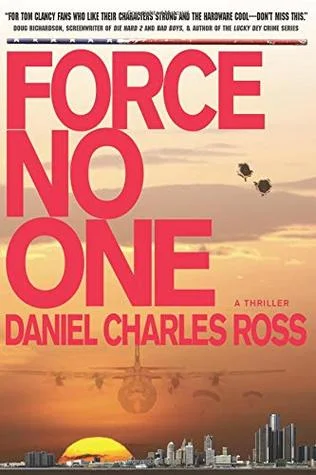
Congratulations on the publication of your new book. Can you tell us a little about it? And how did the idea come to you? Thanks! Force No One grew out of work that was to have been my Mountainview MFA thesis, guided along by Merle Drown and Rick Carey. Regrettably, I only completed the first year of the program when my VA edu-bennies ran out. But in that time--including wonderful feedback from the likes of Jo Knowles, Mark Sundeen, Ann Wertz Garvin, Diane Les Becquets, Amy Irvine, Craig Childs, Katherine Towler, and my amazing cohort--I got what I was there for: Affirmation, and actionable guidance. It's sort of a hybrid crime/military thriller with two overlapping narrative circles that come together in the last "act." A homicide in Detroit usually doesn't raise many eyebrows, but a victim is found with a business card from a Department of Homeland Security enforcement cell no one's ever heard of. FBI Special Agent Amber "Corvette" Watson and Detroit Police homicide detective Sgt. Tracey Lexcellent are a joint task force who catch the case. With a disgraced U.S. Army Ranger who can forget nothing and a black-budget CIA team in tow, they must solve the murder before terrorists parachute into open-air Comerica Park during the opening ceremonies of the World Series to blow themselves up and kill thousands on live television. Yes, of course it's fiction: I have the Detroit Tigers in the World Series.
What was your writing process like? How long did it take for you to write the book? Did you outline the whole story ahead of time?
I had a no-kidding important running start with the boost I received from my MFA year in 2015; there is no substitute for exposure to people who know more than we do, and I didn't know jack. I hammered away at it, in addition to writing other things that are still pending, but the constant novel revision and revisions of revisions drastically slowed my pace. Better to get it down first and then revise; I was "smoothing" as I went along, at least I thought. That was a monumental time-waster, when the real smoothing would come in later drafts. I wasn't an outliner, either, which I'm changing for the sequel. I "pants" it as if watching a movie unspool in my head, seeing the scenes that came one after another and just transcribing them. The fallout of this was having to go back several times to plant justifications for what I'd written much broader later in the narrative. I believe strongly in letting the story go where it wants, but I now believe that process wants adult supervision, too.
What was the path to publication like for you? Was it different from what you expected?
"Path to publication" is a fun term; yes, different than I foolishly expected. When I thought the mss was ready, the first agent I queried was a guy who reps a long-time, very successful thriller writer I read and admire. I thought, He must get what we're doing; surely he's My Guy. Following submission guidelines, I sent the Q-letter and the first five pages about 4:30 on a Friday. Before 6:30, he emailed me back from his phone asking for the full. Sheesh, I thought, freaking out, who says it's so hard to land an agent? I sent him the full--and he had it five months, finally declining in a thoughtful email the gist of which was he didn't connect with the characters. One hundred and three additional queries later, I formed a small press (ForcePoseidon.com) with Mike Hancock (09) to put out our work and that of our talented friends and equally under-represented authors. My thriller is the first "artisanal" result of this process and a proof-of-concept that seems to be working out well. We're reviewing additional projects for publication in the first quarter of next year.

Now that you have completed your novel and published it, looking back is there any advice you would give to aspiring writers? Do the work first, the work being the writing. Finish it in the smooth in Word or Scrivener or in ballpoint on legal pads, whatever works for you, before you seek representation, if that's your goal. Only query once your work is final-final, because when that email comes back two hours after you sent in your Q, you want to respond instantly. If you decide to self-publish, you will still tweak and line edit (sometimes just for typesetting reasons) and maybe even make big changes once your words are laid into InDesign or Vellum, but don't hurry that process. Keep learning. And just write. Getting it down is the foundation of everything that follows. Edit ruthlessly, because that's what the gatekeepers (and readers) will do. That doesn't always mean "trim." When that first agent said he failed to connect with my characters, I plowed back in there and turned up the wick on almost everything. That mss submitted to him was 97,000 words. The novel on Amazon today (bit.ly/ForceNoOne) in print and pixels is 113,000. I expect the sequel, Force Majeure, to roll out at about 90,000 words.
As a self-publisher, do you have advice on that process? We've all seen self-published work that is, charitably, not ready for prime time. Simply uploading a Word doc to Amazon or IngramSpark or wherever, slapping on some low-resolution stock art, and pushing the Send button may be psychically satisfying to you and your mom, but few people who don't know you will respond that well. It just doesn't look like a professionally produced book. Our Force Poseidon was established to be as utterly professional as the Big Five, but with a broader view and less bureaucracy. I've been a writer, editor, photographer, and designer for decades, but we still sought input from beta readers and other pro-grade editors. That said, the editing, cover, and book design were ultimately my responsibility: My name is on the cover. If you don't have those skills, do not be shy about seeking help from professionals who will only make your work shine. If anyone has questions about the process of querying, self-publishing, or anything else, I can be reached at DCR@genuineDCR.com. I never close. Finally, have the confidence in your work that you want an agent or publisher to have. We're writers, creators, and self-doubt is encoded in us at the cellular level. The Mountainview MFA is one of the best ways to access the training and expertise from genuine, published authors who will make your journey better.
Daniel Charles Ross—DCR—attended Mountainview MFA in 2015. The thriller, Force No One, was to be his thesis. Visit his website genuinedcr.com.
Student Picks: The Book of Strange New Things
Arun Chittur - Despite the several weeks it took for me to finish Michel Faber’s The Book of Strange New Things, I recommend it strongly as an example of fiction that explores tough philosophical questions using a plausible, speculative approach. It’s science fiction without being over-the-top, a world easy to imagine as a successor to our present.

An Earthbound multi-national leads an effort to colonize an alien world to support mining of a valuable mineral. Unlike James Cameron’s blockbuster Avatar, the indigenous population capitulates and learns to live as humans overtake them. At some point in an undefined past, a visitor from Earth introduces the Christian Bible to the planet—this leads to hundreds of converts looking for someone to lead them in their question to understand the story of Christ as told in the “Book of Strange New Things.”
Faber crafts a deeply flawed character in Peter, the pastor enlisted by the corporation to minister to the new converts. He leaves behind a family and war-torn world for a new dawn in his own journey as a man and a Christian. We are left to wrestle alongside him with questions of love, loss, and our responsibility to this world and the next.
Arun Chittur is a graduate of The Mountainview Low Residency MFA in Fiction and Nonfiction.
Faculty Pick

Arctic Dreams: Imagination and Desire in a Northern Landscape by Barry Lopez
Richard Adams Carey - There are books that you enjoy and admire, and then books that you so enjoy and admire that you take them into your bones, and their phrases and themes become part of your own DNA as a writer and storyteller.
Such a book for me was Barry Lopez’s “Arctic Dreams: Imagination and Desire in a Northern Landscape.” Published in 1986, the work is a steaming broth of travel, history, folklore, ecology, and philosophy, its subject matter a part of the world as big as China, no more populous than Seattle, and as remote to most of us as the moon.
The impressions of European, Russian, and American explorers in the Arctic are quoted liberally, but Lopez—radically for that time—gave equal or greater weight to the oral histories and belief systems of the Inuit and Yupik peoples he moved among. He is particularly eloquent on what Western explorers called “the native eye,” that nearly occult sensitivity to the nuances of sky, water, landscape, and wildlife behavior that has been lost to Westerners since, more or less, the Agricultural Revolution.
Lopez’s knowledge of and respect for that other mode of being and this other-worldly geography was rocket fuel for me as I researched and wrote my first book, “Raven’s Children,” about the life and struggles of an Alaskan Yupik family. Lopez’s empathy for all things human, along with the grace and precision of his language, inspire me to this day.
BOOKS
When the Men Were Gone by Marjorie Herrera Lewis
Review by Daniel Charles Ross

When I first saw the cover of this novel, I immediately remembered one of my favorite movies, "Summer of '42." The movie brilliantly details the adolescent lives and times of two boys too young to go off to WW II, the heartbreak of a young war widow, and how those life streams connect.
The brilliance of Marjorie's based-on-a-true-story novel is that, like the movie did, it distills the life and times of people facing far-off WW II into a local conflict that they must battle hand to hand. The primary battle is sexism: protagonist Tylene (a real person) is the best choice to be the school's football coach, but the men in the decision chain are skeptical—and her opposing coaches are rudely dismissive.
We look back through our long lenses to those days and just shake our heads today. But this was another time and place that Majorie has reborn and given life.
Tylene was a real person in the Texas school football continuum, and her "factional" depiction is fully realized as a caring, football-loving teacher and school supporter who just wants to do the best thing for everyone. She infuses even her skeptical football team with energy and directs them with skill, finally overcoming the last barrier when a teammate's brother, a former school football stand-out now injured, gives his support.
In the end, they lose the Big Game, but they are victorious in pride and self-worth.
This is "Friday Night Lights" crossed with DNA from "Summer of '42." It has a little Sisyphean top-spin, with tasks that are both laborious and futile. The coaching trials compete with Tylene's effort to rescue a former student and football star from the life-eroding effects of his war wounds; with keeping her marriage happy and functioning; and occasionally, with her own self-doubt.

Photo by Shane Bevel
This is a finely tuned, lyrical story that evokes a time long past but mostly fondly remembered, the war years when Americans all pulled together to fight the Hun while mostly ignoring the social battles on the home front because that's what they always did then. The Greatest Generation at war sometimes wasn't so great back home.
Marjorie's seminal work will one day be taught in high school English Lit classes. Full disclosure: I'm proud to say I shared the Mountainview MFA program with her for a time, but it's clear she paid closer attention than I did. I'm told this story has been optioned for a movie, and that's great news.
But like one often says, the book is better.
Five Stars: One for any writer facing the anxiety of a blank page; one for an ignored story uncovered and illuminated well; one for finely drawn characters who come to life on the page and in the reader’s mind; one for a terrific cover; and one because I'm happy to think this is just the start of a wonderful career full of great reading for us all. Strongly, unequivocally recommended.
Daniel Charles Ross—DCR—was a Mountainview MFA student in 2015. The thriller that was to be his thesis, Force No One, comes out in the fall.