A Digital Ghost Story
by Nadia Owusu

I have been haunted for five years and six months. The voice first came to me through my Blackberry and then through my iPhone. Mostly there is just raspy breathing and incoherent whispering. Sometimes the voice hums my name and laughs. Sometimes there is nothing but background noise—horns honking, a fork clanking against a plate. Once I heard a baby cry and then the call was ended.
Occasionally, I am haunted through my Gmail. The sending address is always different. It is always a man’s name like Fred or Robert or Carl followed by seven or eight numbers. The messages are not especially interesting. Often there is just a question. What did I have for lunch? Was I enjoying the beach weather? Recently, Larry7678919 wanted to know what I thought about the Republican presidential debate. In 2013, the emails were mostly one-sentence directives. Let love in. Don’t be afraid of what you really feel. Open up to new possibilities.
I assume that the voice on the phone and the words in my Gmail are from the same person. It might be the guy I went on one date with in the summer of the year that I got the first phone call at 1:30 in the morning. The guy’s name is Rob. It’s not really Rob, but I don’t want to use his real name because he has a wife and two children now. I know this because I looked him up on Facebook. I was looking for evidence. I don’t know what kind of evidence I expected to find on Facebook, but you have to start somewhere.
On our date, Rob told me that, years earlier, he had stalked a woman who he was too afraid to ask out. He didn’t do anything to her, just followed her around as she ran errands and met friends for brunch. When he told me this, his voice was gurgling in the way that comedians’ voices gurgle when they are telling a joke that they think is really clever. We were eating lasagna and drinking white wine on the patio of a restaurant in the West Village. It had been one of those sticky New York days when you feel like you are breathing in dirty steam instead of normal air. But, now that the sun had set, there was a breeze that tickled the romantic candlelight at our table. The breeze and the perfect crescent moon made everyone happy and beautiful with rustling hair and luminous skin. But, Rob looked like he had smoked a lot of pot. His eyes were red and half-closed.
The stalking happened before he knew how to talk to women, he said. He didn’t have trouble with that anymore because he had taken a weekend-long seminar with a man who wrote a book about picking up women at parks and bookstores. I met Rob at the Guggenheim. I was annoyed that he approached me to let me know that I furrowed my brow when I looked at paintings and that might give me permanent wrinkles in the future. But, after that, he started talking about Analytic Cubism in a way that was endearingly nerdy. Later, I learned that the book about picking up women written by his seminar instructor encourages readers to say something mean instead of something nice as an opening line. This is supposed to change the power dynamic and make the woman feel as though she needs to impress the man. I think that is stupid advice. I agreed to go out with Rob because of the endearing nerdiness and because I liked the idea of telling people that I met a man at the Guggenheim. It had nothing to do with him informing me that I was going to be wrinkly.
I did not go on a second date with Rob. He said “Stop being so uptight” when I told him that all the talk of stalking was making me uncomfortable. Then, he said, “Why do women have to make everything such a big deal?” I got up from the table without saying another word to him. I walked home, looking over my shoulder whenever I heard footsteps close behind me. The breeze no longer felt enchanting. Now, it felt ominous. A shiver worked its way up my spine despite the heat. At home, I told my roommate the story, laughing. I left out the part about being scared.
Rob is at the top of my list of potential haunters. Also on the list are:
1. The guy I worked with at the Pizzeria Uno at South Street Seaport during my freshman year of college. He got my phone number off the schedule that was posted on the staff changing room door and called me to tell me he loved me. I told him that I was flattered but I did not love him. He told me that he would wait until I did. Two weeks later, he started dating the pretty hostess with very large breasts, but sometimes he looked at me when he kissed her hello or goodbye.
2. The ex-boyfriend who showed up in front of my job to say that he was getting married to the woman he cheated on me with unless I told him not to. I did not tell him not to. I had let him break my heart for long enough. He got married at City Hall and texted me a photo of his smiling wife. I texted him ‘congratulations.’ I really wanted to text him ‘you’re an asshole.’
3. The creepy yoga teacher from the studio I used to go to on the Lower East Side who asked a lot of students out, including me. He could easily have gotten my information from the registration system. He got fired for masturbating in the acupuncture room.
4. A robot.
The calls generally come between 1:30 and 3:30 in the morning. They come from a blocked number. I answer because what if it is my brother calling me from Ghana or my friend Pascal calling me from jail? My brother sometimes forgets about the time difference between Accra, where he lives, and New York. Pascal is one of the kindest souls I have ever known when he is sober, but he gets too drunk and fights people in front of bars.
The only thing I ever say to the voice on the phone is ‘hello’ and ‘who is this?’ and ‘stop this.’ I say these things several times, then I listen for a few seconds before hanging up. I never respond to the emails.
I do not believe in ghosts, but sometimes I wake up in the middle of the night with a feeling that something is in my room, floating above me or standing silently in a corner. I have had this feeling since I was a little girl who was afraid of the dark and had to sleep with a nightlight. It is a thumping of heart, a tightness of throat. Recently, I jolted awake and saw a man-like thing sitting in the armchair by my bed. When I turned on my lamp, the shape of the man became a pile of unfolded laundry. Fear is an unpredictable and, at times, irrational emotion. It can be caused by dangers both real and imagined.
The number one lesson in the book about how to pick up a woman is to keep her wanting. Smile at her but then talk to her friend instead. Pretend that you have somewhere important to be so that she thinks that she has to sparkle to convince you to stay. Very slowly increase physical affection. Wanting is perhaps the opposite of fear, but they are both urgent forms of anticipation. The book aims to teach men to create in women the kind of wanting that works like a phobia—a type of persistent fear (want) of a being, object, or situation that the affected person will avoid (pursue) in a way that is disproportional to the actual danger (appeal) posed.
My ghost is a seemingly benign presence. It never threatens or rages. Sometimes, months will go by in which I won’t get a call or an email. Then, the familiar ringing in the dead of night, the realization that I have been waiting for it. The goal of a haunting is the same as the goal of a seduction: to become embedded in the consciousness, to not be forgotten.
Perhaps this is why I am convinced that my ghost is the voice and words of a man who failed to seduce me. Perhaps this is why, once in a while, a summer breeze against my back as I walk home at night makes me pick up the pace, makes me turn to see who is at my heels, makes me, still, just a little afraid of the dark.
Nadia Owusu is a current degree candidate at Southern New Hampshire University's Low Residency MFA in Fiction and Nonfiction.
On Loving Contemporary Horror Movies
And so what’s the final temple? What’s our last defense from horrible death? After we have left our homes, all that we’ve got are our bodies. Which is why, so often, possession films are the most terrifying of all: The Exorcist, The Exorcism of Emily Rose, The Shining (sort of), The Conjuring. The reason we’ve seen such an oversaturation of these stories in recent years is because the horror industry has exhausted all its precedent anxieties. We’ve reached the end of a cycle in which the horror movies have systematically broken our sanctuaries down, violated them, reminded us we aren’t ever safe.
by Daniel Johnson

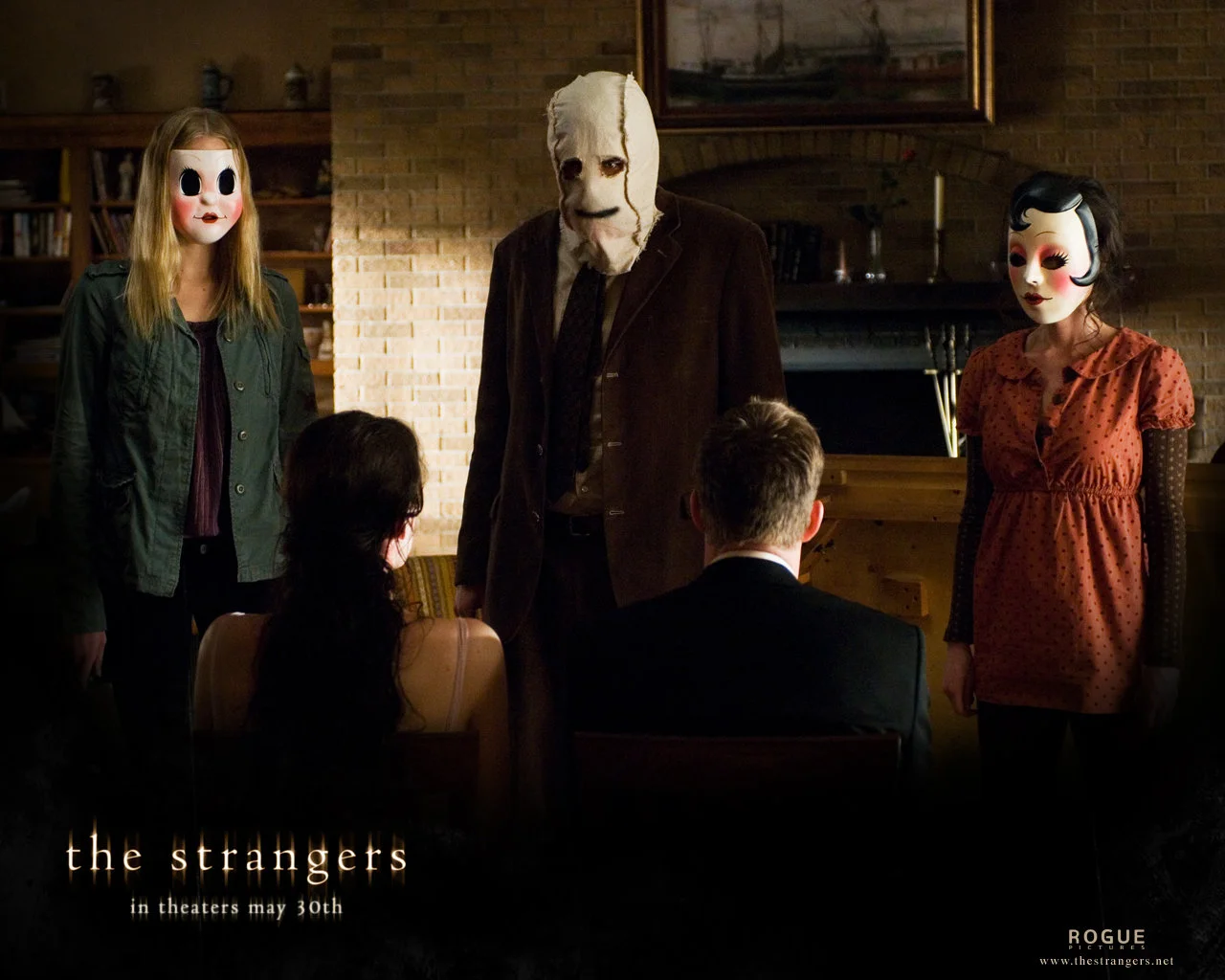
The Strangers (2008)
The most common response I get when I tell people that I studied horror films for my undergraduate degree is, simply: “No you didn’t.”
It’s true and it’s not. My Horror Films Studies course was only one three-credit elective toward the completion of my Film minor. Sometimes I deliver that line as if my degree thesis was, say, an analysis of how the graphic reportage of the Vietnam War contributed to the terror surrounding The Texas Chainsaw Massacre. I do this, in part, because I’ll take any chance I can get to seem eccentric; it’s a fast-paced world out there, after all, full of people far more interesting than I am.
A fraction of the truth is that I’m particularly smitten by the genre because I associate the fear it elicits with the thrill of being young and dumb and in love. When I was in high school, such was the move: invite a girl to your place, share a blanket, and watch a scary flick on the couch in the basement, under the exposed guts of your house, pipes that would writhe and groan in uncanny rhythm with the silences in the movie. Lights off, obviously. Just she and I and the electric blue of the PG-13 hellscape on the old tube TV, a couple of Diet Cokes. This was my introduction into the realm of filmic terror.
It was also how I started seeing my first long-term girlfriend. Our initial dates were viewings of Disturbia and Cloverfield—two of those hedged, quasi-horror, quasi-thriller films that served to ease us into the genre before going full-on Rosemary’s Baby. We took it slow.
Those nights, beneath the blanket, we’d rub socked feet, lean into each other as cameras panned down dark hallways, excruciating and unhurried. If I was lucky, her shirt would have slid up during a jump-scare so that, when I put my hand back where it had been before we both reacted, it would be resting against the soft skin of her lower back. Some of my first exposure to intense, blue-balling sexual tension went just like that: my arousal, as well as the possibility of embracing its source, intensified at the same rate as manufactured fear.
With the same girlfriend, whenever we were at her place—a ranch home full of Catholic, conservative, God-fearing Italians—we’d have to play board games or watch rom-coms on the couch with her mother, who often chose the movie, and who could only handle leaving us alone for the duration of a bathroom break. We could hold hands. No blankets. She left the lamp on.
About halfway through Hitch or Just Friends, she’d feed us homemade, ultra-breaded marinara dishes made brick-heavy by all the cheese. My girlfriend and I would reluctantly eat on separate couch cushions while we watched the rest of the movie. We did this out of respect. My lap would grow warm from the heat of the food on the plate; I’d sweat in places I really didn’t want to be sweating.
I’m still convinced her mother was some sort of overprotective super villain. It was brilliant: she only made food that she knew would give us the meat/lactose sweats, so that whatever immediate attraction we felt for each other would be absolutely bludgeoned to death. The sexiest thing about those nights was the shit I would take when I got home that mercifully rid my body of maybe half the dairy I’d consumed for dinner.
To be clear, I wasn’t (and am not now) opposed to some good old fashioned family fun. I wasn’t (and am not now) a dog. But in that specific environment, under the shadow of my girlfriend’s mother, in the glow of a movie which likely had some ideologically rigid and self-righteous portrayal of love, trapped in home-cooked sweat, it all felt constricting. It felt like something that hadn’t yet taken shape was being viciously and unfairly molded by someone who had, all her life, suffered her various terrors. All her daughter and I wanted to do with each other was embrace terrors of our very own, twist ourselves in them. We wanted to use them to get weird with our unexplored, pubescent bodies.
Horror films were crucial to this sort of young, suburban passion. They were a superficial, straight-to-DVD rabbit-hole into the warped kingdom of my sexuality. At my house, what ended up happening beneath the blanket was always in stark contrast to the banality of the Diet Cokes, the buffalo-plaid couch, the artisanal, colonial décor of my suburban New England home. It was a netherworld made accessible by even the cheapest jump-scares.
She and I eventually moved on from the Cloverfields to more realist contemporary horror. Our staple was The Strangers: Scott Speedman and Liv Tyler alone together in house that wasn’t theirs, fucking on the table after Liv turned down Scott’s proposal for marriage. Three masked strangers with knives dog them through the night, mechanically breaking them down with horrifying foreplay: knocks on the window, record players mysteriously turned off in the other room, the front door left wide open. All of which led up to the slowest, gentlest, most terrifying stabbing sequence I’ve ever seen.
*
The ‘suburban’ modifier to that passion is perhaps its most important quality. In the short length of a year following the September 11 attacks on the World Trade Centers, vacancy rates in Lower Manhattan more than doubled. Families fled to places like my hometown: good public school systems, vast green commons, neighborhoods labeled as "Estates." I remember the influx of people, the municipal scramble to develop more cul-de-sacs, more condos, all the DPW trucks with their hazard lights flashing, fleets of them parked on top of berms outside vacant lots.
Over the course of the next decade, the horror industry exploited the safety America projected onto the suburbs. For those of us who were already there, like myself, the walls had closed in on our world a little bit. We understood then that we might be in the suburbs for the rest of our lives. At the time, after the attacks, we didn’t know how long those, our lives, would even last. We had less of a possible escape than we did before, and there seemed to be a doomsday clock on our American existence.
An example of how the horror/terror genre was always a step ahead of us: a film like Cloverfield exacerbated our fear of faceless, monumental terrors sacking our metropolises and burning them to the ground. The logical escape from that is an exodus to the suburbs. That’s where films like Disturbia, The Strangers and It Follows come into play; there are serial killer neighbors hiding in plain sight, and whatever it is that’s chasing us won’t stop just because we moved to a cul-de-sac. So okay, we’ll stay inside. But then our houses are haunted in films like Insidious, Paranormal Activity, and (my favorite campy-slogan example of this) When a Stranger Calls: “The call is coming from inside the house!”
And so what’s the final temple? What’s our last defense from horrible death? After we have left our homes, all that we’ve got are our bodies. Which is why, so often, possession films are the most terrifying of all: The Exorcist, The Exorcism of Emily Rose, The Conjuring. The reason we’ve seen such an oversaturation of these stories in recent years is because, within the last decade, the horror industry has exhausted all its precedent anxieties. We’ve reached the end of a cycle in which movies have systematically broken our sanctuaries down, violated them, reminded us we aren’t ever safe, the way masked sociopaths do to beautiful, nearly-married couples on vacation.
Perhaps that’s why it always felt like the awareness and discovery my ex-girlfriend and I experienced with regards to our bodies was a profound sort of transcendence. In beating the genre’s most unbeatable gambit, we came to appreciate it. I went on to study it.
This cycle is starting over. Earlier this month, Robert Eggers released his critically acclaimed directorial debut, The Witch. It calls itself a “New England Folktale,” in which a Puritan family is exiled from a settlement in 1630, only to move out to the banks of a forest, where they’re under siege from woodland witches. They struggle with their own fears of a fundamentalist God. We’re returning to the origins of American horror, to the forms it took when it secured its foothold in our country’s earliest people: when sexuality meant witchcraft, and believing in God meant believing that we were the devil.
*
Another response I tend to get when I tell people I studied horror films for my undergrad degree: something to the effect of, “Why?”
Fair question. A lot of them are unadulterated garbage. As a genre, though, and as a complete corpus of filmic art, they’re not deserving of such a reductive dismissal. Sometimes the psychology behind them is painfully on-the-nose, but at least they offer an accessible window into some complex ideas. They start conversations. They deserve their place in academia. A lot of them are kind of hot.
And yet, over time, my visceral lust for the genre has leveled off. There’s still all that hormones-on-parade history that textures those films with a certain nostalgic ecstasy. But as I've grown up, I've carved spaces for horror in tamer traditions.
Every Halloween, now, I get together in my basement with most of my fantasy football league—some years as few as three of us, others as many as twelve men and women. After I shut the porch light off at 9:00, we bring whiskey and beer and the remaining trick-or-treat candy to the basement and watch three horror movies on Netflix that we’ve never seen before. Lights out, obviously. Sometimes blankets, a better TV than before. We revel in the tradition, in the terribly-delivered lines that become part of our shared vernacular. Occasionally, we’re all genuinely scared. Even when we're not, there’s always a palpable energy in the room, something alive and slightly dangerous.
It’s no surprise to me that the folks with whom I watch sports are exactly those who appreciate the subtle nuances of sharing a horror film together. In his short essay for The Paris Review Daily, “Nauseating, Violent, and Ours,” Chris Bachelder (The Throwback Special) writes this about sports as a shared experience:
“I’ve spent some time wondering why I still watch and care about sports, particularly football, and I grasp at the idea that an avid interest in sports might be connected to a desire to belong. We could debate whether this is a justifiable and edifying expression of this desire, but the desire itself seems vital and real. In caring about sports, we join others in caring deeply about something over which we have essentially no control, our lucky socks notwithstanding. The stakes are not genuinely high, but they feel high, and worthy of our passions. Our powerlessness as passive viewers is mitigated by our sense of belonging, as it is by the comfortingly orderly rites and rituals of seasons and spectatorship. We experience occasional joy and wonder, frequent disappointment, and, in some cases, anguish and horror. All of this we experience communally, even when we watch alone.”
Why horror films? Five years ago, I would’ve told you it’s because they make for great dates. I still believe they do. But these days, it’s all about exactly what Bachelder posits: like sports, being terrified is a shared experience. Emotions are wrenched out of us by the spectacular. And it doesn’t really matter what in particular we feel. It doesn't to me, at least. What matters is the experience of feeling something, together.
Daniel Johnson is a graduate of Southern New Hampshire University's MFA in Fiction and Nonfiction. He currently works at The Paris Review.

Chill, Baby
by Nadia Owusu

There was, as is often the case, no warning that the G train would not be running past midnight. No flyers or posters. No announcements on the A train telling passengers not to bother getting off to transfer. Nothing. The woman on the microphone at the Hoyt-Schermerhorn Street station sounded thrilled about this inconvenience even as she apologized for it.
I was pissed off because nobody came into the restaurant for dinner that night so I didn’t make any money. I only had two thirds of my rent that was due in a week. I was going to have to pick up shifts during finals. I stood around all night polishing wine glasses and folding napkins instead of studying for my statistics exam. Tonight would be another sleepless one. There would probably be crying. I usually cried when I studied for math tests because I’m very bad at math. Doing things that I’m very bad at makes me sad about all the things in the world that I will probably never really understand, like electricity and Einstein's general theory of relativity.
During my shift, the bartender I was in the process of breaking up with had gotten drunk and annoying. He flirted all night with that blonde woman from across the street, and not just in the compulsory bartender way. She came to see him every night, even in this snowstorm. Usually he was polite to her, but disinterested. She had thick, square, acrylic French-manicured nails. She wore sticky pink lip gloss. She always started out her evening with a Sex on the Beach. Her voice sounded like her acrylic nails on a chalkboard. But, he leaned over the bar and looked into her eyes. He probably talked to her about his art, how he’d dropped out of law school for it. I did not like the thought of him sharing that part of himself, the part I liked, with her. So what if I had ignored his phone calls for three days? I was supposed to be the one ending it, not him. And now the stupid G train wasn’t running.
I kicked an empty forty bottle that someone had discarded on the platform. It was still wrapped tightly in a brown paper bag. It rolled unsatisfyingly for a few seconds then stopped at a middle-aged Rasta’s feet. He had his head tipped up as though waiting for further instruction from the MTA. I was not holding my breath for any such thing. We were, I knew, on our own.
“Chill, baby,” he said.
I hate it when random men call me ‘baby,’ especially when they’re telling me what to do. I might have told him as much. I thought about it. I was in the mood for it. But I had kicked a bottle at him so I didn’t exactly hold the moral high ground. I scowled at him instead.
“I hear ya,” he said, even though I hadn’t said anything. “How we supposed to get home?”
“Yeah,” I said.
There was a bus that would get me close enough to walk to my apartment. Not as close as the G train, but closer than the A train. I had never taken that bus but I knew it existed because my friend Sarah who lived down the street was always going on and on about how she took it everywhere. She talked about taking the bus the way people talk about juice detoxes and meditation which is weird because there’s nothing about the bus that is healthier than the train. At least nothing I can think of.
Outside, the snow was still coming down in heavy, sharp white pellets. It was the kind of snow that made opening an umbrella look pitiful. I buttoned the coat button that pinches the skin under my chin. I had to do that so my hood would not blow off in the whooshing wind. Google on my cellphone told me that the bus stop was six blocks away. The bus, I thought, better be running as usual. My brain said this in threatening tones. I needed the universe to know that I meant business.
What’s nice about walking in a snowstorm when you’re somewhat unreasonably miserable is that it makes your misery more reasonable. I don’t mind snowstorms when I don’t have to go anywhere except down the street to my favorite hole-in-the-wall for a hot toddy, or when I can stay indoors reading books and making soup. I do mind them under most other circumstances.
There were very few cars out that night; very few pedestrians. Downtown Brooklyn didn’t feel peaceful though. It felt abandoned. It felt like everyone was safe and sound at home except for me. I blamed a lot of people for this. I didn’t care if my reasoning was irrational. I was not interested in considering association versus causality. Perhaps this tendency is why I was having such a hard time with Statistics II.
It was my landlord’s fault for raising the rent by $150 when I was already struggling to pay it. I knew that this would happen when the hipsters moved in. I blamed those hipsters and their rich parents. I blamed my parents for not being rich. I blamed the university I attended for being so expensive. I blamed financial aid for not covering my whole tuition. It was the bartender’s fault for flirting with that blonde woman and making me jealous enough to stay at the restaurant for an hour after closing time to drink whiskey with him. The MTA was the worst institution that ever existed. Never mind that it ran trains and buses twenty-four hours a day so that I didn’t have to own a car. The G train wasn’t running right now. I also had a bone to pick with the mathematicians who developed theoretical and applied statistics.
I was walking with my head down so that the snow didn’t attack my eyeballs. They’re very sensitive. Walking in that way made it difficult to see where I was going. I had to stop every block to check whether or not I had arrived at the corner where I was supposed to turn left. My sense of direction is very poor. I was standing on Atlantic and Nevins when something large and brown leapt past me and into the street. A bus, perhaps my bus, rolled over it. The bus kept going, leaving the street empty and white again, except for a mangy mutt that was now bleeding red into the snow.
The mutt was silent. I rushed over to where it was lying. Its belly had been crushed and split open. The sight of its exposed flesh and guts filled my lungs with freezing oxygen. It—he—was dead. As far as I could see, there hadn’t been anything or anyone chasing him, nothing to spook him. I wanted to touch his nose but as I bent down and reached out my hand, I started to shake.
“Hey sweetheart,” called out a man wearing a backpack with a hard hat tied to it, “you okay?”
I don’t like it when off-duty construction workers I don’t know call me ‘sweetheart,’ but it didn’t seem important in that moment.
“There’s a dead dog in the road,” I yelled at him.
“Why?” he asked.
That the mutt had been hit by a bus was not the answer to that question. It was only a consequence.
“I don’t know,” I yelled. I didn’t need to yell. He wasn’t very far away. Maybe I wasn’t yelling at him.
I felt ridiculous standing in the street now, so I joined the construction worker on the sidewalk. The two of us stood in silence, looking at the mutt.
“That’s the way it is sometimes,” he said after a while. “It was probably the snow.”
What he meant by that last part, I did not know. But, I nodded and started walking towards the bus stop again. This time, I let it snow into my eyeballs. The snowflakes didn’t feel as sharp as I imagined. They just felt like cold water. I blinked and let them drip onto my cheeks. I had to accept that the storm would keep storming until it was over. And when I got to the bus stop, the bus would come or it wouldn’t. There would be reasons for whatever happened just as there must have been reasons for the mutt in the road. But, I might never know them. And they wouldn’t necessarily mean that any of it made sense.
So Go the Ghosts
I think the common misconception with Schrödinger’s experiment is that its findings can encourage indecision. But choosing to make no decision, to take no measurement, to send no text, are still in themselves active resolutions. I’ve consciously left the ghosts of those affairs in the box, cryogenically frozen, petrified in amber. They’re still there. In having done so within the Schrödinger framework, I elected for their life. Rather, I chose life and death and everything else; I elected for their infinity.
by Daniel Johnson

Last spring, I reacquainted myself with Schrödinger’s paradox, the early 20th century thought experiment in which scientists--namely, the Austrian physicist Erwin Schrödinger--sealed both a housecat and a vial of radioactive material inside a metal box to illustrate and examine the effects of quantum indeterminacy. Attached to the interior of the box was a small hammer rigged with a random timer; should the device trigger, it would shatter the vial, releasing nuclear fumes into the vacuum and suffocating the cat. Because the box was metal, and because the death-device was random, it was impossible for observers to know the outcome unless they opened it. And so Schrödinger suggested that, while the box remained closed, the cat existed in two states: dead and alive. His theory was that whoever opened the box and found the cat dead had been the one who, in a sense, killed it.
I was, at the time, spending the majority of my time tending to my family cat. Her name was Bonnie, and she was dying. For the better part of a decade, she had slept in the crook of my arm. She had trouble staying warm. The shelter we adopted her from thought she might have had a chromosome defect that resulted in abnormally thin, soft skin. She was the runt of the litter.
At the end, Bonnie had a bum leg that kept degenerating until she couldn't walk the stairs. Bonnie was my friend. I had shared almost half of my life with her: gray-fogged mornings before the bus ride to high school, afternoon naps when I was too hungover to pet her, evenings of reading marathons, of her chewing the corners of dust jackets and nudging me for attention. During those last days of her life, I worked from home, and when I held her, walked her upstairs, placed her at the foot of my bed and watched her fall asleep just to make sure that's as far as she'd fall, I grieved like she was already dead.
And so, Schrödinger. I pre-mourned my cat's death by spending midnight hours at the kitchen table, reading discussions about quantum mechanics on strange forums at the back ends of the Internet. I followed most the users who dedicated so much time trying to calculate the odds that Schrödinger's cat would be alive when the box opened. Bonnie would be asleep at the foot of the chair, tail wrapped around a wooden leg, belly rising in harsh New England moonlight that shone through the window over the dripping sink.
My fascination with the experiment, though, peaked with the Spring 2015 issue of The Paris Review, in which a character in Mark Leyner’s “Gone with the Mind” (now available in book form) alludes to the experiment in one of my favorite closing lines to a piece of short fiction (emphasis mine):
“Life’s harrowing fucking slog—we’re driven by irrational, atavistic impulses into an unfathomable void of quantum indeterminacy—but, still…it’s nice to have a friend, a comrade, a ‘paracosm,’ whatever, to share things with.”
And so, Bonnie.
*
I was in the room at Franklin Vet Clinic when Dr. Parker squeezed the euthanasia into the rubber tube feeding Bonnie's bloodstream. My hand was on her rib-cage. She breathed deeply, arrhythmically on a threadbare blue towel that was monstrously frayed at the edges. Everything was uncomfortably exposed in swipes of colorless morning light from a window over the examination table. I felt her tiny pulse halt as the final sleep coursed through her body after the doctor and her aide asked one too many goddamn times if I was sure, if I had considered the alternatives carefully enough to be certain this was the right choice. They made it sound like the alternatives were infinite.
I don't think I'm ever more conscious of how uncertain I am than when I try to feign the opposite. And so not only did an uncomfortable awareness of the pathology to the whole procedure rake fire through my throat—the small gasp of the needle, the stainless steel slab that smelled like cleaning products and served as my beloved companion's deathbed—but it also made me feel like I was assuming more and more agency in its execution. As is the case with many people who elect to put their pets down, I was convinced for a while that I had done the killing.
The idea of exchanging my decision for one in which I preserved Bonnie inside a sealed box is psychotic and sad. But I’m not beyond believing that, in my grief, I found some solace in the simple theoretical absolution of a cat that was both dead and still alive—still, somehow, with me—at the same time. I’d invoke Schrödinger whenever I hallucinated her ghost: black blurs of matted fur in my bedroom doorway, the phantom pat of paws on my carpet.
*
Lesser such heartbreaks followed in the summer. I was, around that time, on-and-off dating a string of women who were all committed to other men. With each of them, I absconded to hotel rooms in the New England country. If any of them were house-sitting for a relative, I made love, fucked, whatever, in beds that explicitly belonged to someone else.
It wasn’t always intense. There were smaller days. On the weekends we could get away, we went for riverside walks, read Ben Lerner’s poetry out loud to each other, made bets on who could better sear a blackened salmon for supper, picnicked in mountain valleys, fell asleep listening to evening rainstorms. Mostly, though, our relationships existed in the text messages and emails we back-and-forthed every day for the better part of a year. I shared things with them, told them about Bonnie. I fell in love.
After a while, as these things go, the nights when I felt good about the affairs became vastly outnumbered by the ones when I felt less so. I would eventually pressure each of them to leave their partners. They stopped responding altogether, which a friend recently told me is a modern love phenomenon called "ghosting." They all disappeared.
I never once messaged them asking why exactly they had gone away. And even if I did, I knew any attempt to find out would have ensnared me in the observer’s paradox: by trying to measure the outcome, I might affect its absolution—a mini Schrödinger on my shoulder, offering admonitions. A text might have ushered our relationship to a definitive, punctuated end. Whether they had reconciled with their men, or found someone else, I didn’t want to know. I wasn't ready for that. In a way, I disappeared too.
Schrödinger’s logic is abstract, but it holds. When you reduce the jargon of it all, you get a tautology and a platitude: we won’t know for sure until we know for sure, and sometimes not knowing is the safer state. Ignorance is bliss, etc. I once spent a whole night searching for any online evidence that Schrödinger had been heartbroken prior to conducting his experiment. Jury's out.
I had never been ghosted before. Handling such a sudden loneliness left me wayward. I took off to the Midwest, where I lived for a while in a friend’s study. I walked her dogs through dairy fields, gardened for her, bird-watched for sandhill cranes in soybean farms. I lived at the margins of other people's lives because it was clear I was a self-destructive time-bomb when I existed at center of mine. Sometimes my friend would let me talk to her about Schrödinger, about how I so obsessively believed the essence of his experiment was inseparably linked with all my most recent ghosts. For the most part, I tried to forget about him, move on from all of it.
I live in New York City now. People here ask me why I’m not dating, why I haven’t downloaded Tinder, why I stay after hours at the office, why I bring work to the bar. Mostly I don’t answer. I’m content, and it’s hard to talk about ghosts. There's no lighthearted way to articulate that I’m still learning how to gracefully repopulate—navigate, even—a world affected by all this absence.
*
So much of it had been well off my mind until a few weeks ago, when I heard news about the cosmic superstorm, and the gravitational ripple that all but confirmed Einstein’s theory of general relativity. I’ve been trying, as we all should, to understand the incredible magnitude of what this means.
All of it may suggest that the probability of plural realities and multiverses is more likely than ever. And so perhaps most fascinating about the impact of those two black holes coming together is the way its scientific implications echo religious sentiment. A hopeful reading of the multiverse theory offers a comfort not so unlike the idea of the afterlife, should you believe in it: whatever dissatisfaction we have with the current reality can be mitigated and even justified by the idea of salvation in that “Something After.” Now, it’s coupled with what one might call a “Something Adjacent,” a single reality—or billions of them—moving parallel to ours onto which we can superpose our most desired personal storylines. Theoretical places where the ghosts we carry just might be alive yet.
And so—again—Shrödinger. Of the infinite possible outcomes, our world is merely one of them. We’re just a random, mildly grizzly scene—“a harrowing fucking slog,”—that the universe came upon after it peeked inside its own box.
After the news, I thought first of Bonnie. After she died, my family received in the mail a glossed postcard from Dr. Parker, along with a handwritten note of condolence and a transcription of the prose-poem “The Rainbow Bridge,” one of the more famous consolatory pieces of writing regarding the death of a pet. In the poem, Rainbow Bridge is a destination for the departed—both a literal bridge and the place beyond it, two realities no longer gapped—described as an other-worldly meadow where “those who were hurt or maimed are made whole and strong again, just as we remember them in our dreams of days and times gone by.” There was a fairytale drawing in the corner of the postcard: a wooden bridge, some fluffy trees, a vast green country, blue skies. A reality where our ghosts are both dead and alive, where Bonnie tumbles between states, between that reality and the ones in my dreams.
I thought then of my affairs. In the throes of my Schrödinger fascination, I had spoken to each woman about different worlds where they weren’t with other men, where we were, in some actuality, together and uninhibitedly so. Ours were connections that transcended singular worlds, I said. Plainly, the most insufferable pillow-talk. But this was how I had justified their decision to leave me in boxes, locked in the dark metal chamber of other-manhood. It’s how I rationalized my decision to stay there. I told myself it was possible that I existed as a haven for them in their complicated and otherwise unhappy relationships. My very presence in their lives suggested a multitude of other worlds. That might have given them some sort of hope. It definitely gave them attention.
Most days, in the midsummer thick of grief, and of virtual and occasionally physical passion, it seemed like reason enough to stick around. In the days since the discovery, I’ve found myself wondering again whether I was right, replaying the memories, enduring weeping fits when I think of the way Bonnie looked at me from my lap as we drove her to the vet that spring morning, as if that wave of gravity bent me back through time.
*
I think the common misconception with Schrödinger’s experiment is that its findings can encourage indecision. But choosing to make no decision, to take no measurement, to send no text, are still in themselves active resolutions. I’ve consciously left the ghosts of those affairs in the box, cryogenically frozen, petrified in time. They’re still there. In having done so within the Schrödinger framework, I elected for their life. Rather, I chose life and death and everything else; I elected for their infinity.
This, however theoretically, stripped from those relationships a lot of the ugliness inherent in affairs. Over time, whatever love I felt for each woman has returned to its unspoiled, uncarved state, like the glimmer of poetic possibility before the pen touches the page. It exists now in its purest, quantum form: boxed away, stuffed in some corner attic of the heart, left to crust over until I haul it to a landfill, or reopen it to find something still breathing.
There are moments when I feel like this is as close to acceptance, closure, forgiveness, any of it, as I can get. There are others when I wonder if it’s more like desperation, or the unwillingness to let go, let die. But anyways, you can’t keep a ghost with a stranglehold, or with any conscious grip at all. You just let it be. It’ll stick around until it won’t. You’ll know it’s gone when you feel it pass through the walls of your room, your apartment, the twilit cityscape, the atmosphere—cardboard thin, all of it.
Ghosts go quietly, graciously. They’re like fireworks that don’t combust until the uncatalogued reaches of the universe, where black holes collide and gravity is a tidal thing, eroding us in waves.
Daniel Johnson is a graduate of Southern New Hampshire University's Low Residency MFA in Fiction and Nonfiction. He's currently interning at The Paris Review.

Table for Four
by Sarah Eisner

We don’t always eat together—a necessary downside to our dual entrepreneur, Silicon Valley household—but we try to often, and tonight we do. We eat in the faded drape of winter evening light, all of us returned to each other from our busy days, at the dinner table. We eat in the same seats as always: ten-year-old Wilson across from me, eight-year-old Ben across from my husband, Noah.
Wilson is eating oiled broccoli with his fingers. Noah wipes his hands on a paper towel and says, “Hey buddy, use your fork please.”
Wilson is mid-chew, and Ben giggles and says to his dad, “You didn’t.” Ben is jolly, and right—we all love to eat with our hands. We take an irrational pride in not being formal, and we don’t dine so much as heartily consume.
Noah picks up his fork and spears a floret. “You got me,” he smiles at Ben.
“Hey,” Wilson says. “Let’s play thumbs up, thumbs down.”
We nod and Wilson starts. “Soccer,” he says. Our thumbs go up. We’re all on teams. Noah and I play in the co-ed adult league, our version of church, on Sundays.
“Donuts,” Ben says. He often dreams about chocolate glazed. I like apple fritters and the other two just eat plain.
Technically, it’s Noah’s turn next, but Wilson interjects.
“Divorce,” he says.
I look at Wilson across the table, surprised, though maybe I shouldn’t be, while getting my thumb in a low down position.
***
Until I was twelve, my family ate dinner together. I don’t mean usually, or on most weeknights. I mean every night. In our suburban family room in Concord, California, we sat in the same seats—Rick across from Mom, and Dad across from me.
With a classical music record on low and the TV off, we ate slowly, with our utensils, and we discussed our days as we listened to each other, just like studies—not yet conducted—now recommend.
Dad got home from San Francisco every night at five-thirty. At six o’clock, give or take five minutes, Mom would call Rick and me to the table by clanging her oversized, festive wall-mounted dinner bell, though our little house hardly called for such fanfare. We were usually just a few feet away doing homework or playing Chinese Checkers. Once seated we were not, under any circumstances—aside from the threat of death, destruction, or bladder emergencies—to get up, especially not to answer the telephone. That was fine with me, until boys started calling in junior high. I loved dinnertime and moved toward it like a sanctuary throughout my days.
The only part I didn’t like was saying grace. At six-o-five-ish, we held hands around the table, four voices together, and said thank you God for our food, Amen. I had no use for the flimsy promises of church or God and Jesus. I had faith in dinnertime, and the reliable calm of Rick, Mom, and especially Dad.
Every night we sat at the monumental oak table Dad had restored from a cast-off Boeing office desk, once used for blueprints of warplanes, jets, and cruise missiles. The surface was smooth enough to bowl on. Its deep drawers now held decks of cards. In California, earthquakes came, and the table sheltered us, Dad leading us with controlled urgency to duck, cover and hold on beneath our breaded veal cutlets and his single nightly Anchor Steam beer.
Then one September evening in 1986 after a dinner I don’t remember, the earth didn’t move, but Mom told us Dad was going to.
“We love you both very much,” she said, somber but composed, “but your dad and I have decided to get a divorce.”
Dad didn’t say a word. I suspect he couldn’t. He bowed his head and brought his white cotton handkerchief to his eyes. We’d given it to him, Rick and I, for Christmas.
I looked at Rick. Rick looked at Mom. “Can I go to Craig’s now?” Rick asked.
Mom told him to be home in an hour. She understood the disorientation, his nine-year-old desperation to escape. I sat there a bit longer, watching Dad try to lower the handkerchief, breathe, and raise it again, but Rick’s anxious exit marked the last time we all four sat at that table together. It’s the last thing I remember until I watched Dad labor to heft the table—that amber altar of my childhood—into a U-Haul six days later.
My dad’s wedding gift to us was the worn, oatmeal-crusted table we sit at now. I plan to keep it always.
***
“So,” Wilson says. “You and Dad won’t divorce, right?”
I don’t think Wilson is overly worried about Noah and me. But, with Noah’s divorced and remarried side too, Wilson has eight grandparents. He has three close friends that split their weeks even-steven, and not always amicably, between Mom and Dad. Over the years he has asked me questions: “Did Grandma ever love Grandpa?” and, “Does Ethan’s mom hate his dad, now that they’re divorced?” And I wonder how often he imagines what he could lose.
I’m not overly worried. My relationship with Noah is good. We are devoted to each other, our kids, and also to our soul-crushing business affairs. Our love and care for our startups, our employees, and to some extent our investors, is intense and heady. What makes us solid is that we have our own lives while loving one another without omission.
We’ll be mulling around making peanut butter and jelly for school lunches—I assemble, Noah cleans up—and he’ll say to me in front of the kids, “It’s amazing how many cities you’ve launched,” or to the kids in front of me, “Boys, Mom’s in the news again.” And I will pull him into my chest and promise myself to make more than five minutes to lay with him that night.
But lately, in what has seemed like a series of small misfortunes I couldn’t control, it’s become clear that I will lose my company. Now that it’s in jeopardy, I’m surprised to find myself wondering about the permanence of everything else. When my business fails—when I lose one of the routine mirrors I rely on to see myself—what else might I lose?
“Right Mom?” Ben says. He smiles at me, raises his eyebrows.
I reach across my near-empty dinner plate to rearrange the decaying nectarines in the bowl at the center of the table and look at Noah. He crosses his eyes at me and sticks out his tongue.
“Nope,” he says. “No divorce for us.”
“No,” I say. And I mean it.
While I don’t say it, I also mean “probably not,” and “I will work hard to prevent it.” Because a parent cannot say to a child: “We are a family. Husband, wife, brother, sister. This is our home. We live together, love each other, and we are forever. Thank you God for our food Amen.” Then say: “Actually, no. We are not a family. Ex-husband, ex-wife, part-time son and part-time daughter. Together, we have no home, Mom and Dad don’t love each other, and we will take turns with you. Let’s eat at the counter.” Or, a parent can say these things. Mine had. When they did, they taught me things about permanence and faith.
They taught me that the spoil of a marriage can be a gradual mellowing, a plum that goes soft inside before the bruise appears on the surface. It can sit protected in the silver coiled fruit basket for days before the small flies circle and one or the other of you finally reaches over, feels the rot, and says oh! And in this knowledge I am lucky, even thankful for what I gained, by the breaking of my home.
Sarah Eisner is a current student at Southern New Hampshire University's MFA in Fiction and Nonfiction.

Two National Book Award Nominations, and a New Novel
Crossposted from our MFA in Fiction in Nonfiction homepage
These first few weeks of autumn have brought some exciting news to Southern New Hampshire University's MFA faculty. First of all, we’d like to congratulate to our newest faculty member, Angela Flournoy, whose debut novel, ‘The Turner House,’ has been long-listed for the 2015 National Book Award in Fiction. Also our affiliate faculty member Sy Montgomery, whose book ‘The Soul of an Octopus’ has been long-listed for the award in nonfiction. Angela and Sy are each one of ten finalists for the award in their respective categories.
Angela has also been nominated for The National Book Foundation's Five Under Thirty-Five award.
We’d also like to congratulate Chinelo Okparanta on the launch of her highly anticipated debut novel, 'Under the Udala Trees,' which came out this past Tuesday. The novel chronicles the story of two girls who fall in love against the backdrop of the Nigerian civil war. Chinelo was born in Nigeria and lived there until she came to the United States when she was ten. The Wall Street Journal says the novel ‘draws on the Nigerian folk tales from her childhood, and her family history.’ Kirkus calls Chinelo’s voice 'masterful.’
Acclaimed novelist Taiye Selasi, author of ‘Ghana Must Go,’ writes: ‘Under the Udala Trees interrogates constructions of womanhood, of nationhood, and of sexuality. In these elegant folds of restrained prose lies a searing condemnation: of violence, religion and patriarchy in modern day Nigeria. Raw, emotionally intelligent and unflinchingly honest, Under the Udala Trees is a triumph.’ Selasi joined Chinelo at the book launch event on Wednesday, September 23rd at Housing Works Bookstore Café in New York City at 7PM.

Chinelo Okparanta's UNDER THE UDALA TREES Launch 9/23
SNHU MFA faculty member Chinelo Okparanta's highly anticipated debut novel, UNDER THE UDALA TREES, will launch Wednesday, September 23 at 7:00pm at HousingWorks Bookstore Cafe.
For more information, refer to the event's listing on HousingWork's website here.